The neutral zone is where systems meet reality. Structure can be perfect and still fail if the middle isn’t owned early.
In this clip, Winnipeg is set in a 1-2-2 forecheck. Spacing is clean. Lanes are defined. On the whiteboard, nothing is wrong. But as a Tampa forward attacks through the middle, the picture changes. There’s brief communication between Jets players, yet neither commits to closing the lane. One protects width, the other protects depth, and the most dangerous ice on the rink is left unclaimed.
From deep in his own zone, the Tampa defenseman sees exactly what the structure hides, time in the middle. A stretch pass finds the high forward, one touch splits the seam, and the uncovered attacker is gone on a breakaway. The result looks like a speed problem. It’s really a priority problem.
The 1-2-2 didn’t fail here. The agreement did.
Neutral-zone systems only work when players share the same definition of danger. Communication matters, but words can’t replace commitment. If two players are still deciding who owns the middle as the puck is moving through it, the decision is already late.
Coaches often talk about “protecting the middle” as if it’s positioning. This play shows it’s actually timing. Someone must end the debate the moment the carrier declares his route. Without that trigger, structure becomes decoration and hesitation becomes opportunity.
The lesson isn’t to redraw the forecheck. It’s to teach the moment: Who takes the lane when the middle is challenged with speed? What cue makes that decision automatic? What language turns talk into action?
The neutral zone doesn’t punish effort. It punishes indecision. And the middle you don’t protect will eventually protect someone else.
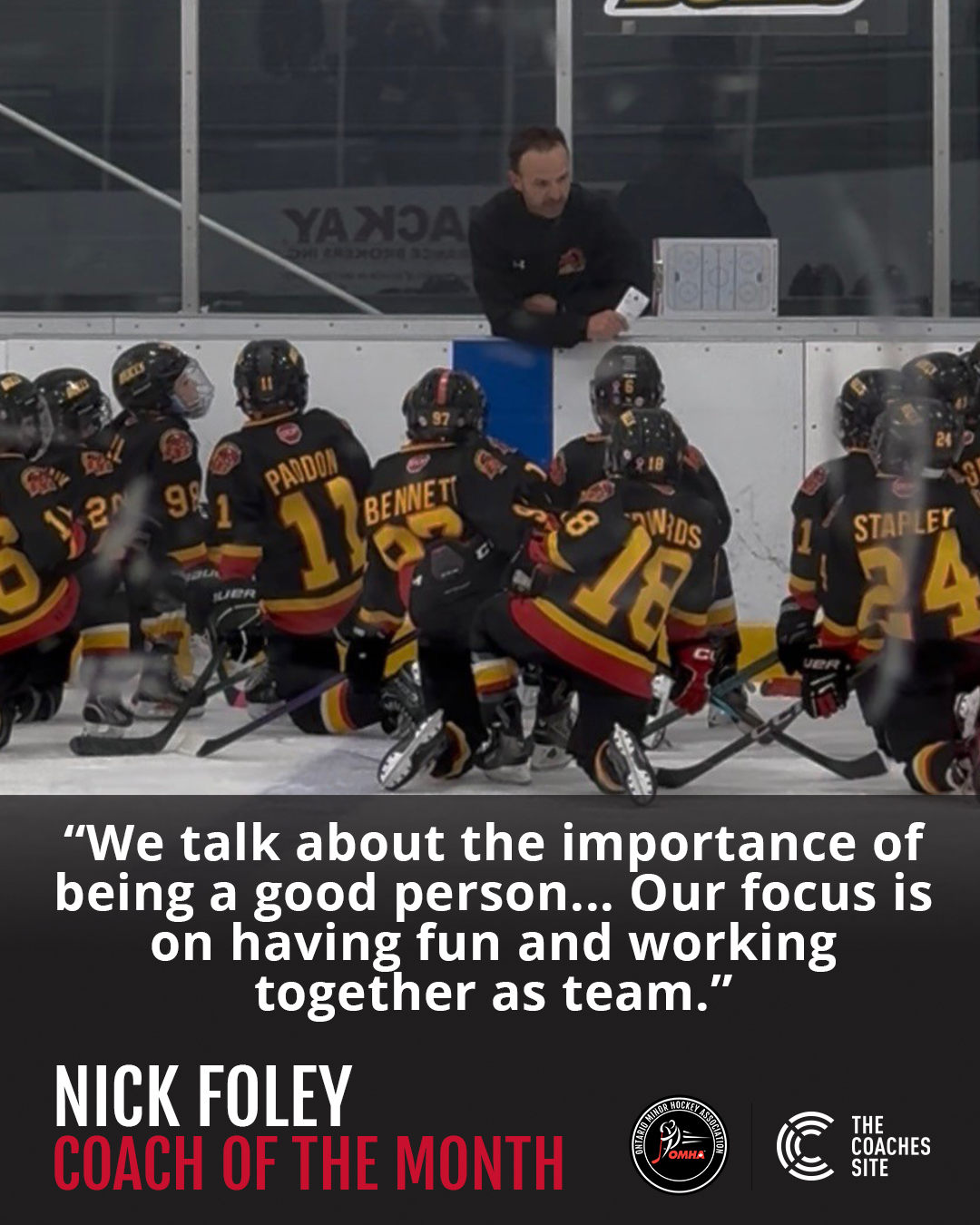
This season marks the ninth year of the OMHA Coach of the Month presented by The Coaches Site. We asked for nominations of deserving coaches and after much deliberation, Nick Foley of the Belleville U10 AA team was selected as the Coach of the Month for January.
Nick Foley is an outstanding candidate for Coach of the Month for the U10 AA Belleville Bulls. He consistently demonstrates exceptional leadership, dedication, and a genuine commitment to player development—both on and off the ice.
Nick creates a positive, structured, and motivating environment where players are encouraged to work hard, support one another, and build confidence. He focuses not only on skill development and game strategy, but also on sportsmanship, teamwork, and respect—values that are essential at this level of hockey.
His ability to connect with each player, recognize their individual strengths, and help them grow has had a clear impact on the team’s performance and morale. Parents and players alike appreciate his clear communication, enthusiasm, and the positive culture he has built within the team.
Nick Foley embodies what coaching should be about, and he is truly deserving of being recognized as Coach of the Month.
What is your background in hockey and coaching this team?
4 years in the OHL with Belleville Bulls, Kingston Frontenacs, and Mississauga Icedogs
Colonial Cup Champion - 1999
4 years at St. Mary's University
AUS Champion - 2002
Coaching Experience:
2008/09: Assistant coach, renton Golden Hawks Jr. A
2009/10: Assistant Coach, Queen's Gaels - University
This is the first year I have taken on coaching the U10AA. I was an assistant last year at the U9 MD level.
How do you instill the values of teamwork and sportsmanship over the season? Over the season we implement “catch them doing it right” recognition, and this is given out daily to the child, who was a good teammate, who worked hard, who was a good person to their teammates. We talk about the importance of being a good person and rising to a standard that includes teamwork and sportsmanship on a daily basis. Our focus is on having fun and working together as team.
How do you balance skill development while also keeping hockey fun? One of our core values on our team is to have fun, as such, we combine skill development with fun drills that have the players competing against each other while at the same time fostering an environment that is conducive to growth both on the ice and off.
What is the importance of being a positive role model for your players? Being a positive role model is everything at the U10 age. When they see the way the coaches do things like picking up tape and holding the door for others, little things, it reverberates through the team. It becomes common practice, when you continue to emphasize the importance that little things matter, when you model the behaviour you want to see, it becomes common practice for the players to learn and act accordingly.
For years, BioSteel fueled the best athletes in the world — until it all came crashing down. Bankruptcy. Headlines. A brand on the brink of disappearing.
Now, under new ownership, the BioSteel Academy in Windsor, Ontario, is stepping into the spotlight. Episode One dives into the rise and fall of BioSteel, the vision for rebuilding, and the grit of a city that mirrors its teams.
The story builds to the 16U team’s first tournament in Detroit — opening against the number one program in North America, Little Caesars. No warm-up. No mercy. Just the first test of a long season.
Above the Net is a cross-ice, single-zone game designed to expose how players manage space, responsibility, and transition around the net. Two east–west nets with goalies immediately shift perception away from straight-line offence and toward lateral scanning, timing, and role discipline.
Each side plays with three skaters. At any moment, only two players are allowed to forecheck or attack the net. The third player must remain above the net on their half of the zone, functioning as either a defensive safety or an F3 support option. This constraint introduces a recurring problem, how to apply pressure offensively while maintaining structure above the puck.
After a goal is scored, the scoring team must exit the zone and defend their own net before re-entering to attack. This removes goal chasing and creates immediate offence–defence role switching.
Game Design Intent
This task is not about set plays or systems. It is about role clarity under time pressure.
By limiting how many players can attack, the environment naturally teaches when to commit versus when to stay connected. Spacing above the net becomes functional, not instructed, as players experience how it protects against counter-attacks and supports reloads. Early support emerges as more effective than late effort.
The exit-and-defend rule after scoring adds emotional and perceptual stress. Players must reset, reorganise, and defend before attacking again, mirroring real game transitions where structure often breaks down.
4 Role Ecology in Action
Offence With the Puck
Players attacking the net must solve scoring problems with limited numbers. Deception, puck protection, and purposeful movement emerge naturally as players adapt to pressure rather than relying on volume shooting.
Offence Supporting (F3)
The player above the net learns to read timing rather than hold position. Staying available without collapsing, managing reloads, and linking attack to defence become functional behaviours shaped by the environment.
Defence On the Puck
Defenders are rewarded for patience and body positioning. With limited attackers, stick detail and angling matter more than chasing outcomes or overcommitting.
Defence Away From the Puck
The above-the-net constraint creates constant scanning and communication demands. Defenders learn that protecting space and passing lanes is often more impactful than directly engaging the puck.
Roles are not assigned by the coach. They emerge through interaction with the task.
Goalie Ecology
Goalies are active participants in this environment. East–west nets increase lateral tracking demands and create changing shooting angles from below and across the net. Frequent reset moments after goals require goalies to manage emotional shifts as well as positional ones.
Because teams must exit and defend after scoring, goalies move rapidly between save mode and communication mode. This promotes active puck and player tracking, early net awareness, and verbal leadership during transitions.
Goalies are learning the game, not just stopping pucks.
Why This Task Works
Above the Net creates a game that thinks back. Players are not told where to stand or what decision to make. Instead, the environment rewards awareness over speed, timing over effort, and structure over chaos.
The behaviours that emerge are shaped by interaction with pressure, space, and time, making them robust and transferable. This makes the task a powerful tool for developing hockey sense, role understanding, and repeatable habits that carry into the full game.
Author Bio: Barry Jones is an IIHF Level 3 High Performance Coach and USA Hockey Level 3 Performance Coach. His work blends ecological dynamics, nonlinear design, and athlete-centred leadership to build adaptive teams that thrive in uncertainty.
The Corner Battle Screen Game takes place in the end zone using one corner as the starting point for puck recovery. The net is positioned approximately 8 metres away from the corner, with a goalie in position and a marked crease area. One player stands at the top of the crease, creating a constant net front presence.
Play begins when the coach spots a puck into the corner. One player from each team enters to compete in a 1v1 battle for possession. The player who gains control of the puck immediately transitions from recovery to attack, using the net front player as a screen while attempting to score.
The screen player does not control the puck but shapes the scoring environment. Their presence alters the goalie’s visual field and changes the conditions under which the shooter operates.
This creates a layered interaction where recovery, screening, and scoring exist as connected events rather than isolated actions.
Game Design Intent
This task is designed to expose the moment where defensive recovery becomes offensive opportunity. The transition is immediate. There is no separation between the two phases.
The net front screen introduces visual uncertainty. The goalie cannot rely on uninterrupted puck tracking. The shooter cannot rely on clear shooting lanes. Both players must interpret and respond to disruption.
The proximity of the corner to the net compresses time and space. Players must act within constraint. This reveals how perception and action are shaped when opportunity exists briefly and under pressure.
The screen player becomes a living constraint. Their presence continuously reshapes what is visible, available, and possible.
The environment does not guarantee scoring opportunity. It reveals how players create it.
4 Role Ecology in Action
Offence With the Puck
The puck carrier emerges from recovery directly into offensive possibility. Their ability to perceive the screen, interpret goalie positioning, and release the puck is shaped by interaction with both players.
The shooter does not operate in isolation. Their opportunity emerges through the presence of the screen.
Scoring becomes a relational event.
Offence Supporting
The screen player exists without the puck but plays a central role in shaping offensive opportunity. Their positioning influences the goalie’s perception and the shooter’s available options.
Their role emerges through spatial awareness, timing, and presence.
They do not create offense directly. They shape the conditions under which offense becomes possible.
Defence On the Puck
The defender in the corner shapes the entire sequence. Their pressure influences whether recovery occurs cleanly, under stress, or not at all.
Their presence alters timing, positioning, and the quality of offensive opportunity.
Defence becomes the force that shapes offensive perception.
Defence Away From the Puck
The goalie exists as the final defensive presence but also as an active participant in the interaction. Their positioning, tracking, and emotional regulation influence how the shooter perceives opportunity.
The goalie is not simply reacting. They are continuously interpreting the evolving environment.
Their role emerges through perception of disruption.
Goalie Ecology
The goalie must track the puck from the corner while managing the presence of a screen. Visual information becomes incomplete. The goalie must interpret movement, anticipate release timing, and regulate emotional response under uncertainty.
This task shapes patience and perception. The goalie learns to exist within visual disruption rather than relying on uninterrupted tracking.
The goalie’s behaviour becomes anticipatory, shaped by environmental cues rather than isolated events.
They learn to perceive threat before the shot occurs.
Why This Task Works
This task connects recovery, screening, and scoring into a single ecological event. It removes artificial separation between phases of play and replaces it with continuity.
The environment thinks back. It challenges players to perceive opportunity as something that emerges through interaction.
Players learn that scoring is not simply about shooting. It is about timing, positioning, and relationship to others.
The screen reshapes perception. The recovery reshapes timing. The goalie reshapes opportunity.
This learning transfers because the task reflects the true nature of scoring in hockey. Opportunity exists briefly, often under pressure, and often through visual disruption.
Players do not learn a technique. They learn how to perceive opportunity within uncertainty.
This is where adaptable scorers and adaptable goalies are formed.
Author Bio: Barry Jones is an IIHF Level 3 High Performance Coach and USA Hockey Level 3 Performance Coach. His work blends ecological dynamics, nonlinear design, and athlete-centred leadership to build adaptive teams that thrive in uncertainty.
The Neutral Zone Circle Game takes place in the neutral zone using the center circle as the defending area. Two defenders operate inside the circle, while four attacking players position themselves outside, split evenly on each side. The circle becomes a protected space, while the surrounding perimeter becomes the environment where offensive construction occurs.
The attacking team moves the puck along the outside using short local passes or cross ice connections. Points are earned when players create a sequence that simulates a D to D pass followed by a cross ice pass. This sequence reflects how puck movement creates new spatial opportunities.
If the defending team recovers the puck inside the circle, their role immediately shifts. They must protect possession and pass between each other while under pressure. The player who lost possession becomes the next defender, entering the circle to recover and reconnect play.
Each round runs for 45 seconds, creating repeated cycles of possession, loss, recovery, and reconnection.
Game Design Intent
This task reshapes how players understand puck movement in relation to defensive pressure. The circle acts as a constraint that separates offensive construction from defensive disruption.
Attacking players cannot advance through space. They must move the puck to create opportunity. This shifts perception away from skating solutions and toward relational solutions.
The scoring condition, requiring a D to D simulation followed by a cross ice pass, exposes how lateral puck movement reshapes defensive structure. Players begin to perceive how connection creates instability for defenders.
The defending players exist within spatial constraint. Their limited space forces continuous perception, anticipation, and pressure.
Turnovers immediately create role transition. This reinforces the relational nature of hockey. Possession and pressure are constantly exchanging roles.
The environment reveals how opportunity emerges through movement of the puck, not movement of the player.
4 Role Ecology in Action
Offence With the Puck
The puck carrier operates without forward progression. Their role becomes one of connection rather than advancement.
They must interpret defensive positioning, locate support, and move the puck in ways that reshape the environment.
Opportunity emerges through shared interaction rather than individual action.
Offence Supporting
Supporting players shape offensive possibility through positioning and availability. Their spacing influences whether puck movement creates opportunity or pressure.
They learn that their role is not static. Their presence creates or limits connection.
Offense emerges through coordinated perception.
Defence On the Puck
The defender inside the circle exists in constant interaction with puck movement. Their pressure shapes offensive timing, decision-making, and connection.
Their limited space forces continuous adaptation.
Defence becomes an active force shaping offensive perception.
Defence Away From the Puck
The second defender inside the circle exists in anticipation. Their positioning shapes passing lanes, influences offensive perception, and prepares them to become the primary defender.
Their role emerges through interpretation of puck movement.
They learn to exist within evolving pressure.
Goalie Ecology
While this task does not include a goalie, it develops foundational perception skills that transfer directly to goaltending environments. The lateral puck movement, pressure timing, and spatial interpretation mirror the conditions goalies face when tracking puck movement across defensive structures.
This task develops the collective behaviours that shape goalie perception in game environments.
Why This Task Works
This task reshapes how players understand puck movement. It removes the assumption that opportunity comes from skating and replaces it with the reality that opportunity emerges through connection.
The environment thinks back. It rewards players who perceive relationships between pressure, support, and space.
Players experience how puck movement reshapes defensive behaviour.
This learning transfers because hockey is defined by interaction. Players must constantly interpret pressure, connection, and opportunity.
The task does not teach a pattern. It develops perception.
This is the foundation of adaptable puck movement.
Author Bio: Barry Jones is an IIHF Level 3 High Performance Coach and USA Hockey Level 3 Performance Coach. His work blends ecological dynamics, nonlinear design, and athlete-centred leadership to build adaptive teams that thrive in uncertainty.
In Part #2 of this three drill progression, we add an extra forward to create a full ice 3v2 rush. Forwards should hold the puck in the middle of the ice, making a kick out pass near the offensive blueline to hold the D in the middle. D maintain a tight gap, protect the middle and try to force a bad angle shot.
This drill is a great half ice drill to work on receiving passes off the wall and getting control of the puck while moving. It can be good for defensemen and wingers / center.
SET IT UP:
Line up the initial players according to the drawing and if you are using 1 or 2 goals.
Set tires on the face off dots as determined, so the players know when to make their turns.
A player for each line will be at the blue line (2 goals) or at one of the face off circles (single goal).
A goalie will be in the nets
RUN IT:
The puck position will rim the puck behind the net, and up the wall to the next player.
The puck passer will breakout to get the pass from the receiver. (2 goals)
The receiver will pass the puck to the player at the faceoff circle (1 goal)
After the player hands the puck off, they will proceed in getting a pass back, skate around the tire(s), dropping back into the slot and shooting.
Players will then move up 1 position numerically as seen in the diagram.
NOTES:
In this drill, handling the puck off the boards is important. The players must be able to meet the puck along the wall and quickly gain control of it so they can make the quick pass to their teammate coming back out.
Keep the eyes scanning the ice at all times. The pass may be off center or in a way the receiver did not intend, and they must adjust to trap the puck.
One thing I didn’t expect when I started coaching this age group is how many decisions happen in your head, not on the ice.
Before the season started, it was easy to say I wouldn’t worry about how my decisions were viewed. That I’d coach the game, trust the process, and stay focused on development. And for the most part, that’s still true.
But the reality is, there are moments in games — especially close ones — where decisions feel heavier than they look from the stands.
Shortening the bench late. Choosing special teams. Managing shifts in the final minutes.
These aren’t decisions made against kids. They’re decisions made for the game in front of you, while still trying to balance development, confidence, and fairness. And at this level, that balance isn’t always clear.
We’re coaching nine-year-olds. At the same time, we’re also coaching teams that care about competing, learning how to close out games, and understanding situations. Those two truths exist together, and navigating them is part of the role.
I’ve sent expectations to parents. I’ve been transparent about philosophy. And still, I’d be lying if I said the thoughts never creep in.
Did I make the right call? Was that the right moment? Should I have handled that differently?
I don’t think those questions come from insecurity. I think they come from caring. Most coaches I talk to go through the same internal dialogue. We want to be fair, we want to develop players, and we want to compete honestly. Sometimes those priorities align perfectly. Sometimes they pull in different directions.
What I’ve learned is that worrying about decisions isn’t the problem. Letting that worry control decisions is.
There’s a difference between reflecting and second-guessing.
Reflection helps you grow. Second-guessing keeps you stuck.
At the end of the day, coaching youth sports isn’t just about drills, systems, or ice time. It’s about judgment in moments that don’t have perfect answers. It’s about communicating clearly, being consistent, and remembering why you’re there in the first place.
The players don’t see the internal debate. They see whether you’re steady. And that steadiness matters more than any single decision ever will.
About the author I’m a U10 Rep A coach and an OJHL regional scout who writes about the realities of youth hockey — the lessons, the challenges, and the moments that shape both players and coaches along the way.
If your organization is not aligned, you have no chance.
That's in business, relationships and especially youth sports.
It is very easy for an organization to hand over the keys to a U10 program to their coach and expect it's handled.
But, if that coach does not know your expectations, guardrails, benchmarks and attributes they are responsible for teaching in creating a player, you will fail in developing a full athlete.
Every coach is only a piece of the puzzle in youth athletic development - it's not be-all-end-all/information dump every year.
Get your organization aligned and your coaches will feel more supported, have clearer communication avenues with their parent groups and be able to go all-in on their "piece" of the puzzle.
My formula for player development is proven successful because of the programs I've researched and gathered from.
Learn more at www.mattdumouchelle.com and reach out so I can show you the way, today.