
 00:00:00
The other night, watching Vancouver vs. Winnipeg, a small detail stood out.
Winnipeg runs a low cycle with the intention of hitting the weak-side post option — a common, rehearsed release. It’s a play many teams build into their offensive-zone structure.
But Vancouver anticipates it.
The Canucks defender reads the timing, leaves his check early, and cuts off the weak-side seam before the puck arrives. Turnover. Immediate transition.
The issue wasn’t execution.
It was predictability.
Cycles are designed to move defenders, create confusion, and open space. But when the route and release become automatic, defenders begin to pre-rotate. Instead of reacting, they’re jumping patterns.
Modern defenses aren’t just containing — they’re studying tendencies.
If your cycle always leads to the same outlet, it becomes a trigger for the opponent.
The teaching point:
Rehearsed offense must still look unpredictable.
If defenders know where the puck is going before it gets there, the play is already broken.
Structure creates options.
But variation creates threat.
 00:00:00
By Coach Barry Jones | IIHF Level 3 High Performance | USA Hockey Level 3 Performance
Elite performance with limited time demands more than flow drills. It demands battle, constraint, and environments that feel messy. Because hockey isn’t scripted, it is solved in real time.
With the Perth Inferno Women’s team, we had 45 minutes a week.
That was it.
Interstate competition. Limited shared training. Athletes coming from different backgrounds, different sporting influences, different histories of being coached.
We did not have the luxury of perfect reps or rehearsed patterns.
So we stopped asking, “How do we make practice look clean?”
We started asking, “What problems must our players solve under pressure?”
That shift changed everything.
Flow drills disappeared.
Lines got shorter.
Decisions got harder.
Failure became visible.
And here is what we learned: when athletes move from being directed to becoming autonomous, the emotional load increases. Mistakes feel heavier. Responsibility becomes personal. If you are going to create decision-makers, you must also create psychological safety.
Discomfort without safety creates fear.
Discomfort with safety creates growth.
And that is where real adaptation lives.
Author Bio:
Barry Jones is an IIHF Level 3 High Performance Coach and USA Hockey Level 3 Performance Coach. His work blends ecological dynamics, nonlinear design, and athlete-centred leadership to build adaptive teams that thrive in uncertainty.
 00:00:00
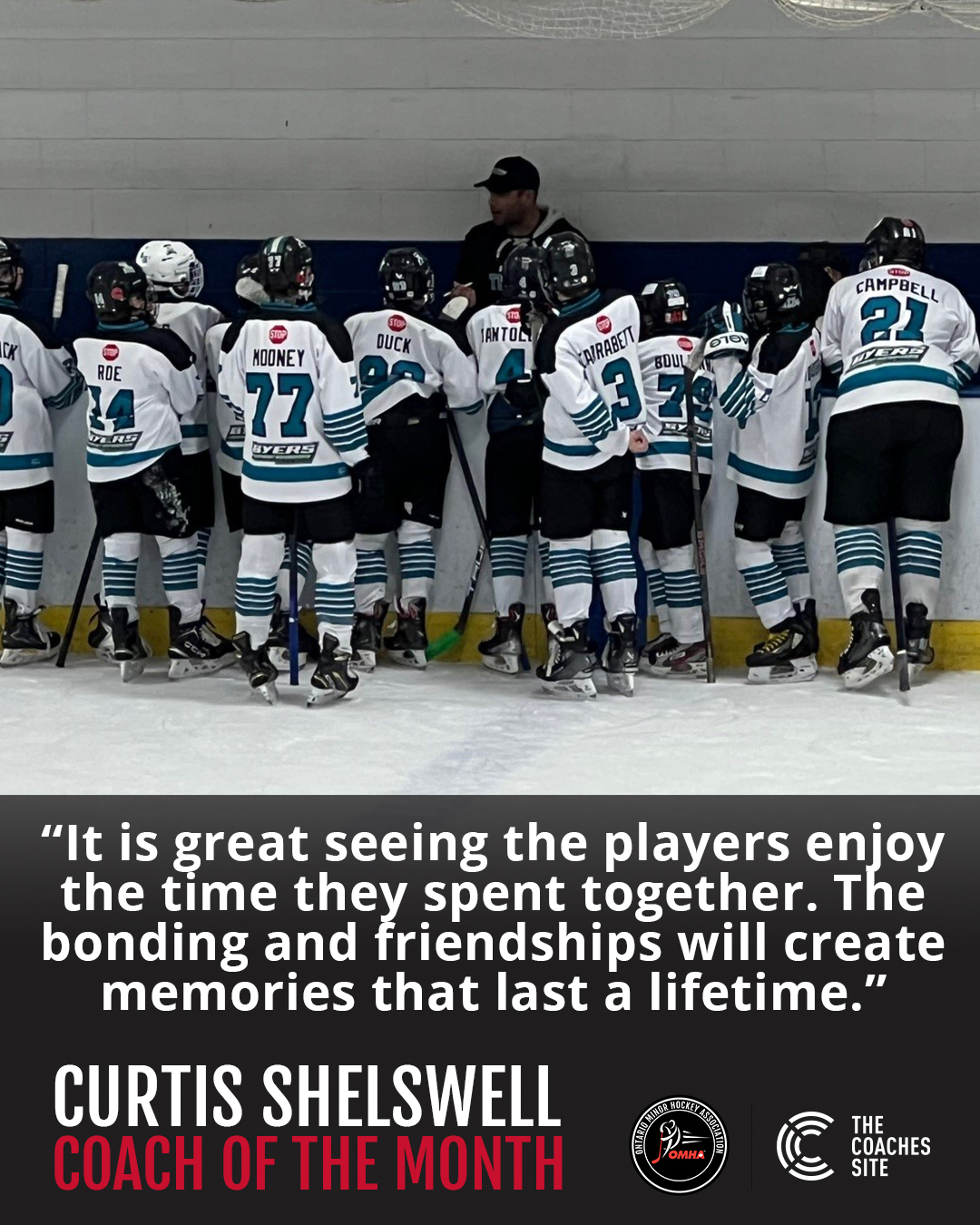
This season marks the ninth year of the OMHA Coach of the Month presented by The Coaches Site. We asked for nominations of deserving coaches and after much deliberation, Curtis Shelswell of the Orillia U13 A team was selected as the Coach of the Month for February.
Know someone who should be Coach of the Month? Click here to nominate them.
Here's his story as told by his nomination:
Curtis Shelswell, head coach of the U13A Orillia Terriers, exemplifies what it means to lead with passion and purpose. Having coached the team for the past two seasons—and with prior experience behind the bench—Curtis brings a wealth of knowledge and dedication to the game of hockey.
His commitment goes far beyond the rink. Curtis invests countless hours into planning and sharing detailed practice plans with players, ensuring they are prepared and confident. He fosters an environment where athletes feel comfortable approaching him, creating a strong sense of trust and respect within the team.
What makes Curtis truly remarkable is his ability to balance it all. Alongside his coaching duties, he manages a full-time job, runs a family farm, and prioritizes time with his family—all while showing up for early morning practices at 6:30 a.m. every week. His dedication and energy set an incredible example for his players and the entire hockey community.
Curtis also emphasizes the importance of character and community. Under his guidance, the Terriers have actively participated in initiatives such as food drives, Christmas toy collections, sponsoring a family during the holidays, and volunteering at the local fall fair. These efforts teach players the value of giving back and being leaders off the ice.
Driven by a desire to see his players succeed both in hockey and in life, Curtis encourages his team to strive for excellence and competitiveness while maintaining sportsmanship and teamwork. His passion, energy, and positive influence make him a truly deserving recipient of Coach of the Month.
What is your background in hockey and coaching this team?
I grew up playing competitive hockey from the age of 9 through to the age of 21. From starting with Oro Thunder to moving over to Orillia Terriers then on to North Central Predators, I enjoyed the game of hockey, the competitiveness and friendships that were gained. At the age of 17, I joined the Penetang Kings Jr. C. organization and finished out my competitive career.
Now a parent of three, I continue to be involved in the game. I have been a head coach with the Orillia Hawks, assistant coach with the Barrie Sharks, and the past two seasons as a head coach with Orillia Minor Hockey organization. Last season, I started at the U12 level and stayed with the group through the U13 season. As a coach, I lead by example and ask that my players bring a strong work ethic, respect each other, and come to the rink prepared and ready to learn. I am a firm believer in strong work ethic and ensure that my team understands the importance of team-first culture. I like to push the players so that they can reach their full potential each time they are on the ice.
I feel lucky because I have had a great group of parents, players, and bench staff that makes my job easy and enjoyable. I feel it is important at this age level to build up their confidence by providing them with opportunities to grow and gain confidence that can assist them and the team. Coaching isn't just running the group through drills at practice or guiding them during a game. I feel it is crucial as a coach to be able to communicate with your players and the parents to make sure they are aware of your coaching philosophy and expectations. Players have to be comfortable coming to the rink and talking to the coach regardless of the situation.
In what areas has the team improved in the years that you’ve coached them?
Over the season, I believe they have developed a stronger work ethic and understand the meaning of team play. Their effort on ice has increased and become more consistent. I also see a great improvement in their team game; the puck movement has helped elevate their play. Hockey is a team game, and I feel very strong about ensuring we play that way.
Why are community initiatives so important for your team?
Being involved within our community is important to this team and it is a good way to give back and support others. We rely on sponsorships to help fund extra activities for the team, so it is important that we do our part to support others within the community. This year the team has been involved in a food drive to support the local food bank, prior to Thanksgiving, during a home game, families/spectators from both teams had the opportunity to donate food and/or cash for the local food bank. The team participated in a second food drive, partnering up with the local detachment of the Ontario Provincial Police and our team sponsor, players and family members went door to door within the community while others set up outside a local grocery store to collect food and cash donations for the Orillia Sharing Place/Food Bank. The team filled a side by side and police cruiser. Just prior to the Christmas break, during one of our home games the team organized a toy drive in conjunction with the Orillia Fire Department and Simcoe Muskoka Paramedics, both teams donated toys to the cause. We also sponsored a family for Christmas, our team donated funds, players were provided a list of items and the team went gift shopping!
How do you keep hockey fun at this point in the season?
As we head down the stretch, I feel it is important to continue to keep things positive, introduce new ideas with on-ice drills/skills so that the team remains focused and enjoy their time with the team. It always puts a smile on my face when I hear a player shout out "Can we run that one more time." It is great seeing the players enjoy the time they spent together, the bonding and friendships will create memories that last a lifetime.
 00:00:00
The Ajax-Pickering Raiders celebrate the holidays together and get ready to close out the regular season in Episode 4 of Home Ice!
Those who've experienced the journey of minor hockey know how special it can be. The Raiders take some time to reflect on the year, their teammates and not taking the moment for granted.
Home Ice, produced by the Ontario Minor Hockey Association and presented by Hudl, goes behind the scenes with a team as they navigate the balance between their lives on and off the ice. This year's series follows the Ajax-Pickering Raiders U18 AAA team, a perennial contender for the OMHA's coveted #RedHats and championship.
The series, now it its sixth season, has previously featured current NHLers Cole Perfetti and Owen Beck during their time in the OMHA.
Miss any episodes? Catch up on previous seasons here.
 00:00:00
2 PUCK SHOOTING DRILL:
1) Heel to heel with eyes up and an "inside leg release"
2) Lateral Reception to an "inside leg release" shortside
 00:00:00
It's been an atypically dark winter in the mountains. It barely snowed until December and even then the flurries fell few and far between. I moved here from Manitoba after being let go from my job running a junior hockey program - a dark time no matter how you slice it - and the darkness seemed to follow me like a shadow.
And the darkness had set in, darker still than usual, one frosty morning in January when I sat down with an old friend and new boss and a new connection.
Team Canada World Cup Soccer Coach, Jesse Marsch.
If you had the pleasure of joining The Coaches Site in Vancouver for Marsch's fireside chat with aforementioned pal and boss-man Aaron Wilbur then you know where I'm going with this. Marsch is verbose. He's engaging. If he was coaching in a more traditional futbol country like Britain or Scotland you'd claim he was a wee bit men'al.
And it's contagious. I wrote about 5 takeaways from Marsch's fireside chat here, including the power of diversity, mindset, and setting a standard.
It was freeing for me to listen to him talk about doing things differently with soccer in Canada. For Marsch, sometimes Canadians defer too much. We're too nice. But for a team and a program to capture gold atop the pinnacle of their sport, the athletes need to be hunters - savage in their pursuit of excellence every single day they're not on the pitch or on the ice preparing for a game. If you become the hunter only when there's a crowd then it's already too late. You'll be spotted.
I spend a lot of time in my own mind (hey, usually I enjoy the company), and we all know coaching can be lonely. Doubt is part of the process. Well, it's part of my process. Marsch has a vision and he's laser-focused on executing that vision. He's turned down management roles in the past because "he's a coach", it's what he was born to do.
He's true to himself, and that's the lesson. I believe legendary San Francisco 49's Head Coach Bill Walsh was right: the results take care of themselves. It's not the path for everyone, but it's the path for me. My meeting with Marsch helped reignite that truth and lightened things just a bit.
These days I'm still a coach, but I'm a manager once again. A current mentor of mine told me to imagine what someone could do to make me hate them (a strong word normally reserved for cancer and the Calgary Flames), but the point was to believe in what I believe.
That means that no team of mine will ever finish a practice again if they're wearing the wrong socks. I'm serious, check back in a year and ask me about it.
I believe in the players, and I believe in the coaches. I believe they'll be dedicated and contribute what they can, when they can, to the upper limit of their abilities. But I also believe in the power of a growth mindset, and that it's up to me to remain true to form when it comes to my own creed. I cherish the responsibility of leadership, but I'd rather walk the walk than talk about it. This is like stepping into the weirdly warm water at the top of a waterslide and hoping you won't get your hair wet at the bottom.
Our season ended a few hours ago, so I'm working on a Culture Box. Imagine a square within which you'll place the precious elements you believe will deliver success for your team. Put them in the box and lock it up.
Our priority is to make every player better. Every drill. Every rep. Every shift. Winning games is simply a result of positive reinforcement, good habits, and consistency.
Ensure every location is left better than it was found.
Coaches are responsible for setting the emotional standard of the program. Competitive intensity is expected; emotional volatility, public humiliation, and demeaning communication are not. Staff must model composure, professionalism, and respect at all times.
Use constraints in practice as a means to control the chaos.
Players should
Feel challenged but not demeaned
Feel accountable but not shamed
Feel respected even when corrected
Emotional regulation is a professional standard, not a personality preference.
We believe in decentralized leadership. It can be anyone who steps up and leads in a positive, productive way.
Accountability feels like a dark morning in a chilly part of the world, but it's not. It's a gift, a favour. I've learned more than I care to admit after bouncing around the industry, and I know I've got it a lot easier than a lot of you out there. We're human beings and we're trying to influence the next stewards of a society that's learning to balance on the edge of irreparable, inevitable calamity.
But that's the job, right? Humans have been engineering chaos since an asteroid wiped out the competition.
Make yourself better, make them better.
 00:00:00
Over the past few years, I've had the same conversation dozens of times — with GMs, performance directors, and head coaches across multiple professional leagues. The setting changes. The language varies. But the question underneath is always the same:
"We have great people. So why aren't we getting great results?"
These aren't conversations about training methodologies or which analytics platform to invest in next. They're deeper than that. They're about organizational coherence — about why talented, experienced, highly specialized professionals can work side by side in the same building and still produce outcomes that fall well short of what their collective expertise should deliver.
After thirty-plus years in elite sport, I have a name for what I'm describing. I call it performance fragmentation. And it is, quietly, one of the most expensive problems in professional hockey.
Here's the uncomfortable truth: the more specialized your support staff becomes, the greater your risk of fragmentation.
When you hire a world-class sports scientist, an elite medical team, a sharp analytics group, and experienced coaches — each of whom has spent a career developing deep expertise — you create something that looks like a performance department but functions more like a collection of separate businesses sharing a locker room.
Each specialist optimizes for what they understand best. The sports scientist manages training load. The medical staff monitors injury risk. The analytics team tracks performance trends. The coaching staff builds tactical systems. Every recommendation is evidence-based. Every individual is doing their job well.
And yet — the team still underperforms relative to what their combined expertise should produce.
This is the paradox. Individual excellence, without integration architecture, doesn't compound. It fragments.
Let me make this concrete.
Picture a demanding road trip — multiple time zones, back-to-back games, varying arena conditions, compressed recovery windows. A scenario every professional hockey organization faces repeatedly through a long season.
Your sports science team reviews load data and flags three players who need reduced practice intensity based on fatigue markers. Your medical staff independently identifies two players — partially overlapping, partially different — for load management based on injury risk profiles. Your analytics department has pinpointed tactical adjustments that require specific players to maintain their normal roles. Your coaching staff now has to synthesize all of this in real time, under competitive pressure, without a shared decision-making framework.
Nobody gave bad advice. Every specialist did their job. But the recommendations contradict each other, and no one is asking the question that matters most: How do these inputs interact — and what does the system actually need right now?
This is what organizational theorists call local optimization at the expense of global effectiveness. Each department solves for the variables within its own domain. The broader system pays the price.
The consequences aren't abstract. When training load management and injury prevention protocols operate in isolation, you compromise both. When tactical planning assumes physical capacities your conditioning program isn't systematically building, you produce strategies that can't be executed. When travel scheduling ignores recovery science while your medical staff simultaneously tries to optimize sleep and adaptation — you don't get either outcome. You get internal friction dressed up as professional rigor.
The most important shift I can offer is this:
Integration is not a coordination problem. It is an organizational capability — one that must be intentionally built.
Most organizations treat integration as something that should emerge naturally once you've hired enough talented people. It doesn't. Talented specialists, left to their own professional instincts, will continue to optimize within their domains. That's not a character flaw. That's what expertise does.
The organizations that consistently outperform their apparent resources have figured out something different. They understand that assembling world-class specialists is only step one. Step two — the step that determines whether those investments compound or cancel each other out — is engineering the coordination infrastructure that allows specialist knowledge to flow into collective decisions.
This looks different at every organizational level, but the principle is consistent. Consider equipment management. In a fragmented organization, the equipment team focuses on player preferences and gear maintenance. In an integrated organization, the equipment team understands how skate sharpening choices connect to forechecking systems, arena-specific ice conditions, and individual player development trajectories. That's not a minor operational detail. That's organizational integration turning a routine function into a competitive edge.
Or consider travel management. Fragmented organizations treat travel as a logistics function — move people and equipment efficiently from city to city. Integrated organizations treat travel as a performance variable. One that directly affects sleep architecture, circadian rhythm, training adaptation, injury risk, and tactical execution. They coordinate flight scheduling with recovery protocols. They adjust training intensity based on time zone displacement. They modify tactical approaches based on predictable fatigue patterns that show up, game after game, season after season.
None of this requires a revolution in staffing or technology. It requires a different organizational question — not "is each specialist doing their job well?" but "are we designing the system that lets their work actually connect?"
Before I get into the solution — which I'll cover in Part Two — I want to leave you with one question that cuts through most of the noise I hear in professional hockey:
If you removed every title and reporting structure from your performance department for a week, and simply watched how information actually flows — who talks to whom, where decisions get made, how often specialists know what their colleagues are recommending — what would you find?
In my experience, most organizations would find islands. Competent, well-intentioned, professionally excellent islands.
The job of organizational leadership isn't to make each island better. It's to build the bridges — and in Part Two, I'll show you exactly what those bridges are made of: three architectural elements that the most coherent elite organizations have learned to engineer deliberately, starting with the single most important leadership relationship in any modern hockey organization.
People. Purpose. Performance.
Magnus Ågren is a Performance System Architect with over 30 years in elite sport, including seven seasons as Head of Performance & Medical in the Swedish Hockey League.
End of content
No more pages to load
copyright (c) 2026 The Coaches Site

