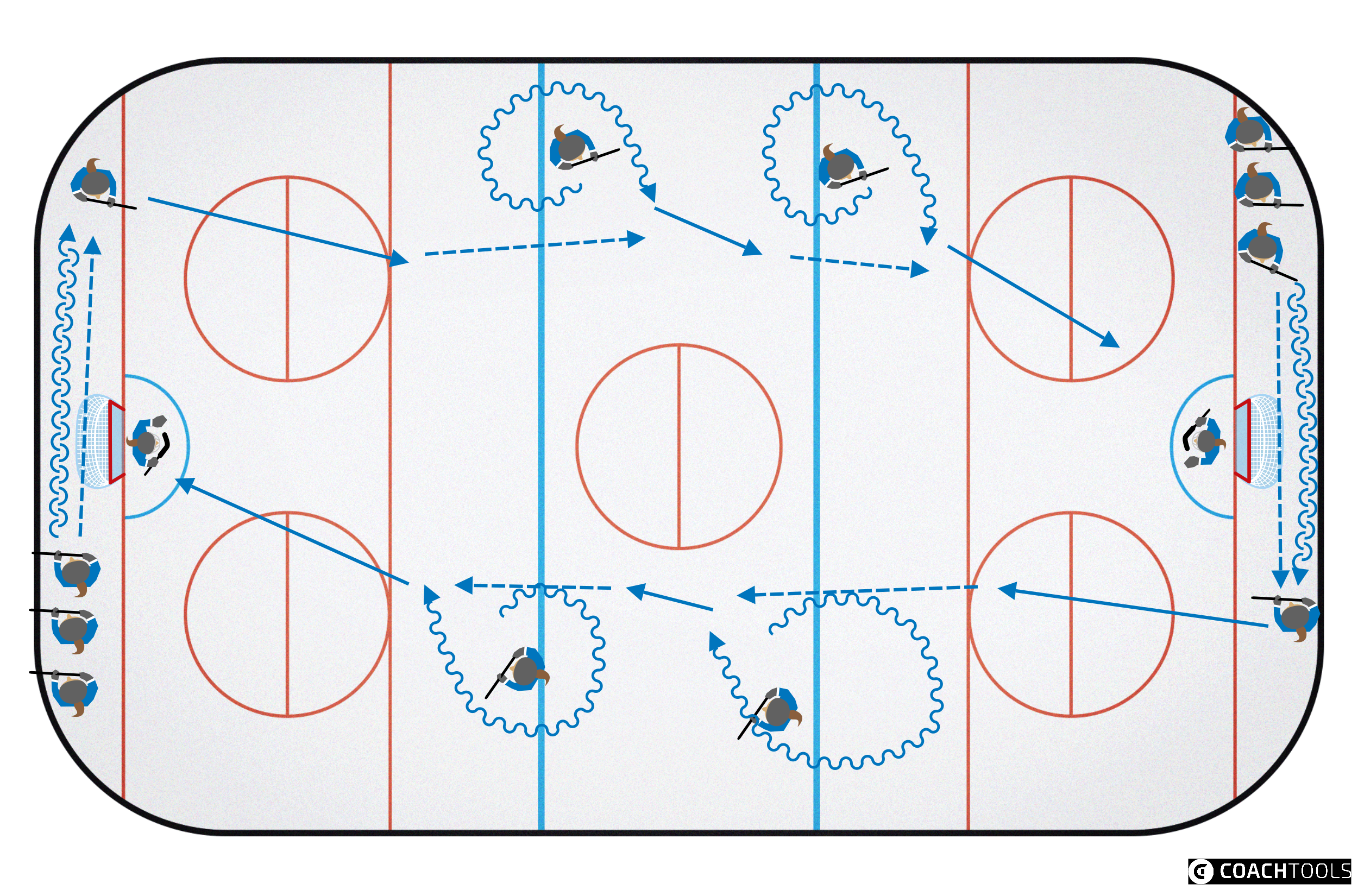
Ringette is sport that for you to enter the next zone, ring needs to be passed over the blue lines to enter the zone.
"Juice" is a drill where you active players to breakout from their own zone, passing skills over the lines, timing of each player that receives the pass and also shooting. Shooting part of the drill will also serve as a good warm up drill for the goalies too.
Drill starts with a "defensive" player skating backwards from one corner to another behind the net. Player receives a pass from the line and turns towards to breakout from their defensive zone. There are 2 other players that are waiting on blue lines. Player on the first blue line makes a circle towards the boards and receives the pass to the middle. Same thing for the next player on the offensive blue line, who will finish the drill 1-on-0 with a shot.
Players rotate for the next position that they gave the pass, and player who shoots changes to the group that does the same drill towards the other end.
Objective of the drill is to active players vision and timing as well as understanding the speed of the game or individual player. Secondary objective is to time your passes for the speed of the receiving player.
Skater has to face the pads and react to the puck coming blind from behind them. Object is to react to puck quickly and get eyes up to know which way to escape the attacker.
Attacker is at the bottom of the barriers near the net. Attacker MUST wait until the skater has touched the puck before they can attack and pressure skater. Object is to use deception and speed to prevent skater from getting a good shooting angle or opportunity.
Note:
Some skaters did not get eyes up and skated right into attacker. Some attackers did not follow the rule of watiing for skater to touch the puck.
This drill was modified off another great drill found online. Refer to "IHS 1v1 use the net" drill. Can find on YouTube for reference. This version works better with older groups. Bantam, HS, Junior.
Emphasizing headfakes and deception with puck control. Skaters should attack at an angle across the pad right-to-left, and are working on getting the puck across their body and outside their shoulders with quick control.
Drill should progress to attacking from the other angle for changes with right-handed and left-handed skaters.
Skater begins with speed attacking the bumper and looking for puck, continues with speed and shoots on net for shot #1. Immediately, skater should turn and look for a direct pass for shot #2. Then works back up ice with speed to react to bumper pass to turn and reattack the net for shot #3.
Hockey is a game of repeated force absorption and force production. Every stride, stop, and directional change requires the athlete to absorb load efficiently before reapplying it into the ice. Exercises that train this quality help players move more explosively while maintaining control.
The medicine ball rear foot elevated drop split squat is an advanced progression designed to challenge eccentric control, positional strength, and core stability.
By adding load and increasing the speed of the descent, this exercise teaches athletes how to absorb force effectively and convert it into powerful movement.
Why Eccentric Control Matters for Hockey Players
When an athlete cannot absorb force well, several issues tend to show up:
Poor balance and instability in single-leg positions
Slower transitions between movements
Reduced agility and reacceleration ability
Increased stress on joints rather than muscles and tendons
Improving eccentric control allows athletes to slow down faster, change direction more efficiently, and reapply force with greater intent. This is especially important for skating, where force absorption happens constantly under high speeds.
Purpose of the Drop Component
The drop portion of the movement increases demand without requiring heavier external loads. As the athlete drops quickly into the split squat position, they must decelerate their body mass and the added medicine ball load.
This teaches the athlete to:
Absorb force through the hips and legs
Maintain trunk stability under rapid loading
Stay organized in deep single-leg positions
The pause at the bottom ensures the athlete owns the position before standing back up.
How to Coach the Exercise
Setup
Hold the medicine ball tight to the chest
Rear foot elevated on a bench or stand
Front foot planted with pressure through the ball of the foot
Execution
Drop quickly into the split squat
Catch the bottom position with control
Pause briefly to confirm stability
Stand back up tall with full control
Throughout the movement, the athlete should remain tall through the torso with strong core engagement. Speed comes from the drop, not from rushing the ascent.
Key Coaching Emphasis
Drop fast, stop clean
Stay tall through the chest
Control the bottom position
No bouncing out of the bottom
Own the position for 2s before standing
These cues reinforce intent and quality rather than fatigue or volume.
Where This Fits in a Program
This exercise is best suited for athletes who already demonstrate strong split squat mechanics and good single-leg control. It works well in later off-season phases, pre-season blocks, or as part of a power and agility emphasis.
It should follow simpler split squat variations and precede more reactive or plyometric work when sequencing sessions.
Final Thoughts
The medicine ball rear foot elevated drop split squat is not about lifting heavy weight. It is about teaching the body to absorb force efficiently and stay organized under load.
When athletes improve this ability, they move with more control, transition faster between movements, and become more agile on the ice. Used appropriately, this exercise can play a valuable role in preparing hockey players for the demands of high-speed skating.
About the Author
Travis Martell is the founder and head coach of Martell Elite Fitness, specializing in off-ice development for hockey players. He has trained athletes from youth hockey through the NHL and regularly presents on skating mechanics, injury prevention, and long-term athletic development.
The Ajax-Pickering Raiders head to the OMHA U18 AAA Showcase presented by Hudl in episode three of Home Ice!
It's always exciting to face new teams during the regular season. In the Showcase, it's East meets West in crossover action. That means the two divisions collide under one roof and the games count in the standings. How will the Raiders fare against these new opponents?
Home Ice, produced by the Ontario Minor Hockey Association and presented by Hudl, goes behind the scenes with a team as they navigate the balance between their lives on and off the ice. This year's series follows the Ajax-Pickering Raiders U18 AAA team, a perennial contender for the OMHA's coveted #RedHats and championship.
The series, now it its sixth season, has previously featured current NHLers Cole Perfetti and Owen Beck during their time in the OMHA.
Just the other day, before one of our games, we were preparing to face the top team in the league, a powerhouse squad that had just dropped its first loss of the year earlier that morning. For us, this whole season has been a first-year experiment. New program. Short bench. Injuries earlier in the day. Young culture. A whole lot of teaching moments and adversity. The kind of “battle” season that’s tough, but the good kind of tough.
As I’m grabbing lunch, their coach pulls me aside to proudly share with me he’ll run his weaker players most of the game, while his so-called elite “AAA-level” players, who skate 24 mph and weigh 180 lbs, as he made sure to mention, would barely see rhe ice. It wasn’t said as a courtesy or out of respect. It landed like a putdown. In that moment, it didn’t feel like two coaches talking hockey; it felt like he was telling me and my team, that we weren't worthy.
I told him straight: “Give me your best.” Adjust along the way if you have to.”
But it didn’t land. Instead, with some ego and condescension I wasn’t expecting. The implication was clear: we weren’t worth his best. And then came the kicker: he warned that if our team “played rough,” he’d unleash his top players to “go after us.” (Just to be clear, we are not a "dirty" team. If you mess witht one of use, yes you'll have the pac to deal with.)
I’m standing there, holding a cafeteria burger, wondering what to even say to this guy. Not in a competitive sense, in a values sense. Hockey is a competitive sport, yes. But it’s also a sport built on respect. On giving your best. On acknowledging the hard work other teams are putting in, and the mutual respect.
We wrapped up that conversation and went our separate ways. He went back to his dressing room and proceeded to dress his backup goalie as a skater, a move that, in my opinion, sends a message that we aren't good enough. Not just a message to his players, but to ours: we’re so good we can treat this like a joke.
Coaches, if you’ve ever been on the receiving end of that kind of gesture, you know how it feels. It’s not about the scoreboard. It’s about dignity. About the idea that your team isn’t worth real competition.
So we prepared for the game with a clear plan. Structure first. A 1-2-2 neutral zone forecheck and a disciplined D-zone, funneling everything to the outside and refusing to open up the middle. Which is something we have been working on in practice and done lots of video on with Hudl Assist and Hudl Instat, so it wasn't a suprise for our players. We knew we’d spend long stretches without the puck, but we also knew we didn’t have to make it easy.
And you know what? After one period, it was 1-0 for them. Eighteen and a half minutes, almost entirely in our end, but disciplined. Composed. Smart hockey is what I told our team over and over again.
Then something interesting happened.
Midway through the second, my assistant coach nudged me and said, “Their bench is losing it.” Sure enough, the tone had shifted. Coaches yelling at players, they were suddenly playing their so-called “AAA player who skates 24 MPH” regularly.
We finished the second trailing 3-0. Respectable by any measure, given the talent gap, the depth difference, and the game script. But the real moment wasn’t the score. It was during intermission, when I entered the bathroom in which our dressing rooms shared to get some water. Their head coach was screaming, not coaching, not correcting, not teaching, but tearing into his players with insults that carried through the entire break.
And here’s what floored me, the anger didn’t come from the scoreboard. It came from his own choices. From underestimating an opponent and the value of teamwork verus his team's individual skill. From taking the game and his players for granted. From disrespect.
We ended up losing 5-0. No trophies for moral victories, but I’d argue we walked out with something better: identity. Pride. A sense that we earned their attention and pushed them out of their comfort zone without sacrificing our standards.
Meanwhile, as our players headed to the showers, their coach was still screaming. Still blaming. Still unloading. As if his own ego was the victim.
Coaches, here are the two takeaways I hope are loud and clear:
1. Respect the opposition by giving your best. Whether you’re in first place or last place, whether you’re blowing a team out or getting blown out, whether the gap is size, skill, or depth, if you are in the same league, hockey deserves your best effort. Anything less isn’t just disrespectful to your opponent, it’s disrespectful to the game itself. Yes, there’s an unwritten code when the score gets lopsided: pull back on the drive-bys, move the puck twice before shooting, and tone down the celebrations. But you don’t get to enforce that code before the puck even drops. Don’t count your chickens before they hatch.
2. Don’t punish your players for the consequences of your own ego. When you approach a game like it’s beneath you, your players feel it. Kids aren’t dumb, and they mirror the tone set by adults. If you treat the game like a joke, they will too. And when that mindset creates adversity, don’t turn around and scream at them for not caring enough. That’s not development. That’s insecurity.
The scoreboard didn’t define that game. Character did. And the character I saw from our group, a young, thin roster in a brand-new program, is the kind of character that gets you places over time.
Winning is great. Developing players is better. But respecting opponents, teammates, and the game itself, that’s the highest standard we can set as coaches.
- Players in all 4 corners with pucks in opposite corners (Bench and Stands sides - Switch pucks to other corners after 2 full reps / Approx 3 minutes)
- 1 Player to start up on blue line (Stands side)
Executions:
First Whistle
1) On first whistle, the stands side player leaves the corner carrying the puck diagonally to the middle through face off dot and stands side player in same end takes off diagonally to the middle through their face-off dot
2) Puck carrier makes pass to weakside player who carries the puck up the middle, and at the same time the player that started on the blue line takes off north ahead of puck carrier. NOTE - Initial passing player now sprints to far blue line on their side to wait for the next wave of skaters coming out of the opposite end to receive a pass from
3)These two carry on into the far OZ 2 on 0 and F1 can shoot from the outside while F2 drives net or pass to F2 for High/low slot shot. Once shot is taken these two players will continue into opposite corners from which they started.
Second Whistle
1) The stands side player leaves the corner carrying the puck diagonally to the middle through face off dot and stands side player in same end takes off diagonally to the middle through their face-off dot
2) Puck carrier makes pass to weakside player who carries the puck up the middle, and at the same time the player that started on the blue line takes off north ahead of puck carrier. NOTE - Initial passing player now sprints to far blue line on their side to wait for the next wave of skaters coming out of the opposite end to receive a pass from
3) These two carry on into the far OZ 2 on 0 and F1 can shoot from the outside while F2 drives net or pass to F2 for High/low slot shot. Once shot is taken these two players will continue into opposite corners from which they started.
This will go back and forth for 2-3 reps (Approx 5-6mins)
KTP:
1) Timing / High Tempo
2) Accurate leading passes
3) Quick decisions in the OZ - Sell the shot then make the pass or get the shot low far pad for F2 to rebound
I have always felt that this poem embodies the qualities we each strive for as Coaches...
If you can keep your head when all about you Are losing theirs and blaming it on you; If you can trust yourself when all men doubt you, But make allowance for their doubting too: If you can wait and not be tired by waiting, Or being lied about, don't deal in lies, Or being hated don't give way to hating, And yet don't look too good, nor talk too wise;
If you can dream—and not make dreams your master; If you can think—and not make thoughts your aim, If you can meet with Triumph and Disaster And treat those two impostors just the same: If you can bear to hear the truth you've spoken Twisted by knaves to make a trap for fools, Or watch the things you gave your life to, broken, And stoop and build 'em up with worn-out tools;
If you can make one heap of all your winnings And risk it on one turn of pitch-and-toss, And lose, and start again at your beginnings And never breathe a word about your loss: If you can force your heart and nerve and sinew To serve your turn long after they are gone, And so hold on when there is nothing in you Except the Will which says to them: 'Hold on!'
If you can talk with crowds and keep your virtue, Or walk with Kings—nor lose the common touch, If neither foes nor loving friends can hurt you, If all men count with you, but none too much: If you can fill the unforgiving minute With sixty seconds' worth of distance run, Yours is the Earth and everything that's in it, And—which is more—you'll be a Man (Coach), my son!