Preseason practice plan for Bantams / 15U. Focus on passing & receiving.
Watch this companion video for an explation for passing & receiving in today's game.
 00:00:00
Preseason practice plan for Bantams / 15U. Focus on passing & receiving.
Watch this companion video for an explation for passing & receiving in today's game.
 00:00:00
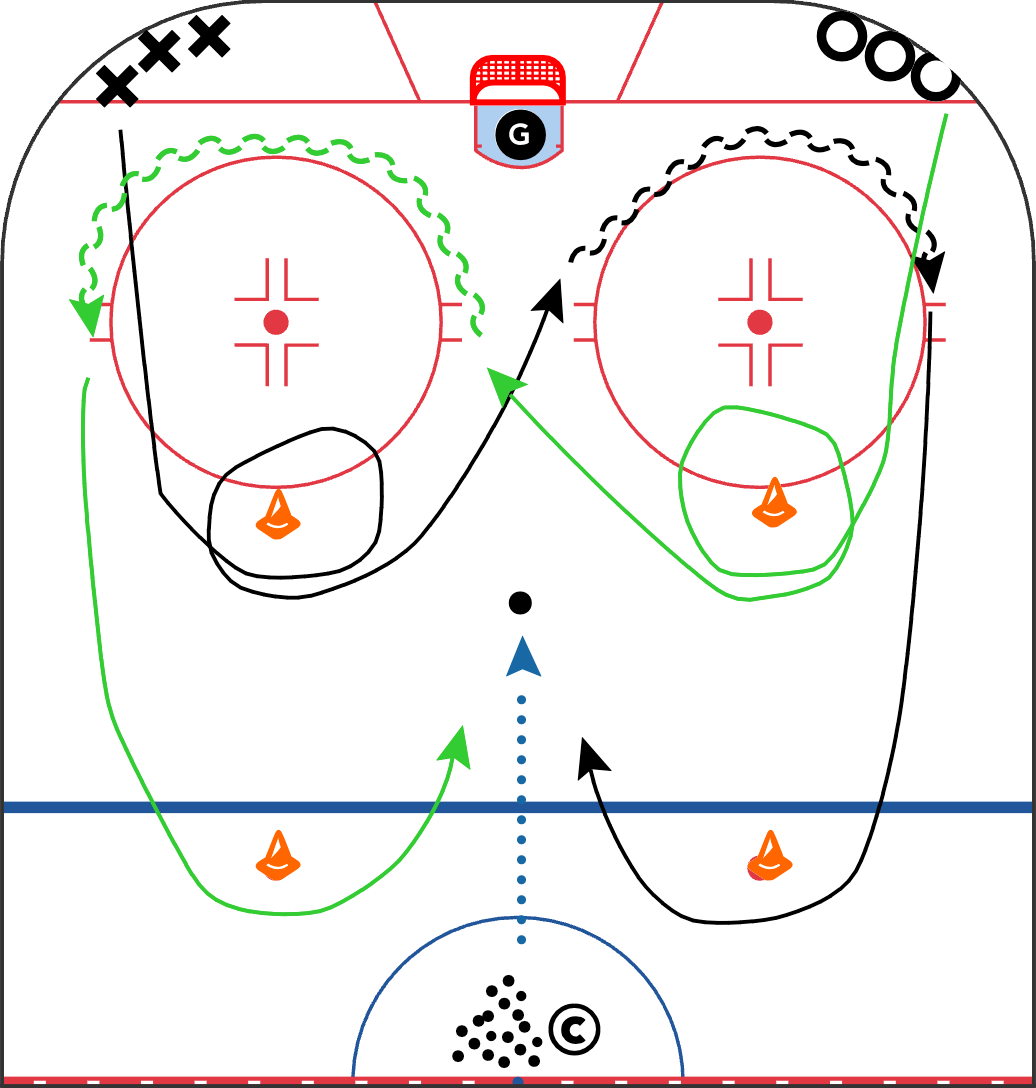
Drill Description:
Key Notes
 00:00:00
In addition to being a hockey professional, I am also a beekeeper. In my apiary, I’ve developed a deep respect and understanding of my bees — an oddly symbiotic, cross-species relationship. I tend to them, and in return, they reward me with honey.
Suited up in protective gear and guided by countless references, I’ve learned the how, why, when, where, and what of beekeeping. I often find myself listening carefully to the wisdom of more experienced beekeepers, trying to follow their best practices and proven standards. Yet, even with preparation and expertise, beekeeping often defies expectations. What should work sometimes doesn’t. What’s prescribed occasionally fails. And what’s considered conventional can yield disastrous results.
In those moments, I’ve learned that success requires adaptation, customization, and a willingness to individualize — to meet the specific needs of each hive. It struck me one day, as a bee stung my finger, that my bees are not unlike the hockey players I’ve coached.
Here’s what the bees have taught me about coaching:
Be player-centred.
Just as a beekeeper carefully observes each hive, a coach must watch players closely — in practice, competition, and beyond. Are your interventions working? Before acting, ensure your corrections match your players’ unique needs. Understanding your “super-organism” — the collective team — will sweeten your results.
Get over-prepared and stay curious.
Be a student of sport science — physiology, psychology, growth and development, biomechanics. Study the old and embrace the new. Follow mentors, innovators, and credible specialists. Your players notice when you’re informed and current. Master both the art and science of the game, from skate hollows to skill acquisition.
Maximize your environment.
Location is everything — in both hives and hockey. Great beekeepers and coaches cultivate the right surroundings for growth. Even challenging environments can produce “honey” when properly managed. Build a team environment where players feel nurtured, valued, and protected — your hive depends on it.
Intervene at the right time.
Plan, anticipate failure, and adjust thoughtfully. Growth often requires small setbacks. Like beekeeping, coaching demands patience and the courage to let nature (and development) take its course.
Don’t overmanage.
Both bees and players thrive with a light touch. Overhandling hives or overcoaching athletes can disrupt natural progress. Provide purposeful interventions, celebrate effort, and trust the process. Sometimes the best coaching move is simply to observe with reverence and respect.
Keep good data.
Track what matters. Objective analytics and subjective notes together create a full picture of progress. But avoid paralysis by analysis. Information should clarify, not complicate.
Prevention beats the cure.
Healthy hives — and teams — are built on fundamentals and collective strength. Focus on developing habits that prevent issues before they arise. A unified, selfless group can resist the “diseases” of ego, distraction, or poor culture.
Respect the bees (and the players).
Be humble. You are a partner, not a controller. Work obsessively, but become part of the team, not above it. Sometimes there’s honey; sometimes there isn’t. Celebrate the wins, learn from the losses, and marvel at the wonder of the process.
Recruit for character and adaptability.
Top beekeepers don’t select solely for honey yield — they look for resilience, cooperation, and versatility. Great teams are built the same way. Support players as they grow through changing roles, from “nurse” to “forager,” and value those who adapt for the good of the group.
Work with the seasons.
Beekeepers follow nature’s calendar; coaches must do the same. Respect the rhythms of your season — build, perform, recover, and reflect. Align your plans with your sport’s ecosystem and teach players why governance and structure matter.
Use the right tools wisely.
From bee suits to whiteboards, the tools matter — but not as much as the skill and wisdom behind them. Technology and gear can enhance learning, but only if guided by thoughtful coaching.
Beekeeping has taught me that leadership, whether of bees or hockey players, is an act of stewardship, not control. It’s about creating the right conditions for others to thrive — balancing intervention with patience, precision with humility. Coaching, like beekeeping, is both art and science, both craft and calling. When we respect the process, the environment, and those we guide, we find that the sweetest rewards — like honey — come naturally.
 00:00:00
Each year at training camp we get the players to decorate a practice puck. We put the pucks into the puck bag to remind us of our core values. This year our theme is Build our House with core values of Support, Connection, Accountable and Repect. At the end of the season players can take the puck home or leave it in the bag for next year's team to discover.
Thanks to Greg Telfer my assistant coach at the time for the idea.
This is a constant reminder about what's important in terms of your culture. Another way we remind the players of these 4 pillars, is instead of player of the game, we acknowledge Pillars of the game. The acknowledgement can be from on ice, on bench, or somethng the coaches have seen throughout the week.
 00:00:00
This is a fun game to start practice off with or even run at the end. I've run this game with many age groups. Promotes urgeny, creativity, and good competition. Kids from 10u to 18u love it.
Players line up along the boards, below the blue line on opposite sides of the rink.
Each teams has a pile of 9 pucks at center ice.
On the whistle the first player in line from each team will collect a puck for their pile and go in for a break away.
If you score, you must race back to your team before the next player can go.
If the goalie makes a save or you miss the net, you must collect your puck and skate it back to your pile of pucks at center ice. Once that puck is place back in the pile then the next player can go.
First team to put all 9 pucks in the net wins.
 00:00:00
In todays game something that often separates good goalies from great goalies is their willingness and ability to get out of the blue paint and play the puck. For me and my team this is crucial and has been a work in progress for my goalies and defence over the last season and a half.
 00:00:00
When coaching young players, one of the biggest challenges isn’t just teaching skills — it’s helping them understand the game. For U10 players especially, concepts like defensive positioning, support, and transition can seem abstract. They’re still learning where to go and why.
Earlier this season, I created a simple visual teaching tool for my U10 A team using CoachThem. It outlined our defensive zone coverage and forecheck — nothing fancy, just clear visual breakdowns of each position’s role.
When I shared the document, I also encouraged parents to review it with their kids at home. I wasn’t sure what the impact would be, but the results were eye-opening.
Within weeks, players were communicating more effectively on the ice. They began anticipating plays, reacting with purpose, and showing a better grasp of what teammates around them were doing. The difference wasn’t just in skill — it was in hockey sense.
What really stood out was how engaged the parents became. Several told me they finally understood what their child’s “job” was in each zone. That understanding allowed them to support — not coach — their player in a positive way.
Instead of vague feedback like “skate harder” or “shoot more,” parents were reinforcing specific habits like “stay on the defensive side” or “support the puck.” That small shift changed everything.
By getting parents involved in the learning process, we created a shared language across the team. Players started connecting practice concepts to game situations faster.
For young players, hockey IQ doesn’t only develop on the ice. It’s built through small conversations, simple video clips, and even diagrams reviewed at home. When players start visualizing the game outside of practice, they internalize it faster.
Coaches can support that by giving parents tools to work with — diagrams, short video clips, or quick notes that explain the “why” behind what’s being taught.
When a 9-year-old starts to understand positioning not as “where coach told me to stand,” but as “where I can best help my team,” that’s when learning really sticks.
This isn’t about giving parents homework or overloading them with systems. It’s about empowering them with understanding.
The takeaway for coaches: if you want your players to develop hockey IQ faster, bring parents into the process in a positive, structured way. The more everyone speaks the same language, the quicker players connect the dots.
For me, this approach completely changed how our team absorbed information. Practices became more productive, in-game communication improved, and our overall structure tightened.
Hockey is a team sport — and when players, parents, and coaches all work together, development accelerates in ways you can’t achieve alone.
Jesse Candela played Junior hockey before spending eight years coaching U Sports football at the University of Waterloo. He has since transitioned back to hockey, where he coaches youth teams and scouts for the Georgetown Raiders (OJHL). His long-term goal is to continue growing as a coach and move into a Junior coaching or player development role.
 00:00:00
This is the beginning of a series on Skating Skills. In an effort to help reset and reafirm the basics, a simple truth prevails - if you want to play, you have to skate.
2 Full Laps around the Rink. Sticks Down, good mechanics
Down and Back, skate to the blue line, then down on one knee, up, down on the other, up. Skate to the opposite goal line, and come back same.
Down and Back, skate to the blue line, transition to backwards, transition at center ice to forward motion, at blue line down on both knees, hop back up, end at goal line. And come back same.
End of content
No more pages to load
copyright (c) 2026 The Coaches Site

