In episode 289 of the Glass and Out Podcast we're joined by Cognitive Behavioural Sports Specialist Larissa Mills for a very important conversation.
Whether it’s social media, sports betting, pornography, or any number of other apps designed to highjack the focus of your players, smart phones have become an opponent we’re all grappling with.
Mills holds a BA in Sociology, Psychology, and a Masters of Science in Education, specializing in brain functionality and learning mechanisms. She is the Founder of the Mental Game Academy, an organization committed to empowering athletes, specifically by helping them overcome addiction to their phones.
Listen as she shares why confidence is directly linked to phone usage, why gambling and porn have become a major issue for today's youth, and solutions for coaches on handling these many issues.
This comprehensive off-season program from Evan Brownrigg, CEO & Director of Player Development of Next Generation HKY, focuses on puck skills, featuring daily stickhandling and shooting drills you can practice at home. Each workout consists of two stickhandling drills, two technical shooting drills, and one game application drill—everything you need to improve your game!
There’s even some rest days built right in. It is the summer after all!
Every drill set comes with detailed instructional videos showing you the techniques needed to become an elite stickhandler and shooter. These videos remain accessible as reference materials, providing key teaching points while you progress through your daily drills. You can always return to them in the future as well. As hockey coaches we understand that what separates good players from great ones isn't just what happens during team practices or games—it's the commitment to improvement during the off-season, particularly in the comfort of their own homes. The development of fundamental skills like shooting and stickhandling requires consistent, focused repetition that simply cannot be achieved through team practices alone.
That's why Brownrigg created this course. He has been a driving force behind Next Generation HKY since its inception, helping grow the program from its 2008 beginnings to serving 6,500 athletes. As the primary facilitator for on-and off-ice development, Brownrigg also works with the Belleville Senators (AHL), Ottawa Charge (PWHL), and Ottawa 67’s (OHL) in player development. Passionate about tailoring coaching to each athlete’s unique needs, Brownrigg continually evolves his approach, mentors coaches, and pushes the boundaries of player development. His energy, communication skills, and commitment to excellence make him a pivotal part of NGH’s success. And now he can be part of your success too!
Character and determination are measured when no one is looking. When players dedicate time to practicing shooting and stickhandling at home during the off-season, they're building natural pathways that transform conscious movements into unconscious abilities. Deep practice in the summer sets players up for tangible skill development when the season starts in the fall. This is the foundation of what we call "hockey sense"—the ability to execute skills automatically while focusing on the dynamic aspects of the game.
Here are examples of what players will work on in Brownrigg's at-home hockey skills course:
Stickhandling Drills
FAKES, THE WAND: Deceptive puck handling using wand-like movements to create false impressions for defenders. Focus on quick hand movements while maintaining proper stick position to sell convincing fakes.
ONE HANDED, WIDE: Players develop single-handed control with wide puck movements. This drill builds independent hand strength and improves puck protection skills when defenders are closing in.
TWO STICKS (FLIPS): Using two sticks, players practice controlled flipping motions to enhance hand-eye coordination and quick transitions. This drill develops the ability to quickly change puck direction under pressure.
EXCHANGE (SINGLE/DOUBLE): Quick puck exchanges from one side to another, focusing on clean transitions and maintaining control. The double exchange adds complexity by requiring multiple directional changes in succession.
Shooting Drills
PULL & ELEVATE BACKHAND: Players develop the critical skill of pulling the puck across their body before elevating a backhand shot. Focus on proper weight transfer and wrist snap to generate lift and accuracy.
SKATER STRIDE, STRIDE SHOT: Combining skating momentum with shooting mechanics, players learn to release powerful shots while in stride. This simulates game situations where players must shoot without stopping.
FEET STAGGERED (INSIDE/OUTSIDE LEG): Players practice shooting with feet in staggered positions, learning how foot placement affects shot power and accuracy. This develops versatility for shooting from different body positions.
Game Application Drills
CROSSOVER SHOT BASIC: Integrating crossover skating with shooting mechanics, simulating game scenarios where quick direction changes lead to shooting opportunities. Focus on maintaining proper form throughout the movement.
DRAG & FIRE (FEET STAGGERED): Players practice dragging the puck laterally before quickly releasing a shot, replicating how to create shooting lanes against defenders. Emphasis on quick hands and rapid release.
NET FRONT EXCHANGE: Close-quarter puck handling and shooting skills for battles near the crease. Focus on quick exchanges and accurate finishing in tight spaces where goalies are most vulnerable.
Here's a preview from Stickhandling Fakes: The Wand.
This course, At-Home Puck Skills, allows for high-volume repetition, crucial for muscle memory and technique. Players can take 100+ shots or get thousands of stickhandling touches, developing puck feel and control. Without team practice constraints, they can refine mechanics in a pressure-free setting, making skill transfer to game situations more seamless.
Coaches quickly recognize players who put in offseason work—their confidence, shot velocity, and creativity stand out. Self-motivation shows dedication, and the best players treat every day as a chance to improve. Just 15-20 minutes of daily shooting and stickhandling adds up, making a noticeable impact when they return to the ice. And it should be fun!
To celebrate Women's History Month, we're taking a look back at some of the inspiring females who have graced the TCS Live stage.
Over the years, we're proud to have provided a platform for female presenters to share their experience and insights with our global coaching community. This collection of women have provided some of our most memorable presentations on everything from on-ice skill demonstrations, to keynotes talks on leadership and culture.
Tara Watchorn - How to Build and Capitalize on Momentum
After an illustrious playing career, Tara Watchorn is back at her alma mater as Head Coach of the Boston Terriers Women’s Hockey Program. Watchorn is always preaching to her team the value of gaining momentum and at TCS Live 2024 she discussed how to build and ultimately capitalize on those peaks and valleys in a game.
Watchorn’s biggest message to her players is not to be bigger than the person next to you. A simple way to do this is line changes. When everyone is fresh and eager to get out there and involved in the game, momentum follows naturally. Watchorn hyped the benefits of building momentum as a team because it enhances value and understanding for all roles in a team’s line up. It also creates an energy mismatch with your opponent while also increasing the likelihood of causing an icing and penalties by the other team. The more time and space generated causes more quality scoring chances. Watchorn preaches to her team about the three shift idea. Rather than thinking about needing to score right away, Watchorn tells her players to focus on putting three strong shifts together where all lines can build off each other.
Shift lengths are the key to a team's success. The likelihood of getting a shot later in your shift decreases by every second. For the best players to be impactful they need to be fresh and short shifts is the way to make that happen.
Rachel Flanagan - Retrievals and Exits: Owning the Middle
At the TCS Live at St. Andrews College in the fall of 2024, Rachel Flanagan showed us how to start the attack in the middle of the ice - 200 feet away from the opponent's net.
There are two key states in the game: you either have the puck or you don't. I'm serious. You're defending or you're attacking. Of course you can put the puck in space while you're on the attack so you can recover it closer to the other net, but the concepts remain true. If we can leave our zone with possession, skate through the neutral, and finally enter the offensive zone with the puck on our stick, that gives us a better chance to score than dumping it in. But the other team is trying too!
That's why Flanagan answers the question of how to manipulate what the defending team is doing so you can attack faster and more efficiently.
Kim Weiss - The Importance of Wall Play and How to Incorporate it into Practice
Kim Weiss understands the importance of wall play in hockey. She delivered a thorough and upbeat presentation at TCS Live 2024 in Ann Arbor, Michigan that got her players moving the puck off the wall quickly and more efficiently.
For Weiss, the three habits of elite wall play include a focus on shoulder checking and scanning, getting the first touch of the puck, and including deception in a player’s next move off the boards.
To get going Weiss puts her players through a simple drill of collecting the puck off the wall with no pressure while focusing on shoulder checking. She added a deception turn before picking up the puck and passing it off to the next player in line. The next phase in Weiss’ drills is to add a little bit of pressure as a player picks up the puck on the boards. This allows her players to get comfortable with using the three habits that make for elite wall play while having a defender on them. This also helps her players read and react to where the pressure is coming from and creates a more game like situation.
Since the Czechia’s National Women’s team began playing in the World Championship in 1999, the team has medaled twice: in 2022 & 2023. Those are the first medals in the history of Czechia’s National Women’s team program. What’s significant about that is those are the first two seasons the team has played under Head Coach Carla MacLeod. What’s the secret to such an impressive turnaround on the world stage? Being authentic.
To MacLeod, who is currently the Head Coach of the PWHL's Ottawa franchise, that means asking players straight up what they need from the coaching staff in order to be successful. The response she got from over 80 per cent of her team was honest communication and feeling respected. This gave MacLeod a glimpse into how the team had been run prior to her arrival and reinforced that it wasn’t necessarily going to be about what she was teaching, but how she was teaching it.
Check out MacLeod's talk from last year's TCS Live where she shares why coaches need both focus and fun to be successful, not just one or the other.
Kori Cheverie - How to Turn Off Auto-Pilot and Develop High-Performing Players
There seems to be a belief in the hockey world that once a coach reaches a certain level of coaching, say having a role on an Olympic team for example, they’ve made it. The truth is, coaching is just like playing and is anything but linear. PWHL Montreal Head Coach Kori Cheverie reminded everyone that during her powerful TCS Live presentation in 2023.
Cheverie was named an Assistant Coach of the Canadian National Women’s team for the 2022 Beijing Games. Prior to leaving for the games, Cheverie tested positive for Covid and was unable to make the trip with Team Canada. Instead of being down on herself, Cheverie changed her mindset. She altered her sleep schedule and continued to coach the team virtually, ultimately leading to a gold medal for Team Canada.
Following the Olympics, Cheverie led the Nova Scotia U18s at the Canada Winter Games to a silver medal and a generational upset over Team Ontario.
During all this winning, Cheverie made a drastic mindset shift as a coach realizing perfection and fearing failure have no place behind the bench. Watch as she reflects on her experiences and encourages coaches to be curious and creative about the possibilities of what can be accomplished.
Cathy Andrade - Leveraging Crossover Patterning for Skating Development
When Cathy Andrade moved from Calgary, Alberta, to San Jose, California, in the early 90s, she did not hang up her skates in favour of a surfboard.
In fact, she did the opposite.
Andrade, a former competitive figure skater, doubled down on life in the rink and is now regarded as one of California’s premier power skating instructors. She has coached tens of thousands of skating lessons to athletes ranging from minor level hockey players through NCAA D-I, PWHPA, OHL, AHL, KHL, USA National Team, Olympic Team members & NHLers, over the past 37 years.
At TCS Live 2023, Cathy, alongside her son Cameron, demonstrate and teach patterning to become the most effective skater possible. No more wasted glides, don’t hang on your toes, improve your posture, learn mohawk turns, and learn how to use your undercut when coming off your inside edges.
Emily Engel-Natzke - How to Scale Up Your Career as a Video Coach
Not only does Emily Engel-Natzke enjoy breaking down plays, she’s a big fan of breaking down barriers.
Engel-Natzke is the Video Coordinator for the NHL’s Washington Capitals and has been the franchises’s first full-time female coach for the past two seasons. But just like the players on the ice, it took a lot of hard work and determination to get where she is today. At TCS Live 2023, Engel-Natzke detailed her inspirational journey.
The Colorado product, who has a Bachelor of Fine Arts/Film from the University of Colorado-Boulder, got her coaching career started in 2014 with the University of Wisconsin as Video Coach for the women's basketball team. With hockey always being her end goal, she eventually took on the role as Video Coach for both the men and women's hockey programs the following season. After two seasons, she would be promoted to Director of Hockey Operations for the men's program, along with her duties as the team’s Video Coach. Under the leadership of Badgers head coach Tony Granato, Engel-Natzke gained the valuable experience that led to a historic signing with Hershey; at just 29-years-old, she was hired to be the Video Coach of the Hershey Bears, Washngton’s America League affiliate, and in the process became the first female coach hired in the AHL.
Cara Morey - Building Resiliency in Your Players and Program
Since Cara Morey was announced as head coach of the Princeton women's hockey in June of 2017, the program has won its first ECAC tournament title, won an Ivy League championship, qualified for two NCAA quarterfinals, set the program wins record, and established itself as a weekly inclusion in the national top-10 rankings.
Harry Potter humour aside, the turnaround the Tigers have made under Morey has been nothing short of magical. In 19 seasons before her arrival, Princeton advanced past the quarterfinals in their conference tournament just three times. The Tigers already have moved past the quarterfinals in three of four seasons with Morey, including a memorable ECAC tournament title in overtime over number one ranked Cornell in 2019-20.
How is such a turnaround possible? At TCS Live in Ann Arbor this past June, Morey shared some insights in her presentation titled Developing Resiliency and Grit in the Modern Player.
Leah Hextall is a trailblazer and when the ESPN commentator speaks, well, she always has something important to say. That was especially the case when she spoke as one of the headliners at TCS Live.
What Hextall had to say was raw, emotional and shocking, but sadly not surprising.
Play-by-play commentators often feel like friends to us all. They’re with us during some of the most memorable sports moments of our lives. Hextall’s 27-minute presentation was the highlight (and lowlight, understandably) of TCS Live and of the 36 presenters who spoke during the three day hockey coaching masterclass, no one’s talk garnered more support from those lucky enough to be in attendance.
The clip reminded me of a years ago, exercise I used when coaching Junior.
I noticed a number of players had a poor perception and lacked confidence in self. Others had a poor perception, and lacked confidence in their teammates. I thought it important to intervene.
I introduced "Confidence Cards".
On the next road trip, on the bus, I had my leadership group pass out cue cards and pens.
Before we left, I had added each player's name and number to the centre of the cards using a fine tipped sharpie.
I asked the players to pass the cards around so that each and every player had an opportunity to add a constructive and positive comment on the card about who was identified on the card. I also added myself and my assistant coaches.
What resulted was astounding.
The confidence cards immediately drew players together. Some players discussed what they liked about teammates with others while some found a quite spot and reflected on each guy and his position.
All described in a brief phrase or cleverly selected word qualities that they admired and respected in others and added what value each player made to the team!
When the cards were returned and then shared with each player and coach for them to keep, spines stiffened, smiles and gratitude was observed and dare I say, a few prideful tears were seen.
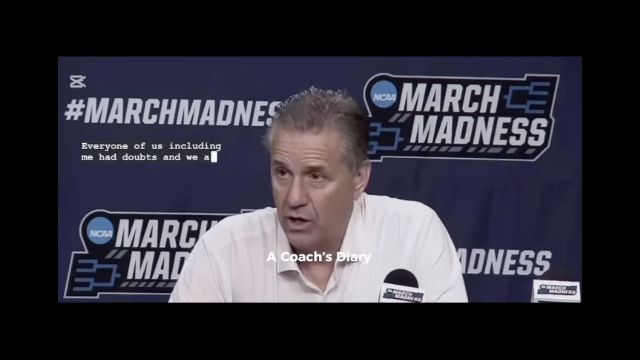
As coach Calapari mentioned, "We all have doubts." and we all need reminders of what qualities, abilities we have and can contribute. We also need to be reminded to stay in the journey and appreciate the ride we are on.
Incidently, as the Playoffs progressed I noticed in one key game that our Goaltender kept looking at his blocker hand. Thinking he was injured, on a stoppage, I motioned for him to skate to the bench. I asked, "What are you looking at?", "Are you hurt?". His reply, "No, coach...I'm looking at my confidence card!"
Technical Tip - Preparation is Key for a successful 2-touch shot release. Here, Logan is working on neutralizing the puck on the 1st touch, adjusting his body, surrounding, then impacting to complete the 2nd touch.
It's important for the body to follow the puck squarely towards the target.
I suggest when training, to start stationary, get comfortable, then add motion.
In episode 294 of the Glass and Out Podcast we welcome back a man who requires no introduction (but we'll give one anyway): Player Development Coach Daniel Broberg.
Broberg is the founder of DB Hockey Factory and is regarded as one of the top development coaches in the game, travelling the world extensively to work with players, teams, clubs of all levels, and is sought after by some of the the top players in hockey to improve and refine their skills.
We recently collaborated on a course, 7 Steps From Basic Skills to Smooth Power, which provides players and coaches with a blueprint for building a foundation that will not only enhance fundamental skating and puck skills, but also empower players to read and react to whatever the game gives them and tap into the full spectrum of their creativity. Check it out here.
Listen as he shares the importance of posture in skill development, why players need to face adversity on their own, and why finding the state of "flow" is the key to building elite players.
Seneca once said, “Excellence withers without an adversary.” In the world of minor hockey, this lesson is often forgotten. Many parents believe that getting their child on a stacked, undefeated team is the best path to success. But when the scoreboard is always lopsided, and games regularly turn to running time, the opportunities for real growth and character development disappear.
The Problem with Stacked Teams
Stacked teams, brimming with top talent, may seem like a dream scenario. Winning is fun, after all. Parents often think that constant victories will build their child's confidence and provide exposure for future opportunities. But the reality is that these teams can stunt growth — both as players and individuals.
On a star-studded roster, ice time is limited. Coaches often lean on their top scorers and most reliable players. Development takes a backseat when the priority is maintaining an undefeated record. For players lower on the depth chart, it means fewer opportunities to gain experience in critical situations.
Additionally, when teams dominate their opponents, competition becomes meaningless. When every game is a blowout, the challenge disappears. Players stop learning how to battle, strategize, and respond under pressure. And when running time kicks in, cutting down playtime even further, it diminishes the very purpose of participating in the sport.
The Value of Adversity
Losing is uncomfortable, but it is also invaluable. Struggling through tough games, facing stronger opponents, and making mistakes are all essential to growth. On a more balanced team, players experience the highs of victory and the lessons of defeat. They learn resilience, perseverance, and how to handle frustration.
These lessons extend far beyond the rink. Hockey is not just about goals and assists; it’s about building character. Players who face adversity become stronger competitors and more capable individuals. They develop the mental toughness to deal with setbacks, both in sports and in life.
More Ice Time, More Development
On a team where every player has a meaningful role, ice time is more evenly distributed. Players have the chance to practice their skills in real-game scenarios, not just during drills at practice. They gain confidence by contributing to their team’s efforts, whether it's on the power play, penalty kill, or during the final minutes of a tight game.
When players are consistently challenged, they sharpen their hockey sense, decision-making, and physical abilities. They learn from their mistakes and grow into well-rounded athletes. This kind of development simply doesn’t happen when a team is cruising to an easy win every game.
Choosing the Right Path
Parents should carefully consider what’s best for their child’s development, not just the allure of a winning record. Opting for a competitive but balanced team often provides a better environment for growth. Players receive more ice time, more responsibility, and more chances to learn from their experiences.
Instead of fearing the sting of a loss, embrace it as an opportunity. Encourage your child to see challenges as chances to improve. Celebrate their effort and progress, not just the scoreboard. In the long run, a player who has learned to lose, adapt, and persist will have a stronger foundation for success — in hockey and beyond.
Because as Seneca reminds us, true excellence thrives only when it has an adversary to overcome.
Looking to build grit and resilience s part fo your character?
DM me for a strategy call to see if you qualify for my program.
The echoes of skates cutting across the ice on the countless outdoor rinks, a deep hockey culture and tradition, and a legacy of success at every level - this is what makes Minnesota truly the State of Hockey. This year, that passion takes center stage as The Coaches Site brings its renowned hockey coaching conference to St. Paul, Minnesota, from September 27-28, 2025.
A Two-Day Immersive Coaching Summit
Described as the "Ted Talks of Hockey," TCS Live is more than just a coaching clinic, it's an experience designed to ignite new ideas and elevate the game. Featuring a line-up of Minnesota’s most accomplished hockey leaders, the event will provide an in-depth look at cutting-edge strategies in player development, team dynamics, and seasonal planning.
With the backing of The Coaches Site, the Minnesota Wild, and Skate it Forward, this event is a must-attend for coaches of all levels, from mites to high school and beyond. Whether you're looking to refine your coaching philosophy or discover innovative training methods, TCS Live guarantees inspiration and practical takeaways for the 2025/26 season.
On & Off-Ice Presentations by Minnesota’s Top Coaches
Honoring the Minnesota Hockey Model, this year’s event exclusively features speakers with deep ties to the state. Expect a dynamic mix of on-ice demonstrations and engaging stage presentations, as top coaches share the lessons that have shaped their careers. The agenda will focus on grassroots player development, ensuring that attendees walk away with actionable insights to bring back to their teams.
Connect & Network with Fellow Coaches
Hockey thrives on collaboration, and TCS Live Minnesota offers unparalleled networking opportunities. Attendees will have the chance to exchange ideas with coaches from youth, high school, and collegiate levels, fostering connections that will ensure every young player in the State of Minnesota enjoys an enhanced development experience.
Support the Skate It Forward Initiative
Beyond education and networking, this event is committed to making hockey more accessible. All profits will be donated to the Minnesota Wild's Skate It Forward initiative, which in turn will be reinvested back into youth hockey programs and assist with more kids being introduced to the game. Your investment in coaching development will directly contribute to the growth of the game at the grassroots level.
Spring hockey season is upon us and everyone is so happy that they got to go franchise mode in NHL 23. If the kids are having fun and the parents are enjoying some exotic locales like Kelowna and Winnipeg then that's all that matters. The point is still the game, so let's make sure we're maximizing our ice time and teaching skills the players can use when the games start for real.
And no I don't know why it's called Cam Neeley.
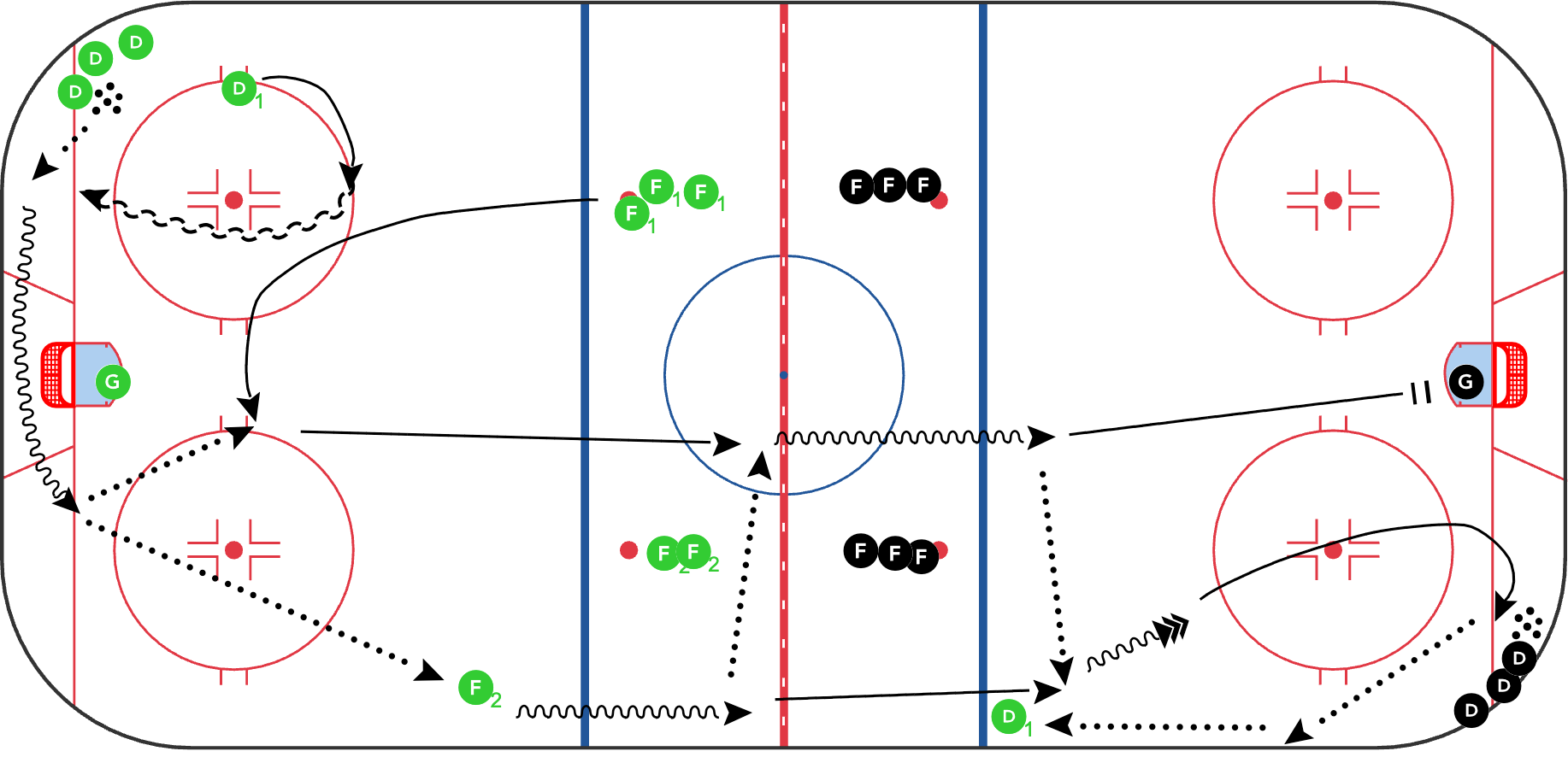
At this point in the regular season this is a progression I can announce by name and watch the players run themselves.
All About Habits
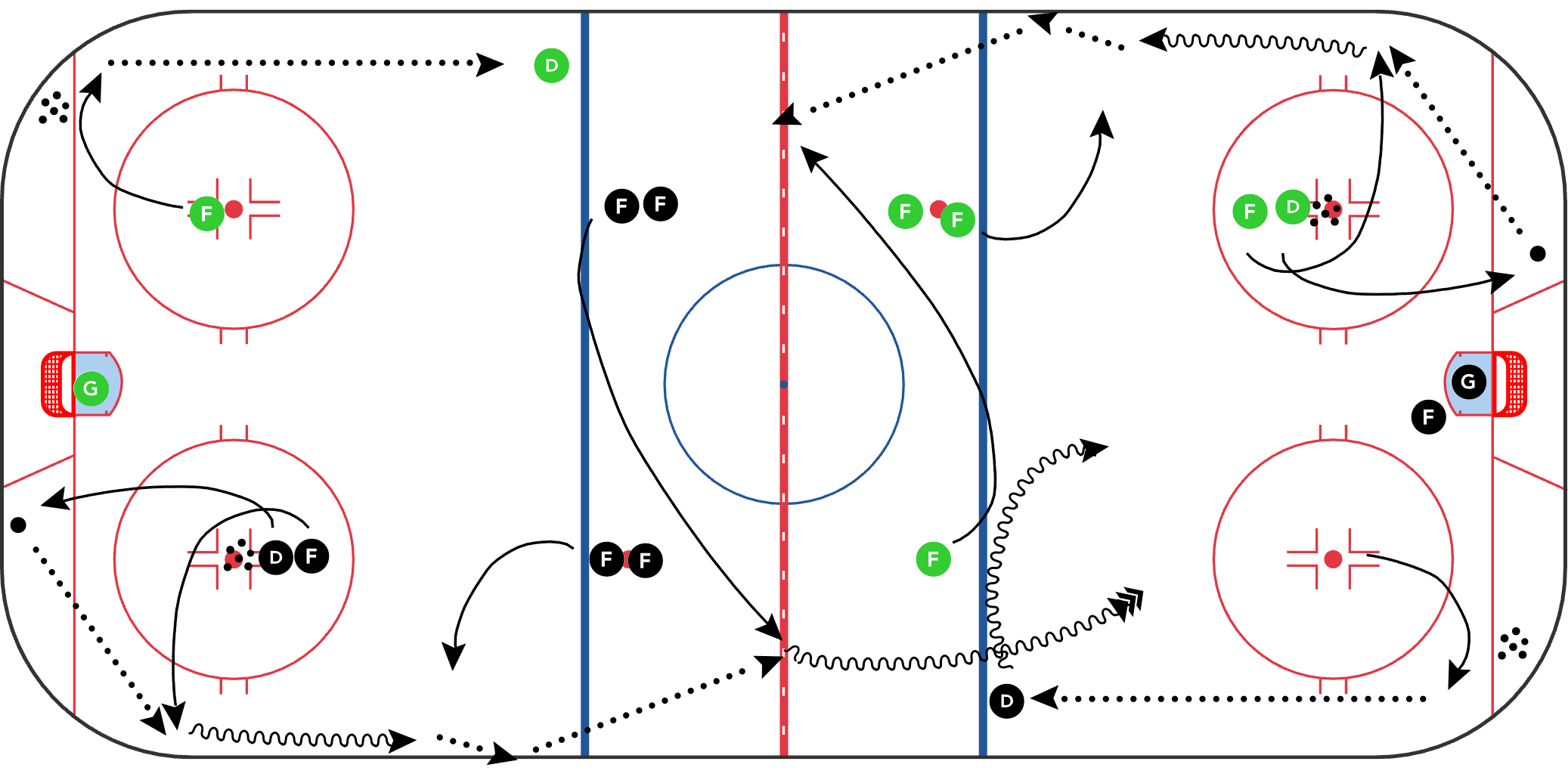
D have to shoulder check before retrieving the puck on the breakout
forwards have to scan the ice, get low, and open up
everyone should be calling for the puck
forwards kick the puck out, middle drive, warmup shot off the pillows
pick up second puck, low to high, D get off wall and second shot
One thing I tell my teams is to play out the rebound. Go unti the whistle blows. There isn't an early shot in this drill so there can be some carryover. Keep the goalies honest and put the puck in the back of the net if it's open. You'll see some huge saves!
Progression 1
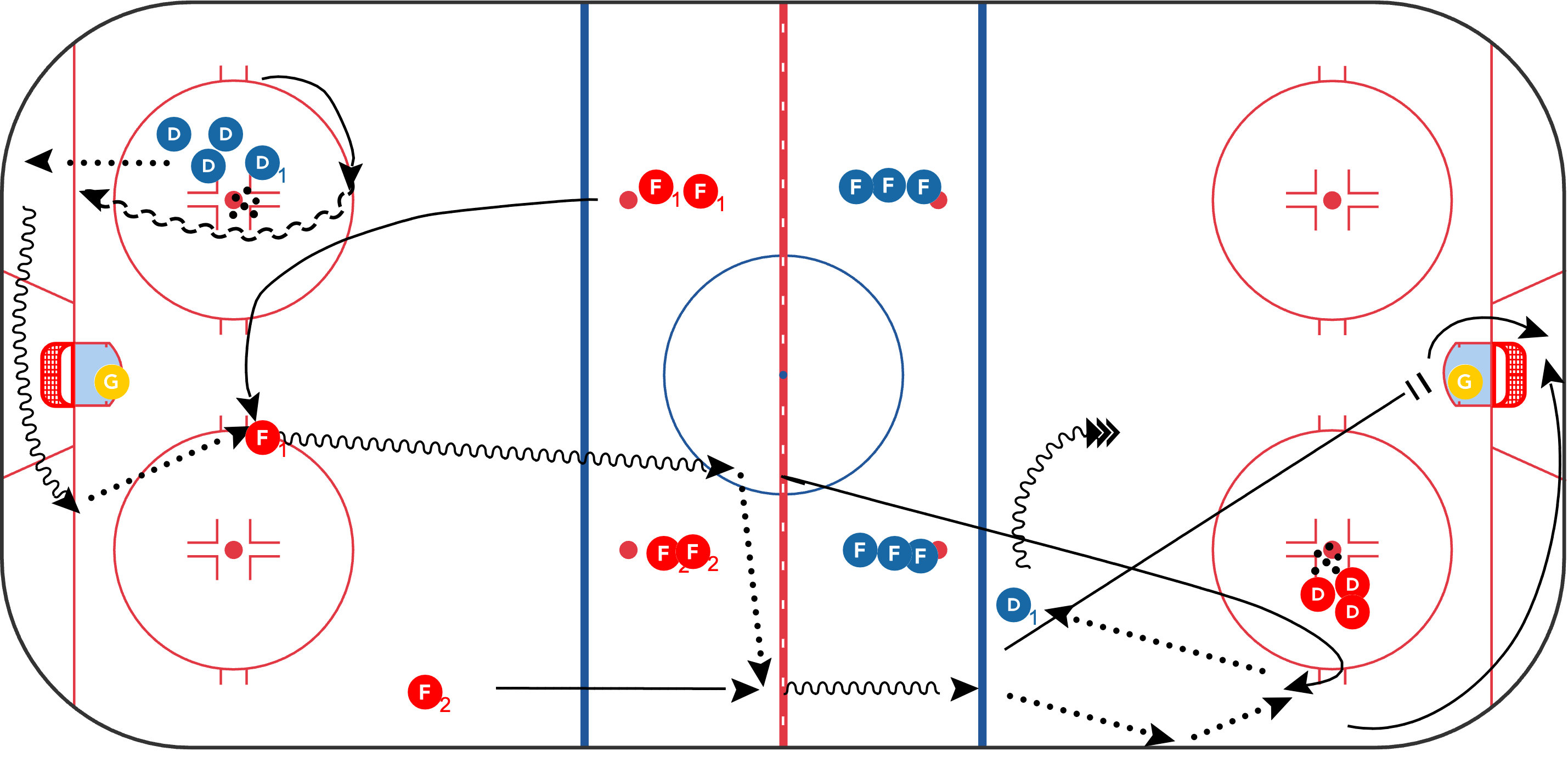
Drill happens out of both ends at the same time, these descriptions just show one side at a time.
Progression 2
This looks crazy but it's really not, I promise. On the first breakout pass, the D passes up the strong side to the forward from the previous rep. they move it up the wall and then we get a slash support breakout from the weak side.
Progression 3
Same start, but now the forward who enters the offensive zone is pulling up to hit the trailing D with a perfect pass, one-timer to follow, seeing-eye tip in front and the goalies are mad already. Beautiful!