
Gordo 9 Double Regroup - Video
 00:00:00
Every year around this time I end up doing the same thing — I replay moments in my head.
Not goals.
Not wins.
Not losses.
Moments.
A look on a player’s face.
A tone I used on the bench.
A reaction that was bigger than the moment deserved.
And if I’m being honest, there are parts of this season that I don’t like when I look back at them. Not because we lost. Not because kids didn’t develop. But because I can see times where I let frustration leak out of me in ways that didn’t help anyone.
I get animated. I always have. I care deeply, and that care comes out fast and loud when things aren’t going well. And while that intensity helped me in other environments, I’m learning that at this level, it can do more harm than good.
There are moments on the bench where I can feel myself reacting before I’ve thought.
A bad turnover.
A missed assignment.
A lazy backcheck.
And I’m already talking before I’ve decided what actually needs to be said.
That’s the part I’m trying to change.
Not because emotion is bad.
Not because passion is wrong.
But because kids don’t always hear the message — they hear the emotion.
And when the emotion is frustration, what they feel is pressure.
So coming into this new year, that’s my focus: not coaching less, not caring less, but reacting less.
Pausing before I speak.
Choosing what actually matters.
Letting some things go so I can teach others better.
Here’s the lesson I’m trying to apply:
If I want players to slow the game down, I have to slow myself down first.
If I want them to be composed under pressure, I have to model composure.
If I want them to make better decisions, I have to show what that looks like when things go wrong.
We talk a lot about habits for players — scanning, supporting, stopping, starting, resetting.
But coaches have habits too.
Tone is a habit.
Body language is a habit.
Reactions are a habit.
And the environment we create is built from those habits.
I want my players to feel safe enough to try things.
To fail.
To experiment.
To grow.
And that only happens if I’m steady.
This doesn’t mean lowering standards. It means raising awareness — of myself.
Because the biggest thing I’ve learned this season is that coaching isn’t just about shaping players.
It’s about shaping yourself in front of them.
They’re always watching.
They’re always reading tone.
They’re always feeling the environment we create.
So if the new year is about anything for me, it’s about being more intentional with the one thing I control every single day:
The way I show up.
Not perfect.
Not calm all the time.
Not emotionless.
Just better.
About the author:
I’m a U10 Rep A coach and an OJHL regional scout who’s still learning how to balance standards, emotion, and development at the youth level. I write about what I’m trying, what I’m struggling with, and what I’m learning along the way — in hopes that it helps other coaches who are navigating the same challenges.
 00:00:00
In recent years, I’ve found myself rethinking how much instruction actually helps players learn.
Like many coaches, I was drawn to research-informed approaches—particularly ecological dynamics—that challenged the idea that learning comes primarily from commands and explanations. Instead, they suggest something both simpler and more complex: behavior emerges from environments. Players adapt to the constraints in front of them, often without conscious instruction.
This shift has been important for me. But as these ideas filter into youth hockey, I’ve also noticed a quiet misunderstanding taking hold:
If learning emerges from environments, then the best coaches should remove themselves from the process.
In practice—especially with young players—I’ve found that this is rarely true.
The Myth of the “Hands-Off” Coach
Some modern coaching conversations describe the ideal coach as:
The intention is good: reduce over-coaching, allow exploration, let players self-organize.
But youth hockey is not a neutral space.
Young players do not arrive with shared understanding, stable confidence, or the ability to regulate emotion under pressure. When coaches step back without designing intentionally, confusion often fills the gap.
Over time, I’ve learned that the real issue isn’t whether coaches should talk less. It’s whether they recognize what their presence—or absence—is already shaping.
Environments Don’t Design Themselves
Ecological dynamics reminds us that learning is context-dependent and behavior adapts to constraints. I agree with this. What’s often left unsaid is something equally important: Coaches choose the constraints.
They choose:
What I have to remind myself—often—is that even silence is a choice. The coach is never outside the system. We are always part of the environment.
Control vs. Influence
Traditional coaching often seeks control:
“Stand here.”
“Pass there.”
“Do it this way.”
“Don’t do that.”
In reaction, some modern approaches swing to the opposite extreme—stepping back completely and hoping learning simply emerges.
A more useful frame, I’ve found, is influence.
Influence asks:
Influence is quieter than control—but in my experience, far more powerful.
Concrete On-Ice Examples
Example 1: A “Free Play” Drill That Isn’t Free
A coach sets up a small-area game and tells players to “just play.”
Within minutes:
What’s missing isn’t effort—it’s guidance.
One small change: “A goal only counts if all three players touch the puck.”
Suddenly:
The coach didn’t control behavior. They designed for it.
Example 2: Teaching Defense Without Lecturing
A coach wants defenders to close gaps earlier.
Instead of stopping play repeatedly:
Players begin closing space naturally.
Afterward, a simple reflection: “What made defending easier in that game?”
Learning becomes shared—not delivered.
Example 3: Language as an Invisible Constraint
Two coaches run the same drill.
Coach A says:
“Don’t lose your check.”
Coach B says:
“Protect the middle first.”
The behaviors that emerge are different. Language shapes perception. Perception shapes action. The words we choose are part of the environment.
The Developmental Reality Youth Coaches Must Hold
Young players are still learning how to:
An environment with no guidance can feel unsafe. An environment with too much control can feel suffocating.
The coach’s role is not to disappear. It is to design clarity.
Designing for Learning, Not Compliance
Compliance looks like:
Learning looks like:
Well-designed environments reward learning behaviors. Poorly designed ones reward obedience.
Why This Matters Beyond Youth Hockey
Elite players are often praised for:
Those qualities don’t appear suddenly at higher levels. They are shaped—quietly and consistently—by early environments.
When players grow up in systems where:
They may execute well—but struggle to adapt later.
High performance depends on early influence, not early control.
Closing
Modern coaching — like modern teaching — has rightly challenged the idea that learners need constant instruction. But the solution is not absence. It is intentional design.
When coaches stop trying to control every action and start shaping environments with clarity and purpose, players don’t need to be told what to do. They learn it.
Next week in Part 3, I’ll explore why teaching still matters in a constraints-led world—and how great coaches know when to step in and when to step back.
 00:00:00
Subscribe: Apple Podcasts | Spotify | Linktree
In episode 323 of the Glass and Out Podcast we're joined by Head Coach of the York University Women's Hockey program, Dan Church.
Back in November, Dan joined us for Hockey Calgary’s leadership day and presented on shared leadership, specifically how you can build stronger teams through coach-athlete collaboration. Stay tuned for that video coming later this season on The Coaches Site.
Church has led the program at York since 2004. His career spans both university and international hockey. He has represented Hockey Canada in multiple leadership roles, including Head Coach of the Canadian National Women’s Team, where he led the program to a gold medal at the 2012 IIHF Women’s World Championship.
Church places an emphasis on culture, long-term athlete development, and values-driven leadership, and is widely regarded as one of the most influential coaches in Canadian women’s hockey.
Listen as he shares why coaches need to build better leaders, how to manage a players stress and exhaustion, and why the coach-player relationship needs to be collaborative.
Video Timestamps:
 00:00:00
My dad, for what seemed like a bajillion years, was the Director of Chicago Regional Recruitment for a small, private NCAA D3 University in the middle of the state of Illinois. I got to grow up watching and learning from every coach at every sport that used our house as hub to visit high schools in the area. Some nights the football coaches would sleep on an air mattress in our basement; earlier in my life they'd sleep on the pullout couch bed with the infamous back-breaking bar of doom. Sometimes the basketball coaches would play NBA Live with me on Playstation 1. But I always liked to hear the chats going on in our house.
As I got older, some of these coaches ended up at major universities - coaching or recruiting at places like Miami, Army, Ohio State and Notre Dame. I got to see THOSE recruiting calls up close and personal. A running back flipping his commitment to go to a rival Big Ten school, a coup getting an SEC-caliber tight end to go to a MAC school, etc.
I gained really fascinating insights into a world that I've now since entered as an ACHA coach that happens to work for a fully-funded and school-run hockey program.
I get to recruit like my heroes. And it has come at a massive, massive learning curve. In my handful of years recruiting college-level players, I've come to learn that The Times They Are a-Changin'.
For years, the prevailing rule of thumb in junior hockey went something like this:
The best players from Tier III teams play NCAA Division III hockey. The next tier plays ACHA, and so on.
It was simple. It was intuitive. And at one point, it was directionally useful. Me and 50 other guys would compete for the same caliber of player at various showcases or a coach would let us know a player is available (usually meaning they didn't have any D3 offers) and then the best ACHA offer would win most of the time. Fortunately, we have a lot to provide players and so getting players to join us has been easier than some have had it. I also tend to think the recruiters make their own luck a bit too... but that's for another article.
Anyway, junior hockey — and college hockey — do not operate in that world anymore.
Over the last several seasons, three forces have quietly but fundamentally altered the landscape:
Roster-slot pressure at the NCAA Division III level
The continued expansion and stratification of junior hockey
The growth, funding, and legitimacy of ACHA hockey as a parallel pathway
Add to that the impending eligibility of CHL players for NCAA hockey, and the pressure becomes impossible to ignore.
This piece lays out a pressure model, grounded in player-level data, that shows where Tier III players actually land — team by team, league by league — and why expectations around Tier III → NCAA Division III outcomes need to be recalibrated.
Importantly, this is not an argument against Tier III hockey.
It is an argument for accuracy of expectations.
To keep this analysis honest and aligned with how coaches and advisors actually think, I am making one key distinction:
Tier III (Core): NA3HL + USPHL Premier
Tier III+ (Bridge): EHL (treated separately, excluded from core Tier III conclusions)
Lumping all Tier III leagues together muddies the signal and inflates expectations. I am of the belief that the EHL is not better or worse than the other two leagues, but it is different. Regionally it is located closer to most NCAA D3 hockey programs and rosters skew older. This matters.
From here forward, when we say Tier III, we mean NA3HL and USPHL Premier only.
NCAA Division III men’s hockey has roughly 2,650 active roster spots nationally.
Those spots are not expanding.
When we normalize by a conservative four-year average roster tenure, that yields:
~660 new D3 roster slots per year across the entire country
From the '25-26 data:
386 active NCAA D3 players came from NA3HL or USPHL Premier
Annualized:
~97 new NCAA D3 slots per year for all NA3HL + USPHL Premier players combined
That number — under 100 seats per year — is the foundation of the pressure model.
Everything else flows from it.
Spread those ~97 annual slots across:
~38 NA3HL teams
~80+ USPHL Premier teams
You get a sobering baseline:
~0.8 NCAA D3 players per team, per year
That is a bottleneck.
And even that assumes an even distribution — which the data shows is not how reality works.
When we map Tier III (NA3HL + USPHL Premier) representation against MYHockeyRankings NCAA D3 team strength, a pattern emerges.
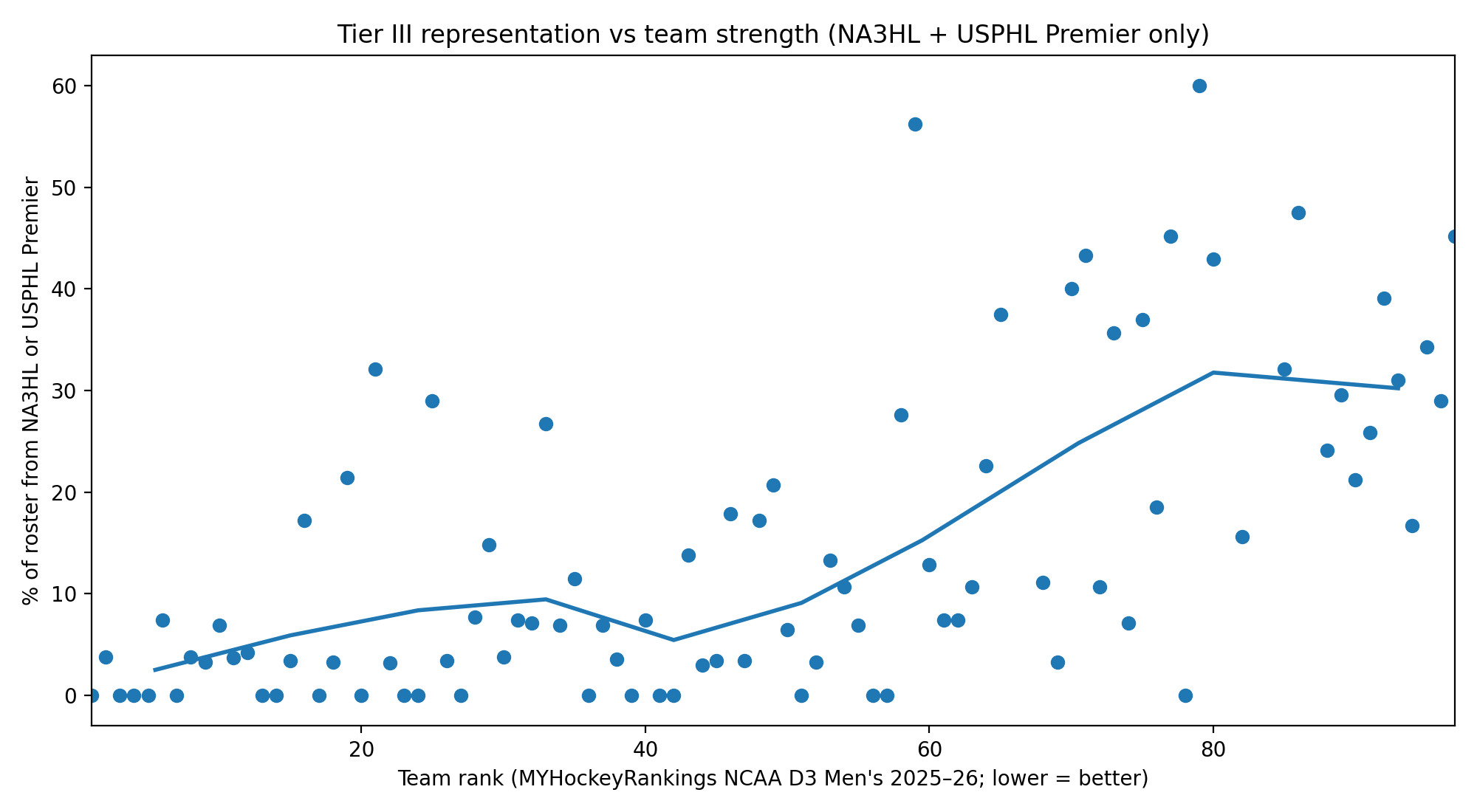
[Chart: Tier III % of roster vs MYHockeyRankings rank]
What this chart shows:
Top NCAA D3 programs: effectively zero Tier III (core) players
Middle tier: sporadic, inconsistent representation
Bottom tier: Tier III players dominate roster composition
When we isolate the extremes:
Core Tier III share of roster: ~0–1%
Most rosters contain zero NA3HL or USPHL Premier players
Core Tier III share of roster: ~60%+
Tier III players do reach NCAA Division III.
But overwhelmingly, they do so in the lower tier of the division.
That distinction is almost never made in placement graphics — and it is the most important one.
When a junior program advertises:
“20 NCAA Division III placements”
What that often means in practice:
Spread across many birth years
Spread across many seasons
Concentrated in the lower tier of NCAA D3
Translating to ~1 player per year or less
Aggregation hides both volume reality and quality of landing spot.
The pressure model forces us to ask better questions:
How many per year?
From which league?
To which tier of NCAA D3?
All of this is before accounting for:
CHL eligibility entering the NCAA ecosystem
Continued junior expansion at Tier II
Transfer behavior inside NCAA hockey
The number of NCAA D3 roster seats does not change.
Competition for those seats does.
Pressure flows downhill.
Tier III feels it first.
The takeaway should not be pessimistic.
For exceptional NA3HL and USPHL Premier players:
NCAA Division III is one possible outcome
It is no longer the default
And when it exists, it is far more likely to be:
lower-tier competitively
high-cost institutionally
not meaningfully superior in experience or value to ACHA options
This is why ACHA hockey must be discussed as a parallel pathway, not a consolation prize.
There are many programs under the ACHA banner that have similar (or better) resources as NCAA D3 teams. You ever see Liberty Unversity's locker room?
The market has already moved.
The messaging to players and families just hasn’t caught up yet.
The Tier III pressure model does not exist in isolation. It is the downstream result of forces already at work higher up the college hockey pyramid — particularly at NCAA Division I.
Several structural signals at the D1 level matter directly to the future of Tier III pathways:
Beginning in 2025–26, CHL players became eligible for NCAA Division I hockey. This represents a meaningful increase in the supply of older, experienced, professionally trained players competing for a fixed number of D1 roster spots.
While CHL players (for now, and probably not much longer) remain ineligible for NCAA Division III, the impact does not stop at Division I. When D1 recruiting pools deepen, marginal D1 recruits are displaced, not eliminated — and those players re-enter the ecosystem elsewhere.
NCAA Division I hockey now uses the transfer portal as a primary roster-management mechanism, not a secondary one. Coaches increasingly fill needs with older, proven players rather than projecting long-term development on younger recruits.
This shortens the runway for developmental players at the D1 level and reduces the number of "open" freshman slots in any given year.
Independent tracking of NCAA Division I rosters consistently shows average team ages approaching or exceeding 23 years old. Older rosters mean longer player tenure — and longer tenure means fewer annual intake opportunities.
This is the same math that governs Division III slot pressure.
When rosters age, the annual number of new seats shrinks, even if total roster size stays constant.
When Division I becomes harder to access:
Tier II players face stiffer competition for D1 slots
More Tier II players land in NCAA Division III
Competitive D3 programs fill from the top down
Remaining space for Tier III pathways compresses further
At this point, this is not theoretical. The Tier III pressure model is best understood as downstream math, not failure of any league or program.
The most important takeaway from this analysis is not that any single pathway is "good" or "bad." It is that college hockey outcomes are governed by fixed capacity and increasing competition — and that pressure always redistributes downward.
At every level, roster spots are finite. When more experienced players enter the system at the top, fewer opportunities exist below. That pressure does not disappear. It simply moves.
For Tier III players, especially those in the NA3HL and USPHL Premier, this means NCAA Division III can no longer be treated as a default outcome — even for exceptional resumes. When D3 opportunities exist, they are far more likely to come from the lower half of the division, and they increasingly compete on cost, experience, and value with well-funded ACHA programs.
In today’s landscape, labels alone are no longer sufficient proxies for outcomes. The difference between pathways is no longer binary — NCAA vs ACHA — but contextual: quality of program, competitive environment, financial value, and player experience.
The pressure model doesn’t argue against Tier III hockey. It argues for advising that reflects the actual math of the system players are entering.
Data Source:
Player-level NCAA D3 roster data (active 2025–26 season)
Tier Definitions:
Tier III (Core): NA3HL, USPHL Premier
EHL excluded from core Tier III conclusions
Normalization:
Active players divided by 4 to estimate annual slot availability
Team Strength:
MYHockeyRankings NCAA D3 Men’s rankings
Key Assumptions:
Average NCAA D3 career length ≈ 4 years
Roster sizes ≈ 25–27 players
Focus on structural trends, not individual outcomes
This model is intentionally conservative.
If anything, future eligibility changes are likely to make these conclusions more pronounced — not less.
 00:00:00
Subscribe: Apple Podcasts | Spotify | Linktree
Welcome to the Coaching Crossover Podcast! Join Matt Dumouchelle as he invites two coaches from different sports to discuss leadership, team culture, and what it takes to thrive under pressure, straight from the experiences of the people who live the grind and shape the standard every day.
In episode 1, we focus on soccer and lacrosse with Wake Forest University men’s soccer coach Bobby Muuss, and the general manager and co-head coach of the Saskatchewan Rush of the National Lacrosse League, Derek Keenan.
Bobby Muuss - Head Coach, Wake Forest Demon Deacons Men's Soccer Team
Coach Muuss has been with Wake Forest since 2015 and all he’s done since then is dominate. Coach Muuse has 152 wins and 111 home wins, both the highest total in NCAA D1 soccer. His club has made 14 straight trips to the NCAA Tournament, has won 3 ACC Championships and 2 College Cups. He started his coaching career as an assistant at Wake Forest from 2001-2006 before taking the head coaching job at the University of Denver until 2014. He then returned to Wake Forest where he has helped 31 of his athletes join the MLS.
Derek Keenan - GM & Co-Head Coach, Saskatchewan Rush
Coach Keenan is coming off his 16th year with the Saskatchewan Rush. He's won championships in 2016 and 2018 while coming up one game short this past season in the NLL Finals. Keenan is a lacrosse legend in Canada, being named to the Canadian Lacrosse Hall of Fame in 2012 and being named the General Manager of the Year and Coach of the Year three times each, both the most of any individual in NLL history.
We’ll discuss building a culture and challenging your leaders, how much personality matches with performance in recruiting and drafting, and the great destinations these two coaches go to so they can disconnect.
 00:00:00
Any defenceman wanting to improve their game should be watching Zach Werenski. Watch to find out why.
 00:00:00
In a sport obsessed with rush goals and transition speed, one of the most overlooked offensive skills remains the blue line hold. The offensive hold is more than just “keeping it in.” Done well, it extends pressure, forces defenders to overshift, and turns what should have been a clearance into time, space, and threat. At higher levels, those thin margins are what build a layered offense.
 00:00:00
I once coached a player with elite-level skill. His hands were excellent. His skating was smooth. He could execute every move you asked for in a drill.
And yet, there were moments where I honestly wanted to put an anchor on him.
Not because he was lazy, but because he never stopped moving. He looped endlessly. He circled away from pressure instead of into opportunity. You could tell he had spent countless hours working on skills, but very little time learning how to play the game.
He struggled with start-and-stop habits. He arrived late to space that mattered. He rarely recognized when a play was over and when the next one was beginning. The puck became something he carried, not something that connected him to what was happening around him. He always looked busy — just never effective.
This wasn’t a player problem. It was a development problem.
Small-area games have become the gold standard in modern coaching. They’re competitive, engaging, and often praised as the fastest way to improve hockey sense. And in the right environment, they can be powerful.
But here’s my honest opinion: small-area games don’t teach hockey sense on their own. They only work when players already understand the game they’re being asked to play inside of.
Decision-making requires information. Creativity requires boundaries. When players haven’t been taught spacing, pressure, timing, and purpose, small-area games don’t build awareness, they reinforce habits. Looping becomes a safety blanket. Constant motion replaces reading the play. Instead of stopping, scanning, and arriving on time, players default to what feels comfortable.
This is where I think we’ve flipped the order of development.
Before we ask players to play creatively, we have to teach them hockey. That means teaching why players start and stop, how pressure changes decisions, and where offense is actually created. Hockey sense isn’t instinctive — it’s learned through context, repetition, and clear teaching.
Once that foundation exists, small-area games become incredibly effective — but only when they’re built with intent.
Rules and restraints matter. If you want quicker decisions, remove time. If you want better spacing, restrict movement. If you want players to stop looping, design scoring conditions that reward arriving, not circling. Creativity should happen within structure, not instead of it.
True creativity in hockey isn’t doing whatever you want. It’s solving problems inside the game. The best players aren’t the ones with the most freedom — they’re the ones who understand the boundaries well enough to bend them.
I’m not anti–small-area games. I use them constantly. But they’re a tool, not a philosophy.
If we want players with real hockey sense, we have to stop hoping it magically appears through chaos. Teach the game first. Then create environments that allow players to explore, adapt, and create, with purpose.
Because structure doesn’t kill creativity.
It gives it meaning.
 00:00:00
WINGER DEPTH is always a great discussion, some coaches prefer bringing their wingers below the hashmarks to improve passing angles and create a layered exit while other prefer to move them higher in hopes of getting the puck above the opponents forwards & creating counter pinch scenarios with center support from underneath.
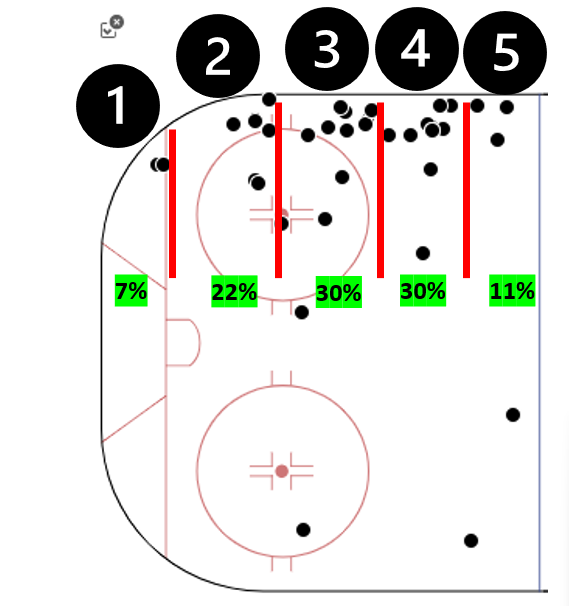
The image below shows an NCAA Div1 winger's puck touches during zone exit situations, the map shows he received pucks anywhere & everywhere between the goal line and the blueline.
Once again we have landed on "never say never, and never say always" however, if we simply count the number of touches below the hashmarks vs above the hashmarks we can see a trend emerging.
Below Hashmarks (outside the dot line): 8 touches - 30%
Above Hashmarks (outside the dot line): 19 touches - 70%
If we break it down further into 5x zones, the majority of touches happen in Zones 3 & 4 accounting for 60% of all touches.
There are a host of variables (some obvious some not so obvious) affecting winger depth, however it all circles back to the athletes having sufficient scanning habits that produce a level of awareness which leads to finding optimal pockets of time and space based on the current state of their environment!
End of content
No more pages to load
copyright (c) 2026 The Coaches Site