In recent years, I’ve found myself rethinking how much instruction actually helps players learn.
Like many coaches, I was drawn to research-informed approaches—particularly ecological dynamics—that challenged the idea that learning comes primarily from commands and explanations. Instead, they suggest something both simpler and more complex: behavior emerges from environments. Players adapt to the constraints in front of them, often without conscious instruction.
This shift has been important for me. But as these ideas filter into youth hockey, I’ve also noticed a quiet misunderstanding taking hold:
If learning emerges from environments, then the best coaches should remove themselves from the process.
In practice—especially with young players—I’ve found that this is rarely true.
The Myth of the “Hands-Off” Coach
Some modern coaching conversations describe the ideal coach as:
- Silent
- Neutral
- Non-directive
- Almost invisible once the drill begins
The intention is good: reduce over-coaching, allow exploration, let players self-organize.
But youth hockey is not a neutral space.
Young players do not arrive with shared understanding, stable confidence, or the ability to regulate emotion under pressure. When coaches step back without designing intentionally, confusion often fills the gap.
Over time, I’ve learned that the real issue isn’t whether coaches should talk less. It’s whether they recognize what their presence—or absence—is already shaping.
Environments Don’t Design Themselves
Ecological dynamics reminds us that learning is context-dependent and behavior adapts to constraints. I agree with this. What’s often left unsaid is something equally important: Coaches choose the constraints.
They choose:
- The drill
- The spacing
- The rules
- The scoring system
- The language used
- What gets praised
- What gets corrected immediately
- What is allowed to unfold
What I have to remind myself—often—is that even silence is a choice. The coach is never outside the system. We are always part of the environment.
Control vs. Influence
Traditional coaching often seeks control:
“Stand here.”
“Pass there.”
“Do it this way.”
“Don’t do that.”
In reaction, some modern approaches swing to the opposite extreme—stepping back completely and hoping learning simply emerges.
A more useful frame, I’ve found, is influence.
Influence asks:
- What behaviors does this environment invite?
- What decisions does it reward?
- What mistakes feel safe here?
- Where does attention naturally go?
Influence is quieter than control—but in my experience, far more powerful.
Concrete On-Ice Examples
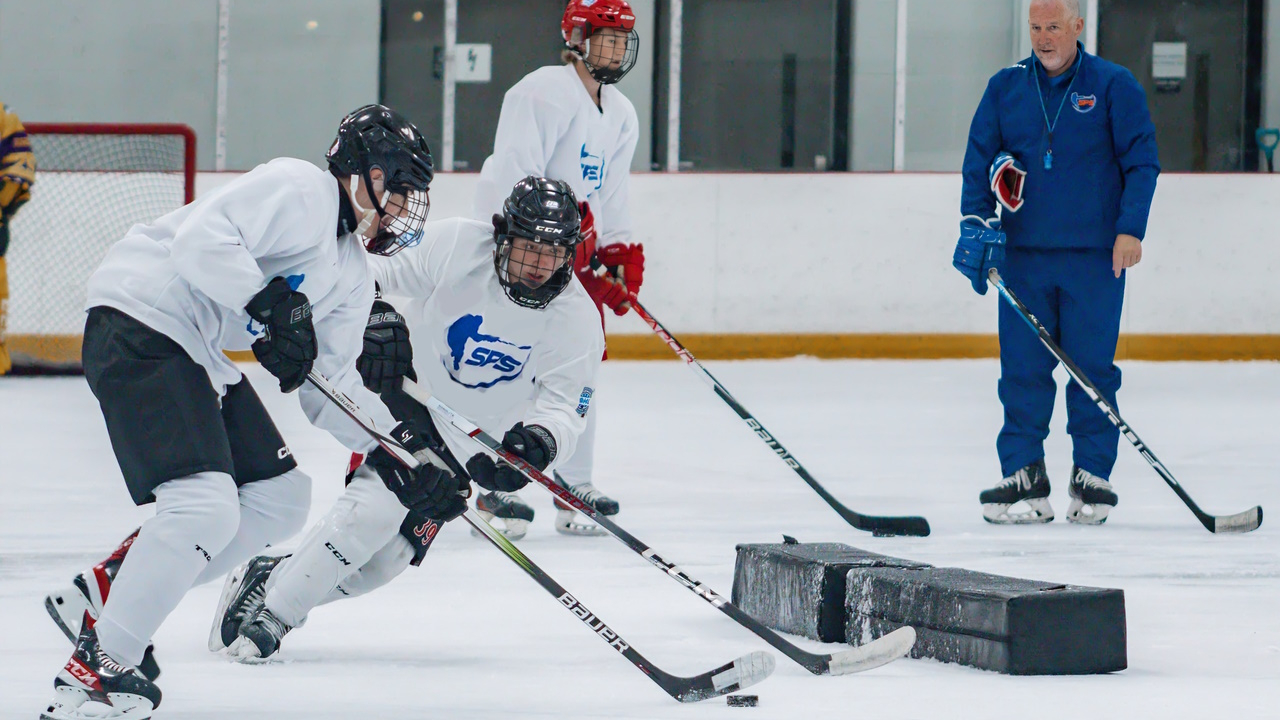
Example 1: A “Free Play” Drill That Isn’t Free
A coach sets up a small-area game and tells players to “just play.”
Within minutes:
- One or two players dominate
- Others drift to the perimeter
- Old habits take over
What’s missing isn’t effort—it’s guidance.
One small change: “A goal only counts if all three players touch the puck.”
Suddenly:
- Space is used differently
- Communication increases
- Less confident players are pulled into the play
The coach didn’t control behavior. They designed for it.
Example 2: Teaching Defense Without Lecturing
A coach wants defenders to close gaps earlier.
Instead of stopping play repeatedly:
- Shrink the playing area
- Limit time for attackers
- Reward turnovers, not hits
Players begin closing space naturally.
Afterward, a simple reflection: “What made defending easier in that game?”
Learning becomes shared—not delivered.
Example 3: Language as an Invisible Constraint
Two coaches run the same drill.
Coach A says:
“Don’t lose your check.”
Coach B says:
“Protect the middle first.”
The behaviors that emerge are different. Language shapes perception. Perception shapes action. The words we choose are part of the environment.
The Developmental Reality Youth Coaches Must Hold
Young players are still learning how to:
- Interpret feedback
- Regulate emotion
- Understand expectations
- Recover from mistakes
An environment with no guidance can feel unsafe. An environment with too much control can feel suffocating.
The coach’s role is not to disappear. It is to design clarity.
Designing for Learning, Not Compliance
Compliance looks like:
- Doing what the coach says
- Executing a pattern on command
- Avoiding mistakes
Learning looks like:
- Adjusting when things break down
- Trying again after failure
- Making decisions under pressure
- Self-correcting without being told
Well-designed environments reward learning behaviors. Poorly designed ones reward obedience.
Why This Matters Beyond Youth Hockey
Elite players are often praised for:
- Hockey sense
- Adaptability
- Creativity
- Decision-making
Those qualities don’t appear suddenly at higher levels. They are shaped—quietly and consistently—by early environments.
When players grow up in systems where:
- The coach solves every problem
- Mistakes are punished quickly
- Exploration feels risky
They may execute well—but struggle to adapt later.
High performance depends on early influence, not early control.
Closing
Modern coaching — like modern teaching — has rightly challenged the idea that learners need constant instruction. But the solution is not absence. It is intentional design.
When coaches stop trying to control every action and start shaping environments with clarity and purpose, players don’t need to be told what to do. They learn it.
Next week in Part 3, I’ll explore why teaching still matters in a constraints-led world—and how great coaches know when to step in and when to step back.