The product of Spruce Grove, Alberta, is an incredible coach and an even better person, one the hockey world is rallying around.
Donations are being made to Breast Cancer Canada and The Coaches Site is proud to have donated $500 in MacLeod’s name.
MacLeod, who was a PWHL Coach of the Year finalist for helping Ottawa to last year’s Walter Cup Final, is leaving the Charge for an undetermined amount of time as she continues her treatment for breast cancer.
The organization is fully behind MacLeod as she focuses on her healthy and recovery.
This small area game became a really valuable drill for our team because it forces players to solve game-like problems in a tight space. The setup is simple, but the habits it teaches are important. Two players compete against two defenders in a confined area around the net, with the coach putting a puck into play and the group immediately having to sort out possession, support, attack, and defending. Once a goal is scored or the puck leaves the area, a new puck is spotted in and the next rep begins.
What makes this drill special is how many key game details it brings out in a short amount of time. We used it to help our players make better passes in small areas, stay under control with the puck, and learn how to read a 2 on 2 situation instead of forcing plays that were not there. In games, we were struggling at times around the net front, both offensively and defensively, so this drill gave us a way to directly challenge that part of our team game. Players had to get to the inside, fight for body position, find sticks, protect space, and make quick decisions under pressure.
Offensively, the drill teaches players to support the puck in tight space and complete short, accurate passes under pressure. Because there is not much room, players cannot rely on hope plays or soft decisions. They have to move to open ice, present a stick, protect pucks, and recognize when to pass, when to attack the net, and when to take space away from defenders. It also encourages quick puck movement around the slot area, which is where many scoring chances are created in real games.
Defensively, it puts players in situations where they must read a 2 on 2 properly. Instead of chasing, they have to sort out who has the puck, who has net-front responsibility, and how to take away sticks and second chances. That was a big reason we liked this drill. It exposed players who could think and compete around the net, not just players who looked good in open ice. It made them defend with purpose in a hard area of the rink.
Another reason this drill worked well for us is that it can easily be adjusted. We can run it as a 2 on 2 to work on puck support and defensive reads, but we can also simplify it to a 1 on 1 version to really isolate compete level, body positioning, puck protection, and willingness to get to the hard areas. That flexibility makes it a drill you can come back to throughout the season depending on what your team needs most.
One of the ways I have been preparing to use this drill even more is during tryouts. A variation I plan to run is setting it up out of all four corners with four nets, creating multiple stations at once. That format gives a really good look at players in a true tryout situation because it highlights close-area compete, awareness, passing ability, offensive instincts, and how players handle pressure in a confined space. In a tryout, that matters. It is one thing for a player to look good skating in lines or in open ice, but this type of game quickly shows who can process, compete, and execute when space and time are taken away.
Key teaching points:
Win body position early and get to the inside.
Make short, firm passes in tight space.
Support the puck quickly after possession is won.
Read the 2 on 2 instead of forcing low-percentage plays.
Attack the net with purpose and be ready for rebounds.
Defend sticks and net-front space with urgency.
Compete through contact and stay engaged after the first play.
At the end of the day, this drill is special because it teaches more than just skill. It teaches players how to think, compete, and execute in the areas of the rink where games are often won and lost. For our group, it helped address close-area passing, 2 on 2 defensive reads, and net-front habits, while also giving us a great tool we can use in both practices and tryout evaluations.
These phrases are so common in hockey that they feel almost unquestionable—passed down from coaches, analysts, pundits, and so‑called authority figures as though they represent truth.
They don’t.
In fact, they reflect a deeply outdated and scientifically ill‑informed model of how performance actually happens in sport.
Thinking Is Slow — and That’s the Problem
As human beings, we cannot simply think faster. We are constrained by our biology: what we perceive, how we perceive it, and—most importantly—how the brain processes information.
Conscious thinking is slow. Very slow.
In today’s game, where space closes in fractions of a second and tactical demands evolve shift‑by‑shift, the expectation that players can consciously “read, think, decide, and act” in real time is unrealistic. Processing information, evaluating options, and choosing a response cannot keep pace with the modern speed of hockey.
Fatigue, stress, and pressure only worsen this. They narrow attention, distort perception, and degrade decision quality—topics that deserve their own discussion around fatigue management, recovery, and regeneration.
But even in ideal conditions, thinking your way through the game is not the solution.
The Myth of “Read and React”
I encourage you to abandon the “read and react” paradigm.
Asking players to figure it out or be better problem solvers in live play assumes they can:
Gather information in real time.
Interpret it accurately
Generate a solution
Execute it —all in a fraction of a second.
That simply doesn’t happen.
This type of problem-solving is possible in video analysis, where the game is slowed, paused, rewound, and discussed retrospectively. Video is valuable as a teaching and reflection tool. But live hockey is not a slow‑motion film.
When we coach this way, we unintentionally promote slow, inaccurate, and random outcomes.
Players coached to “figure it out” often look overwhelmed and reactive. On the ice, they appear hesitant, late, and disconnected—surviving rather than influencing play. Creativity disappears, spontaneity fades, and instinct is replaced with caution.
Eventually, players self‑limit because they feel they “can’t keep up.”
Performance Runs on Memory, Not Thought
If we truly want players to play fast, we must lean into what modern memory science and sports performance research actually show us.
Thinking is slow. Memory is fast.
Short‑term memory (STM) and long‑term memory (LTM) operate at speeds that do match the demands of elite sport:
Short‑term memory: ~150–250 milliseconds
Long‑term memory retrieval: ~200–800 milliseconds
That is fast enough for today’s game.
More importantly, memory does not require problem-solving at game speed. When a response is stored and accessible through memory, it does not need to be figured out—it simply is.
This is why elite players appear to “see the game differently.” They are not thinking more. They are recognizing patterns they have already encoded.
Ice Hockey Example: The Seam Pass
Consider a high‑level center receiving the puck off the half wall under pressure.
A developing player is consciously scanning, thinking, and weighing options.
An elite player has seen this picture thousands of times.
The pressure angle, the defender’s stick position, the weak‑side D pinching—these cues instantly activate stored responses. The seam pass isn’t chosen; it’s released.
That’s memory at work.
Memory Enables Creativity—Not Rigidity
A common misconception is that memory‑based coaching reduces creativity.
The opposite is true.
STM and LTM allow for scaffolding. New experiences are layered onto existing ones, creating variation, innovation, and invention. Creativity emerges not from chaos, but from a deep library of structured experiences that can be flexibly recombined.
Great hockey players don’t improvise from nothing—they improvise from something.
Why Memory Beats Trial and Error
Memory is:
Correctable
Verifiable
Reliable
Trial‑and‑error “read/react” learning is none of these.
Well‑encoded memory requires no formulation time, minimal effort, and little conscious cognition. There is no searching, referencing, or approximating. Retrieval is automatic.
This is why experienced defensemen step into lanes before the pass is released. They are not guessing—they are recalling.
Coaching Short‑Term Memory
STM is best supported by small chunks of information, typically 4–7 units.
For example:
Stick positioning
Body angle
Pressure direction
First touch option
When successful outcomes are reinforced, STM becomes stable and accessible. When information is overloaded, conflicting, or poorly anchored, STM is overwritten.
The coach’s role is to:
Manage information density
Cue and remind rather than explain
Highlight relevance at the moment it matters.
Coaching Long‑Term Memory in Hockey
LTM has enormous storage capacity and is rich in contextual cues.
Well‑rehearsed and practiced responses can be retrieved in 200–300 milliseconds—fast enough for forechecks, breakout reads, and defensive rotations under pressure.
Procedural knowledge—how to do something, not what to think about—is the foundation here. Repetition, routine, and consistent feedback consolidate memory.
In hockey terms:
Consistent forecheck structures
Repeated neutral‑zone attack patterns
Familiar defensive switches
When these are encoded properly, players respond confidently, accurately, and fast—without conscious effort.
The Takeaway
If we want players to play faster, we must stop asking them to think faster.
Speed in hockey is not cognitive—it is mnemonic.
The future of coaching lies not in shouting instructions louder or demanding better problem solving, but in designing environments that build memory.
Because in the game’s most critical moments, the best players aren’t thinking.
In Episode 9 of Coaching Crossover, we head to Southern California for an all-UCLA episode featuring women’s softball head coach Kelly Inouye-Perez and football offensive coordinator Dean Kennedy.
Kelly Inouye-Perez – Head Coach, UCLA Softball
Kelly Inouye-Perez is a legend and ambassador for the game of women’s softball. She is the only person to win an NCAA Softball Championship as both a player and a coach. As a catcher at UCLA, she won three national championships. Since 2007, Inouye-Perez has guided the Bruins to five appearances in the Women’s College World Series, including two championships in 2010 and 2019. UCLA has reached the Division I Softball Tournament every year during her tenure. This season, she became the all-time winningest coach in the history of the program. Beyond wins and titles, Inouye-Perez is widely admired for her commitment to mentorship, academic success, and empowering student-athletes both on and off the field.
Dean Kennedy – Offensive Coordinator, UCLA Football
Dean Kennedy is in his first season with the UCLA football program. He joined alongside head coach Bob Chesney and was hired as offensive coordinator and quarterbacks coach this past offseason. Kennedy and Chesney have worked together at several stops, including James Madison, where Kennedy has served as offensive coordinator since 2023. Last season, his offense led the Dukes to their first appearance in the College Football Playoff and a perfect 8–0 conference record, just the 10th such season in Sun Belt history. His coaching approach emphasizes fundamentals, preparation, and accountability, helping student-athletes maximize their performance on the field while maintaining strong standards off it.
Listen as we discuss the remarkable history of sport at UCLA, why effective communication is key to coaching and player development, and how to build trust between coaches and players alike.
The off-season is where programs gain separation - but only if it’s approached with intention. In this webinar, three-time ECAC Hockey Coach of the Year Mark Bolding shares how his philosophy around off-season development has evolved, from managing workouts to building connection, accountability, and culture from a distance.
In this session he'll cover:
Structuring communication during the off-season
Supporting strength and conditioning across varying environments
How he integrates new players into the group.
Coaches will come away with practical ideas and a clear framework for bringing more structure, visibility, and strategy to their off-season.
MEET THE HOST
Mark Bolding, named Yale’s Susan Cavanagh Head Coach for Women’s Ice Hockey in 2019, has transformed the program into a national contender, highlighted by a Frozen Four appearance and AHCA National Coach of the Year honors in 2021-22—the first Yale women’s team to reach an NCAA semifinal. Across six seasons, he has led the Bulldogs to multiple ECAC regular season titles, three NCAA Tournament appearances, and numerous program records in wins, scoring, and defensive performance, including historic campaigns in 2021-22, 2022-23, and 2025-26. He earned his 100th career Yale victory in 2025 and has been a multi-time ECAC Coach of the Year. Prior to Yale, Bolding built a Division III powerhouse at Norwich University, compiling a 266-68-22 record, winning two national championships, and earning four AHCA National Coach of the Year awards while developing dozens of all-conference and All-American players.
Teaching does not mean learning. Coaches need to check for understanding.
Like any job, there are skills of the trade. Too many coaches confuse knowledge with skill. Today, we want to look hard into one of the underdeveloped skills of coaching: checking for understanding.
As we all know, teaching does not mean learning. We must find ways to understand where the player is currently at so we can best push them to another level of performance.
Failing to appropriately check for the learner’s level of understanding is simply one of the worst mistakes that communicators/coaches make. And it starts with either a lack of questioning or using some variety of the two worst questions in hockey.
Let’s start by looking at a great and poor example of checking for understanding, brought to us by the Vancouver Canucks pre-season for the 2022-23 campaign:
OPTION #2
Player 1 - “Do you know what that means?” Player 2 - “yeah” Player 1 - “What does it mean?” Player 2 explains correctly pic.twitter.com/NbEW68B5Z1
This blanket statement’s aim is to poll the room for misunderstanding or unclarity. It sometimes gains a token question of two, but really leaves a lot to be desired and rarely has its intended effect. Rather too often the room is silent because no one wants to hold up the meeting with their question.
Poor Question #2
“Does that make sense?”
To ask this, your explanation has to be truly terrible. Plus, you have to be teaching a very curious and courageous person for them to step up and ask for clarification. It’s easier to simple respond “Yes Coach” when asked if something makes sense, then to actually understand it, especially at younger levels.
The Issues
Both questions are broad and do no engage the audience to appropriately poll where the learner is at.
Better Options
I’ll leave room for you to come up with much better ways and questions. Here are some examples if you’re finding it hard to get going:
What did you see?
Can you explain back what I just said?
What parts are confusing?
What are we about to do?
When should you do this?
Checking For Understanding
There are a million great questions that dive deeper and better engage the learner/listener. But why wait to be the teacher? Be an engaged student. Learners can do a better job of checking for understanding: “Am I understanding this correctly…(then say back what your understanding is from what the speaker/teacher just said)?”
Communication is the most important skill for any person or coach. In our endeavour to be excellent, laziness of the 2 worst questions in hockey won’t do.
There's something exceptional happening with Frölunda. And not just on the first team, it flows throughout every player, coach and parent involved in the club.
How did a team with three Le Mat trophies (the reward for winning the SHL Championship) as of 2005, change its mindset and return gracefully back to the top?
Frölunda is hockey lore.
Västra Frölunda introduced hockey into its program in 1944. The club went back and forth from the Gothenburg League and Division 3, 2 and 1 for most of the 50s.
They won Division 1 multiple times throughout the 60s, their last being in 1965, before some lean years in the 70s and becoming the independent Västra Frölunda Hockey Club in 1984.
In 2003, after 38 years, Frölunda was crowned Swedish Champions again. Two years later, champions once more – for a third time in team history.
After that, the team struggled.
From 2009-2013, the team finished as high as fifth once and did not make the second round of the playoffs, including missing the SHL playoffs entirely in 2010-11.
In 2013-14, the program went in a different direction – a franchise altering direction.
They looked to their academy to set the tone; they started from the ground up to pave their road to future success.
It was the academy where they would find their future stars, their philosophies and The Frölunda Way.
To do that, they needed a new regime. To begin that build from within, they found a missing piece from the outside.
That piece was Roger Rönnberg.
===================
Roger Rönnberg wins.
He coached Sweden’s National Team to a World Championship bronze medal in 2008-09 and 2009-10, followed up by a silver medal in 2010-11, before capturing World Junior gold in 2011-2012 and silver the following year.
After coaching Luleå in the SHL League, Rönnberg took on the national team challenge and helped grow the Swedish program into one that can almost always be counted on to be there when the dust settles in any world championship.
A self-proclaimed nerd in every way, Rönnberg thinks differently than a lot of coaches in the national spotlight.
“I think the X’s and O’s are one part and that’s important for all coaches, but I’m more into the leadership and psychology of the game,” Rönnberg admits. “How can I be a better leader to lead different people, because that’s the challenge. If I can have the skills in my leadership to be a leader for as many different people as possible.”
He goes as far as calling the hiring of a psychology coach for Frölunda “the best thing I’ve ever done.”
“It’s so important when you work on developing humans that you don’t look for certain type of people to bring into the program. We think we can help every person to grow their character and we have our role models in the men’s team who have tremendous character to help them.”
Rönnberg came to Frölunda with a plan.
Instead of paying out for costly, high risk free agents, Rönnberg wanted to develop their own players, in Gothenburg, and teach them the Frölunda Way.
“It was my biggest mission, that’s why I signed up to go to Frölunda,” Rönnberg details. “It was an unusual approach when you are recruiting, it wasn’t just about winning, but building a winning culture in the whole club and setting a new vision and values for the whole organization.”
“Developing humans is the most important aspect. It’s more important than winning.”
That mindset was taken in by the first team and set as the standard for Frölunda’s growth.
“This is how we do things on the first team, this is how our program is going to success from our youngest teams.”
Rönnberg is not just a preacher of development, of the human side first. He is one of its most active participants.
He “nerds” out to podcasts, books, anything he can get his hands on to improve his leadership skills and his people skills.
For him, that’s the greatest advantage.
And to get there, the first stop is looking inside yourself.
“You have to learn your own habits,” Rönnberg shares. “What kind of bias do I have and why do I have them? What are my core beliefs? Those two things are how I see the world and then finding a way to get better at knowing what the reality really is, I can be a better leader and face different people in different situations.”
“It’s from the beginning,” he emphasizes. “You’ve got to know yourself. Things like, how you react under stress or in different situations. That’s where you find where you need to be better and improve your leadership skills.”
Rönnberg set out to change Frölunda forever, despite the program having such a rich history. His goal is individual development, working hard, practicing hard and growing together, with winning a part of that growth.
The team that was assembled with him had the same frame of mind.
===========================
Mikael Strom is at the forefront of development.
Since 2012-13, Strom has been the general manager of Frölunda’s U16, U18 and U20 programs. He is also the club’s Director of Player Development.
Strom and his respective coaching staffs begin working within the academy with a goal that one day these players will impact the first team, and beyond.
“When they are younger it’s important that they can skate, it’s important for us to have the puck and it’s important to take the puck to the goal as quick as possible,” Strom says of the program’s game plan. “We start in a really easy way with the young kids, but in the end it should be along the same line as we play in our first team.”
“We have to take small steps, but we have a system how we want to play. It’s not always that we play in that system every night, but when they grow up there are more and more details we add to the mix.”
Strom admits throughout practices and making sure the players handle the puck as much as they can growing up, there is a big emphasis on small area games.
But their teaching is not just on results.
“We coach to educate the players, not to win the games,” Strom confirms. “If you skate hard it’s good and if you take the puck to the net it’s good, but if you win or lose, it’s not the most important thing right now. In the future, if you practice well, we will win those games, but at the beginning most important is to practice well.
“When Roger came to us, the standard in each practice got higher from there,” Strom recalls. “It’s only one way to get better is to practice hard. He is mostly focused on the first team and myself and my coaches are in charge of the younger kids, but we believe in working hard every day, making other players better, knowing every individual player is unique and get them to understand we need each other.”
The next key component came through the ranks of Frölunda as a player and, after his playing career, from their front office.
Fredrik Sjöström played in the Frölunda system up until the 2001 season, when he came to North America to play two years with the Calgary Hitmen of the Western Hockey League.
Before that first season, Sjöström was selected 11th overall by the Phoenix Coyotes in the 2011 NHL Draft.
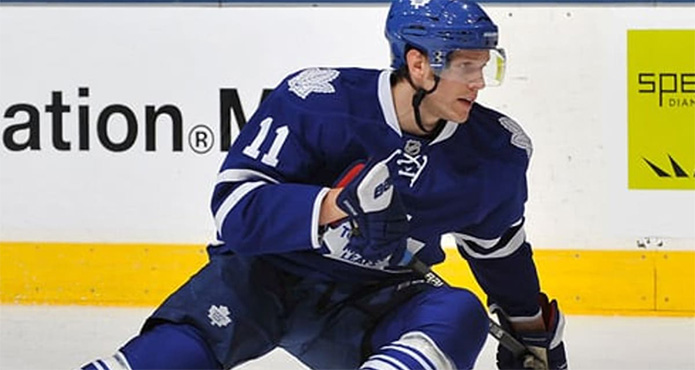
From there, the speedy, hard working forward suited up in 489 NHL games for Phoenix, the New York Rangers, Calgary Flames and Toronto Maple Leafs.
He finished his playing career back with Frölunda in 2012-13, before taking a scouting role with the club after that year.
“When I retired, probably like a lot of players, you’re not sure what you want to do because you have such a strong identity as a player,” Sjöström admits. “I got an opportunity to work for the team as a salesman, selling sponsorship and doing a little TV and scouting, a good mix of things with the club. After a year or so working for the team I realized I liked the sports side of the club and work a little more in that.”
Sjöström became the clubs assistant general manager and director of scouting in 2014-15 and continued his accent mid-season 2015-16 when he was chosen as the club’s GM.
“In a way I fell into this, I’ve always loved the game of hockey, but I wasn’t sure if I was going to be any good at this,” Sjöström laughs. “I was willing to work hard and willing to learn and very curious and the club taught me so much. I was given a lot of leeway to try things and taught to look at things in a different way, so it’s just been a great experience for me.”
With Rönnberg, Strom and Sjöström at the helm, and the board of directors on board, the club began its revitalization.
=========================
When academy players begin to see their potential, that’s when eyes from above start taking notice.
Frölunda’s association features 17 youth clubs in Gothenburg (the second largest city in Sweden) and produces an outstanding level of talent.
From there, one of the greatest missions of the club is to keep their program local.
“The most important thing is to recruit players from the Gothenburg area,” Strom admits. “It’s a goal from our club that 90% of the players from the academy program is from Gothenburg area and then 50% of our pro team coming from the academy program.”
“We are a small country, but Gothenburg is a good area, and we have a great connection with the young clubs, so Gothenburg and Stockholm make up a lot of the players in our country. It’s a big part of what we are trying to do.”
With kids starting with Frölunda between five and six-years-old, Strom estimates the players and families they bring through their system will count 6,000 days from the beginning to the end of their youth program.
“Our coaches are really important for us in that way,” Strom admits. “The youth coaches are welcoming the kids and parents to sport, showing them how to play the right way and helping them as best we can when they grow as players and people.”
“We want to develop everybody in our system, we want every single player that we have to succeed and that looks different for everyone,” Sjöström explains. “If we can educate them that some guys will play second division, some will play in the SHL and if we do a good job and get lucky, some guys can even make it to the NHL. But that’s kind of our motto, we want to develop everybody.”
“We have so many good people in this organization, coaches and management for youth and the junior program,” Rönnberg says. “My role is to work with the men’s team and what we do there can spread into the organization. We have a lot of meetings with everyone about who we are, how we play, how we train and how we want to develop.”
For Sjöström, it’s about getting the best out of every player that walks through their door.
“Whether it’s a skilled forward or a defensive defenseman, we want to see them succeed as a player and a person. Some people will not get to live on hockey, but they’ll get a great education, and they will use that to get a good job somewhere else and they’ve learned a lot from our education, so it’s different levels of succeeding.”
There is a mutual respect amongst the three, something they all account for being extremely important when growing a program of this magnitude.
“Mikael is such a good manager for the youth and junior programs,” Rönnberg shares. “He’s an expert on what he’s doing. We share thoughts and values and we learn from each other and then we will meet with the coaches every week, so it’s a constant learning process together.”
“I think Roger is an extremely driven coach,” compliments Sjöström. “He really wants to work with these young players and help the understand what it takes. He loves working with these young players and challenging them every day. I think we know pretty well what it takes physically to get to the SHL or NHL and then, of course, on the ice what it takes to become a pro. Roger is absolutely instrumental in these kids’ development.”
“Roger is a really good coach and Fredrik has been here so long too, that we work so well together,” Strom adds. “Roger will send information to me and I’ll send it to the youth coaches and explain, this is how we want to play. This is the right way for us and then we work with the first team to make sure we are all doing that.”
That respect continues up to the board, which Rönnberg says has always had a clear mission.
“The club was looking to develop their organization and that is why I signed up. The management has not only been backing up what we should be doing, they are setting the tone and vision of what we want to be and it’s always from the top. My job is to see how we are working on a daily basis within the organization.”
=======================
As a youngster, Jacob Larsson was one of those players.
“I’m from a small town, they have a hockey team there, but they were not as competitive as Frölunda was, so it was a great chance to go there,” Larsson recalls. “It’s always been a dream to play for a team like Frölunda, it was a pretty easy decision.”
Larsson, a native of nearby Ljungby, Sweden, came over to Frölunda in 2013-14, playing parts of four seasons with the club, while being drafted in the 1st round, 27th overall, by the Anaheim Ducks in 2015.
The 6-foot-2 defenseman, who now has over 120 NHL games under his belt, says Frölunda changed the way he played the game.
“Everything in my game got better,” Larsson admits. “When I got called up with the big team, they taught me a lot about playing with and without the puck and the structure. They showed me a lot of stuff from moving the puck, defending and all of that.”
“They are just really good developing guys,” Larsson continues. “When I was a junior player, they had everything I needed. The facility and gym are unreal, you can go on the ice whenever you want. The compete level and practice levels are so high; you learn a lot from that. No one there likes to lose.”
For Elmer Söderblom, things started to change once he joined the academy portion of the program.
“When I first came to Frölunda it was like any other team in Gothenburg, but when we turned 15-16, that’s when Frölunda starts to show they are better than other teams,” Söderblom recalls. “You get into the real program, you get to develop more, practice more, get into the gym and you’ve got great coaches with a lot of tips and tricks to find ways to get better every day.”
Söderblom’s brother Arvid is a graduate of the Frölunda program. He signed a contract with the Chicago Blackhawks in 2021 and made his NHL debut on New Year’s Day 2022.
Elmer saw what his brother went through with the club, practicing in the morning, going to school during the day and then back on the ice in the afternoon.
He was all in.
“The competitive level from a young age is at such a high level,” Söderblom says. “The off-ice and gym part is a big thing. You have to be really fit and strong and well trained in the gym to be able to play in Frölunda, so I think that’s a big part as well.”
And, as Söderblom mentions a few times in our conversation, it starts with the head coach.
“Roger is just a great coach,” Söderblom exclaims. “He’s won a lot of titles and he’s big here in Gothenburg. He has high demands, and he expects a lot of you, but he has helped me a lot to become a better player and even more a better person.”
The younger Söderblom’s hockey journey is still somewhat in its infancy.
Elmer was drafted in the 6th round, 159th overall, by the Detroit Red Wings in 2019. The hulking 6-foot-8 forward played with Frölunda’s first team this year, but has his eyes on where his hockey path could take him.
“For me, it was real fun to even get drafted, get over to the development camp and show what I’ve got,” Söderblom recalls. “I was proud to go to Detroit, an original six team. It’s a great organization with a lot of Swedes there, so it was a really cool team to get to be part of.”
A lot of Swedes may be an understatement.
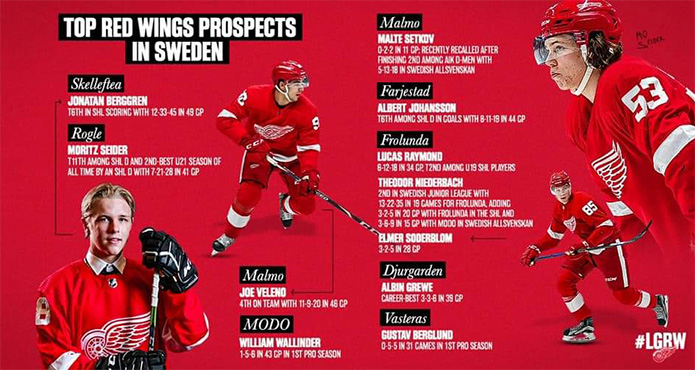
The Red Wings, maybe most famously known for “The Russian Five,” have found a home in Sweden in recent years, particularly Frölunda.
In 2019, Detroit selected two Frölunda players: Söderblom and Gustav Berglund.
The next year, they doubled down on the Swedish hockey factory and selected two more: Lucas Raymond with the fourth overall pick, and Theodor Niederbach in the 2nd round.
To complete the hat trick, the Red Wings grabbed Simon Edvinsson sixth overall in the 2021 NHL draft and Liam Dower-Nilsson in the 5th round.
“We have had a great relationship with them for a number of years and there’s a few reasons for that,” explains Fredrik Sjöström, Frölunda’s general manager. “Håkan Andersson has been a great scout for a long time here for Detroit and five-six years ago he was a member of our board, so I’ve gotten to know him over the years. As well, Detroit has hired Niklas Kronwall on the player development side and I’ve played against him and played with him. He’s a really good person and he’s great for these players.
“I think it’s been a good club to work with and I think they run a good club, so they are easy to work with.”
Having players selected so consistently is a big thing any program would brag about.
Another is when you have the top pick of them all.
==============================
Trollhättan, Sweden, is 90 minutes north of Gothenburg.
The small town of 59,000 holds a dam, canal locks and a hydropower station for the Göta älv river, which rolls down to Gothenburg 75 kms away.
That is where Rasmus Dahlin was born.
But Gothenburg, is where he grew up.
The impressive defenseman came to Frölunda in the 2015-16 season to join their U16 program after playing Division 1 and 2 hockey with HC Lidköping.
He climbed the ladder quickly that first year, recording games with the U16, U18 and U20 programs in Frölunda.
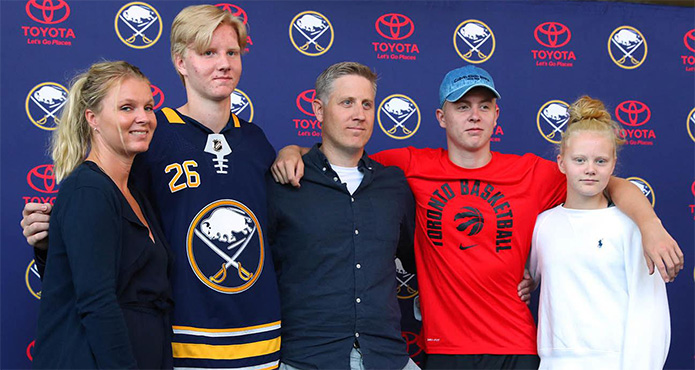
After two more seasons with the club, and several international appearances, Dahlin was selected first overall in the 2018 NHL Draft by the Buffalo Sabres.
“It was fantastic, of course,” says Rasmus’ father, Martin “It was a little unreal because everything went very quick. He moved away from home when he was young to play at Frölunda and that was his dream. His development really took off when he came to the academy.”
The senior Dahlin, who has been coaching with the U18 and U20 programs over the past three seasons, knew Frölunda was going to get the best out of his extremely talented son.
“The biggest thing was that he was a skilled, young player and coming to Frölunda, they let him play his style of hockey,” Dahlin explains. “He didn’t have to change much, he could play his way and be as good a player as he could be. He was always pushed to play his own game and play with confidence and that made him develop all the other parts of his game too.”
Now getting to work inside the Frölunda factory, Dahlin sees this with a number of players that come through.
“It’s different from player to player and they pick up different things, but in Frölunda it’s always hard work,” Dahlin stresses. “You really learn to prepare, to practice hard, to always compete every day. The environment here forces you to always push yourself to do your best every day – on the ice, in the gym. We are trying to create an environment to make these players the best they can be.”
Dahlin has coached national teams in Sweden and Division 2 and 3 teams throughout his coaching career, but he sees something obvious that separates Frölunda from the rest.
“What stands out in Frölunda is how the players develop their character as an athlete,” Dahlin says. “As a coach here it’s so much fun because everyone is pushing in the same direction. Everyone wants the players and coaches to grow. We have a clear idea of how we want to work and everybody here wants to work hard and develop every day and that creates the environment that is very good for the players.”
Strom recalls great memories of the Dahlins and Raymonds of the world, sharing they all have certain characteristics that made it clear they could be stars.
“The most important thing for us coaches was to let him play and let him have fun and then we will see where he goes,” Strom says. “We can’t say he’s going to the NHL, because from our organization, maybe putting them up a level is better, maybe them being the best at a lower level is a bigger help for his confidence. But, of course, it’s really good for us and we are really happy for them and their success.”
===================
In the early 1990s, Frölunda was the first team in Sweden to practice hard in their youth programs.
There was an understanding of how important that would be for the future of the club.
Bringing in the culture was the next obvious component.
That culture, otherwise known as Roger’s vision when he first arrived, is now Frölunda’s.
And not just the first team, it flows throughout every player, coach and parent involved in the club.
“I feel the last 8-9 years, we do it together in the club,” Strom says. “We feel like we are doing it the right way and we talk a lot to each other and we believe in our way to educate our players and our way to play.”
At the beginning, the results were not there on the scoreboard, but inside those walls it was clear something was changing.
“We know we aren’t going to win each game. We know if we win or lose a few games in a row, we are still going about things the same way,” Strom continues. “If we are worried about losing one game it’s easy for us to change what we do, but we still work the same way together and that’s a really important thing for us.”
“It’s a pretty simple plan,” Sjöström regales.
“I have a goal from the board of 50% of the men’s team we want to be from our own academy. I think it’s important for me, it’s something I strive for every year. It just makes sense. We put a lot of money and resources and energy into our academy, so it wouldn’t make sense to not use it.”
==================================
Frölunda has returned to glory.
They captured Le Mat Trophies in 2016 and 2019.
They are also the most successful franchise in the Champions Hockey League, with four tournament titles since 2015, matched up against the top teams from Europe’s first tier.
But for the coaches, there is still plenty of work to be done.
“Right now in Sweden, we have to be humble and say a lot of organizations work in a similar way like us. We are not unique any more,” Rönnberg reminds. “There are a lot of good organizations out there. It’s harder and harder to be on top. We are chasing the details every day to be better than other clubs.”
“We’ve built up a good reputation over the years and we want to keep that reputation and that’s not easy,” Sjöström agrees. “A lot of other clubs are doing a great job, so we have stiff competition but we look at ourselves every year, every season to see if we are doing the best job possible. We make sure we have the best development plan for our teams, we look at our competitors to see what they are doing. It’s just a mindset to not be comfortable, always striving to be better and do a better job.”
“It’s never a given, we have stiff competition and a lot of teams are doing good,” Sjöström continues. “I think the day you think you know it all and stop being curious is when you get passed by other clubs. It’s important that we always strive to get better every year. Being humble and working methodically and having people that want to get better is the most important thing.”
And above all, keeping the ties bound between Gothenburg and Frölunda.
“I think our history has been good to us, but we have to look to the future now,” Strom cautions. “A lot of players and a lot of fans know we have a great system and they call us and see if they can start here, but the most important thing is in the local area, it’s important we get them to Frölunda.”
=============================
Now nine years in under Rönnberg, Sjöström and Strom, Frölunda has focused on dialogue, philosophy and development throughout the club.
Every message is the same, and every action, whether it in the youth program or on the first team, has a standard.
Everything they are doing is for the club.
“You need to strive for perfection in every area,” Rönnberg explains. “We refuse to be second in anything. That’s the push we need and that’s not all in results, that’s what we do on a daily basis.”
“If I hear another club is working a certain way and it’s working for them, then I push our guys to be better than that club. We have a mantra ‘We should be best in everything that is free’ and that’s a lot of the soft values and how we are working to get the right environment where people find growth.
“It’s a constant process and competition amongst those other organizations.”
Your breakouts and zone entries will be useless without this fundamental skill.
The fundamental skill of passing the puck effectively, with purpose, and also with pace, is a lost art in hockey.
Being in my third season of my post-playing career, I have seen it way too often, from numerous vantage points. As a scout, an advisor, a coach, a skills coach, you name it.
It starts in minor hockey.
But before we get in to that, why is it that so many coaches want to dissect their systems before looking at the essential skills amongst those systems? Why is it that skills coaches in today’s game want players to be able to flip pucks over obstacles, while those same players some of the time, can not consistently catch a pass on their backhands?
No system or set play in the world will ever work without players being able to give or receive a pass effortlessly and with control.
X’s and O’s will only take you so far
Being the owner/founder of the hockey development company CrossIce Developments, we get approached by minor hockey teams as far down as Atom. When we initially consult with the coach, it’s like clock work.
“We can’t break the puck out” is the phrase I hear over and over. Another frequent issue is zone entries.
I proceed to ask the coach if they have honestly worked on developing their passing skills, and broke it down by positions (splitting up the forwards and defence) to work on situational passing. Generally, the answer is ‘no.’
X’s and O’s only go so far if the fundamental skill of passing is limited.
Even at the Junior A level where I presently coach, I see players from teams all over struggle with passing the puck. I am a firm believer in the fact that the habit of gathering information before a player receives the puck, or arrives at the puck, will make the pass much easier. It can be argued that being good at passing is a mental skill, or a choice. While valid, it is also a technical skill that must be developed.
The good news is with passing drills there are so many other aspects that can be taught to players. Proper passing angles, coming underneath pucks, timing, and spacing are just a few of them. We all talk about that illusive hockey sense skill that I believe can be taught.
A good start is working on passing.
Passing is not only the most important skill in hockey other than skating, it is a great teacher of decision making, execution, communication, and so much more. Players need to recognize what way the passing receiver shoots, times the pass, executes proper puck skills to make sure the pass arrives with purpose, etc. I guarantee you that if your team could pass more efficiently and with more confidence, your breakout would improve immediately.
Start with the basics
Before you get into systems or positioning, start with the basics. Teach your players to not pass the puck by reaching out in front of them. Load that puck and pass it crisp. When they receive a pass, the big cushioning of a pass that is often taught, is actually partially false believe it or not. Instead, allow the puck to travel to you. The puck will arrive where you want it to a lot faster than it will with your stick pulling it back. Mirror the puck with your blade, yes, but allow the puck to travel to the spot you want it, before you catch it.
How fast players can handle a puck and get it to their forehands so they can make a good pass, is crucial. Work on getting a pass on their backhands, moving it to their forehands, and passing. Getting passes in their skates. Picking up pucks off the boards and getting it to their forehands. If a player has to stickhandle it eight times before passing, options are closed and time and space is fading rapidly.
As we all know, passes in a game are by no means all perfect. Work on players adapting, and eliminating or minimizing these hurdles that will work against the team’s passing. How often are these areas worked on? Ask yourself that honestly.
Part of the battle of effective passing after learning the fundamentals, is decision making. Are players analyzing options before they get the puck, so their passes can be quicker? Are players getting to pucks fast, so they have more time when they get the puck? Are players away from the puck putting in the work to make sure they are in a good spot, and good position to receive the puck? If options are too late, the puck is not moving north, meaning we are not getting to the offensive zone. Transition speed is 90% on the players away from the puck!
Make passing a priority
I challenge coaches to make passing a priority in practices. Break it down. Develop it. Challenge players to pass pucks under stress, or after receiving the puck in a poor spot. Challenge players to work away from the puck, present targets, and communicate.
When we focus more on developing these skills and improving players’ passing, we are checking a crucial box off for our players to be able to make the jump up to the next level, which should be every coach’s goal as far as I am concerned.
If players can’t execute fundamentals at a high pace, that jump will be difficult. If players can’t execute the fundamental skill of passing, coaches, your breakouts and zone entries will always struggle — no matter how cute the play you have drawn up is, or how many times you practice it.