
1vs1 Power Drive works on open ice angling and checking. This drill places a large emphasis on body positioning, foot work and defensive play.
 0:00:23
Colorado 2vs1 & 3vs2
This drill focuses on zone entries and is a great way to incorporate full ice offensive and defensive situations.
 00:00:00
Explained: Umbrella Power Play Formation
What is the The Umbrella power play in hockey?
The Umbrella power play in hockey is generally a starting point for other power play formations, and starts with three players high in the offensive zone in an umbrella shape with two players in the middle of the ice near the net.

What are the benefits of using the umbrella power play in hockey?
The Umbrella power play is beneficial because it gives players on the power play a lot of time and space to make plays with the puck. This formation is especially effective when the high players on either end of the blue line are on their strong-side hand, which allows them to easily receive passes from the middle player on their forehand in motion. This means a right-handed player plays on the right side of the blue line and a left-handed player plays on the left side. power play players who combine more than one above average or elite skill are more difficult for penalty killers to defend, so the Umbrella power play is especially effective when these players are available to take the puck from high in the zone to low in the zone.
What are the disadvantages of using the umbrella power play in hockey?
The disadvantages of the Umbrella being used as a permanent formation is that it’s predictable and far away from the net. Penalty killers, including the goalie, are most comfortable when the puck is as far away from the net as possible. The Umbrella starts with the puck at the blue line, or at the top, and then moves to either side. Shots through traffic and screens in front of the net are dangerous, but if the penalty killers can move the two low power play players out of the way and the goalie can see the shot, then the Umbrella loses effectiveness.
What are the forward responsibilities for the umbrella power play in hockey?
The Umbrella power play typically utilizes four forwards and one defenseman. Two forwards are responsible for playing on either end of the blue line, ideally on their strong hand side because it’s easier to receive passes on the forehand moreso than the backhand, while the other two play in the middle of the ice, in front of the net and between the faceoff circles. The high forwards are responsible for making and taking passes while skating “downhill” towards the net and shooting the puck, while the low forwards are responsible for creating screens, occupying the penalty killers in order to make room for the high forwards, and retrieving the puck in the corner after shots and scoring attempts.
What are the defenseman responsibilities for the umbrella power play in hockey?
The lone defenseman on an Umbrella power play is responsible for distributing the puck to the two high forwards as well as getting shots through traffic. Important qualities for this defenseman are patience, composure, and excellent passing and shooting skills.
Which coaches use the umbrella power play in hockey well?
Coaches who use the Umbrella power play effectively will have players available that possess the necessary skills to run this particular formation.
What skills or strengths does a team or player need to run the umbrella power play in hockey?
To run an effective Umbrella power play, a team needs at least one player, typically a defenseman, to play in the middle of the blue, who passes and shoots the puck well, and possess composure and creativity. The team also needs two players, typically forwards, to play at either end of the blue line, who possess speed with and without the puck, creativity, and an accurate shot. The last ingredient is two players, usually forwards as well, to play lower in the zone in front of the net to tip pucks screen the goalie along the ‘handle’ of the umbrella.
Which teams are the best examples that use the umbrella power play in hockey?
Edmonton Oilers: watch for Connor McDavid skating downhill and setting up 50 goal man Leon Draisaitl on the other side
Toronto Maple Leafs: Mitch Marner or Auston Matthews like to skate downhill
Dallas Stars: Miro Heiskanen patrols the blue line looking for Jason Robertson skating downhill and Joe Pavelski tipping shots in front of the net
What other types of power play formations are there in hockey?
 00:00:00
Explained: 1-3-1 Power Play Formation
What is a 1-3-1 power play in hockey?
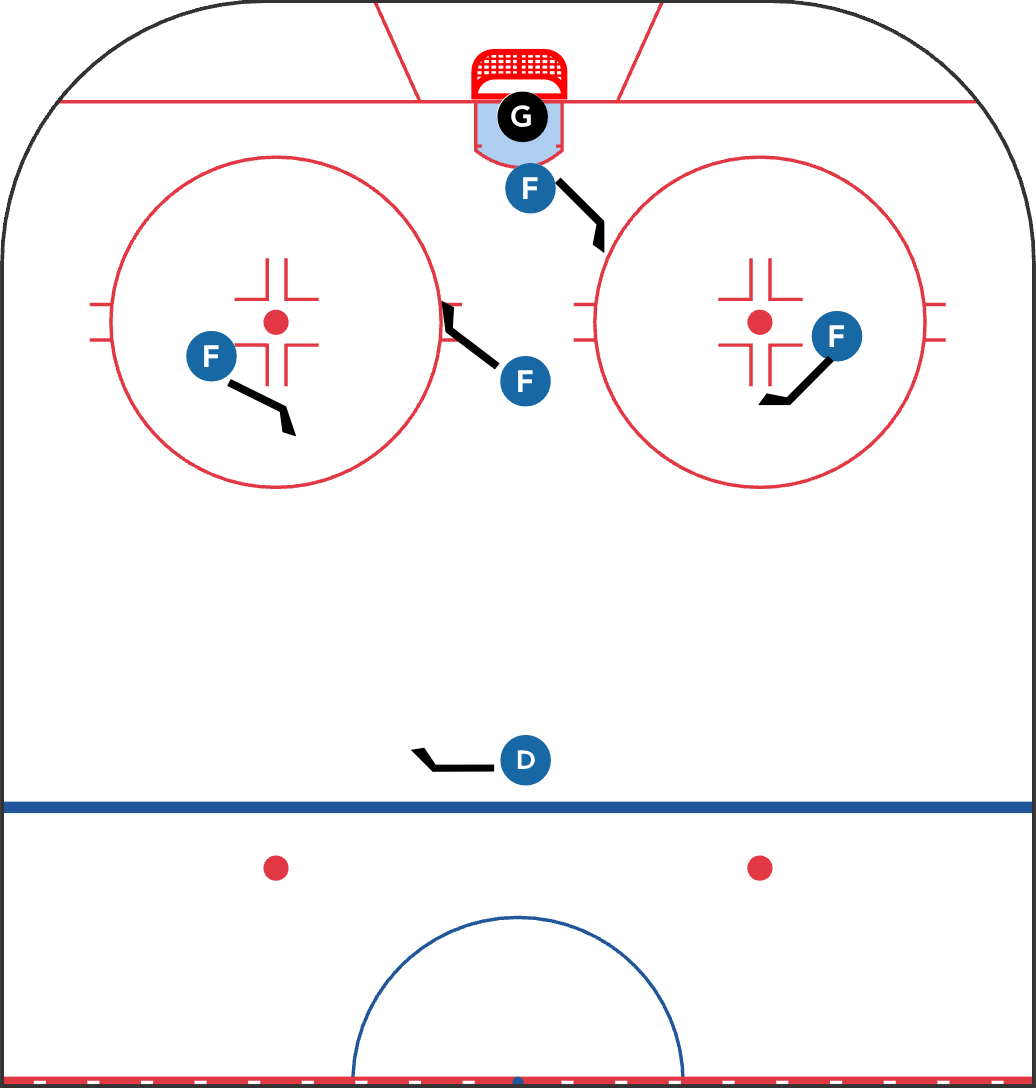
A 1-3-1 power play hockey is a unique formation that uses one player, usually a defenseman, at the top of the offensive zone inside the blue line, with one player in front of the net, usually a forward, and three players stationed in a straight line through the middle of the zone (also typically forwards) along the imaginary line extending between each faceoff dot. A 1-3-1 power play formation is generally considered one of the higher risk / higher reward scenarios. It requires a lot of skill and preparation, whereas other formations are considered quantity over quality.
What are the benefits of using a 1-3-1 power play in hockey?
A 1-3-1 power play formation is beneficial because it puts skilled players in optimal spots on the ice to score a goal. Players near each faceoff dot are often lined up on their off-hand sides, which means a left-handed player lines up on the right and a right-handed player lines up on the left. This puts each player in prime position to unleash a one-timer slapshot, which is nearly impossible for a goalie to stop provided the puck is placed in the right spot on net. The two players on each faceoff dot plus the defenseman at the blue line represent three unique threats to score a goal, and the players in the middle are ideally placed to screen the goalie or score a goal off a rebound.
What are the disadvantages of using a 1-3-1 power play in hockey?
The downside of using the 1-3-1 power play is that it requires elite skill-sets in the scoring areas to be effective. The best way to beat a penalty kill and its goalie often involve the toughest plays to make from a skill standpoint. Passing a puck from one side of the zone to the next, often along the imaginary line connecting the faceoff dots, with enough force that the penalty killers can’t intercept it is a challenging skill, and it’s even more challenging to receive that type of pass and take a one-time slapshot. It would be easy if there were no penalty killers to play against!
What are the forward responsibilities for a 1-3-1 power play in hockey?
The forwards on a 1-3-1 power play typically line up in one of the four low positions: near either faceoff dot, in front of the net, and in the middle of the ice in the slot area. The two forwards on each dot are considered shooters, their job is to pass the puck back and forth with each other or the defenseman and shoot the puck, ideally a one-timer, when they have a clear opportunity to do so. The net front forward is responsible for screening the goalie, scoring off rebounds, and retrieving the puck in the corner after a save or a shot misses the net. The second middle forward is called the bumper. Their responsibility is screening the goalie and providing another option for a pass and shot. Often the bumper is used as a decoy, but since it’s impossible for four penalty killers to completely cover five power play players, the bumper can get lost in coverage and find themselves open for a dangerous scoring chance.
What are the defenseman responsibilities for a 1-3-1 power play in hockey?
The defenseman’s responsibility in the 1-3-1 power play is primarily to patrol the point, or the middle of the blue line, and distribute the puck to the two flanking forwards on each side, in addition to shooting through traffic.
Which coaches use a 1-3-1 power play in hockey well?
Coaches who use a 1-3-1 power play devote plenty of time in practice to working on this particular formation. Since the 1-3-1 is a predominantly static formation, it’s important for players to have a good idea of what their teammates are going to do during a game when communication is difficult. Coaches who have forwards with heavy, accurate one-timers will often utilize the 1-3-1 power play.
What skills or strengths does a team or player need to run a 1-3-1 power play in hockey?
A team needs forwards with excellent shooting abilities, preferably the ability to take one-time slapshots that give the goalie no chance of stopping the puck. A team needs players who have the courage to stand in front of the net and in the middle of the ice. Finally, a coach needs to trust a defenseman to run the top of the power play and distribute the puck efficiently and know when to pass and when to shoot.
Which teams are the best examples that use a 1-3-1 power play in hockey?
Tampa Bay Lightning: Steven Stamkos and Nikita Kucherov are both one-timer threats on the faceoff dots
Buffalo Sabres: if Tage Thompson or Jeff Skinner don’t have room for a one-timer, Rasmus Dahlin can also score from the point
Winnipeg Jets: Kyle Connor and Mark Scheiffele are the one-timer weapons with the smooth Josh Morissey moving the puck from the blue line
What other types of power play formations are there in hockey?
 00:00:00
Explained: Overload Power Play Formation
What is an Overload power play in Hockey?
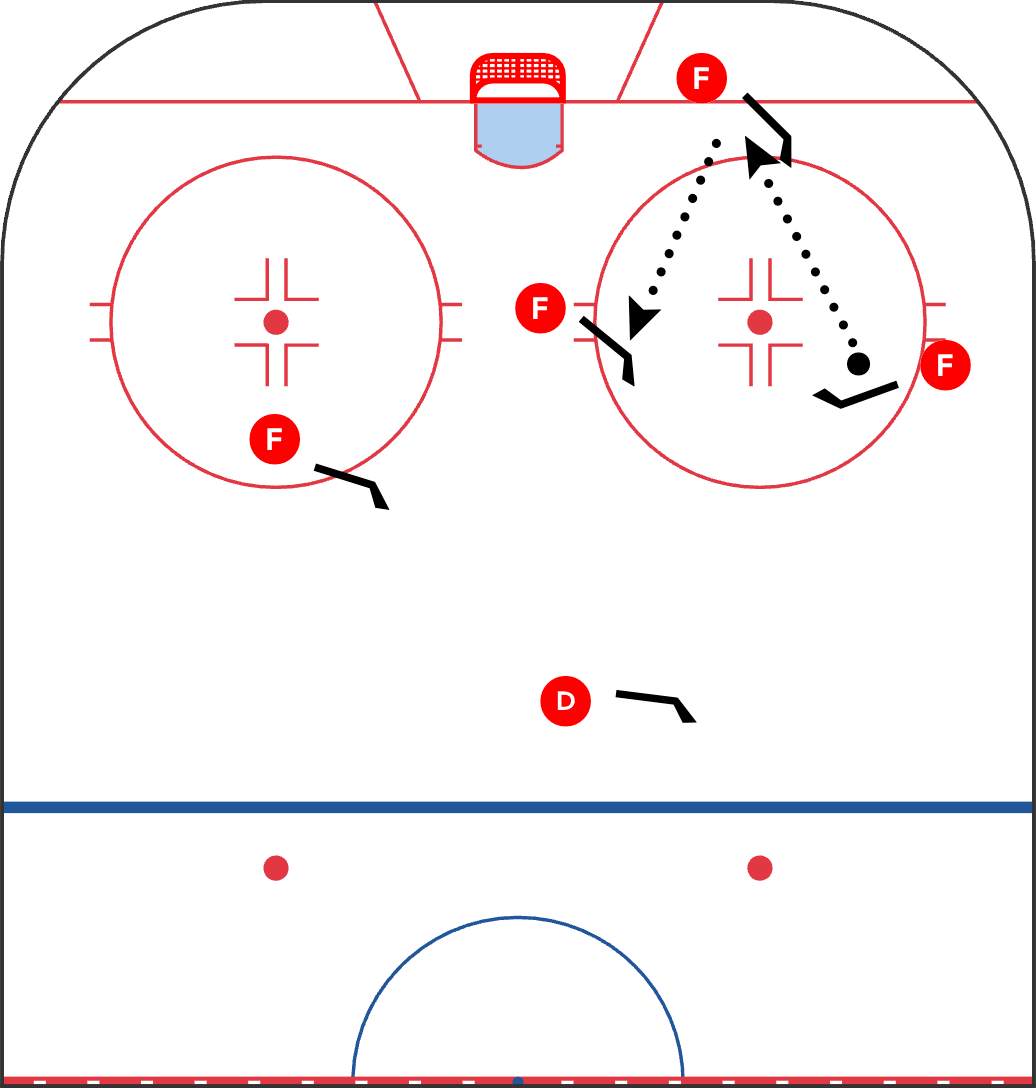
An Overload power play in hockey aims to overload one side of the ice to create a numerical advantage in a small area. Most Overload power plays will borrow from one other formation or another, but the main focus is keeping players on one side of the ice close to provide guaranteed passing options.
What are the benefits of using an Overload power play in hockey?
This formation presents a lot of options to create scoring chances. An overload power play has the effect of freezing the penalty killers because the puck carrier always has a short pass to a teammate. The primary puck handler operates on what’s called the half-wall, the area from the faceoff dot to the boards on either side of the ice. Usually that player is on their off-hand side (a left-handed player on the right side or vice versa) and can efficiently pass to the low forward, the bumper, or back to the defenseman who can shoot or pass to the player on the other side of the zone.
What are the disadvantages of using an Overload power play in hockey?
The drawback of the overload power play is that one player will be too low in the zone to generate their own dangerous scoring chance. While some players can surprise penalty killers and goalies by shooting from a tough angle below the goal line, this is a low percentage play. Penalty killers facing an overload power play are content to defend in front of the net as long as all the power play players are confined to a small space.
What are the forward responsibilities for an Overload power play in hockey?
The primary forward responsibility is controlling the half-wall. That forward starts each play and leads the way for the power play group. One low forward will present a kick-out option near the net and is responsible for making quick passes and retrieving wayward shot attempts or blocked shots. Another forward assumes the bumper role in the middle of the ice to screen the goalie and tip shots from the point, also known as the middle of the blue line, while the last forward tries to get lost in coverage on the opposite or far side of the ice.
What are the defenseman responsibilities for an Overload power play in hockey?
The defenseman positioned on the point on an overload power play is responsible for transporting the puck across the blue and resetting the power play after each missed chance, which is done by passing the puck back to the half-wall player. The defenseman also shoots from the point and sets up the weak-side forward for a one-timer.
Which coaches use an Overload power play in hockey well?
Coaches who use the Overload power play to its maximum advantage have usually had the same collection of players for a relatively long period of time. The Overload requires a firm understanding of each player’s strengths and weaknesses. Once that comfort and trust is developed, a coach can build deception and creativity within the structure of the Overload power play.
What skills or strengths does a team or player need to run an Overload power play in hockey?
The primary need of an Overload power play is creative players who are deceptive passers. If the Overload scheme becomes too obvious to the penalty killers, it will be easy to break up plays by intercepting passes.
Which teams are the best examples that use an Overload power play in hockey?
Washington Capitals: Alex Ovechkin is a long-time staple taking one-timers on the left faceoff dot while longtime running mate Niklas Backstrom mans the half-wall
Vancouver Canucks: Left-handed Elias Petterson has a rocket for a one-timer from the right faceoff dot while JT Miller plays the half-wall on the strong side of the ice (the overload side)
Montreal Canadiens: Nick Suzuki works the half-wall on the right (overload) side while the skilled Cole Caufield uses deception and a powerful shot from the left faceoff dot
What other types of power play formations are there in hockey?


 0:00:23
Get Lost
Player 1 navigates around the 4 pylons, using their edges and deception to "lose" players 2. Player 2 follows player 1, staying on their tail and applying pressure.
NOTES:
- Coach controls drill with "Go" "Stop" queues
- An extra pylon can be added in the middle (think 5 side of a dice) to increase deception
- Puck can be added for more advanced practice
 0:01:30
OZ bringing 4 players up above Hashmarks
Offensive Zone
- Low to high
- 4 players come up
- D to D wide pass on the blue line
- F3 comes up in the middle between both D-man
- F2 Off Wing position - behind coverage
- Net presence keeping both Dman occupied