Every hockey player in the game wants to score more goals, and to score more goals they need to shoot the puck. This is an oversimplification - Zach Hyman scores a lot of rebounds and deflection goals, but those still technically count as shots, so bear with me.
When I'm coaching in a game my style is to narrate the action for the players on the bench. Then I can basically repeat myself when players finish their shift and change. I'm never telling players to shoot the puck more if we found ourselves defending in D-Zone coverage the entire shift. Or let's say we successfully broke the puck out and chipped it into the zone, but the forecheck broke down and they came back the other way.
It drives me nuts when players on the bench say we need to get more shots. For sure we do!
But there are so many other actions that need to click into place before we're in a position to score. Jack Han has made a career out of finding these types of counter-intuitive lessons in the game. Of course we want more shots, but chances are you've got a lot of shooting built into your practices already. A shot on net usually starts 200 feet away from the opponent's net.
We need to shoot more! We need to break out more
We need to shoot more! We need to clean up our neutral zone regroups
We need to shoot more! Our forecheck has been useless tonight
I like to think of shooting as a result of good work elsewhere on the ice. Kind of like the game as a whole, right? Everything else is the process, and a shot or scoring chance is a reward for a healthy process. If your team is consistently being out-shot, it's not because they lack the same skill to shoot the puck as the opponent. In other terms, it's not the quality, it's the quantity you should concern yourself with more. Ryan Reaves' wrist shot might be just as hard as Auston Matthews if you measure it in practice, but Matthews has the ability to give himself more chances to shoot during a game.
Now if you're getting 40 shots a night and none of them are going in?
That's a good problem to have. Ask the right questions about how you can boost your shot totals and a whole new world of possibilities will open up.
If you want to score more goals (or any goals) as a team or a player, the most important area of the ice on which you should focus isn't the highway between the dots in the offensive zone. It isn't the crease in front of the goalie or even the offensive blue line.
It's 200 feet away from the opponent's net. If you're a defenceman and you want more points then puck retrievals in the D-zone should be your number one focus. And as you've been told several times, points aen't evertything, and even though you roll your eyes when coaches tell you that, it's true. So focus on breakout habits and two things will happen: you'll end up with a couple more points eventually and scouts will notice how determiend you are to play a safe and responsible two way game in your end. Perfect, right?
One defenceman skill to watch in the clips: shoulder checks
Every single defenceman in these clips checks once, twice, and thrice to take a snapshot of what's going on behind them so they can move the puck.
Maybe you're a forward, specifically a centre. Whichever forward makes it back to the D-zone first needs to be that next connection with the D. It takes two people to make a good pass, and good passing is contagious. The D ight start the breakout, but if it breaks down on your stick then the attack will stall and everyone will suddenly be stuck in the D-zone. The coach will probably be perturbed as well, which is a word you just learned and want to avoid forever.
One F1 (or centre) skill to watch in the clips: picking up passes
These are the best centres on earth, but if you want to be one of the best centres in your league then you'll pay attention to how they can pick up passes even if the puck is rolling or behind them or just a straight-up grenade.
How about the wingers? Often forgotten in the grand scheme of the breakout, but if it weren't for the wingers then the puck would never get out. The wingers have to make the next play to finish the breakout. A tape to tape pass would be great, but sometimes you'll have to resort to chipping the puck off the wall. But it's out, and the coach is happy and sudden;ly trusts you more, so you'll be back on the ice in no time.
One winger skill to watch in the clips: making the next play
The play is never the same. There are cutbacks, chips, wingers taking it low and passing - this is where your skill needs to take over.
“Everybody loves playing here, that’s the saddest part of it. Hockey works here in the desert. It works in Arizona.”
Tyson Nash, an NHL veteran of 374 games including 69 in Arizona in the 2003-2004 season, sounds defeated as he mutters those words over the Arizona Coyotes broadcast on Bally’s Sports Arizona.
With that you hear the PA announcer inside Mullet Arena let the crowd know there is one minute left to play – not just in the current game they are attending on April 17th, 2024, but in the history of their beloved franchise.
Fans and broadcasters alike wipe tears from their eyes as the final horn goes.
Although the Arizona Coyotes beat the Edmonton Oilers 5-2 that night, no one really won.
As the team packed up to relocate there was excitement about what Salt Lake City would hold for them. Season tickets were sold in record time and ownership appears stable and willing to make this a profitable and viable NHL organization.
The people of Arizona, however, were left with questions to which no one has the answer.
The heartbreak of losing a professional sports team and the memories that went along with it is real and it's deep.
This is not a story about a debunked NHL team in an unconventional market that countless people from outside can tell you won’t work.
This is about a 10-year-old lacing up their skates at the Ice Den in Scottsdale to take the ice with dreams about becoming an NHL player like Auston Matthews, Matthew Knies, Mark Kastelic, Josh Doan and many others. Players from their hometown and made it to “The Show”.
This is about growing the game around the world – conventional or unconventional.
This is about a club that, while their NHL idols moved over 670 miles away, still thrives and is producing the next generation of great players.
In 1996 the NHL’s Winnipeg Jets shipped out and moved from one of the coldest cities in the league to one of the warmest.
The Phoenix Coyotes lost their first game in franchise history 1-0 in Hartford against the Whalers before winning their second contest in Boston 5-2.
With a line-up of players like Keith Tkachuk, Shane Doan, and Nikolai Khabibulin, the Coyotes made the postseason their first year in the desert, losing in seven games to the Mighty Ducks of Anaheim in Round 1.
Along with the team’s creation came a number of establishments, including the Ice Den, which will play a prominent role in this story.
There may be no one more enamoured with the team than Brian Slugocki.
“I was born and raised here, born in 1991. The NHL team came in 1996, I was at the Ice Den the day it opened in 1997 and was one of the first kids ever on the ice,” Slugocki recalls. “I played all my house and travel hockey at the Ice Den. I actually got dressed in a trailer in the desert because the dressing rooms weren’t ready yet.”
Slugocki went to school at the University of Arizona as well, so he spent 13 years in the area as a player and then coached within the Jr. Coyotes program for nearly a decade.
If you’ve spent any time on The Coaches Site, you’ve seen Slugocki's outstanding skills work, drills, or presentations, like at TCS Live in 2024.
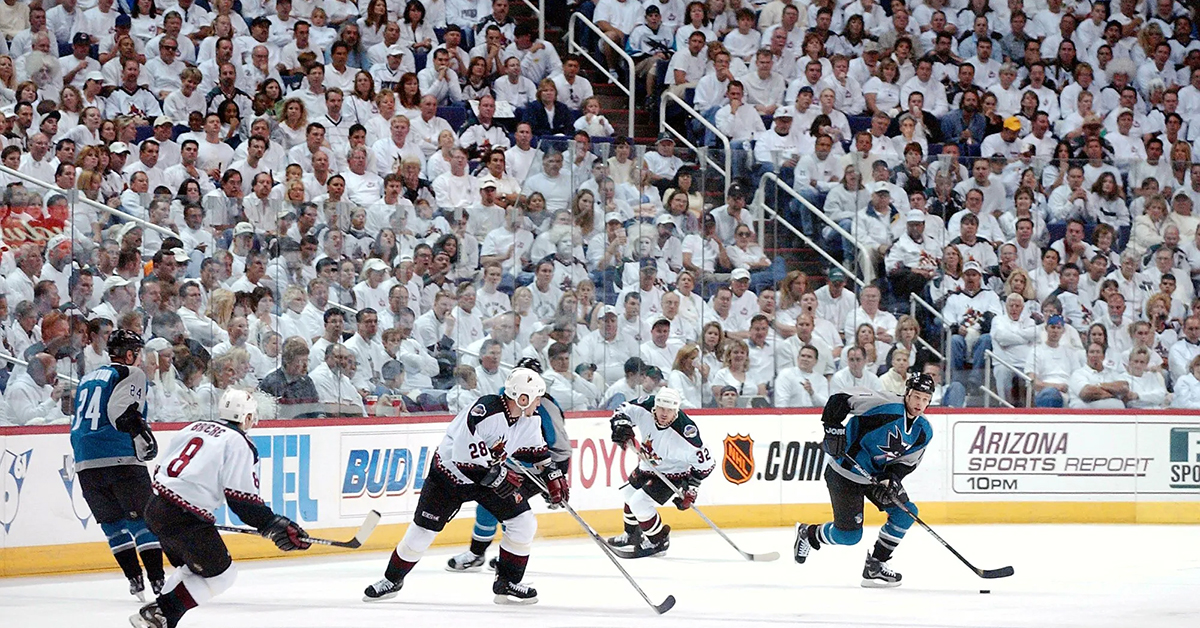
“I remember when the Coyotes were first coming into the valley and doing the White Outs and that’s when so many of my friends and myself got into it,” Slugocki says. “It was a crazy environment during the playoffs.”
As the team’s popularity began to grow merchandise started to sell and interest in hockey overall began taking root.
“For a while there weren’t a lot of high-end teams. It was a lot of AA teams but it was the Coyotes practice facility, which we are still at – Ice Den Scottsdale,” Mike DeAngelis explains. “At the time they were building their youth program to match the NHL franchise. So I took the job as Hockey Director with the Jr. Coyotes and coming up in January 2025 I’ll be on 20 years employed with the club.”
If Slugocki was born with Arizona hockey in his blood, DeAngelis has injected that same spirit into hundreds of kids during his time with the club.
He played college hockey and was an NCAA All-American, played for the Italian National Team three times in the Olympics, and was a part-time scout for the NHL’s Arizona Coyotes for four years.
At the beginning of the Jr. Coyotes journey there was one major problem DeAngelis had to solve.
“It was said to me "how do we get these kids to stay here and play in our rink so we can become the best youth program in the market?" We had the logo and the facility, but the top players were going to different rinks in Phoenix. I was asked to build a program that offered AAA teams so we could go to the top of the pile for local kids who wanted to stay in our program an pursue their dreams.”
In some ways the history of AAA hockey within the Arizona Jr. Coyotes program sounds like the start of the joke.
What do you get when you cross ice hockey in Arizona and Asian cuisine?
“There was a Tier 1 AAA team in town that offered a couple midget teams, and it was called PF Chang’s Hockey – as in, the restaurant PF Chang’s,” DeAngelis explains. “I am good friends with the man who was running it and we ended up transporting the team inside the Jr Coyotes program. We kept it as the PF Chang’s name, but it was the cherry on top for the Jr Coyotes program, so you went up through the Jr Coyotes and if you were really good you made it up to the PF Chang’s club. It was a different jersey and all that.”
One of the players on those PF Chang’s teams was Brian Slugocki.
“I remember vividly when I was on the U16 team with PF Changs, which was great because somehow we got free food when we were on the road,” Slugocki laughs.
PF Chang’s was run by an ex-teammate of DeAngelis, Jim Johnson, with whom he initially spoke about joining the program. When Johnson decided to move on and pursue his coaching career, he left the PF Chang’s teams behind and they were all joined under the Jr. Coyotes name in 2010.
A veteran of over 800 NHL games, Johnson made several NHL stops along his coaching journey: Tampa Bay, Washington, San Jose, Edmonton, and St. Louis. He currently serves as the Director of Player Development for the Anaheim Ducks.
================================
The moniker was there with the NHL affiliation for the Jr. Coyotes to control the market for youth hockey in the state of Arizona.
The next – and ongoing to this day – challenge was to get kids to want to go into an ice facility when it’s still 20 degrees Celsius/68 degrees Fahrenheit outside in January.
For some, like Slugocki, hockey was something they were around all the time.
“My whole family is from Chicago. I have two older brothers so I was always playing catch up and I was always playing multiple sports but baseball is too slow for me and I’m not a marathon runner, so the fast, quick, explosive nature of hockey always fit with me,” Slugocki reflects. “My dad never pushed me but he was not upset that his son wanted to play hockey and we got to share that together.”
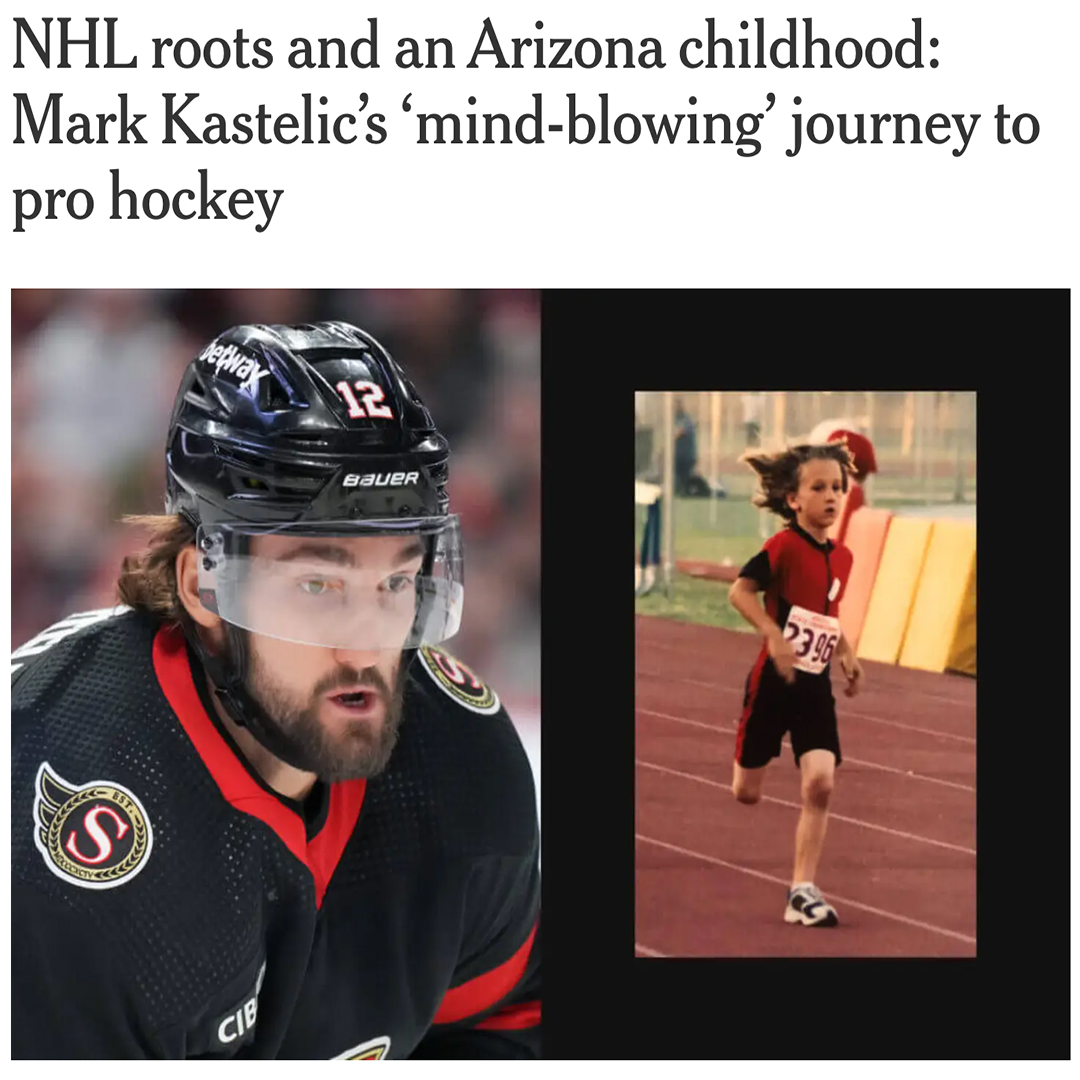
Mark Kastelic had a similar upbringing.
“I have a Canadian background, both my parents are Canadian and on my mom’s side my grandpa and her brother played in the NHL and my dad played in the league as well, so it was always destined that I would lace up the skates at some point,” he suggests.
Kastelic was born in Phoenix three years after the Coyotes came into existence.
His father Edplayed over 200 games in the NHL, his grandfather, Pat Stapleton, played over 600 games in the league and is the namesake of the Pat Stapleton Arena, home of the Sarnia Legionnaires of the GOJHL in Sarnia, Ontario, and his uncle Mikelogged almost 700 NHL games.
Kastelic started playing hockey when he was around 6 years old and as he got more and more competitive had to travel further to rinks like Tempe before returning back to the Jr. Coyotes.
“They were part of the Tier 1 Elite League so it was a lot of high level competition and tournaments,” Kastelic shares. “It seemed like every couple weeks you’re playing the top quality teams from Detroit and Chicago and being a part of that made a big impact on me to get me into junior.”
Whether it was his Canadian hockey bloodlines or not, Kastelic is very aware of how the Phoenix area influenced his hockey pathway.
“As a kid I idolized the Coyotes,” he mentions. “For kids growing up having a team in Arizona meant a lot to us to have players right there that we could look up to.”
Kastelic was drafted by the Ottawa Senators in the 5th round, 125th overall in the 2019 NHL Entry Draft.
Jaden Lipinksi was a 4th rounder to the Calgary Flames in 2023.
“I remember learning to skate at the Ice Den at a public skate when I was like 5 years old,” Lipinski recalls. “The Ice Den in those days was almost like an arcade but it was really the Coyotes that attracted me to the game, having big names around hockey-wise. It was pretty easy to take inspiration from that.”
Perception is an interesting avenue to go down when you talk about players coming from a place that many North Americans would assume couldn’t keep a surface frozen.
“When I got to Vancouver as a junior we had two guys from the Jr. Coyotes on that team in Vancouver, so they must have thought it was pretty good,” Lipinksi believes.
“Perception has changed a lot. We used to go to the Rocky Mountain Districts and would be questioned regularly how we can even play hockey there,” Kristy Aguirre, President of the Coyotes Amateur Hockey Association, admits. “We are getting more and more recognition nationally and our program has a lot to do with that. Outsiders don’t think it’s real – but it definitely is, and our footprint is getting bigger and bigger.”
“It’s what keeps me motivated,” DeAngelis says. “It’s the naysayers that say if you want to play more than youth hockey you have to leave Southwestern USA and go back east or a cold climate to develop. What Dallas, Los Angeles, Anaheim, and the Florida markets are doing is showing these markets work and kids can really develop staying home and sleeping in their own beds as long as they possibly can.”
Long before kids started walking through the doors of the Ice Den with a stick in their hand the facility has something else that is already nationally recognized.
“We have one of the best learn to skate programs in North America,” DeAngelis boasts. “The figure skating club runs the program and they get awards for it every year. Once we get them skating at 7 or 8 years old, they will start working with Kenny Corupe and he is so valuable to our program.”
================================
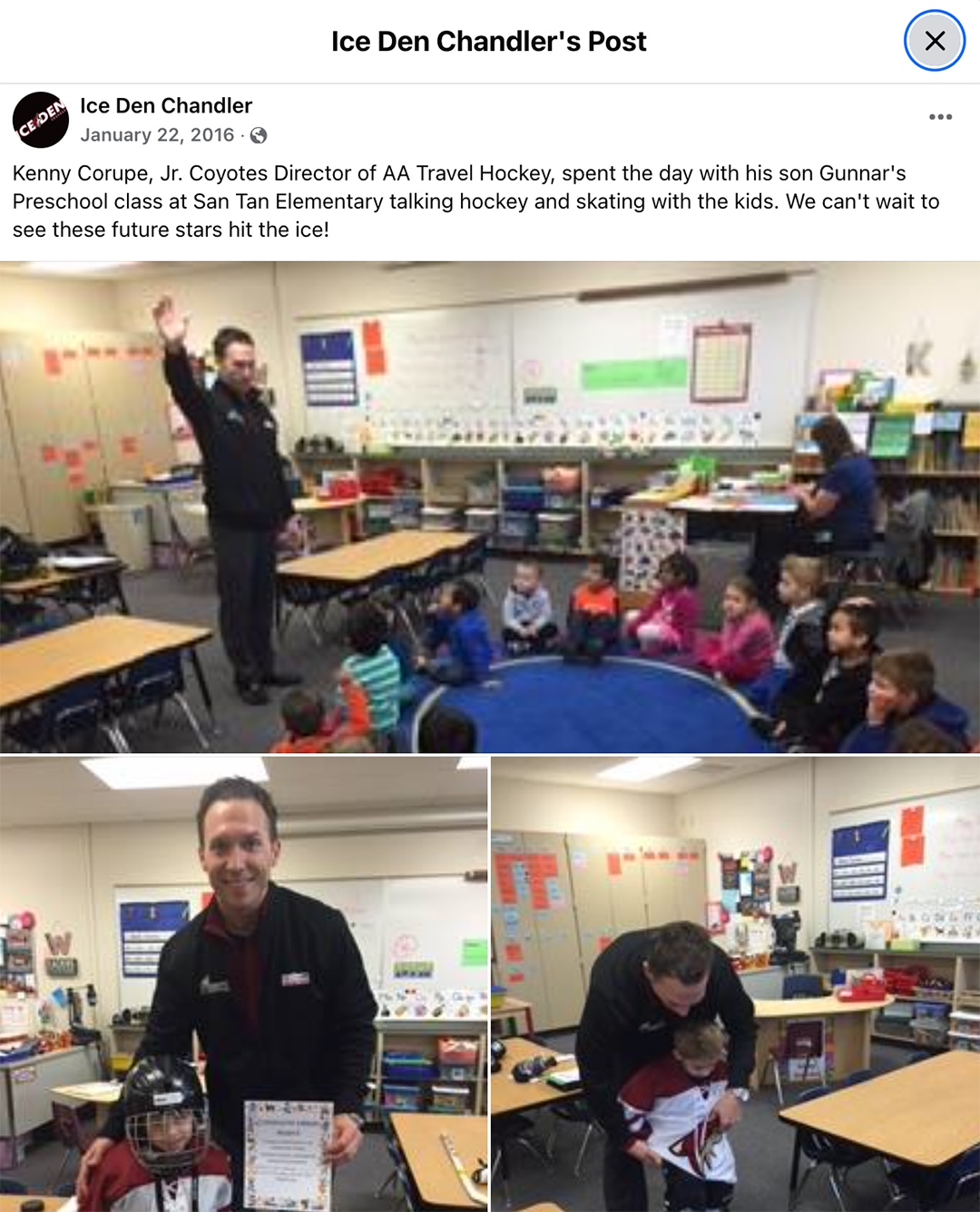
Kenny Corupe deserves his own section in this story.
Of the previous Hockey Factories profiles we have done, I’m not sure I’ve had a more engaging and enlightening conversation about youth hockey than the one I had with Corupe.
“Kenny is going on almost 10 years with us, he is an amazing human,” Kristy Aguirre, Coyotes Amateur Hockey Association President, boasts. “He is well liked, well respected, the players love him – he’s ‘the guy’ when he walks in the rinks. He sets the tone for players and parents at such an important age group. Its guys like him who have helped our program to where it is today.”
Corupe played 15 years professionally, eight in North America. He got the coaching bug when part of his contract with his team in Italy was to help a different youth team regularly, ranging from U8 to U18.
Oh, and he had to do this in Italian – which he did not speak.
“I really found a joy in playing but also helping youth – whether that was a U8 or U18 player,” Corupe says. “I had knee surgery my last year in Norway and doing it after 15 years I knew what my body needed. So, I would skate and work myself around the arenas in Phoenix and started to get to know coaches and was approached by Mike about being a Hockey Director.”
“At that point I went to my wife, we had three kids at the time, and I said, “we’ve done this for 15 years, are you ready to stop?” Her response was: “Please!”
In January 2015 Corupe started with the club and was shocked right away how at the older levels kids in U16 and U18 did not know certain concepts and had bad habits. By that point those habits likely weren’t being broken.
His discovery after researching the program was that no one wanted to work with the younger kids.
When Mike O’Hearn, who ran the Ice Den at the time, approached Corupe and told him he could pick the team he wanted to coach, he told them right away he wanted to go younger.
“I went there because I could tell in our state there are a lot of hockey people here, but the coaches weren’t taking the time, in my opinion, to start at the beginning and build that foundation.”
Most kids enjoy hockey when they first sign up. When they get to Corupe, he has a big message at the beginning of the season.
“I know coming in you love the game but at the end of the year I want you to love it even more and you have the desire to come back and do more,” Corupe preaches. “I always roll back to two C’s – I want you to be confident and I want you to be creative. You can’t teach creativity, but I want to create an environment where the players can be confident enough to try things.”
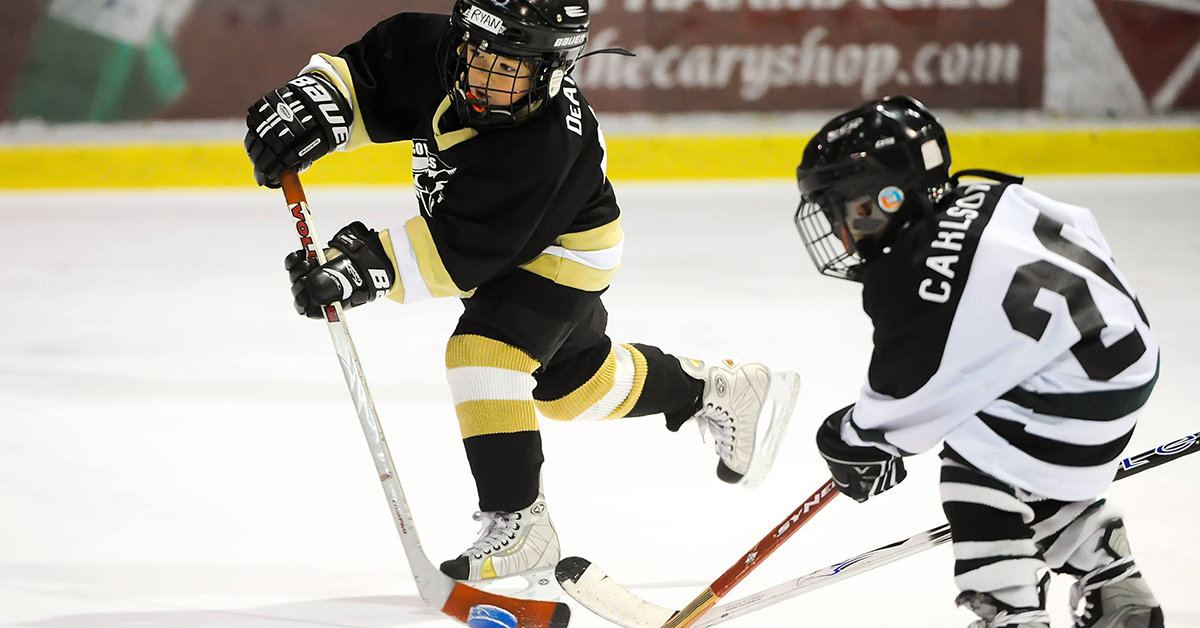
Corupe coaches U8 and U14 within the Jr. Coyotes program and does so intentionally.
The contrast, he says, is where he gets the biggest reward.
“Just because you’ve got different ages you can’t forget to tap into their brains that they are still kids and find a way to motivate them to want to do whatever you’re asking, as a kid,” Corupe states. “At all levels there are times I’m yelling in the locker room – win or lose – but I try to leave it there so when you walk away from it you’re still a kid.”
Corupe was raised in Ontario and knows all about the pressures of youth hockey, external and internal. He sees his role as someone who reminds everyone around him that hockey is fun at any age and level.
“With my U8 team, I get them for 3 hours a week. I try to spend a lot of time off the ice in the locker room or in the hallways trying to connect with the kids and bonding and putting a smile on their face,” Corupe explains.
Corupe is extremely observant in the way he speaks about his players, one of the most enjoyable parts of the conversation is how very rarely X's and O's get mentioned, if at all.
It’s much more human and holistic.
“When I notice a player struggling, I’ve got to find a way to relax,” Corupe points out. “You have to watch that kid more intently, he made a nice pass on the next shift, so when he comes to the bench, I’ll pull him to the side, get eye to eye with him and told him "when you had that desire to go in and make that pass, I absolutely loved everything about that". He literally lifts up. Next shift, he’s flying.”
Having that contrast of U8 and U14 also helps being able to connect the dots in between and learning how to have an age-appropriate conversation with both players and parents.
“I use an analogy with our coaches that when you are on the bench, look at the back of everyone’s helmet. Every single one of those helmets are different, so I want you to think ‘"his is #10, how do they tick? This is #12, how do they tick?" I think it’s extremely important that every kid learns from a different whistle."
Brendan Shaw is one of those whistles.
Shaw has an extended history with the Jr. Coyotes, joining the club in 2004, but a long history in the game. He jokes you don’t see the impact you have on a 16–17-year-old at the time but now that some of his players are in their 40s, it’s something that energizes him as a coach.
“I’m in the start up world and I look at every team I coach like a start up,” Shaw opens. “My thinking is just "we have this business and there are 17-20 kids who run it and we have nine months to do it and how do we do it?"”
Shaw serves as the U12 head coach within the program.
“It was a lot of acclamation coaching a younger group this year,” Shaw concedes. “I want to create the same experience because I’m not going to dumb it down and I’m trying to evaluate myself at the same time, constantly checking how much I’ve done, how much can I do, when is too much or not enough and then you try to hit those milestones as you go.”
Shaw does that with a regular assessment of himself and the team, testing what they know and what they don’t know.
His biggest tell-tale signs are through his drills.
“I’ll do a drill with them I’ve done for 15 years and they can’t do it, and that’s fine. That shows me where they are and I can add or subtract from that drill to make it work,” Shaw explains. “It’s ok for coaches to say, ‘this drill isn’t working today’, look at it and say it’s not a bad drill, it’s just a bad drill for today and it doesn’t work. We don’t have unlimited ice time, and you have to be massively efficient as to what they know and some of that might be doing a drill they’ve seen 20 times but you don’t have time to sit at the board.”
The important part of drills for a coach, Shaw says, is not quantity, it’s quality and familiarity.
“I always tell people you want to get to 30 drills that the kids know by memory that I can just write on the board – not even drawing them out, just writing the name,” Shaw suggests. “The players know we are going to do this, this, and this for 20 minutes and then we are going to split up and go to team stuff, so it’s very structured and that way the onus is on the player, but you can’t expect them to know something they’ve never seen before.”
He acknowledges that even in his age group there are questions about what is next for the players and families.
Shaw, like Corupe, sees the big picture as the younger kids go through his age group.
“You only get 12 years of this. There are a lot of people on the flip side that say I missed out on so many things because I was so worried about what was next and they forgot about the moment,” Shaw recollects. “You hear that in January when they start talking about coaches and such for next season when we still have three months left. Live in the moment, the kid is going to be 18 soon, they are going to be gone and you’re going to be left there thinking ‘wow, this went so fast.’”
That’s where Corupe and Shaw both talk about as much as they are coaching the players, they have to coach the parents.
“I try to give them a story of ‘your kid played great today,'” Corupe will advise. “In two nights, when you’re putting the kid to bed, tell them you talked to their coach and he said he loved the way you backchecked or something like that. They are going to have a parent that loves them, tell them something positive about a coach that likes them and now they are going to bed with all this positive stuff and they'll forget about all the other bad stuff.”
================================
There are a lot of reasons why you would assume the weather in Arizona is not conducive to operating a hockey program, but there is also a big reason why the weather works more in favour for the Jr. Coyotes program than perhaps anywhere in North America.
No one is going to complain about nearly 70 degree weather in January.
As you would imagine, Arizona has always been a destination for people looking to get out of the cold during the winter.
The state has also been referred to as the retirement home for the NHL.
Luckily for Mike DeAngelis and the Jr. Coyotes, these players want to give back.
“A lot of NHL guys still live here. They have kids, they have families, and so they come to the Jr. Coyotes,” DeAngelis admits. “We’ve been able to tap into that and some of these guys become coaches with us, which has a big impact on our program.”
Slugocki agrees.
“The coach’s room was a great place. I would sit in there sometimes two hours before my practice just to answer questions and share information,” he recalls. “The NHL guys that are around may not be the best coaches or even want to coach but they are knowledgeable and willing to answer questions. They are just great ambassadors to talk to the 9 or 10-year-old parents and telling them to calm down and follow the process.”
The Jr. Coyotes website reads like an NHL almanac with no less than 10 coaches who have served some time in the league as players.
Dallas Drake is one of them.
“I was involved in coaching in Traverse City for a couple of years but I had no connections in Arizona when we moved here,” Drake explains. “An opportunity came up to help finish off a year, so I offered to do that and it snowballed from there.”
Drake played over 1,000 NHL games with Detroit and St. Louis. He was also part of the Winnipeg Jets move to Phoenix, spending time with both clubs.
He is now the head coach for the U18 Jr. Coyotes team.
“It seems like all the kids these days have really good skill sets, they can all skate, they can all handle the puck,” Drake details his first thoughts when joining the organization. “When I get them in the U16's and U18's, it’s trying to develop their awareness and hockey sense. Kids these days watch so much video, it’s not always the right video, but it is a great tool to help these kids with a lot of facets of their game.”
The video aspect is something we spoke a lot about, asking him how much video he was using as a player and where analytics would fit into his game.
“Video is very important because what I see is very different from what the kids see, and I always try to explain that to them,” Drake mentions. “It’s important for kids to watch that back and see it directly, kids are all about social media now and they like watching themselves. Sometimes I wish they would sit down and watch an entire NHL game or a Division 1 game, not just clips of it because I think in a lot of ways that helps them as well.”
When it comes to his on-ice practices, Drake is strong on repetition – whether it’s a skill or a drill or combining them all together.
“I really like the amount of times we are on the ice practicing, they have the option of practicing 5 days a week, which was really big for me,” Drake continues. “I think that’s where kids learn and you can break things down for kids, especially when it comes to breaking them down to what they need to play at the next level since this is really the important years to push for that.”
Having NHL veterans like Drake, Shane Doan, Steve Sullivan (who coached in the program for eight years after his retirement and recently became the AHL’s Toronto Marlies’ head coach). Michael Grabner, Derek Morris, and others are invaluable, not just for the validity of the program but also to explain to players and parents what a hockey journey can look like.
Mike DeAngelis and his group call it “The Pathway.”
Because everyone can dream one day about playing in the NHL, but for a community of parents who had never been involved in the sport before – no one knew how to get there.
================================
“It’s unravelling the web of what the industry of hockey is,” DeAngelis explains. “It’s one of the most difficult webs to explain the directions you can go and if one direction is better than the other for each kid.”
Without really giving it much thought before, DeAngelis brings up a great point in his delivery to parents because there is one aspect of this sport no other has – junior hockey.
“This is the only sport you don’t go from high school to college and it’s complicated when you are explaining the WHL or the USHL and trying to get the most exposure,” DeAngelis comments. “We do presentations and things to the parent group and try to make it as simple as we can to say ‘this is the path, these are some options if you are good enough’ but it’s going to get blown up again with the new NCAA/CHL ruling.”
Drake’s insight is similar and at the forefront with his team’s age group.
“It’s difficult to give parents an answer because everyone develops at such a different rate,” Drake admits. “Everyone is so concerned about getting to the junior level as quick as they can but for a lot of them, they aren’t ready to do that. If you are jumping to junior and playing 4 or 5 minutes a night, it’s hard to say you’re getting better. I tell parents to take a breath. If they don’t trust the process and they try to play somewhere they can’t play and then they don’t play and they put themselves in a worse spot and lose an entire year.”
Kastelic went the WHL route with the Calgary Hitmen, admitting it’s not the first route most people in the Southwest US go, but drew that from his Canadian background.
Jaden Lipinski followed suit, playing parts of three seasons with the Vancouver Giants.
Shaw understands that as a coach and a father.
“I’m always talking to kids who are even out of the program now that are in the USHL or WHL about that journey,” he mentions. “I talk to kids who are 14 years old who say they are going to go to the WHL because they haven’t heard from any colleges and I have to tell them, they don’t talk to 14-year-olds. They have to understand the road map.”
Educating families on every step of the journey is crucial to keeping them invested and aware of what’s to come for their child.
Because the journey is long for players.
And for parents everywhere, especially Arizona, it’s also really expensive.
================================
“It truly bothers me how expensive it is,” Corupe states clearly.
“I see behind the scenes where the money goes – everything goes up. In Arizona when you’re paying $400-$500 an hour for the ice. It’s crazy.”
When doing introductory meetings, DeAngelis talks about building the foundation for the love of the game because it does not come as naturally in that area as it does in other parts of the country.”
“But the other important thing we have to do is not scare them away from hockey because, as the kid gets older and starts playing travel hockey in Arizona, there is something scary that is about to happen – and that is the cost of playing travel hockey in Arizona,” he admits. ”There are not a lot of places that are driveable from here, other than maybe Vegas and California. But when the 10 year olds want to go to Detroit for a tournament, it’s an expensive undertaking.”
Simple geography makes it a clearer picture.
“We are two hours from the Mexican border, that’s one way to look at where we are,” DeAngelis details. “The cost of playing hockey is a shock to a lot of people who don’t have a connection to the northern provinces or the northern states.”
“We travel every two weeks, we come home for a week and a half and then we travel again,” Drake shares his U18 schedule. “Every 10 days we are on a plane, and they are long flights and you’ve got to consider the school time that kids are missing – there are a lot of factors minus the cost and the cost is a big part of it.”
Shaw begins to use his playing time as a comparison to what happens in the state now.
“I flew twice as an amateur to the national tournament, there’s no flying in the USHL and we flew once a year in college hockey. So, that’s six flights by the time I’m 24. Some of these kids are doing that by the time they are eight.”
Arizona does host the Tier 1 Elite Tournament in the state and are starting to draw a number of other bigger tournaments, but outside of that area there is not much. Most big tournaments are moved around the USA but, by that, I mean Chicago, Detroit, Dallas, Boston and anywhere that is not the US Southwest.
As state president, Shaw was part of launching the AZYHL, a league that not only benefits families with games, but saves money.
“The biggest thing is what we can’t fully fix – we are out in the middle of nowhere compared to other programs,” Shaw engages. “We can’t just go down the street and find a bunch of competition. We have our area, which is about 15 sheets of ice, but once you get outside there you’re talking about a four hour drive. That’s the difference.”
The challenge has always been having enough high level talent locally so these trips do not have to happen.
“I’m a firm believer that you get what you pay for,” Aguirre mentions. “Our program fees are comparable to others at our level and I think people realize the coaches, facility, staff are all outstanding here. Scottsdale is a bit of a different city, it’s a different clientele because it’s a fairly affluent area but we are trying to do everything we can to offset it as much as we can but not having anyone here – we have to travel.”
The Jr. Coyotes program is unique, compared to others around the country because of its depth. Not only is there the AAA program, but the umbrella also covers AA and house league.
Having that many options for a family is something DeAngelis is proud of.
“If you want to play hockey recreationally, you can and we have that. If you want more than that, we have that too,” DeAngelis will tell families. “We have the AAA travel program and we also have a number of development programs right below it so in that program it doesn’t cost as much, they don’t have to travel as much to find the competition and play locally.”
Corupe has a suggestion, starting from the beginning.
“If we collectively, as a state, work more with our younger kids, there are a lot of hockey players here and I believe we need to have better coaches for younger players to expand it more so our older kids don’t have to travel as much,” Corupe says.
"There’s nothing worse than me having to have a conversation with a parent who says their kid can’t play anymore because it’s costing too much money, that’s a shame,” he continues. “I can’t argue if a kid wants to go play soccer and it costs them $1,000 for the year to play. It’s hard.”
================================
The intention of this feature was not just to highlight the great program that is the Jr. Coyotes but to also shine a positive light on hockey in Arizona.
But there is no point avoiding the white elephant in the room.
The NHL is gone.
So what does that mean for hockey, in general, in the state? I let the experts explain.
Brendan Shaw: "Everyone wants to get into the fact that the Coyotes left and how are we going to handle that now. We are stronger now because that development of the west has made hockey better. It’s raised the level of hockey as a whole and the game needs that.”
Jaden Lipinski: "It was a weird ending at Mullett Arena, it’s going to be weird without them. The Coyotes had a big impact on our lives, without them I’d probably be playing baseball. The game of hockey has brought me to some really great places. We need to figure out how to keep it there."
Mark Kastelic: "I think there’s definitely a market there, so I hope they figure out the logistics and make it work. You could see how excited the city was when the Coyotes were having their playoff runs. Having that team for me growing up was something I cherished and if they can get everything figured out that would be awesome for the area."
Kenny Corupe: "I think another NHL team would absolutely fly here. I’ve lived in so many markets and I can tell you this area could absolutely support it if it is done right."
But we leave the final word to the one who has lived Arizona hockey his whole life.
As I ask the question if the game is sustainable in the desert, Slugocki admits to feeling a wave of emotions as he begins to speak.
His passion is unwavering.
“Hockey in Arizona has given me everything in my life,” Slugocki begins whole-heartedly. “I’ve been on the ice since I was 2-3 years old. It’s all I’ve ever known. I would have never thought I could have a career in hockey and now I get to work with some of the best players in the world because of the Jr. Coyotes and hockey in Arizona in general. It means the world to me. It was crushing for a lot of reasons when the Coyotes left. I know there’s a chance my kids won’t get the same rush of going to a game like I did with my Dad when I was 5 or 6 years old. I have a lot of great memories that have helped shape me. You won’t find a bigger supporter of Arizona hockey than me.”
The Utah Hockey Club's journey started on October 8th, 2024, defeating the Chicago Blackhawks in their regular season opener.
I don’t know if many Phoenix-area TVs were tuned to that game.
But hockey still lives in the desert. The game continues to grow, the list of names, like Auston Matthews, Matthew Knies, Josh Doan and Mark Kastelic gets longer and longer.
In the Valley of the Sun, the sun continues to shine on Arizona hockey.
In episode #284 of the Glass and Out Podcast we're joined by Steve Thompson, Manager of Goalie Development for USA Hockey.
It’s no secret that the US has become a bit of a goaltending factory. In the 2023-24 NHL season, of the goalies who played a minimum of 15 games, four of the top six, seven of the top 11, and nine of the top 20 in save percentage were American. As Thompson explains it, this surge in goaltending development starts with focusing at the grassroot levels.
The native of Alaska played college hockey at the University of Alaska Fairbanks and immediately jumped into developing the next wave of goalies upon graduation.
As you’re about to hear, Thompson's enthusiasm for the position is contagious, and much of what he offers from a development perspective applies to players of all positions.
Listen as he shares why rentention should be a youth coach's number one measure of success, why every goal against is an opportunity to learn, and the importance of keeping your goalies in mind during practice planning.
Most coaches are not confident with the backhand to clear the puck. I agree with that. Maybe one day it will change... But for now here is a tip for this situation.
In this situation, Canadian players show good hockey IQ.
Teaching creativity in the offense zone isn't as straightforward as some may think. It's not black and white like D zone structure or a neutral zone forecheck. It's about showing players their options and then allowing them to make mistakes during a game while being creative. The majority of youth players don't spend as much time on the ODR as they once did, which we all know is a huge part of creativity. Because of this, coaches need to lay the foundation by showing players their options and then allowing them to experiment by using SAGs with boundaries. This can be tricky while trying to avoid over-coaching in the offensive zone.
In the above clip, you will see the puck carrier come up the wall and have a triangle support with all three forwards. As he comes into high us, the D recognizes the puck carrier coming closer, and he will shift away from the puck carrier, filling lanes and staying in good support of each other with passing to the weakside defencemen who will begin their descent.
Drill Design;
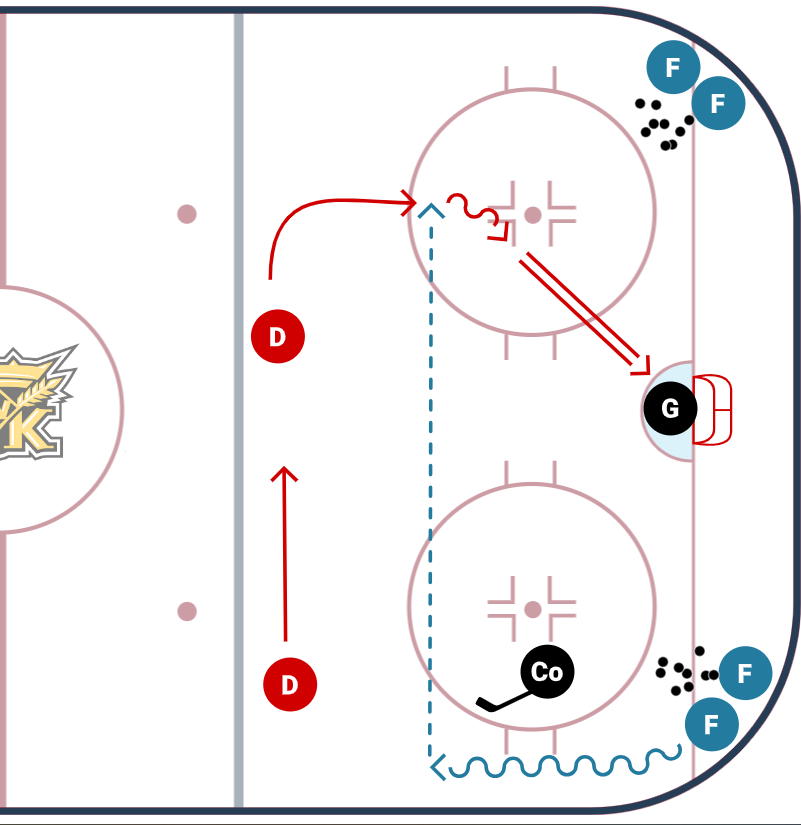
Here is a simple drill to implant the idea of using a weakside dive in a practice.
Forwards will start in the corners
One side at a time, on the whistle the forward will skate the puck up the wall.
The coach will apply token pressure
The weakside D will time the forward movement, and then begin to make a dive.
Triangulation Puck Support – The formation of or division into triangles of the ice surface by Offensive Players without the puck for the purpose of:
Setting quality passing lane options to support the Puck Carrier,
Advancement of the puck and,
The ability of the Offensive Team to retain puck possession & control.
Introduction of the Concept with Players
Young competitive players benefit from learning how to support the puck offensively early in their development. The geometric term to triangulate in sports has been used by coaches in many different sports like soccer, basketball, hockey and others for years. The higher the level of play and competition, the greater the need for support of the puck/ball offensively to advance the puck/ball in space. One against one is one of the easiest plays in sports to defend so we should encourage the learning of how to support the puck offensively as a group. Every offensive player on the ice benefits from structured support of the puck because when executed properly these players get the opportunity to play more with the puck to create scoring chances. Fun, right?
Triangulation Puck Support is necessary for the successful execution of offensive tactics and not limited to the following:
☑︎Defensive Zone Breakouts, ☑︎Neutral Zone Regroups, ☑︎Attack Rush Play, ☑︎Offensive Zone Tactics like the Cycle, Down Low Game (below hash marks) to advance the puck on net down low below the hash marks, taking the puck to the net from above the hash marks, ☑︎Power Play Breakouts, ☑︎Offensive Zone Play, and ☑︎Puck Recovery Battle Exits, essentially all offensive tactics.
The Why
The concept of triangulating as an offensive tactic is important for the following reasons:
Players should only be taught set plays in specialty game situations or for key moments.
Players should be creative in their play making to read and react to what defenders are giving them in situations.
Encourages players to use common sense in their movement of themselves and the puck to make plays.
Supports players finding open ice (space) above, below, adjacent to the puck offensively to set quality passing lanes (good angle).
Players can apply the concept when the group contracts (tight spaces) or expands the ice surface to advance the puck.
Supports players moving their feet into open ice to set a quality passing lane which opens up ice and opportunities for members of the Offensive Group.
Players exploit Defensive Zone Coverage Schemes (seams/lanes) forcing teams to play more man coverage.
Supports a player’s development.
Use of the Ice Surface – Set a Good Passing Lane (Angle)
Whether you are in tight space or using the width and depth of the ice surface it is absolutely essential the player with the puck has a minimum of two passing options. Use of the ice surface to set a good passing lane may require players to come back to the puck or be creative to find open ice to set a good passing lane angle.
Timing in Execution
Passing lanes open and close in the matter of seconds. The timing of a player’s movement into open space to set a passing lane (triangulate) is one of the keys to supporting the puck. Players need to exploit seams/lanes in zone coverage and separate from their man coverage to support the puck offensively. The process requires players to work hard to move their feet to find open ice and develop an awareness of the importance of timing in their execution of player and puck movement.
Give & Goes & Change of Direction
Players should be encouraged to be creative in their support of the puck. We don’t see enough give and goes in today’s game. There should be more outnumbering/overloading puck side and in tight spaces to advance the puck by working two on one’s and three on two’s. Better support of the puck in all three zones is critical to positioning a team to win the puck possession and control game. More stops and starts in tight spaces to work give and goes.
Swivel Head
A term often referred to in defensive play but equally important in offensive play and support of the puck. Having a “Swivel Head” is a term used to describe improving a player’s line of sight to quickly see the positioning of players on the ice surface. A Swivel Head is essential for Offensive Players to recognize a defensive structure, location of defenders and offensive players and open ice to make plays.
Strong Technical Hockey Skills
To play a strong offensive puck support game players’ need to have strong technical hockey skills. Passing (giving and receiving), puck control (stick handling), skating skills (change in direction, tight turns, acceleration).
Application of the Concept
The Triangulation Concept should be coached with age appropriate groups capable of grasping and executing the concept. The concept fits in nicely when running SAGs.
I must admit that the drop breakout is my favorite in a Power Play situation.
It is not the only one, but the drop breakout allows you to focus on zone entry. Have 4 players attacking the offensive blue line with speed to play the rush.
In addition with a few adjustments, it allows you to play against almost all the P.K. fchk.
Some key points:
Drop the puck as late as possible.
Stay inside the dotsas long as possible.
Position the high post at the red line.
Respect the road: Keeper drive / Outside Drive / 2 high support. Some teams will replace the outside drive for a Bumper.
The main focus is on O-Zone entry and the the rush. At a high level, pre-scooting the opposing team allows players to have precise information on the pressure put by the P.K. fchk and therefore to make the best decision based on trends.