Drill where we focused on making a pass out of a transition.
Part 1
- Top hand only. Helped build the player's top-hand strength and control of the puck.
Part 2
- Alternating forehand and backhand
 0:01:09
Drill where we focused on making a pass out of a transition.
Part 1
Part 2
 0:01:04
2 - 2 - 1 Powerplay Shape
 00:00:00
Subscribe: Apple Podcasts | Spotify | Google Podcasts
In episode #254 of the Glass and Out Podcast, we're joined by Barry Smith, a seven-time Stanley Cup Champion and someone who is woven into the fabric of some of the best NHL teams of all-time.
Smith spent 18 years behind an NHL bench, capturing back-to-back championships with the Pittsburgh Penguins as an Assistant Coach, three Cups riding shotgun with Scotty Bowman in Detroit, and two more with the Chicago Blackhawks as their Director of Player Evaluation.
His resume also includes time coaching in Sweden, Russia, and the NCAA; Smith got his NHL start with his hometown Buffalo Sabres and was even an Assistant Coach to Wayne Gretzky in Phoenix.
Smith will be sharing his wealth of knowledge this June at TCS Live.
Listen as he shares his philosphy on developing hockey sense, working with coaching legend Scotty Bowman, and what it takes to win hockey's ultimate prize.
VIDEO TIMESTAMPS:
 0:00:31
Scoreboard idea inspired from Coach David Baird's scoreboard soccer. Choose 2-4 small area half ice games. Can use all 3 zones depending on numbers. Split teams and play. Add music for extra fun. Rotate teams every few minutes or play tourney style. Goal scorers must leave the game to complete a task. Here they move a puck from one circle to another. This leaves an odd man situation for a short time. Encourage your players to take advantage of the situation. The returning player becomes a backchecker. Coaches should reinforce backchecking to the "most dangerous person". Coaches may also incentivize other good habits by sending kids to the scoreboard for good things other than just goals.
constraints/affordances to use to incentivize good habits and allow players to see new options. Learning sticks when players are able to explore and solve problems in a play environment.
Rebound goals = 2
One timers
regroups
quick goals(5sec) after turnovers
deflections
time
shorthanded/power play
down by a goal (one min to tie it up)
up by a goal
Scoreboard options-
Flip a cone-Line up 5 cones for each team, first to flip 5 wins. Can also take away goals from opponent
Tic tac toe- Draw a grid on the ice, players can use pucks/cones/marker to make x's and o's
Sauce contest- Sauce a puck over an obstacle and hit a small target for a bonus goal.
Shooting contest-First team to hit all 4-5 targets wins.
 00:00:00
Subscribe: Apple Podcasts | Spotify | Google Podcasts
In episode #257, we come full circle and welcome back the original co-host of the Glass and Out Podcast, Kelvin Cech.
We're proud to announce that Cech has rejoined The Coaches Site as our new Manager of Content Collaboration!
This comes after he spent four seasons in the Manitoba Junior Hockey League. The first two were spent as the Head Coach and Gm of the Winkler Flyers, where he was awarded Coach of the Year in his first season. From there, he was appointed the Head Coach and GM of the expansion Niverville Nighthawks.
Listen as he shares why a growth mindset is integral for coaches, what he learned form coaching in hockey-mad small town, and what to expect from his new role with TCS.
VIDEO TIMESTAMPS:
 0:02:52
NZ Breakout
 0:00:13
When Zach Hyman lost his check on the Florida Panthers' first goal in the 2024 Stanley Cup Final, I was shocked. Few people work as hard as Hyman. How could he be late on the backcheck?
The answer isn't found in the Oilers' zone on the goal, it's in the Panthers' zone, nearly 200 feet away from the net. This is where Hyman lost Carter Verhaege. It's a great clip because it shows how hard the other team is working to score, so you'd better be prepared to do the same.
Now, should Hyman have kept skating? Yes, absolutely. It's a mistake, and mistakes happen. Cody Ceci also made a mistake in not recognizing the potential danger. Ceci slides towards Alexander Barkov, who blows by him like a house on the side of the road. Ceci has to turn his feet and reach in and Barkov takes care of the rest. If Ceci had played it safe and tracked backwards through the house then the pass likely doesn't make it to Verhaege.
 00:00:00
There's nothing more pure in practice than good ol' fashioned 1on1 battles. Chuck a puck in the corner and see who comes out with it. They're powerful for me to watch because you can see how different playing styles are effective at either retrieving or relieving possession of the puck. Small, quick players can use their agility and speed to check with their feet, or they can snap back and forth with possession if they have sharp puckhandling skills. Conversely, big players with a long wingspan can use that to their advantage to box in the puck carrier, or use their reach to protect the puck while they manouvre.
One issue with 1on1 drills, however, is they can be boring for everybody else. Not always, of course! There's a lot of pressure and excitement when you're playing 1on1 and all your teammates are watching and hollering from the blue line or the bench. There's a time and a place for that, but it's also helpful to build those situations into larger game-style scenarios. I run a lot of 1on1 drills that either add players or components so you get the best of both worlds. Here are two of my favourites.
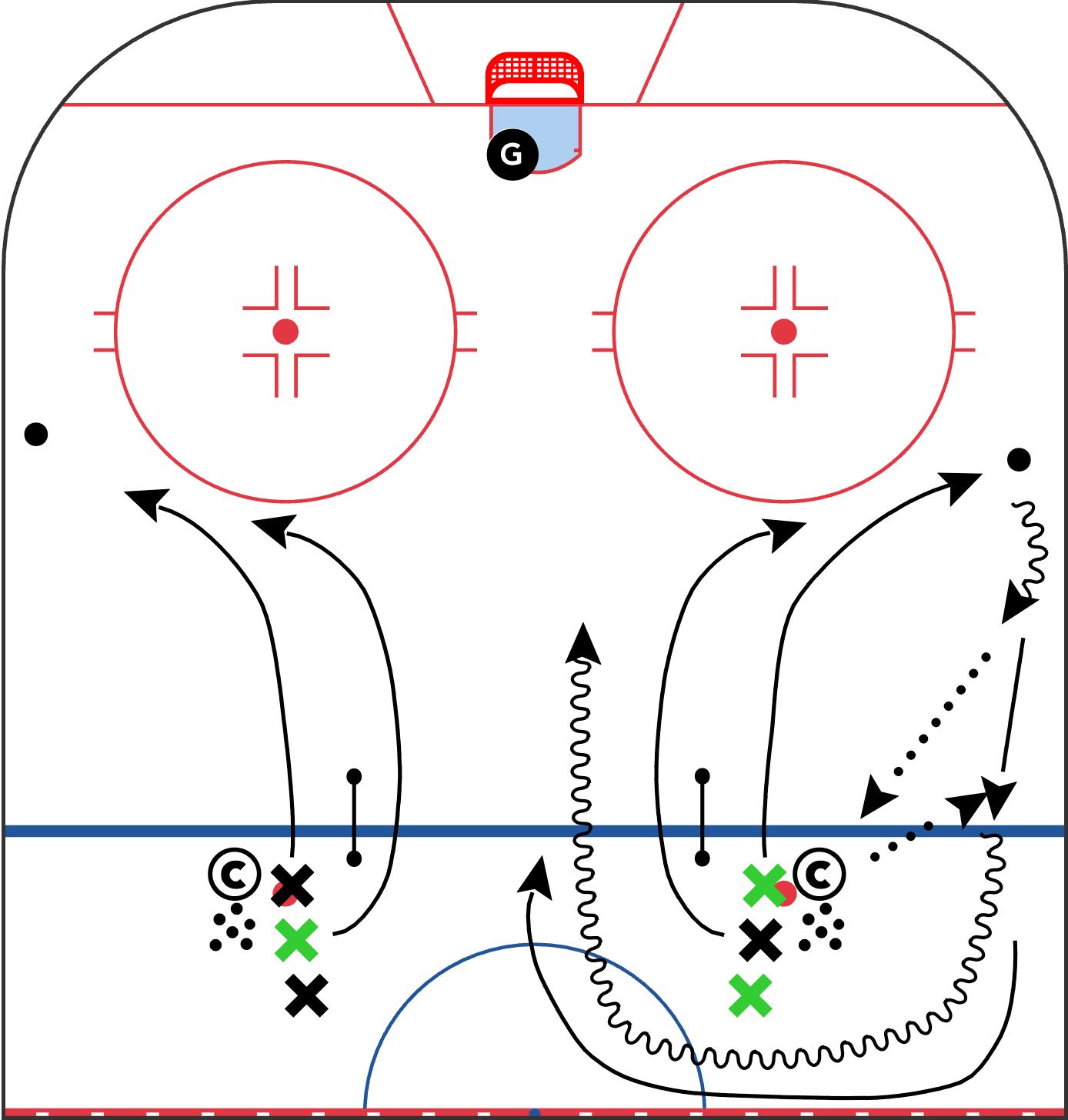
I've done this with every team I've ever coached, though I've tweaked it over the years. It's especially handy for teams who play man on man defence in the defensive zone, but at its core it's a simple tool to work on offensive and defensive habits both on a focused (1on1) and team (3on3) scale.
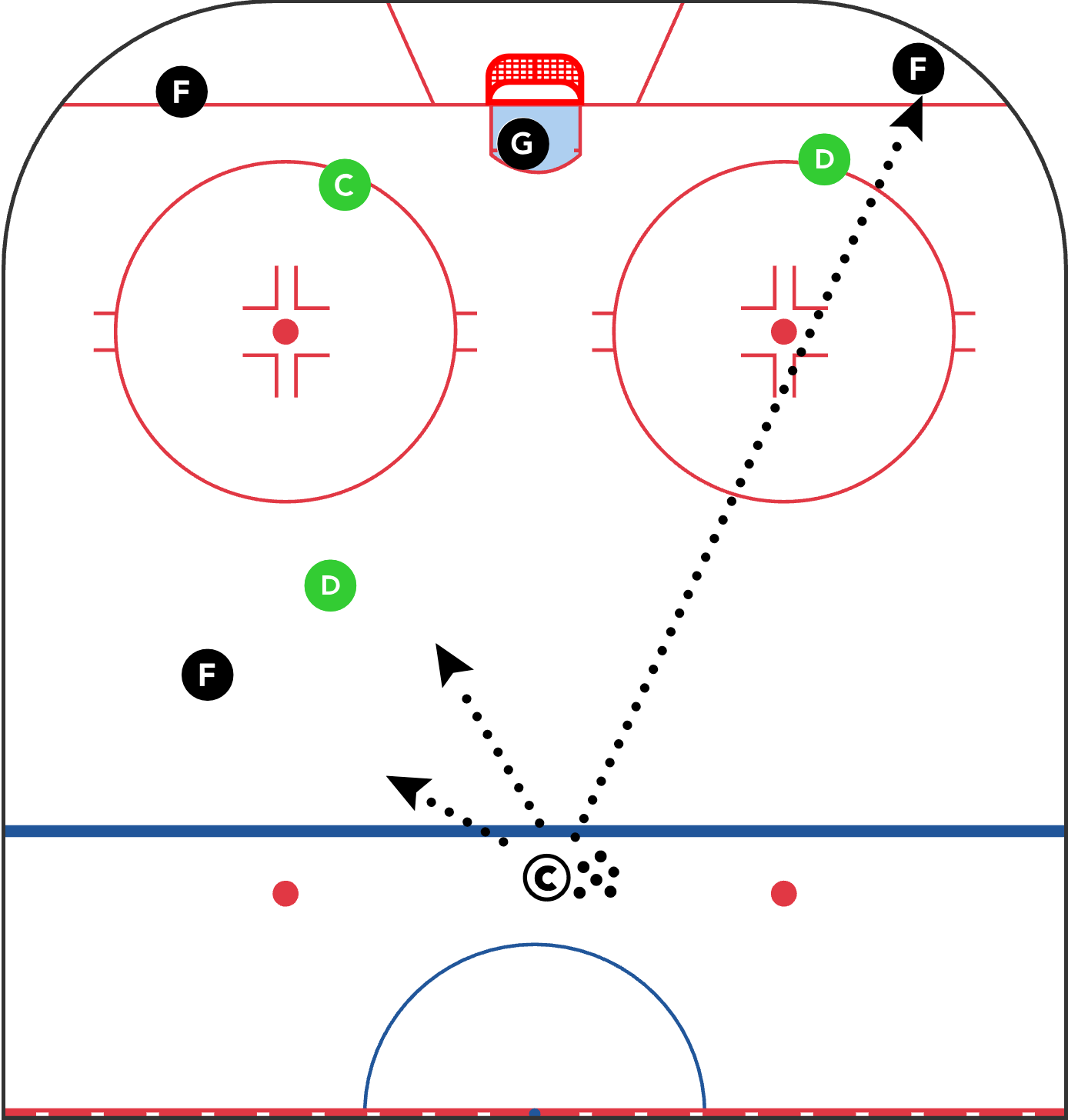
Doesn't get much more old school than this. This disguised bag skate is fabulous for reminding players that your shift isn't finished when you whip a shot 4 feet wide on the far side of then net. Looks confusing but it's not, just make sure you get the players and pucks on the proper sides of the ice. Pucks are all on the same side, coloours should be separated. Positions don't matter.
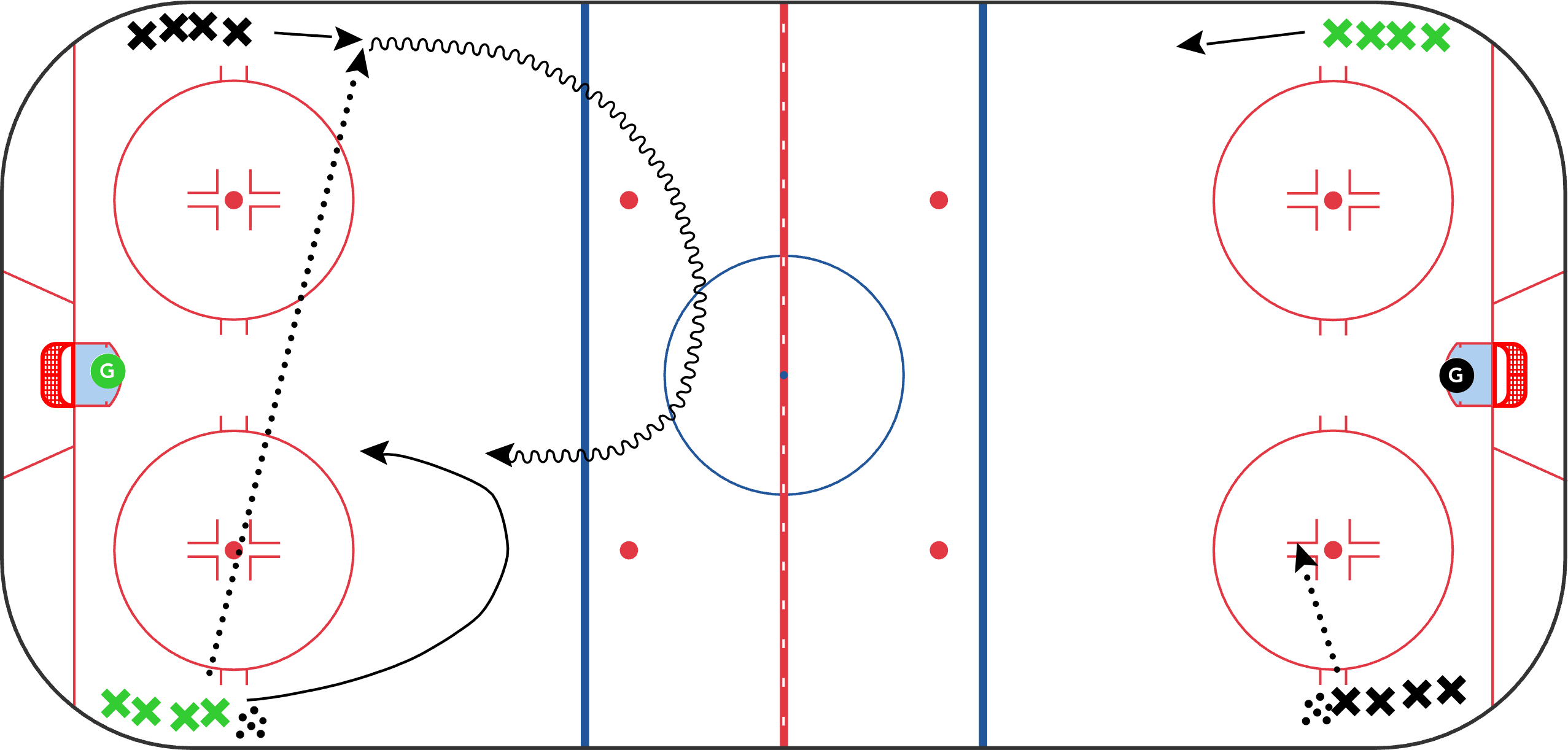
I've actually changed the rule in this one multiple times - sometimes the players can sauce pass the puck, sometimes not. It's remarkable how much more often pucks get picked off when they're sauced, so it proves a point. But still, sometimes it's the right play. Knowing when to do what is the mark of high hockey IQ. This is a pretty simple warmup drill but it's fast and gets the blood going.
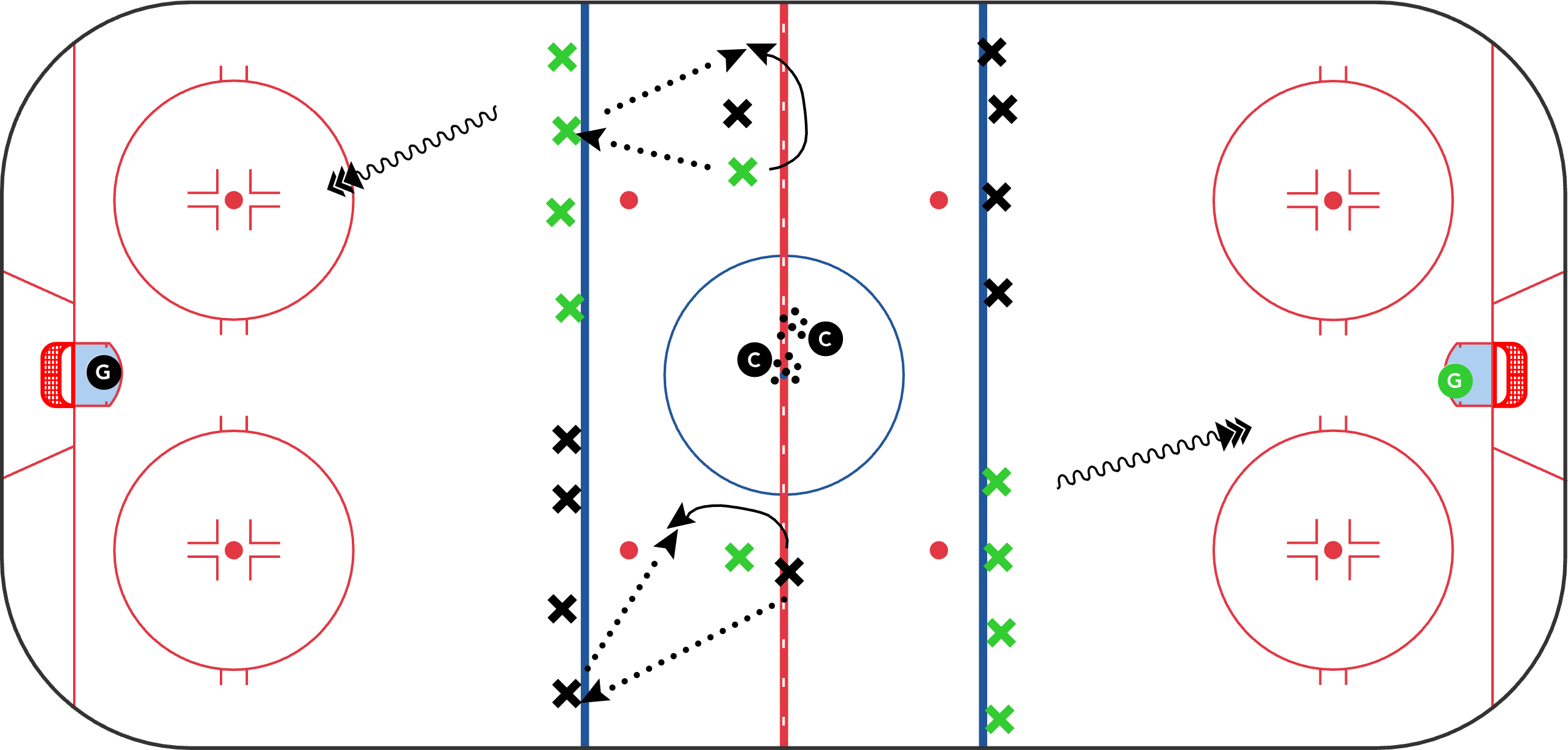
Any position can use this drill, but it's rare for a defenceman to be in this situation. I believe in blue battles above all else - win the blue lines and you likely win the hockey game. Both getting it out and getting it in, but primarily getting it out. That doesn't mean you should shoot it off the glass every shift - you're just giving it away. Sometimes you have to releieve pressure, but this season I'm going to work on winning the blue line every single practice. I mean it. We want possession as much as possible so we can attack through the neutral zone.
 00:00:00
In today's fast-paced world, where success is often equated with immediate results and achievements, cultivating a growth mindset has become more important than ever. By shifting the focus from outcomes to the process, we can encourage young athletes to embrace challenges and strive for continuous improvement.
Challenges and learning lie in the distinction between two fundamental mindsets: the growth and the fixed mindset. Embracing a growth mindset empowers individuals with the belief that their abilities and intelligence can be developed through effort, strategy, and input from others. It's a perspective that views challenges as springboards for growth, valuing persistence over perfection.
The fixed mindset holds that our intelligence and talents are static, leading to an unwillingness to engage with challenges for fear of failure. This perspective can hinder personal and athletic development, as it prioritizes innate ability over the process of learning and growth.
Praise, when used correctly, can be a transformative tool in the arsenal of youth coaches. It's not only about acknowledging success; it’s about reinforcing the behaviors that lead to that success. Instead of highlighting natural talent or end results, focusing praise based on effort and perseverance shown by young athletes nurtures a belief in the value of hard work. This shift encourages them to embrace challenges with a positive attitude, seeing them as opportunities to stretch their abilities and grow. By acknowledging the dedication and strategies employed by players, coaches underscore the message that improvement and excellence are attainable through persistent effort. This approach helps to build an environment where mistakes are not feared but are viewed as integral steps in the learning journey. This, in turn, fosters a culture of continuous improvement and resilience, key components of a growth mindset. By prioritizing effort-based praise, we teach young athletes that their potential is not fixed but can be expanded through dedication and hard work, laying the groundwork for lifelong learning and achievement.
This results-focused mentality, though seemingly beneficial on the surface, can inadvertently create a fixed mindset among young athletes. When emphasis is placed predominantly on outcomes—wins and losses, rankings, and scorelines—players may start to view these achievements as the sole indicators of their worth and potential. This perspective not only magnifies the fear of failure but also stifles the willingness to step outside of comfort zones and tackle new challenges.
Coaches can start by setting achievable, yet challenging goals, emphasizing the journey rather than the destination. This helps athletes see progress as a measure of success, not just wins or losses. Encouraging athletes to step out of their comfort zones and attempt new techniques or strategies without fear of failure is key. It teaches them that growth comes from trying, failing, and learning, not just from succeeding.
Feedback should be constructive and specific, highlighting what was done well and where there is room for improvement. This approach fosters a sense of accomplishment and a clear direction for growth. Celebrating small victories and efforts reinforces the message that effort leads to improvement.
Cultivating a growth mindset in young athletes does more than just enhance their performance on the ice; it lays a foundation for lifelong resilience and adaptability. This powerful perspective equips individuals with the ability to view challenges not as insurmountable obstacles, but as opportunities to learn and evolve. In the broader scope of life's pursuits, these qualities are invaluable. Those who embrace a growth mindset tend to approach problems with a solution-oriented attitude, applying the same persistence and dedication learned in sports to academic endeavors, professional projects, and personal relationships.
 00:00:00
In this video, we show the final product of what we are trying to achieve in a game. As you can see, by having a 4th player jump in on the rush, you are creating about six options for the puck carrier, making it extremely difficult for the defending team to shut down. Here is a breakdown of how you can teach this concept to players as young as U13. With these progressions, your team will become dangerous off the rush quickly!
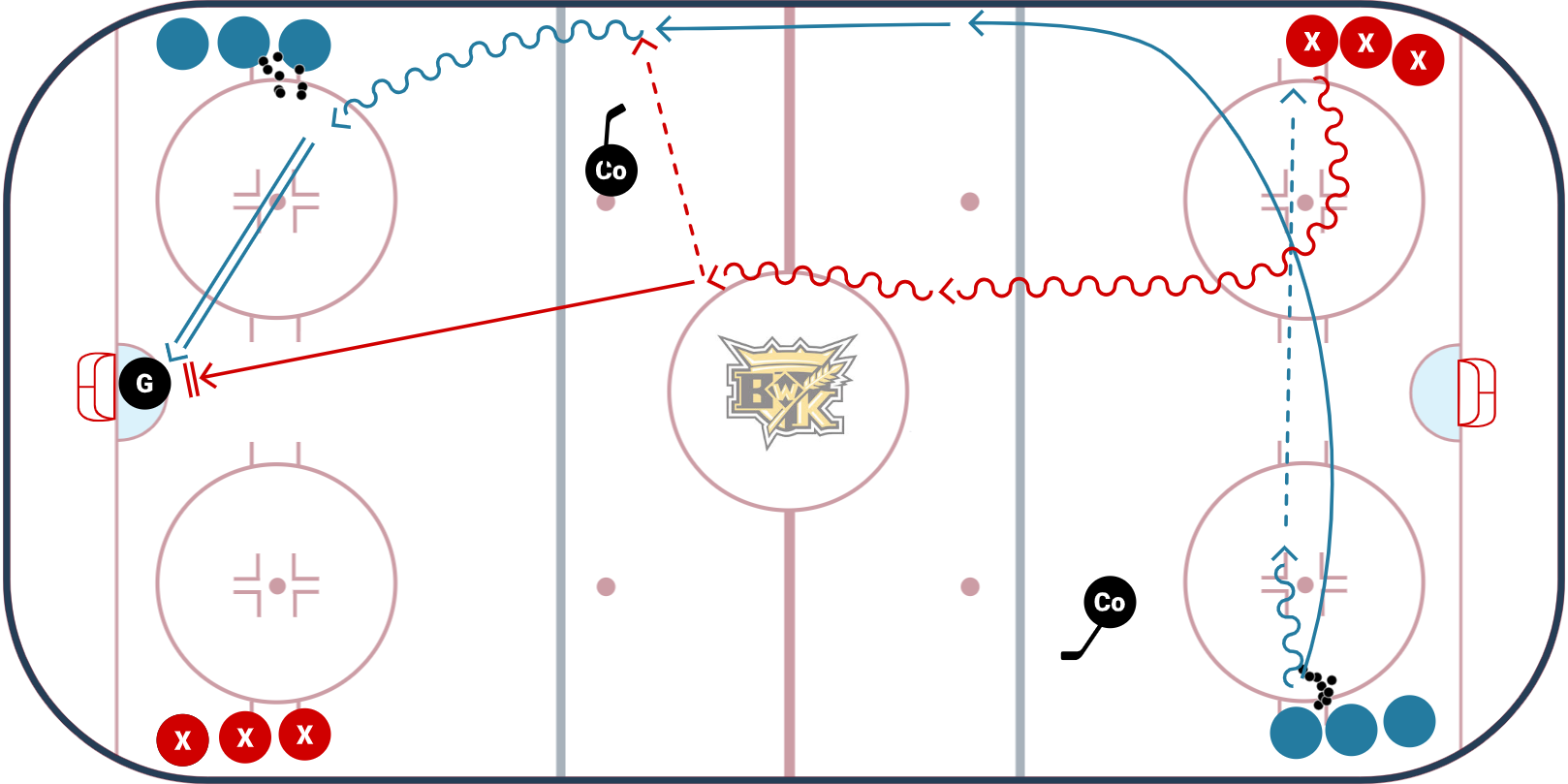
Before getting to a more complex 4 player drive that you will find in our last progression, take a look at the drill below. I stole this drill from Dan Bylsma on his chalk talk series that you can find on the coaches site and is great for teaching a foundation for the bigger picture. Run this drill so both sides are going at the same time. Have coaches positioned at the dot for each rush, acting as the strong side defencemen. Make sure the puck carrier attacks fast through the neutral zone inside the dots towards the coach (strong side D) this will push the the defense backward into their zone. Before entering the offensive zone, have the puck carrier kick out the puck to the wide lane player, and then attack the coach while finishing his or her route as the middle lane driver. Once the players become comfortable with the idea you are trying to teach, you can do this drill with multiple different zone entries.
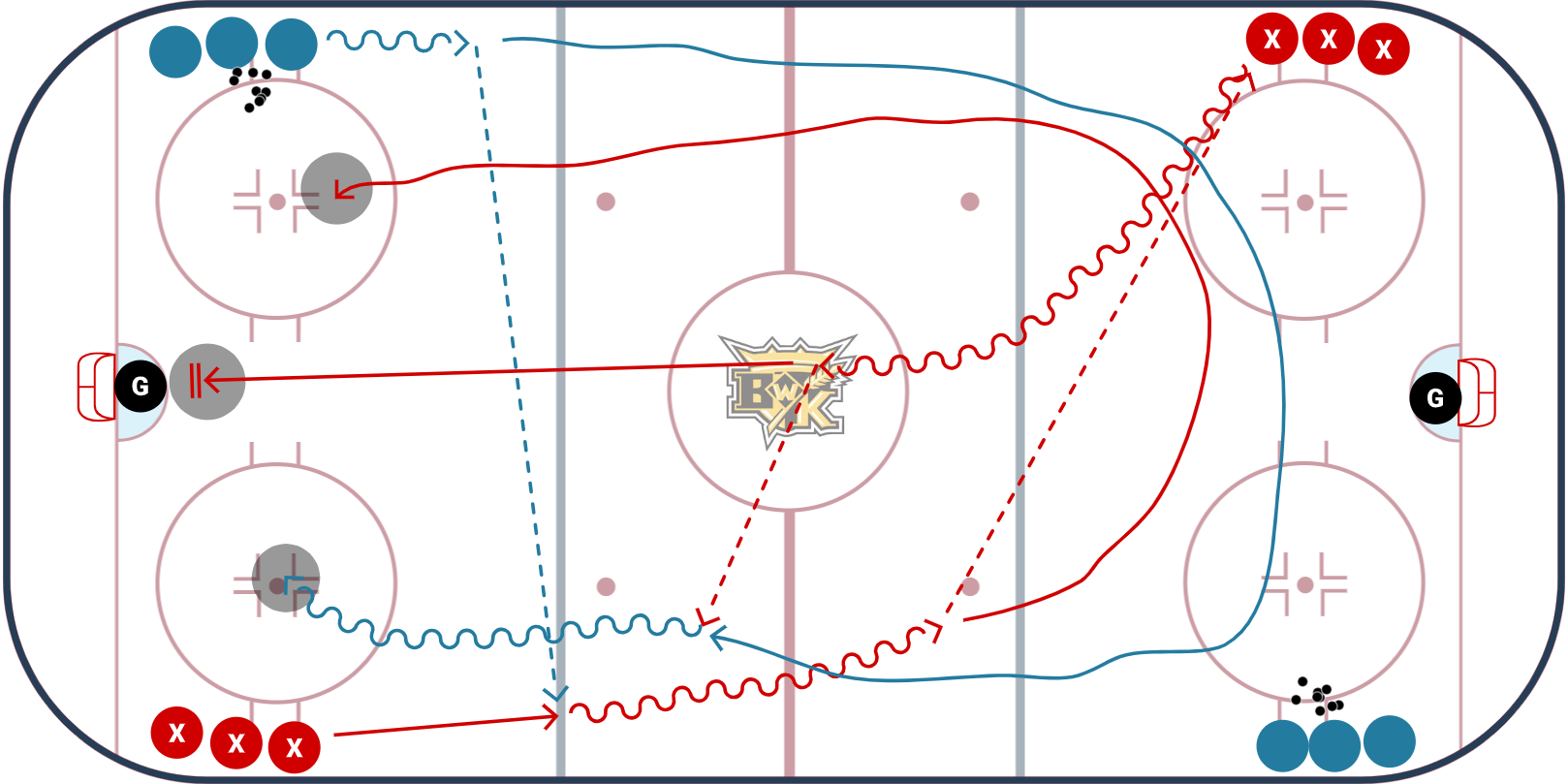
The next progression demonstrates a simple 3-0 that is beginning to show how to incorporate the wide dot lane attacker.
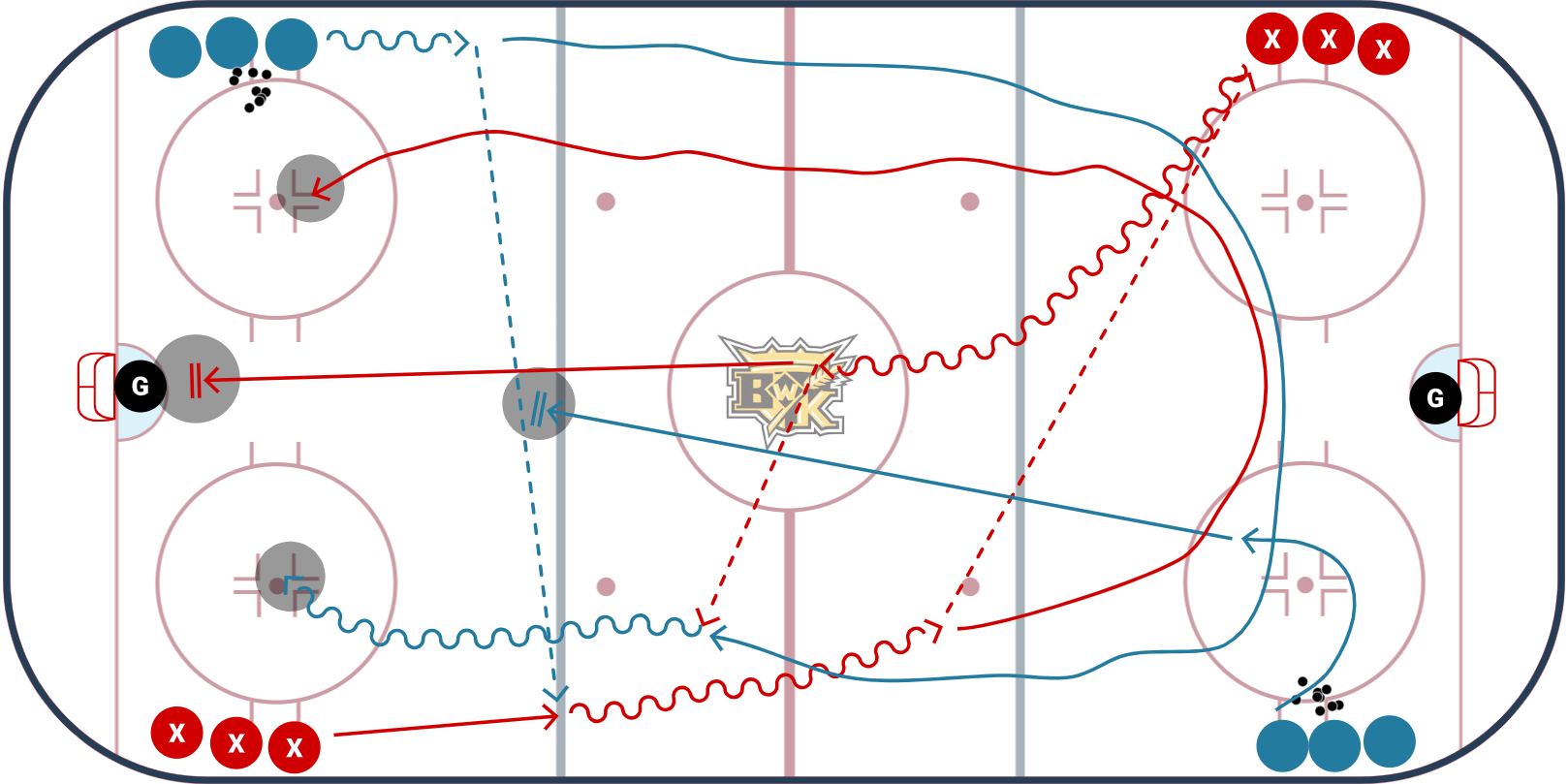
Now bring it home with a four-player attack, the key on the zone entry, is for the 4 players to make a "diamond" look once they finish their routes. Ensure the players are becoming aware of who is F1, F2, F3 & F4 and what lanes they need to fill. The fourth player needs to use their timing skills to avoid leaving too early in the drill. They want to enter the zone as the diamond player in the 2nd rush of attack.
End of content
No more pages to load
copyright (c) 2026 The Coaches Site