Single leg turn on the outside edge.
Gloves on the ice because, you go lower with your whole body. Players have to work with knee. No pressure on the gloves, only touching.
Glide on the edge, long as possible.
 0:00:18
Single leg turn on the outside edge.
Gloves on the ice because, you go lower with your whole body. Players have to work with knee. No pressure on the gloves, only touching.
Glide on the edge, long as possible.
 0:00:18
Single leg turn on the inside edge.
Gloves on the ice because, you go lower with your whole body. Players have to work with knee. No pressure on the gloves, only touching.
Glide on the edge, long as possible.
 00:00:00
Subscribe: Apple Podcasts | Spotify | Google Podcasts
There is more that comes with coaching than the Xs and Os. And coaches shouldn’t feel the pressure to take on building their toolbox all on their own.
Coaches can constantly be learning from each other, not just within their own sport, but from around the coaching community.
Wayne Parro has worked with coaches from across the world, sharing ideas to help grow the game everywhere he goes. In those conversations, he’s learned that the problems in hockey aren’t unique despite what some may think. They exist across the sporting landscape, whether it be baseball, basketball or soccer.
“It’s about communication. As a coach, if you overly communicate with everyone, in this case particularly parents, you’re probably going to get good results,” said Parro. “If you don’t put the effort in, you won’t have a chance.”
In in his time as the Director of International Programs with the Coaching Association of Canada, Parro’s worked with athletes and coaches through roles with Canadian Major Games Organizations. He was the Lead Instructor with the Toronto Blue Jays Baseball Academy, and coached both the Senior and Junior Baseball Canada’s Women’s Team and was an Assistant Coach with the York University Men’s hockey program. He’s also a Facilitator in the OMHA Coaching Program.
A common pre-season team-building session that coaches carry out is setting goals for the season. Parro reminds coaches to get players involved in the process as well, and for them to share their personal goals as part of the exercise.
“Your goals (as a coach) may not align with their goals. Get your athletes involved in goal-setting. That’s the communication that you’re referring to. It’s fine to stand on a bench and give orders or before the game give a motivating speech in the dressing room. Once the game’s over, what’s next? Understanding those individual goals helps coaches build training plans and not only address team goals but individual goals as well.”
Practice isn’t about running specific drills and then having a shootout. When creating a seasonal practice plan, coaches should leave a gap for what the team may need to work on based on recent performance. Have they been struggling on breakouts or powerplays? That’s the built-in timeframe to improve on those areas.
“Take those scenarios, break them down, identify the technical and tactical skills that are required, support it by the physical and mental skills that are required for that scenario that your team is not executing properly. There’s your practice plan.”
Keeping practices engaging while also developing skills is one of the biggest challenges for coaches. It’s about balancing the teaching and the fun of hockey.
“You can get a drill or video and go out and run that on the ice in practice. So, when does the coaching begin? When you’re willing to stop that drill because it’s not going the way it should. You’re going to identify the missing skill and go back and pick it up,” said Ian Taylor, co-host of the podcast.
 0:00:32
A Coach's role in creating and shaping the environment cannot be understated. Coaches who create and train in a safe, inclusive are establishing performance potential. Spend time in preparation to identify harmful potentials (physically, mentally, socially) and adjust your plan to eliminate these factors.
Always seek to match your athlete and team needs so your players will thrive.
 00:00:00
As a kid I played a lot of organized sports — soccer, baseball, rugby, lacrosse, hockey, and football — so naturally I’ve had a lot of coaches. Some of them were volunteer dads. Some were school teachers. Some were former pros. Some were highly experienced and trained. And while a few (too few) of them were good guys, one made the most positive and lasting impression on me.
When I was about 18 years old, as a rookie quarterback in the CJFL, I met the coach who gave me the foundation that I tried to take forward as I moved into coaching — and business — a few years later. What were the takeaways?
He cared. I always felt that he had my back, and that he had confidence in me. As a kid who’d only taken up football in the 11th grade, that gave me the confidence I needed to trust him and, as they say these days, ‘trust the process’. The following season, not only did I become the starter, but he let me call my 99% of my own plays. And together we won a provincial championship.
He never coached the obvious. When he told me that he’d ‘never coach the obvious’ I honestly didn’t know what he meant. But when he explained it, well it all seemed so… obvious. Many times I’d heard coaches say things that weren’t really coaching at all. “You need to complete that pass.” “You’ve got to make that block.” “You’ve got to be faster than that.” As if the players didn’t know all of those things already. As if we forgot. Instead, this guy focused 100% on trying to help me understand and correct either the mental or mechanical mistakes I’d made. He never resorted to blanket criticisms or dumbed-down statements, and I always listened to him, because what he said actually mattered.
He never used conditioning as punishment. As I’d moved into more ‘serious’ levels of various sports, I’d naturally experienced the kind of coaches who would have players run suicides for 15 minutes if they felt things weren’t going well in a practice. Or the guys who’d bag skate players for not immediately grasping a complex drill. ‘Old school’, they liked to call it. This particular coach had a degree in kinesiology, and he explained to me that ‘conditioning’ is what athletes should want to do. He knew that the psychological effect created in young athletes who equate extreme physical exertion with being punished for failure was the absolute last thing a coach should want to create.
He let me fail. Every athlete makes mistakes, and I know firsthand what it’s like to throw a pick-six and lose a game because of it. But the mental part of sport cannot be underestimated, and this coach was a master. He might have gotten this from someone else, but it was new to me: htold me early on, after one bad mistake: “When you throw the ball, three things can happen, and two of them are bad. But you’ve still got to throw the ball.” So that’s why I also know what it’s like to throw for 400 yards and four touchdowns in a championship game.
He communicated. This guy never yelled. He just gave me feedback. Good, bad, or otherwise, he always communicated with me with calm respect, almost as if I were his equal. Looking back all these years later, I have to say it felt like we were a two-man team, and he wanted us to succeed.
I feel incredibly fortunate to have played for that coach. I know he made me a better quarterback, but I also know that he shaped the way I’ve viewed coaching and coaches ever since. I have even more respect for him now that I’ve seen my own kids grow up with coaches who’ve employed various ‘styles’, some of which most definitely rubbed me 100% the wrong way.
What I forgot to mention is that he was not primarily a football player himself. He’d played a little as a kid, but had actually played junior hockey as a young man. But the fact is that I learned the most about myself as an athlete, about what it took to compete and fail and succeed at a pretty high level of football, and, at least in my view, about what it actually means to be a coach, from him.
In my opinion, his approach to coaching is coaching. Obviously.
 0:00:46
Effective warm-ups need our attention as coaches. Have a Trainer, Assistant Coach or other professional monitor warm-ups. As a key to preventing minor and serious injury, an effective routine also drives performance potential. Evaluate your player’s current warm-up.
It must:
Add in a few teambuilders for good measure and you will have a solid pre-practice and pre-competition routine.
 00:00:00
Subscribe: Apple Podcasts | Spotify | Google Podcasts
We close out our look at the five selected presenters for this year’s Global Skills Showcase with Alexandre Chénier, Founder of Hockey Developpement.
A skills coach based in Amos, Quebec, he’s a certified Hockey Canada skills coach, mentor to coaches in the Gold Medal Pathway program, and the Development Coach for Val D’or of the QMJHL.
Chénier's approach to player development is a product of his formal education as a teacher, his relationships in and outside of hockey, his experience as a father and the community he lives in.
Listen as he shares why player development is about connecting skills, why you should always work on the person before the player, and his upcoming GSS presentation on optimizing pass receptions.
VIDEO TIMESTAMPS:
 00:00:00
Visualization can be a game changer for athletes.
Unfortunately, most athletes are not consistently nor effectively using this simple but powerful strategy.
The problem is you either don’t realize the impact or you don’t know exactly what you should be doing.
The good news – that changes today.
There is an abundance of research highlighting the positive effects of visualization, but the story of Major James Nesmeth is by far the most compelling:
Major Nesmeth was an average American golfer and generally shot in the 90’s.
However, his golf game was put on hold as he left for the Vietnam war.
Unfortunately things took a dark turn, as he was captured and became a prisoner of war. He was imprisoned in a small cage, 4.5 ft long and 5 ft tall – preventing him from standing or doing any physical activity.
As you can imagine the conditions were less than ideal and took an incredible toll on his body and mind.
At first, he just sat there and hoped he would be saved. But eventually he needed to do something with his mind to help dissociate from where he was and prevent his spirit from being completely depleted.
So, he started visualizing playing 18 holes, and often 36 holes of golf at his favorite course. He would close his eyes and vividly imagine walking through each hole and playing every shot out in his mind.
The more he practiced visualizing, the more real the sights, the sounds, and the feeling of playing became. It was like he was literally there playing.
This went on for 7 years!
This in and of itself is an amazing feat to survive for that long under those conditions.
But the best part was after being released and coming home – all he wanted to do was go play golf at his favorite course.
Of course, he took a week or so to get some proper food in him and get adjusted back to life at home.
Then without actually swinging a real club in over 7 years, he plays his first round.
He shoots a 74 – his best round ever and gets a hole in one!
*Note this is based on a real person, but the story has been told so many times and is all over the internet with different variations.
That is the power of your mind.
By consistently mentally rehearsing, you can improve your performance without actual in-person practice.
We see this effect with athletes returning from injury. They come back better than before they were injured – because they lean into consistent and effective visualization.
To be clear, you will get the best benefits by combining visualization with actual practice.
Here are the 5 key to effective visualization:
This is all about the five senses: sight, sound, touch, smell, and even taste. In addition, you need to tap into how you want to feel emotionally when you play your sport.
You want to visualize from a first person point of view and in real time. You are trying to make it feel as close as possible to you actually being there and playing your sport.
The realer it feels, the better.
Visualization itself is a skill you will get better at with practice.
It also might be better for you to focus more on the sounds and physical feeling than the visual images.
Regardless, don’t make the mistake of over focusing on what you are doing and not how you want to emotionally feel while you do it.
One of the secret weapons of visualization is to actually prepare for potential distractions or stressors – like pressure or adversity.
This is what Todd Herman calls the “positive power of a negative script”. It is more formally known as coping planning – where you plan how you will respond to stressful situations.
Simply put, you want to visualize a situation where you might start to feel frustrated, anxious, or distracted, but you are able to quickly reset, get centered, and move forward.
This does not mean you visualize yourself making a mistake or a bunch of negative things happening, it’s about the moments after. It is your response when you feel yourself being pulled away from the zone or your intended mental state.
By mentally rehearsing for these potential stressful situations, you will be well prepared to respond effectively when they do arise.
This can be the difference in:
The fundamental idea of visualization is to imagine how you want to show up and play.
Unfortunately, most athletes focus too much on what they want to do and the results, and they miss how they want to feel while they do it.
The majority of your visualization should be about the process, not the results.
It is all about what you do and how you do it that leads to the results. You can and should visualize the intended results, but the benefit is in rehearsing the process.
The process is made of two key components: your actions and your emotions. In other words, what you do and how you feel while you do it.
Mentally rehearsing the way you want to feel is the most important part.
If you do visualization of yourself making a play and achieving a result without any emotion – you will be just going through the motions and missing a key ingredient.
But when you fill your visualization with how you want to feel while making that play, now you are tapping into the full power of your mind.
Think of it this way, you might not do the play exactly as you visualize, but you will want to feel exactly as you visualized. The mental state comes first, the actions comes second.
Another major mistake athletes make is only doing visualization on game days.
If you only visualize two times per week you are missing out on the massive benefits of the compound effect.
It’s like going to the gym to get stronger twice a week versus five times – the difference is huge over time.
I recommend you visualize 4 to 6 times per week for 5-10 minutes per day while you are in season or approaching an upcoming competition.
This consistent visualization will benefit your practice habits, but it also helps you stop putting games on pedestal.
When your mental preparation for games is much greater than practice, you are making them bigger than what they are.
Although practices and games are different, they are more similar than you think. Whether it is a practice or a game your job is to play with confidence, learn from your mistakes, and keep moving forward.
By mentally rehearsing on both practice and game days it will help you keep perspective and perform under pressure.
High quality and vivid visualization is a mentally demanding task.
This is why it is recommended to only visualize for 5 to 10 minutes per day.
Similarly, you want to be mindful of the setup and timing to ensure optimal results.
A common mistake athletes make is doing their visualization laying down in bed before they go to sleep. This can work for some and it might spill into dreaming about it, but the problem is you will likely be too tired, the quality will suffer, and you might fall asleep without even finishing.
Instead, you want to find a time that works for you. It could be in the mornings or closer to your practice or game – pick a time when you are mentally fresh and that works for you, then stick to it.
I recommend 3 hours to 30 mins before your practice or game.
Two setup tips to consider are finding a quiet place and getting into a comfortable position. You could listen to music during the visualization if it helps, but we recommend not to so your full attention is on the task at hand. Secondly, most athletes sit up straight while doing their visualization, but you could lay down – just don’t fall asleep.
An important piece to optimize your visualization is creating a script. Here is the general template of the scripts we use with our 1-on-1 clients:
STEP 1: Take 3 deep breaths.
STEP 2: Reconnect to your why – going back to when you first fell in love with your sport.
STEP 3: Coping planning – key #2 from above where you prepare for 3 potentially stressful events and how you will respond.
STEP 4: Action planning – key #3 from above where you review your process on key plays you want to make (this is the majority of the visualization).
STEP 5: Past success – if you have previous success you can relive some of the key moments to reinforce what you are capable of doing.
STEP 6: Take 3 deep breaths.
Some athletes enjoy listening to a visualization recording. This walks you through the different steps and gives you prompts to keep you on task.
We have pre-recorded visualization scripts for hockey forwards, defense, and goalies. We will be adding to this library for other sports – so if you want one for your sport send us an email at info@cepmindset.com
_______________________________________________________________________________________
In summary, follow these 5 keys for effective visualization:
I hope you found this helpful – please share it with anyone you think would be interested.
 00:00:00
Years ago, I stumbled upon a transformative book called "Hockey Tough" authored by Dr. Saul Miller, a performance and sport psychologist. I read the first edition back in 2010 and then the second edition again in 2022. The book changed my perspective on the entire game of hockey to such an extent that I reached out to Dr. Miller personally to thank him. Today, he is now my mentor.
Through his expert guidance, I have been exposed to the intricacies of sport psychology and have discovered powerful strategies that forever changed how I help others. I have also changed how I plan, approach, and play this amazing sport. It has been an honor to be under his wing for the past year. I want to share with you six compelling reasons why you, too, should consider enlisting the services of a sport psychologist.
Hockey must be viewed as a sport comprised of three components: 1. Physical, 2. Skills, and 3. Mindset. The first two receive the most attention because they are about strength, skating speed, the ability to handle the puck well, and shoot. However, every great hockey player will eventually start to look like everyone else on the ice. They can skate well. They can shoot well. They can make great plays. What separates the great ones from the good ones is the third component of mindset. It is a sport psychologist who can help sharpen that precious asset. A trained professional will develop personalized mental conditioning programs tailored to your hockey needs to help unlock that next layer of personal greatness. These custom programs focus on improving crucial mental skills like focus, self-reflection, emotional control, goal-setting, and visualization. By honing these skills, a hockey player can boost their overall performance and gain a competitive edge over their opponents.
Nervousness and performance anxiety are common challenges faced by athletes before big games or competitions. With that being said, there is a common Peformance/Arousal chart which is used by most professionals. It looks something like this:
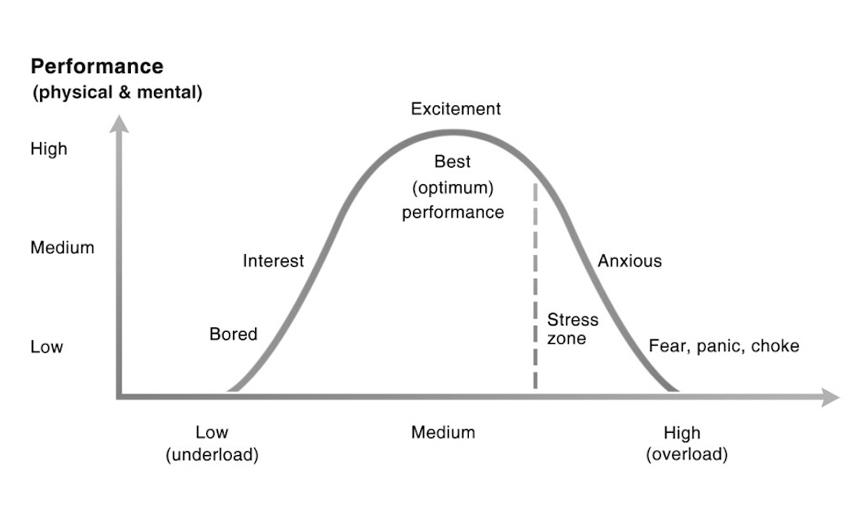
A beneficial task surrounding the arousal performance relationship would be to have hockey players self-reflect and measure how they score in relation to the Inverted-U. Collecting this data is helpful in unpacking where an athlete resides emotionally. In the case of hockey, a player needs to be at the top of the Inverted-U. If they are too far to the right where it slopes downward, the athlete is too confident and may be overthinking. Conversely, if they are situated in the lower left, they lack confidence in their abilities. A sport psychologist can help unpack these truths then create strategies to help the athlete get to a heathier mental state in the way of relaxation techniques, breathing exercises, and coping strategies to manage pre-game nerves effectively.
Hockey is a game of managing chaos. Setbacks and failures are inevitable. Outside factors can pollute your team. Unexpected circumstances can emerge. Unpreditablility is guaranteed. It is how one handles these moments that makes one resilient and mentally tough. I love how author and sport psychologist, James Loehr, defines mental toughness.
"The ability to consistenly perform at the upper range of your talent and skill, regardless of circumstancs and outside factors."
A sport psychologist can teach you how to perform at this level and bounce back stronger from disappointments. In addition, he or she can empower you on how to use those setbacks as learning opportunities for personal and professional growth.
There is a great book by Ash Ali and Hasan Kubba titled the "The Unfair Advantage: How You Already Have What it Takes to Succeed." The main premise of the book is each one of us possesses an unfair advantage - an element that gives you an edge over your competition. Perhaps it is your education, your heritage, your technical skills, and so forth. Think about a superpower or a collection of experiences you have which separate you from the competition. Identify it then maximize it. A sport psychologist will help you pinpoint that unfair advantage and utilize it to level up your game.
Every hockey player experiences slumps or plateaus in their performance at some point. When this happens focus is often lost and must be regained. A sport psychologist can teach you how to eliminate distractions, stay present in the moment, and remain focused on the task at hand. Improved focus can lead to better decision-making and execution during critical moments in the game. When this happens slumps and plateaus are eventually overcome. In addition, a sport psychologist can help you identify some of the other underlying causes of these performance dips and provide strategies to overcome them. Whether it is addressing mental blocks or resetting goals, a trained professional can guide you towards getting back on track.
Earlier, I mentioned the work of my mentor, Dr. Saul Miller. One of the lessons he taught me in our first session was the definition of confidence since it is the lifeblood of any succesful athlete. In the case of hockey where split-second decisions and precise execution can make or break a game, confidence is paramount. So, how can confidence be defined? There are three foundational principles: previous success, planning and preparing, and having a positive self-image. All three must exist in order for an athlete to be truly confident and comfortable in their own skin. As you can imagine, a sport psychologist can work with you on these three pillars to create unshakeable self-belief.
Hiring a sport psychologist can be a game-changer for hockey players of all levels. By tapping into the power of the mind, these professionals can help you fine-tune your mental skills, overcome obstacles, and achieve peak performance. From managing pre-game nerves to building resilience and confidence, the benefits of working with a sport psychologist extend beyond the rink and can positively impact every area of your life. So, if you aspire to level up, consider enlisting the expertise of a sport psychologist and unlock your full potential.
 00:00:00
Yogi Svejkovsky is the Director of Coach Development & U17 Prep Assistant Coach with Delta Hockey Academy, as well as Skills Coach with the Vancouver Canucks & AHL affiliate Abbotsford Canucks. Previously a first round pick of the NHL’s Washington Capitals, Yogi worked as the Skills Coach for the Vancouver Giants of the WHL from 2006 to 2018. Kris Beech is the Development Coach for HV71 of the Swedish Hockey League. He is the Founder of AIM Mindfulness and is a Certified Mindfulness Instructor (McLean Meditation Institute 2015). He earned a Masters of Science in Sports Management from Ulster University in 2016. He was selected 7th overall pick in the 1999 NHL entry draft by the Washington Capitals. He played seven seasons in the NHL and eight seasons in Europe.
The two combined for a look at Situational Passing and Receiving Progressions. The presentation focused on the qualities of a good passer and receiver, and how to improve playmaking ability under pressure. Often one of hockey’s forgotten skills, build up a player’s vision with these effective drills.
DESCRIPTION
KEY POINTS
DESCRIPTION
KEY POINTS
DESCRIPTION
KEY POINTS
DESCRIPTION
KEY POINTS
DESCRIPTION
KEY POINTS
End of content
No more pages to load
copyright (c) 2026 The Coaches Site