Check out these drills from Greg Revak's 2023 TCS Live presentation on Simple Ways to Better Coaching.
Greg Revak is a certified Level 4 USA Hockey coach and a coach developer within USAH’s coach education program. He coaches Worthington Kilbourne High School (Ohio). When not at the rink, Revak hosts the Hockey IQ Podcast and authors the Hockey IQ Newsletter; he has also published nearly 30 stories as a contributor to The Coaches Site.
Revak presented on simple, effective ways that coaches can accelerate their players development. These drills are examples that reflect “coachless,” “whistleless,” and many other great developmental principles.
2V0, 2V1, 3V1, 3V2
DESCRIPTION
F1s on the blueline start 2v0 against the goalie.
D1 pops out to play 2v1 full ice after F1s pick up a puck in the corner.
D2 pops out to play 3v1 full ice after F1s add a player with a puck out of the corner.
Two D3s pop out to play a 3v2 full ice after F1s pick up a puck in the corner. This is continuous as the next line of F2s start with 2v0.
Pit the defense against the offense by determining how many goals the offense needs to score. If they score less than that amount, 2 hard laps.
KEY POINTS
Odd-person rushes progressively become more complex.
Continuous/whistle-less drill.
Coaches are able to use their coaching skills (Observation, question-asking, checking for understanding, etc.) rather than running the activity.
2V5, 5V5
DESCRIPTION
5 players line up similar to an opening faceoff. They are to always break out the puck that is dumped in.
They will start against 2 forecheckers before building up to 5 forechecking players.
5 forechecking players lineup at the far blueline.
Each time the team successfully breaks the puck out, they pass to the next forechecking player in line.
The pass receiver ensures the get over the red line before dumping the puck in and forechecking. The players that forechecked tag up at the red line and forecheck again.
Once all 5 forechecking players have been added and the team breaks the puck out, there is a reset and a new set of 5 takes their turn at breaking the puck out.
KEY POINTS
Breakouts progressively become more complex.
Continuous/whistle-less drill.
Coaches are able to use their coaching skills (Observation, question-asking, checking for understanding, etc.) rather than running the activity.
1V1 FULL ICE ANGLING
DESCRIPTION
Attackers on the far blueline with angling defenders on the far neutral zone dots. Once eye contact is made, the activity starts.
This is a continuous/whistle-less activity.
KEY POINTS
Angling within an unscripted environment.
Continuous/whistle-less drill.
Coaches are able to use their coaching skills (Observation, question-asking, checking for understanding, etc.) rather than running the activity.
In episode #249 of the Glass and Out Podcast, we're joined by Cody Royle, who holds the position of Coach of Head Coaches.
Royle coached Aussie rules football at an elite level before leading Canada’s men’s National team. He is also a coach to 17 Head Coaches across 6 different teams sports, in 5 countries. These coaches are some of the top performers in their respective sports. His work is connected to the belief that the greatest advantage in professional sports is in optimizing the Head Coach.
Listen as he shares why teams become their leaders, why fear is a player's number one obstacle to success, and coaching isn't an art or science, but a craft.
Practice time can be some of the most valuable in minor hockey. It gives your team the chance to work on skills, understand new concepts and put in the effort that will show during games.
It’s more than just drills - those are part of the environment you are looking to create. Practice is about coming to the rink prepared to be in an atmosphere for learning.
“Players need to understand and know what to expect when they come to the rink and what’s expected of them. The first step is defining ‘how’ we practice,” said TJ Manastersky. “What does it look like and what are some of our methods? We want to play fast, so we are going to practice fast. We aren’t going to go to a whiteboard on the ice. We can share that practice plan in advance the day before.”
Manastersky is the Head Coach of the Brock University men’s hockey team that finished at the top of the OUA West division in U-Sports this season.
To keep practices fresh, he suggests theming your days. This will also assist in the preparation for coaches and players as both will know what to expect when coming to the rink. Coaches can target one or two concepts they want their players to understand at the particular practice and build around it. His coaching staff have several drills that can accomplish the learning outcome that they are looking to achieve.
“The drills change within it, but they know what they’re getting into so that they’re mentally prepared. Setting them up that way helps them perform and learn.”
Coaches should consider what the drills are before and after and how it will all flow within the practice.
Familiarity with their team is an advantage for a coaching staff. Manastersky says to allow players time to figure out a new drill and that it’s okay if it looks messy to start off.
“You have to consider some space for your athletes too. You can’t constantly be on them about this or that. You have to allow them to play a little bit too. There’s an art and feel to that.”
When it comes to planning out the practices, have an idea of how long each drill will run for. The coaching staff should know who’s in charge of the whistle, who’s setting up each drill and who’s running each drill.
From there, it’s about monitoring how players are responding to what you are trying to teach them.
“It’s the message that’s received that counts. That happens a lot. You feel like you’ve delivered the message, but you can tell that it hasn’t been received the way you intended it because of the look they’re giving you or the way they’re actually performing it and clearly aren’t grasping what you’re getting after. At that point, is it a one on one conversation or is it a small group thing?”
In the end, coaches are the ones who set the tone in making practice fun. By playing competitive games and being personable, it can go a long way with the players.
“The attitude and energy that you bring to the rink is step one. Come out with some enthusiasm, a smile on your face, you’re buzzing around, talking to the guys and girls, fist bumps, shin pad taps, joking around… that’s such a great opportunity to interact with people.”
In episode #251 of the Glass and Out Podcast, we're joined by Ian Gentile, the USHL’s Vice-President of Hockey Operations.
In his role, Gentile has his hands in a numbers of areas that influence player development. His job description includes the USHL's central registry and drafts, player safety and supplemental discipline. The league's recent success has resulted in it becoming a major source of NHL talent. In fact, last season saw 51 players with USHL ties selected in the NHL, marking the sixth consecutive draft that over 50 players had been chosen.
Previous to his role with the USHL, Gentile spent 13 years with the Chicago Blackhawks that saw him hold the role of Senior Manager of Player Development and win three Stanley Cup Championships.
Listen as he shares the importance of putting an emphasis on the mental wellness of players, why parents should be encouraging their kids to play multiple sports, and why the USHL has become a major source of NHL talent.
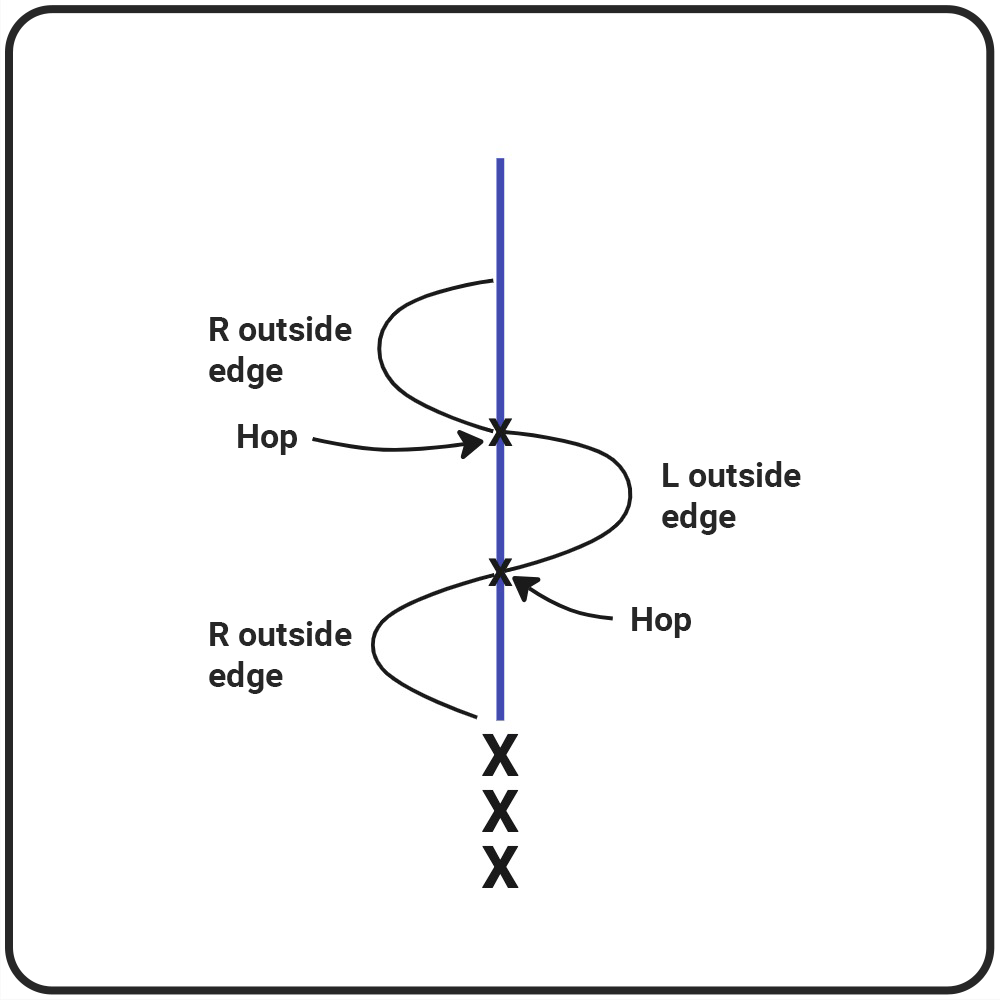
Supporting her presentation on Skating Exercises to Develop the Outside Edge, Jill Plandowski shares this skating drill that works on control and balance while using the outside edge on one foot.
In episode #252 of the Glass and Out Podcast, our guest is Philipp Pinter, Head Coach of both Austria’s U18 and U20 National Teams.
If you didn’t grow up in Austria and play for the National Team, then it might be easy to focus on the reasons why Austria can’t be successful internationally. But Pinter doesn’t seem overly concerned with that. What he does seem focused on is creating a learning environment that makes his passion for hockey and representing Austria internationally contagious.
In addition to his coaching role with hockey Austria, he was recently named the Sports Manager for the Graz 99ers hockey club.
Listen as he shares why you have to first set yourself on fire before inspiring others, being your authentic self as a coach, and the importance of being an active listener.
Former TCS Live presenter Dr. Jody Carrington believes there is no such thing as a bad kid.
“If the coaches aren’t okay, the kids don’t stand a chance,” she says.
Coaches can come up with all of the Xs and Os or pour over video, but a large part of what it means to be a leader on a minor hockey team is creating those valuable connections with your players.
Carrington is a child psychologist who ahs worked with over a thousand kids. For her, it’s about leading by example through showing the players how to be great people and great teammates. Hockey is the perfect environment for kids, as they have to leave the house and come to the rink to interact face to face. There, they can learn how to lose and win, how to be inclusive and all the other life lessons that come along with the game.
“The number one predictor of a successful coach moving forward will be your capacity to regulate emotion in times of distress. To stay calm with stuff starts to go awry. When the parents start to question, because they will. When the kids start to push back, wen the ref makes a bad call.”
Hockey helps players overcome that loneliness and disconnection that you get in front of a screen. Creating those connections on a personal level and learning about the lives of your players shows that you care about them more than just being a skater.
“You can see how fast I can get a kid to skate when I know the name of his dog.”
Carrington says it comes down to three words: Tell me more.
When kids have the ability to open up and explain their feelings, it can unlock more of their thought process behind their actions.
“It just becomes so much more than sport, to me. I just wish those coaches who lose sleep over their players, who write plans at three in the morning, who give their heart and soul and get very little recognition other than ‘why’d you bench my kid?’. I want you to know how grateful and how holy this work is. These kids will think about you ten times more than you think about them for the rest of their days.”
No matter the amount of wins and losses, it’s easy to see if a child had a positive minor hockey experience at the end of the year.
“I want there to be a joy at the end of the season. I want them to already be talking about next season. That is such an indicator of success for me… The season is over and my son is shooting pucks every morning. That’s my definition of success. He loved it.”