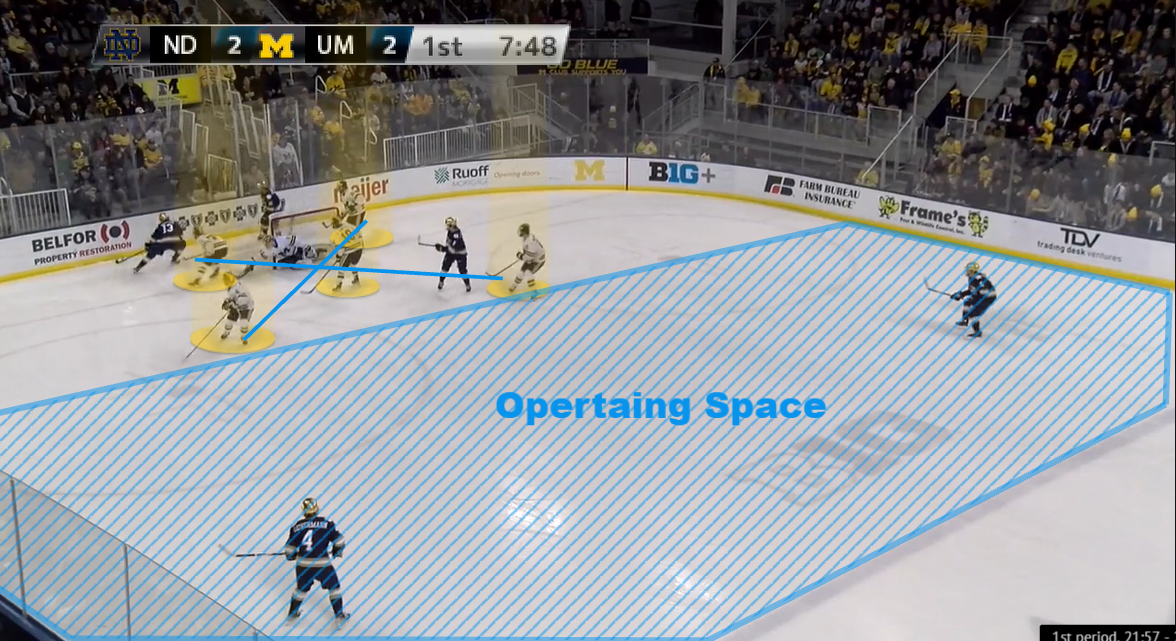
A major key to strong offensive zone play is creating time and space to operate cleanly without pressure.
Coaches are always looking for loopholes in the opposition’s defensive zone structure to find these opportunities.
This particular example lies in the defensive team’s approach to defending a puck that’s behind their net. Most teams will have all 5 players retreat to the slot/house and form an X pattern or what’s commonly referred to as “5 on a die”.
As the defending team collapses to protect the house, the offensive Defensemen are generally considered a secondary threat. Delivering the puck to an offensive Defensemen (from behind the net with an indirect/bank pass) not only gives them room to operate but also creates a better puck to control. As the puck bounces off the half wall it naturally leads the Defensemen towards middle ice. The puck will also have less spin than a direct pass, which is an easier 1 time shot or sprint to mid ice for the Defensemen.
The opposition’s winger (who is responsible for this Defensemen) has a lot of distance to cover and low percentage chance of getting out to the blue-line in time to disrupt or create a turnover…their best option is a shot block.
The attached video & images shows this concept in action, notice the operating space the offensive Defensemen has been allotted by a properly delivered puck.
What you typically see at the minor hockey level is the offensive forward with the puck (behind the net) will skate it to the corner or up to the half wall before telegraphing a direct pass to the Defensemen
Defensemen should understand this concept and have a thermometer for what kind of pucks they are receiving. If your Defensemen have with limited operating space and struggle to attack middle ice, one possible issue could be the quality of pucks they are receiving from down low.
In a future article we’ll explore this concept further, specifically power play exchanges.
Today, I want to introduce you to the idea of ‘body shape’ and break down what goes into a great hard, accurate shot. Let's start by looking at a great shooter, Steven Stamkos. Just look at this goal from the 2020 NHL Stanley Cup Final Game 3.
We all know Stamkos has an elite shot, but what are the key elements in there that make him an elite shooter?
1. Body shape
Body shape is the position in which a player’s body contorts to when shooting a puck (Note: this also could apply to passing). Without a consistent quality body shape, players will struggle with accuracy and power. Within body shape, there are two axis -- vertical and horizontal. This can be simply thought of as:
Keeping chest/shoulders over toes
Staying balanced (not leaning over left or right)
Take a look at the tape:
Clip of the day - Shooting, body shape
Great shots have a distinct body shape - Chest leans forward & give downward force into the shot
Many youth shooters you’ll notice lean back - either bad technique or lack of strength. Easy for a goalie to read
Stepping strong foot -- a player steps forward onto their inside leg. That step/compression drives downforce.
Releasing knee -- a player releases their inside knee. That release allows immense downforce by the player falling onto their stick.
What not to do
Now that we’ve learned what to look for, let’s see an example of what not to do. Jamie Benn gave us a perfect example:
Open shoulders
Leaning back
Off-balance, leaning left -- Naturally this will drag the shot left. Mentally he would need to reprogram his brain to aim further right to have a chance at hitting the net.
Sweeping motion rather than driving downforce into the ice
Watch warm-ups of any youth or adult league game and you’ll see this poor form as players go around in ovals shooting pucks. Usually, they’re missing the net high and making that *dunk* noise against the glass… Congrats on your new pet peeve.
2. Downforce
The hallmark of Stamkos’ shot is in how he drives force into the ice and creates flex in the stick. Stamkos is great at transferring his weight into his shot. The torque generated creates his powerful shot. Here’s an example of Nathan MacKinnon dropping his body weight and pushing into his stick. There is very little sweeping motion like you’ll often see with youth/adult players.
Now Mackinnon’s shot
Jumps into his shot with great downward force
Pulls it off his left foot to his right foot (never in the middle) where he can drive his weight down to create tremendous force to rip it by a hopeless goalie pic.twitter.com/042jnMKvAf
Great shooters position their top hand away from their body and pull back violently. This turns the stick into a lever to create power. The top hand creates the most important part of the lever, the farthest point from the load (the puck). For the science nerds out there: Work (total power) is the force times the distance, W = Fd.
Shooting technique
PLAYERS - Making sure to get get your top hand away from your body to allow the stick to be used as a lever
Top hand is the critical piece for stick skills, including stickhandling as well pic.twitter.com/PuCUtTGOfF
When teaching shooting to yourself or to others, body shape is a vital concept to understand. By starting with quality body shape (shoulders over toes) you’ll be in a great position to execute a consistent, hard, and accurate shot.
Hockey seasons are long and the off-season is short, so properly preparing makes your season much more manageable, enjoyable & successful.
For many of us, tryouts are over and there’s a weird lull between now and the hockey season officially starting. For some, there is little ice time, and even fewer chances to play games. Which is ultimately a positive as everyone should get a bit of a break and have the ability to play other sports.
For coaches, however, it can also be a time to reevaluate your past season, learn about your new roster, and focus on your own education as you prepare what your first practices or training camps will look like. Here are three tips to make the most of your off-season.
1. Reevaluate your own system
When I say system here, I don’t mean what you run on the ice for your forecheck or power play, but instead, I mean how you structure your practice, what you say or don’t say in the locker room, or how or what you teach your players.
Make a list of the five things that went really well in the prior season, or even last few seasons. Now do the opposite and list five things you think went poorly.
Now first, focus on what you don’t think went well. How can you fix those? One thing that stood out for my team was our passing game. I felt we were too selfish in our games, got out passed, and created a lot of turnovers by holding the puck for too long.
To fix that, I am introducing a few new drills early on in the season to put an emphasis on passing. To couple that with off-ice work, I have some dryland games we will play as well that help familiarize themselves with their teammates and help promote passing and working together.
However, this new emphasis on passing conflicts with the practice plans I had originally thought I would use this season because one thing I thought went well was our practice flow and use of the ice.
This isn’t a major contradiction, but it does point out how these reevaluations are more than just replacing the bad, you do need to look at the good and ensure they play a role in undoing the bad of the previous season.
2. Reevaluate your drills
We all have drills we love, but do they work like we think they do? Can we make them better? Study after study has shown that game like situations develop players at all levels much better than static, fixed drills. Yet, some of the best drills we know that teach important aspects of playing the game are static and fixed.
With how precious ice time is, can we afford to keep promoting such drills, or should we find new ways to teach the same techniques?
Look no further than NHL development camps for insight on good versus bad drills.
The Columbus Blue Jackets are seen here in a video found on Twitter, sending a player in alone, with just a little pressure by a coach, getting easy passes and the ability to get off an easy shot.
While coaches may be able to evaluate this player a bit here, what are they evaluating? His ability to make great plays in unrealistic situations without any pressure from other players?
Compare this to another development camp run by the Pittsburgh Penguins who are known for using a more USA Hockey model and small area games.
Here, the players are playing a 2-on-2-on-2 game, which can develop into a 3-on-2-on-2, using 2 nets on the same goal line. It doesn’t look exactly like a game, but it has players moving much faster and competing against each other.
Because the game mimics a more game-like scenario, you get a much better idea of what these players can do and how well they work together. Almost every aspect of the Blue Jackets drill is in here, but it’s far better for development overall.
So with your downtime, take the time to see how you can improve some of your favorite drills and make them more gamelike and find creative ways to further promote player development.
3. Come up with a plan to evaluate success and pivot if necessary
How are you going to measure success this season? It’s easy to say you will measure success on wins and losses, but what if your team was going to lose or win anyway? Maybe you’re already stronger or substantially weaker than the competition you have to play. How can you ensure you’re progressing and developing along the way?
One way to do this is to regularly ask your players to fill out an anonymous survey, and this can be as simple as one question: “Are you having fun at practice?” You can make that a yes or no, or a 1-10 scale.
Players of all ages learn better when they are enjoying themselves. If you learn players are not having fun, look at possible reasons why. Are they waiting in long lines? Are the drills creative enough to push them to think, but also give them the space to play the game?
On top of fun, set some early season goals for the team. What weaknesses did you spot early on that can be developed? Bad skating habits, poor passes, weak shots, or maybe bad decision making.
At regular intervals throughout the season, find ways to check in on those skills and honestly evaluate if your team is progressing. If they are, that’s great, now you can start to layer in more complexity to continue to improve them. If you’re not hitting those goals, be ready to pivot your plans and either bring in new drills or games to build upon them, or if necessary, take a few steps back and find a new strategy.
But when planning your season, you need to know when you will evaluate these things and how. Once the season is going, we know it’s hard to keep track of all the details, so knowing beforehand when, and how you plan to do this will make the task a lot easier.
Hockey seasons are long and the off-season is surprisingly short, so taking the time to prepare makes a long season much more manageable, enjoyable, and successful.
Small Area game that promotes checking and physicality. Players should focus on boxing out the attacking player while keeping there hands and stick down.
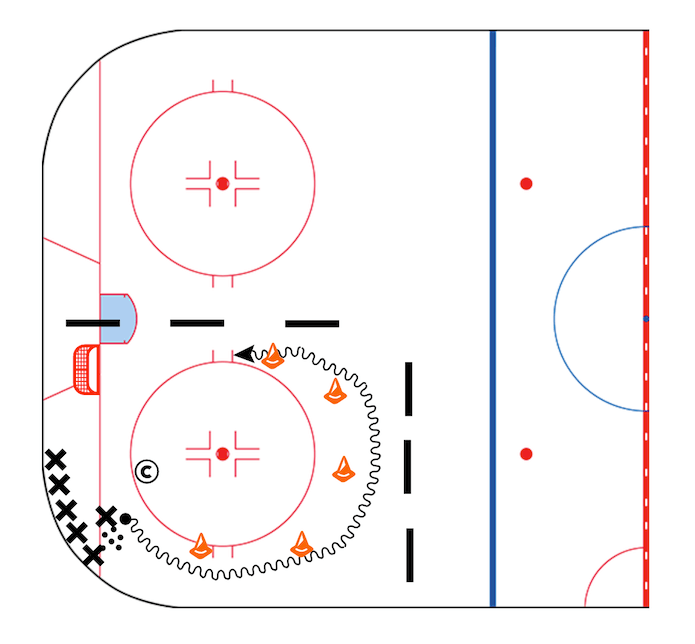
Around the World Puck Handling develops players ability to use their edges and their hands at the same time. Have players roll their wrists and push off their edges.
Description
Coach places 4-5 cones in the drill area around the top of the circle.
Players line up in the corner.
First player skates with a puck to the first cones and performs puck handling while they move. Using their narrow puck handling and their edges to get around the outside of the cones.
Players then move around the cones repeating the pattern.
After the last cone player moves towards the net and shoots before returning to line.
Once a player is past the top cone the next player may go.
Key Points
Reinforce proper narrow puck handle technique:
Hands shoulder width apart on stick and out in front away from body
Stick blade flat on ice puck stay as close to heel as possible
Rotate hands so blade slightly goes over puck, cupping the puck with backhand and forehand
Puck stays in front of body inside shoulder width
Encourage players to slow down to work on puck handling technique
Make sure players practice movement to the backhand and forehand. (change direction and line/net placement).
Welcome back for season 7 of the Glass and Out Podcast! For epsiode #226, we’re joined by friend of the pod and Edmonton Oilers Head Coach, Jay Woodcroft.
He is entering his third season as the Coach of the Oilers, with the best winning percentage of any coach in franchise history. Last season, the Oilers were eliminated by the eventual Stanley Cup Champions, the Vegas Golden Knights, in round 2. This season it’s fair to say there is only one goal in the City of Champions.
Listen as shares his philosophy of repurposing disappointment, why it’s important to “walk the talk” when it comes to building culture, and how a similar path in coaching led to a friendship with Miami Heat coach Erik Spoelstra.
Whether you’re a first-time coach or a seasoned volunteer, the U6 Minor Hockey Curriculum makes it easy to create fun, engaging practices that keep kids smiling, moving, and falling in love with the game from day one. This curriculum is designed to equip you with the knowledge and skills needed to create engaging and age-appropriate training programs for young hockey players.
This curriculum, free for TCS members, features:
A Comprehensive Schedule
Learn how to design complete hockey practices for U6 players. The players will love it and so will the parents!
Expert Guidance
Gain insights from seasoned hockey coaches with years of experience in training young players.
Practical Application
Put theory into practice with hands-on activities and drills that enhance skill development.
In episode #228 of the Glass and Out Podcast,we welcome Manny Viveiros, the new Head Coach of the WHL’s Vancouver Giants.
Viveiros has had an incredible journey of ups and downs, including a battle with two types of cancer during his season coaching the AHL’s Henderson Silver Knights. Thankfully, just prior to last season, he was deemed cancer free!
Listen as shares the how an emphasis on mental health helped him in his battle with cancer, lessons learned during his season playing for the legendary Herb Brooks, and how to implement pace into your team’s play.
VIDEO TIMESTAMPS:
1:30 How the WHL has changed since his playing days