
From Brian Slugocki, 1v1, must pass to the outside before shooting.
 0:00:06
Freeze Tag Stickhandling Game
Great large group game. Taggers carry foam noodles. When frozen players must use different skills on frozen players to unfreeze their teammates.
Examples include,
- through the legs
- under the stick
- toe drag
- Switch pucks
- give and go
- complete tight circle around frozen player
 0:00:11
Circle Escape
The goal is to escape the back of the circle without getting tagged. Can use a marker or cones to make the escape area smaller. Games like this allow coaches to work on several skills at once. Progress to adding a puck. We go 5 in a row then switch. Repetition without repetition.
 00:00:00
Bringing the Juice, with Lennie Childs
Subscribe: Apple Podcasts | Spotify | Google Podcasts
In episode #258, we're joined by Lennie Childs, the newly named Head Coach of the USHL's Omaha Lancers.
This comes following a two year run at Union College, where he worked under Josh Hauge. Previously, Childs spent time with the NAHL's Janesville Jets and the USHL's Des Moine Buccaneers.
As you'll find out, Childs's energy is infectious and he is clearly riding a wave of momentum right now. The USHL has a long and impressive list of coaching alumni that has moved on to college, pro, etc. and it wouldn’t surprise us in the least if down the road, he joins that club.
Listen as he shares why you always need to bring the juice, the importance of standing with your players through the good and bad, and coaching in the generation of "me."
VIDEO TIMESTAMPS:
- 0:00 Sports scene in Omaha
- 1:55 New role with Lancers
- 5:40 Coaching at Union College
- 7:20 Playing career influencing coaching
- 10:25 Bringing energy to the team
- 12:30 Implementing practice habits
- 19:00 Creating a fun team environment
- 21:30 Helping players self-reflect
- 29:00 Working a 9-5 sales job
- 30:55 Friendships in the coaching industry
- 32:30 Growing up in Maryland
- 37:30 Preparing for first season as head coach
- 41:15 Standing out as a coach
- 44:35 Using technology
- 47:00 Prescouting as PK coach
- 51:50 Preparing in the offseason
 00:00:00
Using Positive Peer Pressure, with Ben Syer
Subscribe: Apple Podcasts | Spotify | Google Podcasts
In episode #259, we welcome Ben Syer, who was recently named Head Coach of Princeton University's men's program.
Syer previously spent eight seasons as an assistant with Quinnipiac University and 13 with Cornell University. During that time, Cornell won an ECAC Championship and made six trips to the NCAA tournament.
Based on the outpouring of support he's received from his peers, Syer is no doubt deserving of this new position and is set up to have success leading the Tigers.
Listen as he shares why positive peer pressure is the key to creating a competitive environment, finding the "wow" factor in a player's game, and the importance of improving the situation you're in, rather than jumping ship.
VIDEO TIMESTAMPS:
- 0:00 Sports scene in Omaha
- 1:55 New role with Lancers
- 5:40 Coaching at Union College
- 7:20 Playing career influencing coaching
- 10:25 Bringing energy to the team
- 12:30 Implementing practice habits
- 19:00 Creating a fun team environment
- 21:30 Helping players self-reflect
- 29:00 Working a 9-5 sales job
- 30:55 Friendships in the coaching industry
- 32:30 Growing up in Maryland
- 37:30 Preparing for first season as head coach
- 41:15 Standing out as a coach
- 44:35 Using technology
- 47:00 Prescouting as PK coach
- 51:50 Preparing in the offseason
 00:00:00
Breakaway Podcast: Giving Kids the Tools they Need to Improve
Subscribe: Apple Podcasts | Spotify | Google Podcasts
“Not everyone is built the same way so not everyone skates the same way.”
That’s the philosophy of Corey McNabb, the Director, NextGen Development with Hockey Canada. He’s worked with teams and players of all ages and levels, and has come to understand that players show their skills in ways that work for them.
“It comes down to giving the kids the tools. As they go through the system, to me, your job as a coach is to teach them the when, the how and the why,” said McNabb.
McNabb points out that all the top players shoot different from one another and skate in different ways to be successful in their own methods.
It comes down to simplifying elements to be age-appropriate to build that confidence in the toolbox of skills.
“When they see themselves getting better at something, they’re going to continue to want to do it.”
In setting up game-realistic drills the first step is to have the opportunity to let players develop their hockey sense. Coaches should determine how a drill fits into game application, but leave the decisions on which way to turn, how to get around a defender, and other choices up to players to figure out on their own.
The Hockey Canada Player Pathways are designed for development. The hockey calendar finishes later – at the end of winter – without eliminating teams and having their season end in January if they lose in the playoffs.
This is an increased emphasis on development at the start of the year, with more competition taking place at the end of the season when it should be.
Now that it’s the off-season, if parents are looking for spring hockey, McNabb recommends programs that are focused on fun and individual development over multiple travel tournaments.
A final reminder in that any situation, there is always going to be a ‘best’. Someone always has to win and lose. But that doesn’t mean they are automatically ‘exceptional’ or ‘elite’ compared to the rest of their peers.
 00:00:00
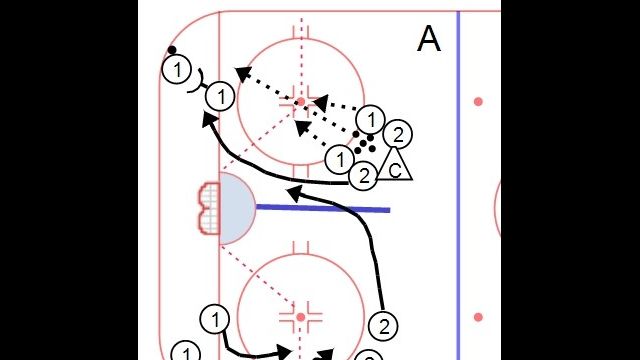
DRILL: 1 - 1 SUPPORT 2 - 1
1 - 1 SUPPORT 2 - 1
Drill incorporates:
1-Winning a puck races with your body position
2- Puck battle- transitions from Offense to Defense
3- Escaping with puck or pinning puck carrier to activate support
4- Puck support to create a 2 on 1 / Potential for a 2 on 2
5- Executing and defending a 2 on 1 situation
Drill Description
1 vs 1 race for a spotted puck into corner by coach -- players cannot cross behind net until it becomes a 2 on 1
Win race with early body position, cut off opponent
If defensive player (lost puck race), they work to PIN opponent along the wall
(A) If a successful PIN is established, stopping the puck carrier, 2 supports creating a 2 on 1
Puck carrier attempts to get outside corner (marked with dotted line) with possession
(B) If successful, 2 supports creating a 2 on 1
Offensive 2 on 1 attempts to exploit defender by using pass across the "Royal Road"
In 2 on 1 play, if defensive player can execute a PIN, 2 may support creating a 2 on 2
Continue play until a goal is scored, save or coaches discretion
 00:00:00
1 - 1 SUPPORT 2 - 2
1 - 1 SUPPORT 2 - 1
Drill incorporates:
1-Winning a puck races with your body position
2- Puck battle- transitions from Offense to Defense
3- Escaping with puck or pinning puck carrier to activate support
4- Puck support to create a 2 on 1 / Potential for a 2 on 2
5- Executing and defending a 2 on 1 situation
Drill Description
1 vs 1 race for a spotted puck into corner by coach -- players cannot cross behind net until it becomes a 2 on 1
Win race with early body position, cut off opponent
If defensive player (lost puck race), they work to PIN opponent along the wall
(A) If a successful PIN is established, stopping the puck carrier, 2 supports creating a 2 on 1
Puck carrier attempts to get outside corner (marked with dotted line) with possession
(B) If successful, 2 supports creating a 2 on 1
Offensive 2 on 1 attempts to exploit defender by using pass across the "Royal Road"
In 2 on 1 play, if defensive player can execute a PIN, 2 may support creating a 2 on 2
Continue play until a goal is scored, save or coaches discretion
 00:00:00
Insights on Climbing the Coaching Ladder, with Ryan Warsofsky
Subscribe: Apple Podcasts | Spotify | Google Podcasts
In episode #260 of the Glass and Out Podcast, Ryan Warsofsky, Assistant Coach for the San Jose Sharks and presenter at the upcoming TCS Live, stops by.
At just 36-years-old, Warsofsky just completed his first season behind an NHL bench after climbing the coaching ladder at a rapid pace. That includes time as a Head Coach in the ECHL and AHL, two Calder Cup championships and an ECHL record for fewest goals against in a season during his first season leading the South Carolina Stingrays.
He’s one of the top up and coming coaches in the game and is highly regarded by his peers in the industry. It will be fun to follow his coaching journey from here.
Listen as he shares why coaches need to find releases to deal with anxiety, the importance of creating a process to avoid negativity, and why practice habits become game reality.
VIDEO TIMESTAMPS:
- 0:00 Playing at Cushing Academy/Ray Bourque
- 6:40 Fundamental skills for junior/college
- 11:55 Deciding to coach/Mike Sullivan influence
- 17:05 Keeping a journal/Coaching in ECHL
- 19:45 Success in South Carolina
- 26:05 Foundational pieces for team defence
- 29:30 Key inches to winning championships
- 35:00 Message after a loss
- 37:40 Dealing with anxiety
- 42:20 Challenging season in San Jose
- 46:15 Helping players succeed
- 50:00 Building lasting habits for dmen
- 53:50 Advice for interviewing
- 58:50 Building your tactical toolbox
- 1:02:15 Mike Sullivan advice
- 1:06:35 TCS Live
 00:00:00
Coach Approach: score more goals, stop at the net
I have a confession to make. In the past I've been guilty of down-playing the level of skill a player possesses by suggesting the best they can do in the offensive zone is go to the net. When in fact, if the best they can do is go to the net, then they're either in possession of a unique skill or they're better at it than their teammates. Think of all the NHL players in the modern era who've achieved premier net front status: Thomas Holmstrom, Ryan Smyth, Patric Hornqvist, Joe Pavelski, and the newest lightning rod for this attention, Zach Hyman. These players often have their offence called into question because all of their goals come from within a few feet of the net. Auston Matthews rips wrist shots from the top of the circle - this takes more skill, people say. It takes skill alright! Ryan Smyth couldn't shoot the puck like Matthews.
But if it's so easy to score from the blue paint, why don't more players do it?
Shooting the puck is a skill. Skating it up the ice like Connor McDavid and Roope Hintz is a skill. Tipping pucks like Joe Pavelski is a skill. Arriving on time and stopping at the net is a skill. So how do we teach it?
1. Three Games in the 2024 Stanley Cup Playoffs
First we establish the existence of said goals. What piqued my interest was Zach Hyman's goal in the Edmonton Oilers' game one win over the Dallas Stars. It's included in the clip below, which you'll see starts with the Rempire State Building causing a traditional net front goal. After that you'll see different players scoring in different ways, with the common theme being they all had to slam on the brakes to arrive at the net on time. Note: these clips were collected over the course of three days, three games. I'll add more throughout the week as these two series grind on!
2. Who's Up For It?
What do these names have in common: McDavid, Rempe, Reinhart, Hyman, Barkov, Wennberg, and Seguin? They're all included in the clip above of course! But they're all wildly different players in terms of skill-set. Hyman and Reinhart scored 50 goals this year, McDavid was over 30, and Rempe - fought some guys. Anybody can score goals at the net, but not everybody does of course. Maybe you have players on your team who are skilled and better suited to the perimeter of the ice. It's not an insult (sure as sugar sounds like one), but in any case you can't have three of those players on the same line. Next season I'm going to use this skill as a carrot for players who want to play higher in the lineup. Can you use your skating, your strength, and your tenacity to compliment players who can pass, shoot, and stickhandle? At least one player on each line is going to be ready and willing to go to the hard areas.
3. Arriving on Time
Alex Lafrenière is a player who's been challenged to live up to his hype early in his career, but that's all over since his powerful performance in the 2024 Stanley Cup Playoffs. He's scored a couple highlight reel goals, but this one demonstrates the skill of stopping at the net and arriving right on time - for the goal, and for the Rangers in the eastern conference finals.
4
4. Practice drill
Here's a drill designed specifically with these clips in mind. At first glance it's fairly simple, but the key is in the focus - arriving on time, stopping at the net.
Structure
- Two forwards retrieve pucks from the corner against one defenceman
- Coaches chip pucks in corner, alternating sides, for forwards to retrieve and pass low to high
- Forwards must arrive on time at net
- After initial shot from D, forwards can collect puck for rebound or another pass to point
- Note: if you don't have multiple assistant coaches, players in line can jump into the designated coaches' spot, chip pucks on your whistle or call, and then jump into the drill on the whistle, replaced by the next players in line
Key Points
- Defenceman plays aggressive - don't play a normal D-zone structure, use feet to check and make life difficult for forwards
- Forwards stop and start - one forward needs to play net front while the other is retrieving
- Bonus - goalie coaches will love this one
Progressions
- Add second defensive defenceman to play 2on2 in-zone
- Add second shooter on point
- Add third forward
