

 00:00:00
Subscribe: Apple Podcasts | Spotify | Google Podcasts
In episode #262, we welcome Dan Watson, Head Coach of the Grand Rapids Griffins.
Watson is coming off his first season with the Detroit Red Wings' AHL affiliate. Previous to that, he spent 14 consecutive seasons with the ECHL's Toledo Walleyes.
During his time in Toldeo, Watson was awarded the Jack Brophy Trophy as the ECHL’s Coach of the Year, he guide the Walleye to two regular season Championships and two Kelly Cup Finals appearances.
Listen as he shares why sleeping in the arena is a right of passage for coaches, his three keys to building a strong team culture, and why it's quality over quantity when it comes to drills.
VIDEO TIMESTAMPS:
- 0:00 Living in Cleveland
- 3:20 Reflecting on first season with Griffins
- 6:50 Workflow changes/keys for culture
- 10:35 Successful practice habits
- 13:35 Starting with the details
- 16:05 Communicating efficiently
- 19:25 Coaching long distance in Toledo
- 24:45 The grind of coaching
- 26:50 Learning from other sports
- 30:15 Adding layers to a coaching toolbox
- 32:30 Challenges of coaching in the AHL
- 35:35 Building relationships with every player
- 37:50 Balancing team needs and player development
- 42:15 Measuring player improvement
- 45:40 Coaching 14 years in Toledo
- 50:45 Relationship with Derek Lalonde
- 52:05 Coach collaboration
- 55:45 Influence from family
- 1:00:50 Ways to improve in the summer
 00:00:00
Subscribe: Apple Podcasts | Spotify | Google Podcasts
In episode #263, we're joined by Steve Sullivan, Head Coach with the the Phoenix Jr. Coyotes 18U AAA.
Following a playing career of over 1,000 NHL games, Sullivan joined the Arizona Coyotes as a Development Coach and worked his way into management to become the club’s General Manager in 2019. Following a change in ownership, he remained in Phoenix and began coaching in the Jr Coyotes program.
Sullivan is an open book when it comes to how he develops players, runs practice and prepares players for the next stage of their career. Guaranteed you’re going to steal a thing or two from this podcast.
Listen as Sullivan shares how to improve a player's goal scoring ability, why stubbornness played a key role in his hockey journey, and why team success is about being predictable within but unpredictable to your opponent.
VIDEO TIMESTAMPS:
- 0:00 Coyotes situation in Phoenix
- 4:40 Growing up in Timmins
- 9:45 How youth hockey is changed
- 14:05 Playing junior in the Soo
- 20:00 Playing for Ted Nolan
- 25:05 Acclimating to the AHL in New York
- 30:35 Being stubborn leading to success
- 32:35 Playing in New Jersey/Jacques Lemaire
- 38:40 Adapting as an undersized player
- 42:00 Details that he stresses with his team
- 47:40 Finding time for reps
- 53:55 Influence from time as skills coach
- 1:00:00 Improving goal scoring
- 1:07:00 Puck over glass incident
- 1:11:05 Ingredients to be a good PKer
- 1:15:15 Next chapter of career
 00:00:00
This stretch technique is difficult for defensemen...their main options are:
A. Jump the receiver and give up D-side positioning (early anticipation, elite read)
B. Stay D-side and attempt a less aggressive disrupt attempt (stick check/tick)
It creates a risk managment scenario in which most defenders will normally back off and live to fight another day, which generally allows the puck receiver to get a clean reception & next play
Notice how Joshua manipulates Nurse's feet so Garland will have an extra half step advantage. Joshau moves the puck to the middle of the ice which influences Nurse to follow...then kicks the puck out to Garland with speed attacking wide (the opposite side Nurse's toe caps are pointing)
For more info on this technique/tactic be sure to watch the TCS Live 2024 presentations on their release!
 00:00:00
Subscribe: Apple Podcasts | Spotify | Google Podcasts
In episode #264, we had the honour of being joined by Gardiner MacDougall, live and in person at TCS Live 2024.
MacDougall presented on "Creating the WOW Factor from Your First Team Meeting" and also stopped by our Overtime event at the Circ Bar in downtown Ann Arbor.
MacDougall is coming off an unprecedented three year run, which saw him capture back to back USports National Championships with the UNB Varsity Reds, the second of which included an undefeated 43-0 season, a Gold Medal leading Canada at the U18 Championships, a Gold Medal at the FISU World University Games and a Memorial Cup Championship with the Saint John Sea Dogs.
After 24 seasons leading the University of New Brunswick, which included nine National Championships, Gardiner is moving on to coach the QMJHL’s Moncton Wildcats. He'll be working alongside his son Taylor, who will be the club’s General Manager.
Listen as he shares why losing can be necessary for overall team success, how to build a players confidence, and why simplicity is key to an effective practice plan.
AUDIO TIMESTAMPS:
- 5:50 Recapping his past three years
- 8:00 Influence of routine
- 10:20 Dealing with losses
- 14:50 Always bringing postive energy
- 19:00 Getting players focused for a big game
- 22:30 Philosphy for practice
- 29:10 Introdcuing competition to practice
- 30:45 Working with Andy O'Brien
- 34:15 Motivating players
- 39:50 Growing up in Bedeque
- 43:30 Carving your career path
 00:00:00
Regardless of your team's systems, strategies, or players, hockey is still a game of 1on1 battles. They happen all over the ice, and all of them result in a victor and a loser. I want my team to win battles next year so badly that it's the number one thing I'm going to focus on. Wall battles, slot battles, blue line battles - you name it, we're going to be the hardest working team in the league when the puck is up for grabs. Your team won't score a goal after every single battle won, but you'll never score after a lost battle.
So to keep it simple and easy and get the competitive juices flowing, here are three 1on1 drills to set the tone.
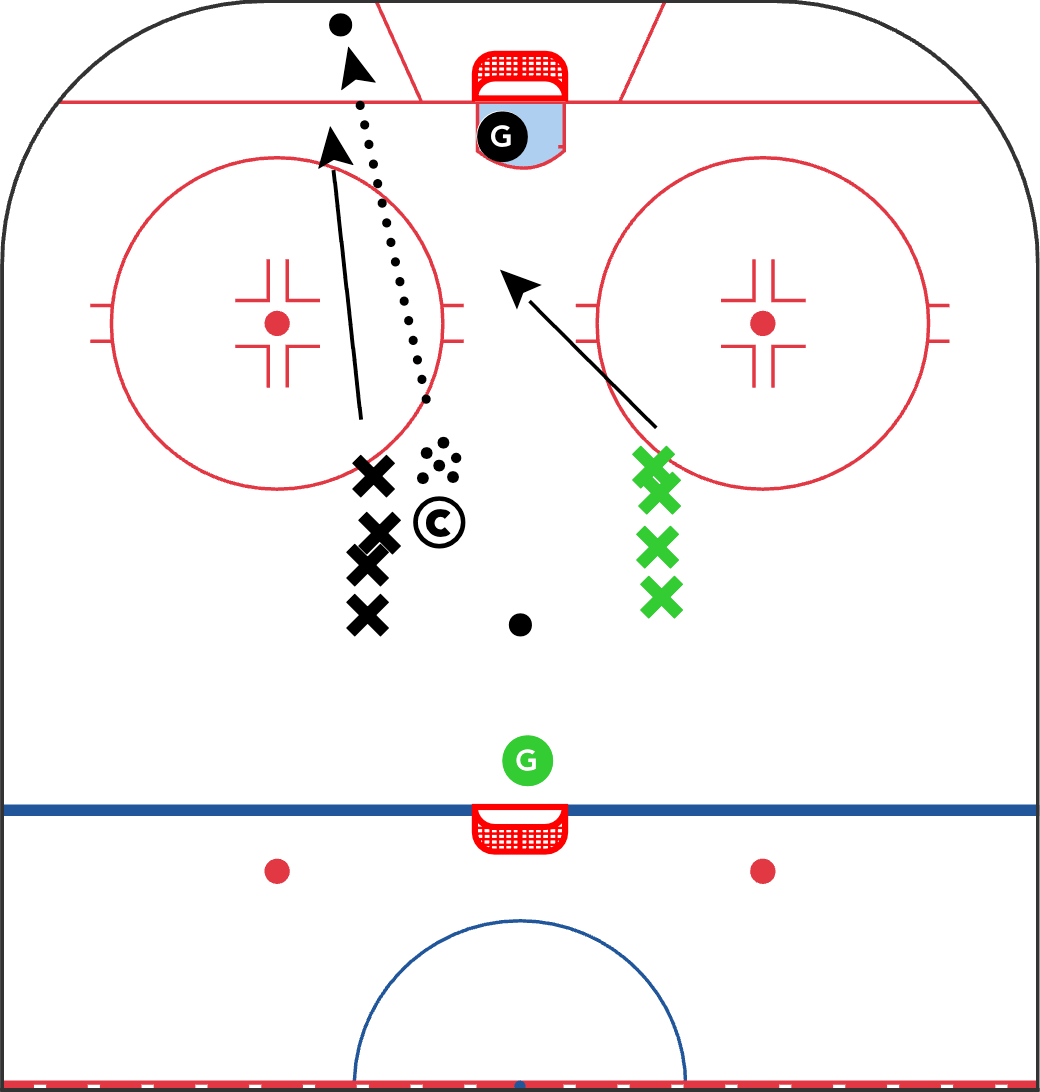
1. Bruins 1on1 Plus Backcheck
This drill decides the winner of the initial race, but it's productive because players don't know if they're starting on offence or defence.
- Coach places puck to either side of the net, corresponding player is on offence, other player defends
- Play for 15 seconds, blow whistle, players back-check through pile to race for second puck
- Offence: use deception on first touch to escape
- Defence: check with your feet - take away time and space, use stick on puck to assist your feet
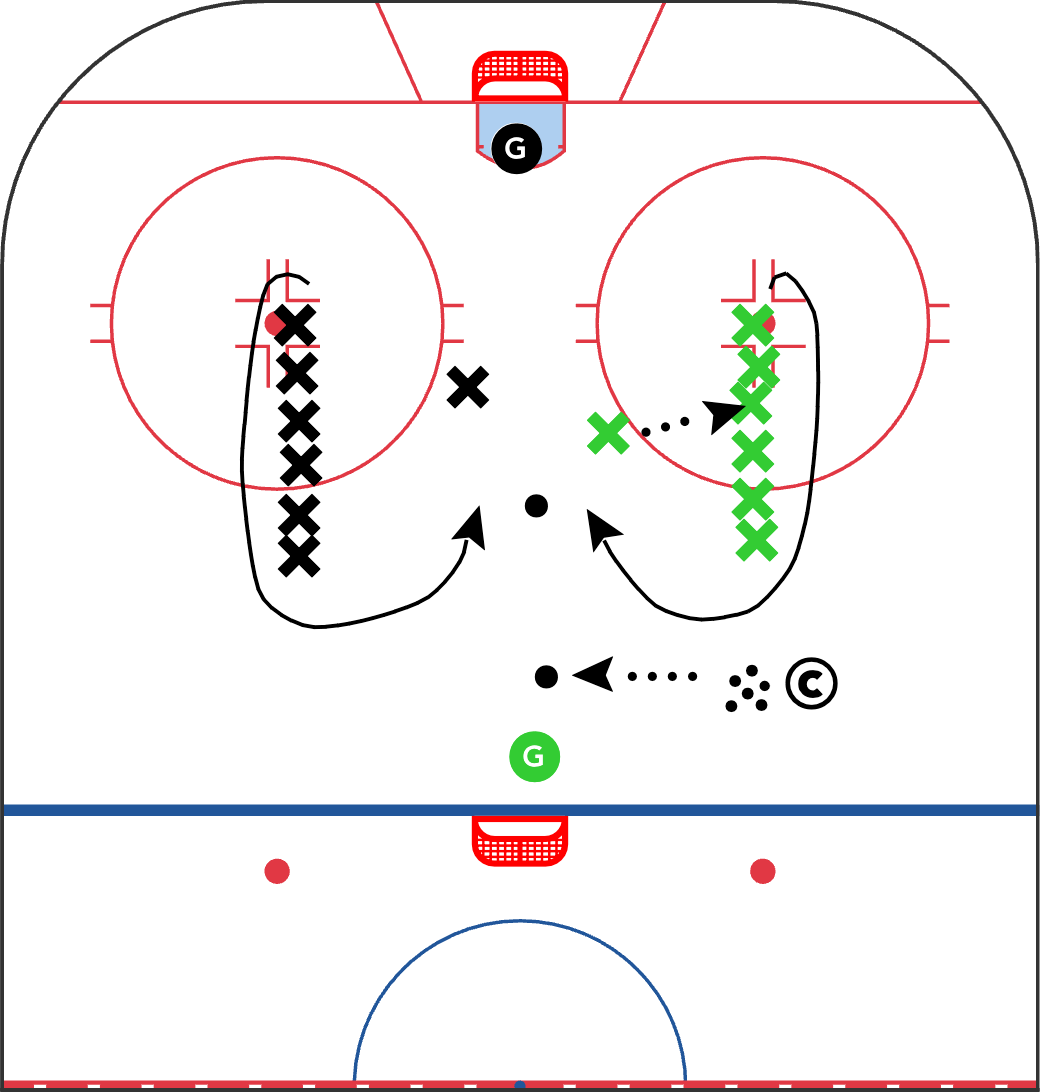
2. Bruins Gauntlet
Same setup as the Bruins 1on1, but this time you're building in a natural race. Whoever gets the puck first gets rewarded with a scoring chance.
- On whistle two players circle around pile and race for puck, first touch is on offence
- Defender goes on offence if he recovers and passes to line
- On whistle race to shoot extra puck in extra net (backcheck through the house) while two new players skate around pile
- Progress to 2on2
3. Grimmer Corner Battle
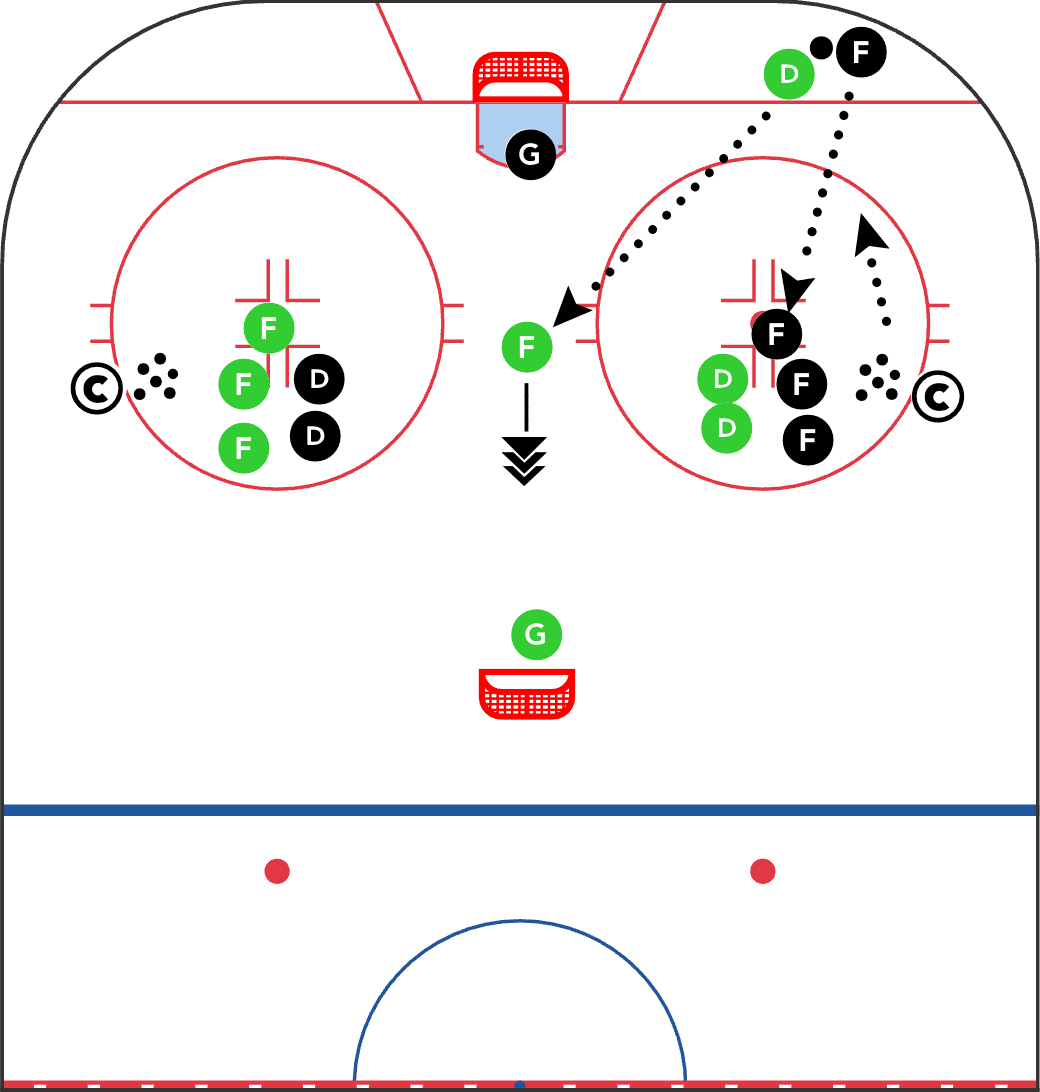
Named for the coach from whom I stole it, this one looks complicated at first blush, but once the players figure out the rhythm it will accelerate and come fast and furious. The premise is simple: two players in the corner in a 50/50 puck battle. The forward is trying to retrieve the puck and pass back to their original line for a strong-side dot shot. The defenceman is trying to retrieve and pass into the slot to start a breakout.
Looks like this. Once puck is chipped in corner to start rep:
- F and D race for puck
- F is trying to pass to original line F for strong side dot shot
- D is trying to pass to C net front for shot on opposing goalie
- Once either pass is made, opposite side starts with puck chipped in corner for new battle
- Strong side dot forward is always involved in the next rep whether or not they receive a pass
 00:00:00
Subscribe: Apple Podcasts | Spotify | Google Podcasts
In episode #265 and the season finale, we welcome Lee Moffie, Co-Founder of State & Liberty Clothing Company.
State & Liberty is the presenting sponsor of Glass and Out. Their line of performance clothing designed for athletic men is worn by athletes in the NHL, NFL, MLB, NCAA, UFC and almost every other professional league.
During our recent trip to Ann Arbor for TCS Live, Moffie and his teamn were gracious enough to host a VIP event for our community at their flagship store the night before the conference. The evening included a sit down with Moffie, who also happens to be University of Michigan hockey alumni.
Listen as Moffie shares the story of founding a clothing company with no past experience in the idustry, leadership lessons he's taken from his career in hockey, and tips on creating a culture for high functioning teams.
AUDIO TIMESTAMPS:
- 6:20 A normal day for a business owner
- 8:40 Starting a business
- 10:20 Origins for State & Liberty
- 12:50 Selling shirts while playing pro hockey
- 15:30 Switching up the dream
- 18:05 Lessons from past coaches
- 20:40 Relationships building
- 22:15 Facing adversity/COVID
- 25:55 Celebrating mistakes
- 28:30 Stressing frugality
- 30:10 Leading with the carrot
- 34:50 Fake communication
- 38:50 Creating an experience for customers
- 40:50 Learning to be confident
- 43:30 Balancing gut feel and data
- 44:50 Questions from Carbery and Warsofsky
- 49:55 Victories so far
- 51:50 Leadership resources
- 53:45 The U of M identity
 00:00:00
Tapering is a strategy for athletes who are looking to maximize their performance before an important competition or game. By reducing training volume while maintaining intensity, athletes can significantly reduce fatigue levels and see a temporary boost in their athletic performance.
By tapering for 1-3 weeks before a big game or event, you can reduce enough fatigue that will support a higher amount of power and speed to an extent than you normally wouldn’t be able to perform.
Tapering can potentially cause, performance improvement, strength, speed, improve agility, decrease mood disturbance, improve the quality of sleep, replacement of muscle glycogen, and much more
Understanding the Basics of Tapering
Tapering is a strategic decrease in the volume and intensity of training as playoffs or an important game approaches, designed to mitigate accumulated fatigue without compromising the athlete's hard-earned fitness level. This method hinges on the balance between recovery and maintaining the peak condition developed through rigorous training periods. By fine-tuning the workload, athletes aim to hit an optimal state of readiness, where the body is fully recuperated and primed for maximum performance. Essential to a successful taper is the concept of selectively reducing training by cutting down on the length and frequency of practices and training while sustaining a level of intensity that keeps the body in a state of readiness. This approach ensures that the athlete remains sharp, both physically and mentally. Tapering is not about halting training but rather about smartly scaling it back to achieve the best possible outcome on the day that counts the most.
The Science Behind Tapering and Performance
The physiological rationale for tapering hinges on its ability to diminish fatigue more rapidly. This reduction enables athletes to maintain their peak physical condition while significantly decreasing the level of exhaustion. When volume decreases but the intensity remains, it sparks an environment where the body can focus on recovery without sacrificing performance capabilities. This balance ensures that muscle strength, endurance, and aerobic capacities are not only preserved but also primed for optimal output during competition. Research supports that tapering can increase muscle glycogen stores, enhance neuromuscular function, and improve metabolic efficiency. These changes can give an athlete a competitive edge, contributing to observable improvements in speed, strength, and agility. Furthermore, this reduction in training load allows for the replenishment of mental and physical reserves, setting the stage for peak performance when it truly counts.
Common Tapering Strategies and How to Implement Them
To effectively implement tapering, athletes and coaches can adopt several approaches, each tailored to the individual's specific needs and the demands of hockey. A popular method involves progressively reducing the volume of training while maintaining or even slightly increasing intensity. This can be achieved by shortening the duration of each workout session, reducing the number of sessions per week, or a combination of both. It's essential to keep the quality of training high, focusing on maintaining skill, speed, and power development during this period.
Another strategy is the step taper, where the reduction in training volume happens in distinct steps rather than gradually. Athletes might cut their training load by a set percentage each week leading up to the competition.
The Impact of Tapering on Performance Metrics
Tapering holds the potential to significantly enhance an athlete's performance, including increased power output and speed, as well as heightened agility. This strategy enables competitors to reach levels of fitness and execution that might remain untapped under continuous intense training. A key benefit of effective tapering is the substantial reduction in fatigue, which not only primes the body for peak physical achievement but also contributes to mental and emotional readiness. Athletes may notice improved responsiveness and quicker recovery times, elements crucial for competitive advantage.
 0:00:35
Simple wall pick up give and go. Wall pickups are important and picking up pucks under pressure is a completly