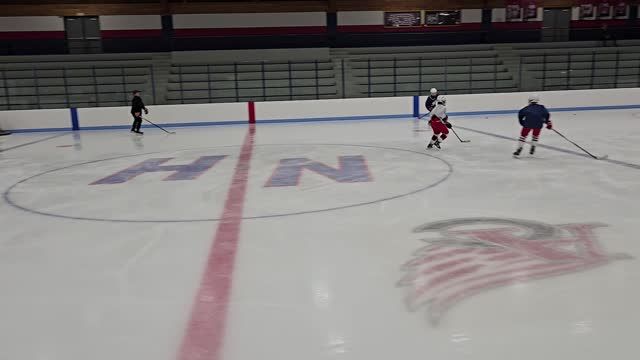
Hockey is a Possession Game and there are two offensive concepts every young player needs to learn to become a better offensive player. The first concept is Outnumbering also referred to as Overloading on the puck/strong side to create a player advantage. The higher the calibre or level of play the more difficult it becomes to beat a defender one against one. You need to create outnumbered situations where your team has the player advantage to support the advancement of the puck.
The Russian players from the 70’s were famous for outnumbering or overloading in space to create the player advantage to advance the puck. The players as a group possessed strong technical hockey skills and were suited to the puck support game which required them to ensure the Puck Carrier had passing options to advance the puck. As a group, the players would be patient with the puck and didn’t mind going backwards or sideways with the puck before going forward with the puck because of the passing options present at all times. Every good player is patient with the puck because they are confident in their technical skills and know they have the support of their teammates to support the puck.
Concept # 2 – Puck Support (Offensive)
Teams that support the puck (Puck Carrier) are excellent at retaining puck possession and control. These teams seldom put the puck off the glass to get the puck out of the zone (defensive zone or neutral zone) and prefer to pass the puck (direct or indirect) to retain puck possession and control. The players without the puck are responsible for finding open ice to set a quality passing lane to support the Puck Carrier. The players without the puck can be above the puck, below the puck or adjacent to the puck but they must “arrive on time” to ensure a quality passing lane option exists. The Puck Carrier is responsible for being patient with the puck and timing his/her passes to players to ensure the group retains puck possession and control to advance the puck. The advancement of the puck is the result of time and space created by the group supporting the puck to create open ice to accomplish the task.
The video below is of the Red Wings Power Play unit made up of five well known Russian players who possess strong technical hockey skills. The players demonstrate patience with the puck and the ability to find open ice, support the Puck Carrier and to create an outnumbered situation to advance the puck. The video clip is worth watching to see these concepts being executed.
Conclusion
The concepts of Outnumbering or Overloading and Offensive Puck Support are key to a player’s development. It is a lot more fun playing with the puck than without the puck. The learning of these concepts support the development of a young player’s technical hockey skills. Players need to have excellent technical hockey skills to execute these concepts to retain puck possession and control. Players should be given the freedom to be creative once they learn the concepts to make plays. Give and Go play is a tactic that is under coached and supports the execution of these two key concepts. Player and puck movement are essential elements of the Possession Game.
It’s not how fast you skate that is important but rather how fast you think. Our young players need to know this and understand key concepts to ensure their technical hockey skills are developed. They will make mistakes but that is how they learn.
The key to successful organizations are evaluating, recruiting and developing the skills and abilities of their people. Once you have recruited and signed an athlete, the development process starts immediately and is a never ending process as illustrated in the above diagram. One of the effective methods used by organizations is to conduct regular One on One Player Development Meetings to establish and build the relationship between the player and his/her coach and the members of the organization.
These meetings are used to support the athlete in the development process. The steeper the learning curve the better and for this reason the process must be efficient and effective in managing the development issues faced by the person/athlete. The goal should be self-reliance, the player should be able to manage his/her own development process with diminishing need for the meetings and support as time goes on. Every player should be supported to get to the skilled or unconscious competence stage in the hierarchy of learning in all aspects of their sport. When we teach and coach character development we are preparing the person/athlete for life because failure is inevitable and they will need to have the skills to overcome adversity.
Purpose Statement
It benefits everyone involved in the player development process to understand the ‘why’ behind the participants involvement. A clear purpose statement should identify the reasons for conducting these meetings. You want to ensure there is a commitment to the process by the participants and they recognize there is value in the meetings to achieve individual, team and organizational goals.
Participants
Head Coach
Player
Assistant Coaches
Subject Matter Experts
Technical Support (as required)
Environment
The environment for conducting the meetings is important to the process. Lighting, temperature of the room, access to electrical outlets, comfortable seating, technical aids (video) and amenities to ensure an effective meeting.
Agenda
An agenda for the meeting with input from the player and coach is important to keeping the meeting focused and time oriented. Setting time to address issues and a time frame to conduct the meeting demonstrates to the participants everyone’s time is important and the meetings are focused.
Continuity
The frequency of the meetings should depend on the player’s needs. Keeping a record of the meeting is essential to tracking the issues addressed and following up on key work and issues in subsequent meetings. What needs to be brought forward to the next meeting must be tracked and on the next meeting agenda.
Subjects
Player Evaluation
Development Plan
Development Issues
Performance Issues (current)
Performance Measurement
Health & Wellness
Family & Friends
Circle of Influence
Educational Issues
Life After Sports
Questions & Answers
Hobbies & Interests
Leadership & Emotional Intelligence
Character
Expectations of Player & Coach
Problem Solving
There are always going to be issues that surface that need to be addressed. Making time to listen to the player and his/her problem(s) and possible solutions is important to the development process. Coach can help by effectively listening and to help the player land on solutions.
Technical Aids/Resources
The more objective the meetings the better so being able to breakdown video and share data and statistical information is important to the development process.
Player’s Goals & Performance Objectives
It’s important for the Coach to know the player’s goals and performance objectives and the work the player is currently engaged in daily to achieve them. Every coach should be interested in learning from the player his/her daily habits and focus to achieve improved performance.
Resources
It is really important to make the player aware of the support that the team can provide to their development process. The player has to do the hard work and be self-disciplined and committed to getting better but the team and organization should ensure the player is fully supported by the resources available to them.
Record/Note Taking
Notes are helpful for reflection and tracking the development process.
Player Engagement
The player is ultimately responsible for their own development as a person and athlete. As a coach and participants to the process it is important to learn the perspectives of the player on development issues. Active listening and engaging the player as an active participant in problem solving and solutions is critical to the goals of self-reliance and their development. Asking the player open ended questions is one of the keys to learning the player’s thoughts and ideas on specific subjects. You cannot coach a player who doesn’t want to be coached so their engagement in the development process is critical to building their trust, respect and a relationship, which will be helpful to the developmental process.
Conclusion
Player development meetings can be a highly effective tool to the development process and in establishing a high performance environment for players.
Whether you’re a weak side Defenceman or back checking Forward defending the Attack Rush, getting defensive position on your opponent is critical to defending. There are good habits you should be aware of in your execution.
Good Defensive Habits
Swivel Head to identify arrivals into the zone supporting the puck carrier,
Establish defensive side of the puck (box out) to establish defensive position, keep yourself between the puck carrier and the player without the puck,
Track between the dots to protect middle ice & to establish defensive position,
Strong Hockey Position (maximum strength and balance),
Stick under your opponent’s, tap up, to prevent stick on puck,
Take your opponent to the net,
No gliding, full speed to get shoulder to shoulder then matching speed,
Communicate coverages with teammates.
Late Arrivals into the Offensive Zone
When there is a good structure defending established and no play on the net your opponent may delay and turn back for offensive puck support arriving late into the zone. It is critical late arrivals are picked up and defended. Teams are dropping their Defencemen down to support the puck offensively into open ice (lanes/seams) to support the puck so there must be constant awareness of the position of players without the puck in the zone.
Weak Side D Play —Transition Game ▪️PS|D Man #7 pivots in the neutral zone to provide D puck support on F2 driving middle lane to support the puck ▪️D Man opens up, pivots to skate forward to get defensive position on F2, note 1/swivel head, 2/stick under F2’s. #TLPFBreakdownspic.twitter.com/r8kuKgt3sM
Excellent TW from The Coaches Site and Laura Schuler on the art of angling in this video clip from their latest edition of Finding the Details. Extremely important subject and relevant to the One on One Attack Rush Play for Defencemen. Laura explains the importance of inside out control, opening up and closing the gap on the puck carrier.
Every defenceman should work on controlling their neutral zone gap (distance between puck carrier and D pairing) to improve their skating skills and ability to match the speed of a puck carrier on the Attack Rush. The D in this clip plays a tight gap to support the F’s and opens up and angles effectively to strip the puck and get position on the puck carrier at the blue line 👍.
"It allows you to dictate the play, get back pucks quicker, and most importantly, it allows you to play on offence more."@LauraSchuler27 on the art of angling in the latest edition of Finding the Details.https://t.co/XOSUG20hLs
Excellent Videos Shared by Nick Neary Belowon Proper Angling
Angling is an important aspect of defending the rush. Instead of skating backwards, players sometimes defend skating forward with a proper angle to cut off the rush. Players like Duncan Keith, Nik Hjalmarsson, and Lee Stecklein are very good at this. Here are some examples pic.twitter.com/G4mo1hvack
Defending|Getting into Position to Defend 1) D GAP distance between puck carrier & D Pair + distance between the D Pairing so important. Tight GAPS. 2) Back up between dots to protect middle ice – you want offensive unit to try & beat you wide with speed #TLPFBreakdownspic.twitter.com/5cUXQV8qXp
— Think Less Play Faster Hockey (@TLPF_Hockey) April 13, 2021
Defending: The use of Gap Control and Angling to Take Away Ice (Time & Space)
McDavid’s Ability to Change Speed & Direction Make Him Difficult to Defend
This post was motivated by reading the tweet below from @CoachRevak. Take a listen to Dwayne Blais @NSDAhockey talk about how a player’s ability to change speed and direction with the puck, to create time and space, make him/her more difficult to defend than a player who just has speed. There are lots of players who are fast but not a lot of players who have different speeds and can change direction in an instant with control of their edges.
Dwayne Blais on his @NSDAhockey podcast dropped this gold nugget
- Yes, being fast is an asset - But, if you’re fast all the time you’re easy to defend - So, changing speeds is the real secret to creating time + space
The ability to change speed and direction are skills necessary to execute almost every tactic in the game, such as, but not limited to the following:
Beating a defender in a One on One match up,
Cycling the puck down low below the hash marks in the Offensive Zone,
Supporting the puck on the Attack Rush,
Regrouping in the Neutral Zone,
Advancing the puck in the Offensive Zone at different levels,
Breaking out of the Defensive Zone.
Being able to skate fast is an asset to any player but there are lots of players who can skate fast and take away your time and space with the puck because of their ability to match speed.
Connor McDavid and Nathan MacKinnon’s names came up in the podcast because they are both skilled in executing change of speed and direction and controlling the puck to create time and space and make plays. There is no player in the world more skilled than Connor McDavid in changing speed and direction and controlling the puck in tight spaces. Take a listen to him talk about his Top Five Plays in the video below and watch his execution in the clips to examine why speed and change of direction make him so difficult to defend.
Connor McDavid’s Change of Speed and Direction Make Him Almost Impossible to Defend
Deliberate Practice
Deliberate Practice is a concept important to developing skills. Watch the video below to examine the technique and proper fundamentals McDavid is working on with Carlo to improve his inside and outside edge control and ability to change speeds and direction while controlling the puck at different speeds and angles.
Deliberate practice is more important than the number of hours you practice. Repetitions matter but you need to be working on developing specific skills with the right technique and fundaments at the same time.
2 skaters use partner passing to get up one side of the rink to the red line. The inside skater should turn towards middle ice and becomes the "outside skater", and the outside wall skater should turn to become the "inside skater" as they move back towards the net. The puck has to end with the "inside skater", who drives the net and shoots.
The other partner continues and turns towards the far boards. He picks up a new partner from the opposite corner and they partner pass up the fall wall. The shooter has turned is filling the 3rd lane on the near wall. All 3 players enter the neutral zone and the puck carrier passes to a coach who is waiting at the far blueline. Players regroup together and recieve the puck back from the coach for a 3v0.
Skaters should fill lanes, create depth, and make passing plays to shoot on net.
There are good reasons for a team to establish a strong forecheck in the neutral zone, especially, after a face-off loss in the zone, not limited to the following:
Puck possession and control matters, the team that wins the puck possession and control game generally wins the hockey game. You’ve lost possession of the puck and you need to execute a plan to regain puck possession & control.
You should always defend entrance into your own end of the rink (your blue line) aggressively to prevent the opponent from attacking off the rush or setting up an offensive attack in the zone.
It’s a significant tactical advantage to prevent the opponent from entering and exiting the neutral zone with speed and puck control.
Good teams pressure the puck in the offensive zone with an aggressive forecheck to regain puck possession and control. Why wouldn’t you deploy similar strategy and a tactical approach to regaining puck possession and control in the neutral zone?
Breakdown of the Video Clip Below Reveals:
Lack of a neutral zone forecheck deployed to put pressure at the puck and push their opponent left or right into an area outside the dots to force a puck turnover opportunity.
No defence of the blue line & entrance into the defensive zone by the Defensemen.
The defending forwards don’t pick up their man coverage assignments entering the defensive zone.
Neutral Zone Forecheck
The concept of forechecking in the neutral zone is no different than forechecking in the offensive zone. The goal, push or force the puck left or right into an area of the ice surface outside the dots to create a turnover over the puck. Whatever neutral forecheck structure is deployed, 1-2-2, 2-1-2, or other structure there should be pressure at the puck to force the puck into an area that provides the best opportunity to contest a puck recovery battle situation. Passing lanes and exit lanes should be blocked by the forecheckers.
Neutral Zone Forecheck Keys
Protect middle ice (between the dots),
Right structure based on situation,
Pressure at the puck to force or push the puck left or right to a confined space or area,
Skating & checking (angling) skills of the defenders,
Puck recovery battle plan for the confined space,
Exit play upon recovery of the contested puck,
Defensemen moving up to close the GAP between the puck and themselves to support the forecheckers,
Forecheckers taking away passing or exit play options.
Offensive team wins the draw back to the strong side D who is able to make a D to D pass to his weak side partner.
Offensive LW skates from the face-off circle to middle ice above the hash marks to escape man coverage.
Offensive RW skates to middle ice below the hash marks in a low position for a deflection, rebound opportunity. C joins the RW in a low position in front of the net.
D sets up the Shooter (LW) position in middle ice up top.
LW shoots and scores with an excellent point shot. The RD had the option of dropping down to get a return pass from the shooter or LD.
Creating Offence on a Face-off Win:
Player and puck movement resulting from players without the puck finding open ice, “soft spots” and getting open. Many teams now are moving a player up top (above the hash marks) to play 3 against 2 to outnumber their opponent to advance the puck. Smart. The defending team has to have the ability to transition between man and zone coverages in the offensive zone.
Wingers Roles & Responsibilities – Face-off Loss Puck Up Top (Opponent’s D)
The RW in this video clip does exactly what he’s supposed to do, get out to the the opponent’s LD to hurry/rush or block the shot by the D, body in shooting lane stick in passing lane.
The LW gets out to the opponent’s RD to try and take away the D to D option and if the pass has been made to hurry/rush or block the shot by the D.
The bottom 3 defenders get into man coverage with the Centre on the opponent’s Centre, and the D pairing locking down the opponent’s Wingers.
The RW blocks the shot and scores on a breakaway deke play.
Face-offs are an important part of the game. When you lose a face off in the Defensive Zone the puck can end up in your net within seconds. Face-off strategy, skills and tactics are generally under coached in competitive minor hockey and this needs to change to support players in their development. Face-offs are important to winning the puck possession and control game and every good team is looking for players who have strong skills and abilities in their execution of face-off play.
No player should step into a face off circle, especially in the defensive zone, without knowing their role and how to execute their role in a face-off win or loss situation. Every defensive player must know their role on a DZ win situation to exit the zone and in a loss situation on who to cover and how to defend the other team.
The short video clip below shows the Washington Capitals defending a defensive zone face off loss situation. Clearly, every player knows their role and how to execute their role to prevent being scored upon and to regain puck possession and control.
In this clip the bottom 3 Capitals Defenders get into man coverage with the Center locking down the opponent’s Centre and the two Defensemen locking down on the opponent’s Wingers. The Capitals bottom 3 don’t allow their opponents to get between them and their goalie, play stick on stick and don’t allow the Forwards to get into position to get a stick on puck deflection or rebound opportunity. The Capitals two Wingers are out to the points to hurry or block a point shot and prevent the opponent’s D from making a quality play with the puck from above the hash marks.
Recommendations for Players:
Study video for examples of good face-off play to learn what strategy, tactics and skills you must develop to make this a strong part of your game.
Talk with Coach about your role and how to execute in face-off win/loss situations in all three zones.
Practice your face-off draws as a Centre and Winger to get your success draw rate at 60%. That’s right as a Winger because sometimes the Centre gets tossed.
Communicate as a group so every player on your team knows their role before stepping into the circle.