Director of Player development for the Winnepeg Jets on the importance of building relationships at Dev. camp. He talks about putting your phone down at dinner and talking to the guy across from you. We all want a "good culture", it starts with good people and strong relationships.
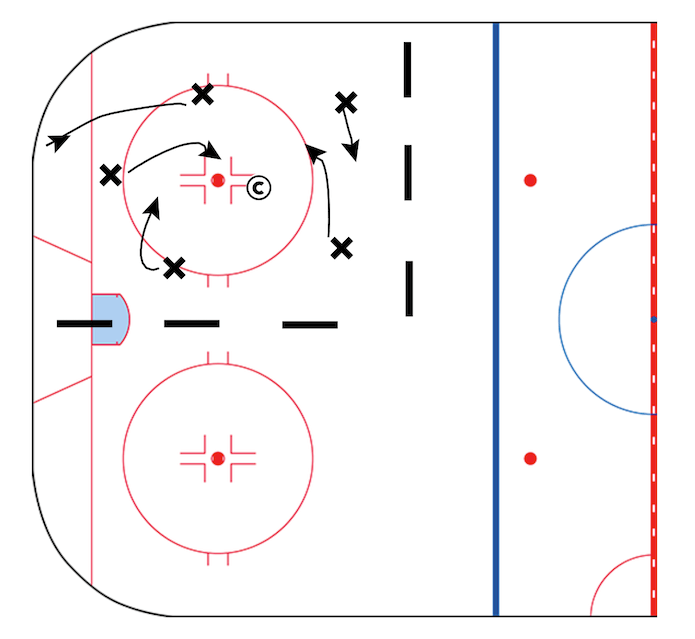
Freeze Tag is a great game for players to work in an invasive environment. Encourage players to have their heads up and avoid all obstacles.
Description
The Coach sections the ice with cones, barriers or by drawing on the ice.
Players mill about in the designated area while the coach gives chase.
When a player is tagged then they must stop and put their arms out in a T position or are "frozen".
Another player can "unfreeze" the "frozen" player by going under one of their arms.
Increase difficulty by having players take turns being the chaser and increasing the amount of chasers.
Make sure to indicate who the chasers are by having them hold a cone or wear a pinnie.
Key Points
Encourage proper movement patterns:
Tight turns
Glide turns
Stops
Stride
This game is invasive. It must be explained to players that they need to avoid collisions and keep their heads up. This may mean slowing down. The danger increases as more players become the chasers.
Coach starts by being it to ease the players into the proper movement patterns and techniques for success.
Increase difficulty by having players go under both arms in order to "unfreeze" a frozen player.
Goal is to get kids moving with their head up.
Can be done in all 3 areas as players come on the ice.
Use Stationary skills to help teach fundamentals. This video illustrates how to help players with their knee drops to work on their posture, balance and leg strength.
Description
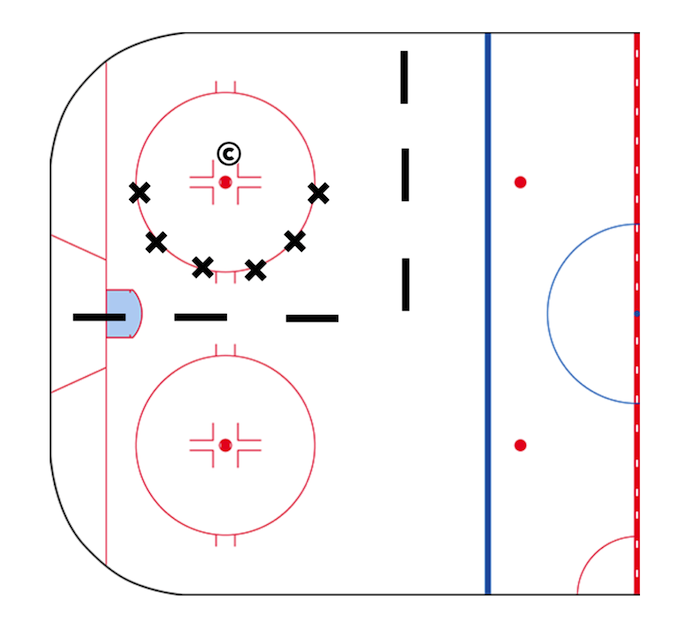
Draw an X for each player to stand on the ice. Coach leads drill with various stationary exercises:
1. Knee drops 2. Hockey stance 3. Scrapes 4. Knees up
Key Points
Have players facing away from other areas to keep focus on the coach. This is where the building blocks are built for turns, strides and stops. Skills to focus on:
Knee drops: one knee at a time, shoulders back, hands up
Hockey stance (hold for 5 seconds): drop hips, hands up, shoulders back
Two foot hops: Hockey stance, hop, hockey stance
Inside edge scrapes: Pushing away from the body, even pressure, big pushes
Knees up: Transferring weight from foot to foot, raise knee high (Penguin vs. Bear)
There is a debate among youth hockey coaches about time spend on individual skill versus team skill and how much practice should be focused on each.
I have had coaches tell me that under the age of 14, it should be all individual skill and once a player reaches a more mature age and can focus on system play, they should then learn more about team play.
I have also had coaches tell me individual skill is for private lessons and team play is for team practice.
While I do favor the side that leans towards team practices for teamwork, I also think players need to be able to develop their individual skill and not all can afford to, or have the time for private lessons.
To balance this, I think coaches should be running drills that allow for the growth of both. A drill that isolates an individual skill, but then progresses to more teamwork.
This drill is a modification of a drill I saw used a lot in small group lessons that only included the puck battle, and then the players reset and got back in line. I found the drill really great from a skill development standpoint, but thought it was lacking in more fun and building into how to use this skill in a game.
Have two players stand with their shoulders touching. One designated forward, one on defense. The coach will then dump the puck onto the wall behind the players and the forward needs to win that race and get the puck, while the defense is trying to win and get the puck out of the zone.
Focus on making sure the forward turns their body in a way to block the defense and get early body position.
From there, the forward wants to pass the puck to the next player in line, activating a 2-on-1 and they try to score.
If at any time the defense gains control and throws the puck out of the small area, the game is over.
The players must use their own skills in winning that battle, using smart body positioning and puck protection and then find the right time to get the puck to their teammate.
3 Team Build a Team
This is a modified version of a drill the Pittsburgh Penguins ran at development camp, seen below:
In this version, the game starts as a 1-on-1-on-1, making each player battle and fight on their own, before finding a pathway to passing to their teammates. The goal is to get three players on your team so that you can score. Teams with one or two players cannot score, and if a team gets to three and another team then gets to three as well, the first team must send a player back to the line.
This ensures only one team can score at a time, and limits the max on the sheet to 2-v-2-v-3.
Players can shoot on any goalie once they reach three players.
As players are added, the individual skills of puck protection, movement, and finding open ice changes and they are able to begin working with someone for support.
3 shots – 3 ways
While this drill is an individual drill, it works on two different players at the same time. A shooter, and importantly, the goalie. It doesn’t necessarily add that team mentality, but it’s about compromise when it comes to all our drills, and this drill adds enough importance to a players ability to help their team score, I think it’s worth running.
This drill has each player taking three shots, in three ways. Backhand, one-timer, and then quick release.
In the video, we show a divider as the pad to bounce the puck off. You can use an extra net (or an 8U mini net), a passer tool, or anything you can find to bounce a puck off.
Start by passing the puck under the player’s leg and bouncing it off the pad, the player should then pick up the puck quickly and skate to the side of the net that puts them on their backhand, taking a quick shot. Once they shoot, they should open up for a pass from the coach for a one-timer. Then the coach will bounce another puck off the pad which the shooter will pick up and make a quick forehand shot on the opposite side of the net.
At the end of the day, we need practices that both increase a players skill and the team’s ability to work together and rather than find ourselves stuck in binary thinking, we can find ways to create or modify drills to do both at the same time.
Octopus challenges players to use their edges and move laterally. Have players keep their puck in front of their body so they can move to either side.
Description
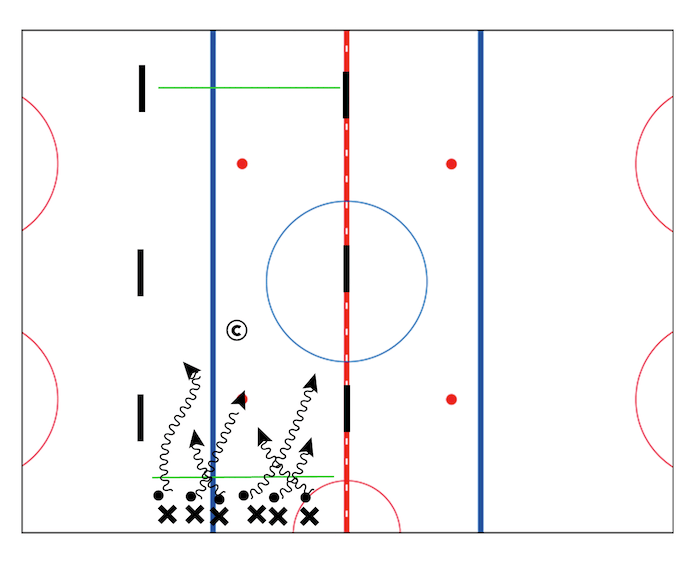
Coach draws a line 10 feet from the boards or end of boundary.
Players line up on the boards.
When the coach says “Go” players try to to get over the opposing line without getting caught by the coach.
If a player is caught they have to stop and they are now “seaweed”. They can’t move but can now assist the coach with trying to tag players while stationary.
Key Points
Encourage players to stop before the boards (in the 10 foot safe zone allocated by the coach).
Keep head up
Use edges to move laterally away from coach and other players.
Story tell to increase interest for younger players. Coach is an Octopus, Players are swimmers and the Octopus is trying to turn players into seaweed.
The puck has dropped on another minor hockey season in the OMHA! We are so excited to be back on the ice and see everyone’s smiling faces. There are great programs in store this season that will help players both new and returning, as well as help our Associations to deliver the best programming possible for skaters of all levels and skills.
You may have seen #HockeyIsFun being used on our social media platforms – this is part of a registration campaign to remind everyone why this is the best sport on earth. It features assets in Mandarin and Punjabi as a way to speak to families in those languages and invite them into our game and connect them with their local minor hockey association. There is also a Parent Kit to share with hockey parents, so they’re properly equipped ahead of getting their kid into the rink.
“We wanted to speak as we talk about the game. We’re fans of the game and it all boils down to – we love it. So, we wanted to get that message across, that playing hockey is fun,” said OMHA Executive Director Ian Taylor.
Along with working with new hockey families, we’ve also been listening to our current membership. While examining registration trends and the feedback from our players, the OMHA is introducing a non-bodychecking Representative option for this season.
“We had players who wanted to keep playing at the skill level that they were capable without just that one element of the game,” said Taylor.
“Understanding that there is a huge desire for athletes that still want that Rep feel and experience four times a week, at a little higher at a competitive level of hockey but don’t want the element of body checking, they can go and participate in that. There was a definite ask for that,” said Michael Dundas, the OMHA’s Manager of Hockey Development.
A new stream of MD is being introduced to the U9 age group as well.
“All players should have access to the same volume of hockey that they choose but still be tiered by ability. That’s really the essence of it,” said Taylor. “It’s trying to do everything we can to give players a great start and learn and enjoy the game. Players will find their watermark in terms of what level and how often they want to play.”
Other programs to keep an eye out for this season include the OMHA’s Player and Goalie Assist, where free sets of equipment are distributed to associations to support their efforts in Try Hockey and gear swap initiatives.
The iPad Assist Program supports associations as they deliver programming and will break down the initial costs of hardware needed for the digital game sheet software by supplying a minimum of one iPad supplied to each Association. Having all games scored digitally offers valuable information, trends, and in-depth analysis of the occurrences at all OMHA games, providing a comprehensive understanding of the actual happenings and emerging patterns. It will also provide the opportunity to address teachable moments and areas of emphasis for Players, Team Officials and Game Officials and the game overall.
Team sponsorship through jersey patches from Dairy Farmers of Ontario and Desjardins supply additional funding to teams that can help offset some of the costs that occur during the regular season such as registration, tournament fees, and other expenses.
The Referee Assist program is returning for another season as well.
We will also be keeping the conversations going with our friends at the Carnegie Initiative and Respect Group.
“How can we make our sport more inclusive? How can we provide tools and support to our coaches? The partnerships that we’ve created with these groups, we go to them for the latest and greatest. This is a lot of learning for us,” said Taylor.
For the player the ability to evade opponents while maintaining puck control is a core skill requirement. In this segment, technique’s used to hide the puck and create on ice tactical advantage are provided with emphasis place on awareness on ice and an understanding of key on ice locations.