What Behavioural Economics Can Teach Us About Creating a Culture of Year-Round Development
Have you ever noticed how athletes flock to training right before tryouts, but then disappear once the team is selected?
It’s like watching someone scramble to pay off a credit card bill they’ve ignored for months. Urgent. Emotional. All in, for now.
As a coach, I see this cycle every season. Two weeks before state team selections, my schedule becomes hectic. Athletes I haven’t seen in months suddenly want every slot I’ve got. Their motivation? Off the charts. Their focus? Laser sharp.
And then? Crickets.
But there’s another type of athlete. The quiet ones. The planners. The ones who show up, whether there’s a selection coming or not. They train like it’s part of who they are, not just something they do when the pressures on.
That’s when it hit me: These aren’t just two different commitment levels. They’re two entirely different financial mindsets.
One group trains like they’re paying off a loan, rushed, stressed, reactive. The other trains like they’re saving for the future, steady, patient, invested.
And just like in finance, it’s the savers who build real wealth. Or in this case, real development.
Behavioural Economics and the Hockey Brain
Athletes aren’t lazy, they’re human. And humans, as behavioural economics reminds us, aren’t wired for long-term thinking. We respond to urgency, proximity, and pressure. We don’t naturally prepare for a future gain when there’s no immediate reward.
This is what researchers call “present bias”, the tendency to favour immediate gratification over future benefits. It’s why athletes will go all-in when tryouts are two weeks away but struggle to train when the next event is months down the road. The deadline makes it real. Without it, the motivation fades.
Then there’s “loss aversion”, the idea that people will do more to avoid a loss than to achieve a gain. Missing out on a team feels like a loss, and that fear is a powerful motivator. But once the risk passes, so does the urgency to improve.
And if we zoom out, you see “hyperbolic discounting” in full effect: the further away the reward (a better season next year, or skills that pay off at 18), the less value athletes place on it today. Training tomorrow always feels easier than training now, until tomorrow becomes today.
A Quick Observation from the Ice
This past season, I tracked booking patterns at our training centre. In the month before state team tryouts, private session requests increased by 170%. Some athletes trained two times a week over their normal training slots with teams and private coaches. But after selections? We dropped below our yearly average within ten days.
Compare that to the handful of players who train every week, year-round. They didn’t spike. They didn’t crash. They just kept building.
That consistency, the long game, isn’t just rare. It’s the edge.
The Cost of Panic-Based Training
This “loan repayment” style of training might feel intense, but it’s built on shaky ground. When athletes only train in bursts, around events, they never reach the kind of deep skill development that comes from consistent effort. It’s start-stop. Burn-recover. Panic, then disappear.
That kind of reactive development leads to a few predictable outcomes:
“Higher injury risk” from ramping up too fast
“Stagnant progress” because gains don’t have time to solidify
“Burnout” when every session feels like make-or-break
“Dropout” from athletes who didn’t “make the team” and now feel they have nothing left to play for
And when only 15 games are played across a 30-week training season, that’s 15 moments of urgency, and 15 weeks of wondering what it’s all building toward. For many athletes, especially those who “don’t” make state teams, that’s simply not enough.
The Fix: Balanced Event Management
If we want more athletes to train like savers, not sprinters, we have to reframe what they’re saving “for”. The answer isn’t more pressure. It’s more opportunity.
Here’s how we’re tackling it:
Mini-Competitions Throughout the Season
· Break the 30-week season into” three 8–10 week blocks”, each ending in a “mini-competition, festival, or tournament”.
· Each event gives athletes a short-term target, but not a one-shot deal.
· The format can vary: 3-on-3 weekends, cross-group skill challenges, small-area game leagues, etc.
Purpose-Built Pathways for Levels 2 – 4
· For athletes who don’t make state or national teams (Levels 2–4), we build “alternative competitions” that are just as structured and meaningful.
· These events aren’t just "fill-ins", they’re legitimate platforms for development and recognition.
· Awards focus on improvement, skill development, and contribution, not just goals and wins.
Aligning Games with Training
· Instead of having 15 scattered games, we strategically “seed these mini-comps” across the training calendar to keep motivation and structure in sync.
· Every block has a build-up, a competitive moment, and a reset.
Making the Off-Ramp Optional
· When a player doesn’t make a state team, they’re still on a clear and engaging journey.
· Their progress doesn’t end; it simply shifts lanes.
· With ongoing competition and development, they stay in the system, improving steadily instead of exiting the pathway.
This model doesn’t just keep athletes training. It keeps them connected, to their goals, their teammates, and their future in the game.
It gives them something most systems don’t:
A reason to keep showing up.
The Ripple Effect: Benefits Across All Levels
A restructured development calendar doesn’t just create more hockey, it creates “better hockey”. When we space events strategically, align them with training blocks, and design opportunities for every athlete, not just the elite, we tap into something powerful:
Consistency becomes culture.
Let’s break down how this approach transforms the training journey for every level of athlete:
Level 4: New to the Game
What they need: Exposure, fun, low-pressure entry points
How mini - comps help:
· Short, frequent games remove the long wait between opportunities to play
· Training is framed as preparation for the “next mini comp” not just a vague future event
· Athletes feel like they’re part of something, right from the start
Bonus: Weekly attendance becomes a “ticket to play.” If you show up, you earn your spot. Training isn’t a chore; it’s the gatekeeper to the good stuff.
Level 3–2: Developing & Intermediate Players
What they need: Measurable progress, belonging, and identity
How mini-comps help:
· These athletes often miss out on state/national team selections. Without a “why,” many drift.
· Mini-competitions give them “fresh targets every 8–10 weeks” new teams, new roles, and a sense of growth
· Performance tracking over blocks helps visualize improvement, even without elite benchmarks
Training becomes the reward. It’s where they get better, earn event access, and build their identity as hockey players.
Level 1: High-Performance Athletes
What they need: Long-term development cycles with short-term tests
How mini-comps help:
· Provide regular opportunities to apply what they’ve trained in game-like settings
· Maintain edge and engagement between major tournaments
· Allow coaches to tailor feedback in live, competitive environments
Psychologically, these mini-events help prevent burnout by pacing the mental demands of peak competitions across the season.
And for Everyone: Retention That Works
Retention isn’t a spreadsheet, it’s a feeling. Athletes stay when they feel valued, challenged, and part of a journey. In this system:
· Training becomes social currency, you show up, you belong, you grow.
· Progress is visible and celebrated through seasonal blocks, not just elite selections.
· No one is left behind, every level has something to strive for, and something to return to next week.
Final Reflection: From Urgency to Identity
We don’t need more pressure. We need more purpose.
For too long, athlete development has operated like a financial panic cycle: ignore the balance, wait for the deadline, then scramble to pay it off. It’s not that athletes don’t care, it’s that the system only makes them care when the bill comes due.
But development isn’t debt. It’s investment.
The best athletes aren’t training to “catch up” before an event, they’re building something bigger over time. They’re not worried about repaying missed sessions. They’re committed to compounding the ones they’ve already made.
As coaches, clubs, and governing bodies, we get to choose the model we promote:
Will we keep rewarding urgency?
Or will we build a system that rewards identity?
Mini-competitions. Balanced event blocks. Tiered pathways for every level. These aren’t just calendar tools, they’re culture shifters.
When training becomes the reward, not the punishment, athletes stay longer, develop deeper, and fall in love with the process, not just the spotlight.
The looming sexual assault trial involving members of the 1989 World Junior team casts a long, dark shadow over hockey and sport in general. This disturbing incident—and the troubling culture that allowed it to occur—demands more from us than fear, silence, or avoidance. As coaches, leaders, and sport advocates, we must confront this uncomfortable reality and commit to meaningful change.
Yet beyond this single event, there lies a deeper, systemic challenge: the need to reshape the very culture of sport, particularly in how we define masculinity, leadership, respect, and personal integrity for the young people in our care.
I. The Persistent Problem in Sport Culture
Despite progress, awareness campaigns, continuing education, and new policies, incidents of abuse, harassment, misconduct, and ethical violations continue to emerge in Canadian sport. National Sport Organizations (NSOs), Regional Sport Organizations (RSOs), and Local Sport Organizations (LSOs) have invested in reforms: leadership overhauls, third-party reporting mechanisms, gender inclusion training, and consent education. Some corporate sponsors, who previously withdrew support, are cautiously returning.
But these efforts raise critical questions:
Are these reforms more than just public relations exercises?
Do they truly change hearts, minds, and behaviours—or simply patch over deep cultural cracks?
The media continues to report breaches of conduct and failures of leadership. Meanwhile, public trust in sports institutions has eroded, as has the confidence of parents, government funders, and corporate partners. Rebuilding this trust requires not only new policies, but a new way of thinking, acting, and leading—starting with coaches.
II. The Coach’s Role: Front-Line Moral Leadership
As coaches, we stand on the front lines of culture change in sport. Whether in professional leagues or local minor hockey rinks, we shape the values, attitudes, and beliefs of the next generation. We are not just teaching skills; we are teaching character.
This responsibility cannot be outsourced to policy documents, online webinars, or distant administrators. We cannot shrink away because we feel uncomfortable, ill-equipped, or fearful of saying the wrong thing. Nor can we hide behind old attitudes packed with bias or denial.
"The three scariest words to a boy are 'Be a man.' Boys are taught to disconnect their hearts from their heads… If you don’t understand your own feelings, you’ll never understand the feelings and emotions of another human being." — Joe Ehrman, InSideOut Coaching
Instead, we must embrace a Transformational Coaching Approach—an approach that starts from within and extends to the players we lead.
III. Transformational Coaching: A Better Way Forward
Joe Ehrman’s InSideOut Coaching: How Sports Can Transform Lives offers a blueprint for this necessary transformation. Ehrman argues that coaches must be moral leaders, shaping not only athletes’ skills but also their humanity, empathy, and sense of purpose.
Core Principles of Transformational Coaching:
Know Your Purpose:
Why do I coach?
Why do I coach the way I do?
What does it feel like to be coached by me?
How do I define success?
Coach the Whole Person: Sport must build character, integrity, and empathy—not just competition and trophies.
Redefine Masculinity and Strength: Strength means vulnerability, empathy, and respect—not dominance, conquest, or status.
Challenge the "Three Lies of Manhood": Reject the false beliefs that worth is based on:
Athletic ability
Sexual conquest
Material wealth
Teach that true success lies in personal growth, positive relationships, and integrity.
IV. Practical Steps for Coaches: Changing Culture One Team at a Time
How can coaches lead this transformation—right now, with their own teams?
1. Start With Self-Awareness
✔️ Reflect on your purpose, values, and leadership impact. ✔️ Model integrity, vulnerability, and ethical courage.
2. Create Safe, Honest Dialogue
✔️ Open team meetings with emotional check-ins. ✔️ Normalize talking about feelings like fear, stress, and excitement. ✔️ Share your own stories of courage or vulnerability.
3. Explicitly Teach Respect and Consent
✔️ Discuss boundaries, consent, and how integrity extends to relationships and sexuality. ✔️ Bring in experts: counsellors, advocates, women athletes. ✔️ Declare zero tolerance for sexist, homophobic, or degrading "locker room talk."
4. Debunk Harmful Myths About Masculinity
✔️ Openly challenge the cultural lies about manhood, winning, and power. ✔️ Teach that worth comes from character, not athletic ability or conquest.
5. Empower Peer Leadership
✔️ Establish a team standard for respectful language and behaviour. ✔️ Empower captains and leaders to enforce these values with teammates. ✔️ Promote accountability among peers—not just top-down from coaches.
6. Connect Sport to Life Beyond the Game
✔️ Ask players: “What kind of person do you want to become after hockey ends?” ✔️ Discuss how daily choices shape their future relationships, work, and life. ✔️ Remind them: Sport is training for life, not life itself.
V. The Risk of Inaction
The greatest danger is doing nothing.
To ignore these lessons—or to rely on surface-level policies—is to risk further harm: ✔️ Another abuse scandal. ✔️ Another lost or damaged young person. ✔️ Another erosion of trust in sport.
As coaches, we cannot afford the belief that "it happens elsewhere, to someone else." Leadership means stepping into discomfort, taking responsibility, and guiding youth toward better ways of living, loving, and leading.
VI. Conclusion: A Call to Courageous Coaching
"Your worth isn’t based on wins, muscles, or money—it’s built on how you live, love, and lead." — Joe Ehrman
We are in a moment of reckoning in Canadian hockey—a moment that demands more from every coach.
The choice is ours:
Remain silent and complicit in a flawed culture, or
Lead boldly with empathy, ethics, and integrity—transforming sport into a force for good.
If we are to rebuild trust, heal broken systems, and serve the youth who look up to us, we must embrace transformational coaching—not as a luxury, but as a necessity.
For Further Action:
✔️ Consult your NSO/RSO/LSO resources on safe sport, consent education, and athlete protection. ✔️ Seek personal training in gender sensitivity, emotional intelligence, and ethical leadership. ✔️ Build a team code of conduct with your athletes—one that reflects these principles. ✔️ Never shrink from hard conversations. Step up, speak out, and lead the change.
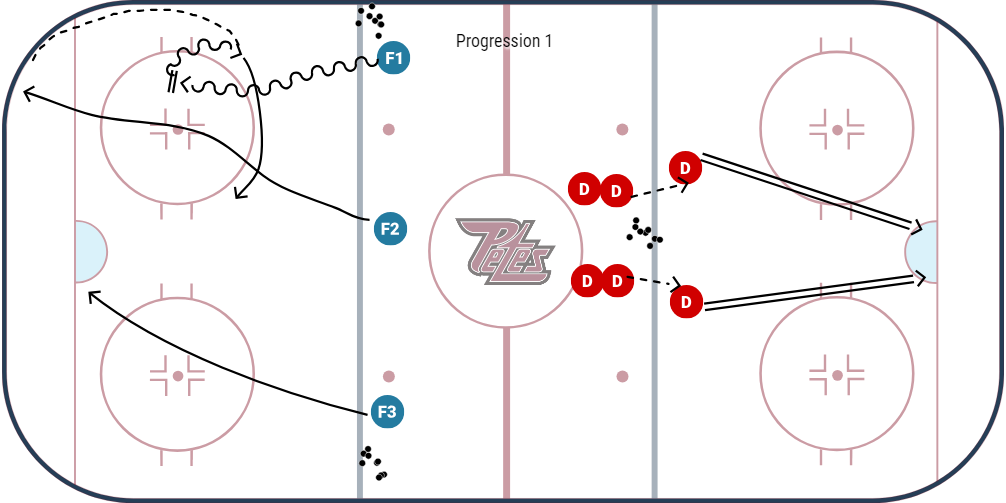
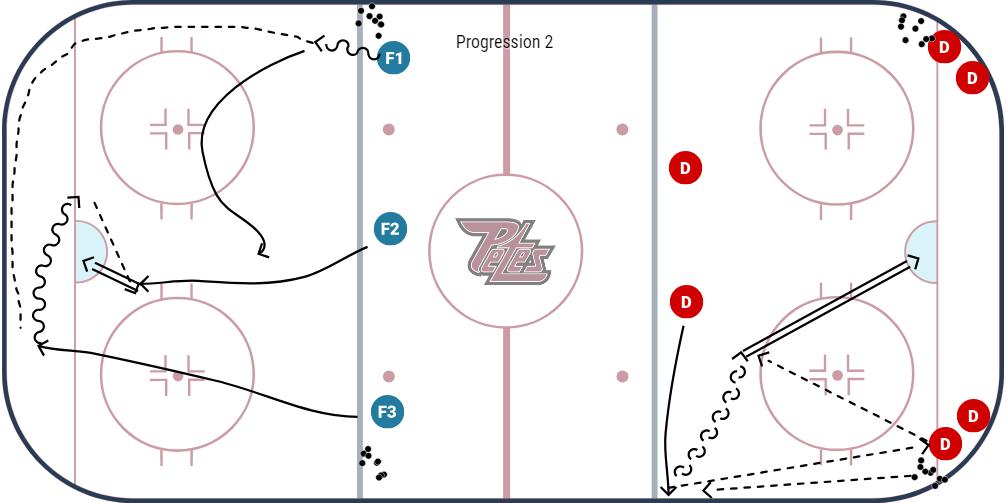
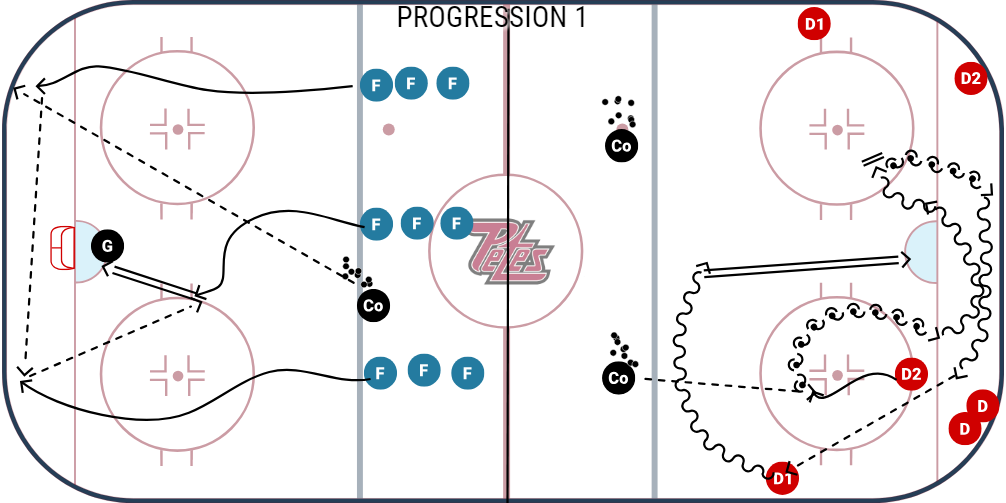
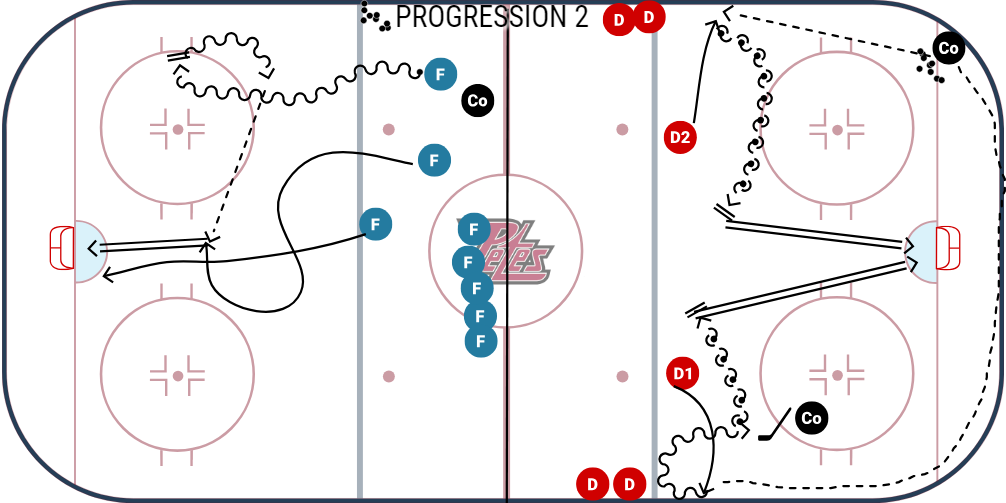
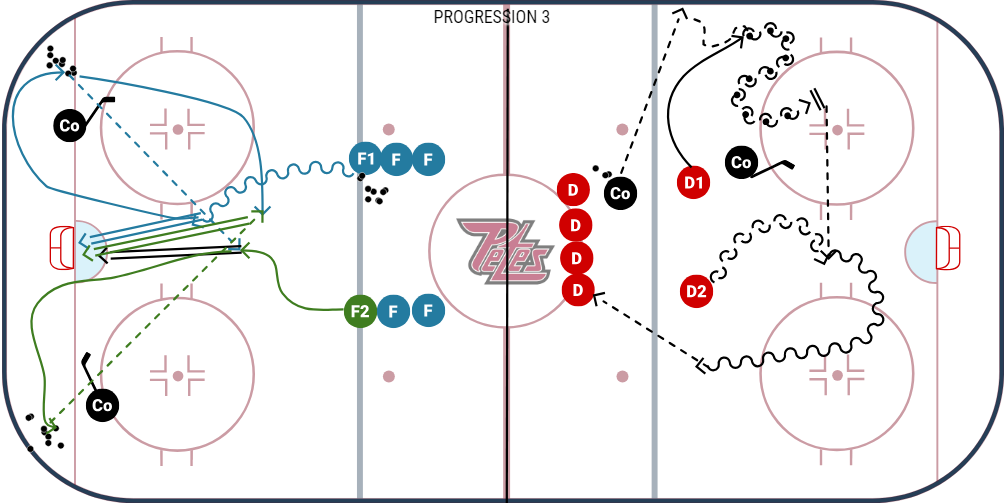
Initiate the drill with two forwards and a defenseman engaging in quick passes in a triangle formation near the neutral zone faceoff area. At the whistle, the forwards will send the puck into the corner. The defenseman will skate backward initially, then pivot forward and accelerate to retrieve the puck.
The forward positioned closer to the center of the ice will assume the role of F3 (center), maintaining a low and controlled poistion while breaking out. The other forward will take on the duties of the strong side winger. As the defenseman starts the breakout, the forwards can pass the puck back and forth a few times as they advance up the ice into the offensive zone.
The forward driving through the middle lane will direct the puck towards the wide lane, allowing the forwards to enter the zone and occupy the first two lanes of the attack. After taking a shot, the middle lane driver will screen the goalie while the F1 forward retrieves the puck from the corner to pass it to the defenseman at the point, who has joined the rush.
The defenseman will then move inside the faceoff dots for a point shot. As the breakout team skates quickly past the center line, the next group of three players will enter the ice, form a triangle, and begin quick passes to restart the drill.
Key Points: - The centermen should time the breakout by using the principles of; hard, low and slow. - The winger needs to find the passing lane with the defenseman. - After the defenseman passes to the winger, they should join the rush between the dots.
It’s one of the more magical scenes in film history.
Ray Liotta (as Shoeless Joe Jackson) and cast walking through the cornfield into a makeshift diamond in the movie Field of Dreams; “if you build it, he will come” echoing throughout the film.
That moment was the first image I had trying to picture what it looks like at Hermantown High School.
As the school bell rings, seeing students spill out of the doorways, joyous not only because their time behind the desk was over for the day but maybe more so for their next destination.
School bags traded for hockey bags, boots and shoes dismissed for skates, the sound of a blade hitting the fresh ice, the puck dropping, the game starting.
But this is no ordinary game – in some ways, this isn’t a game at all.
This is the way hockey is meant to be played as a kid.
Unstructured and outdoors.
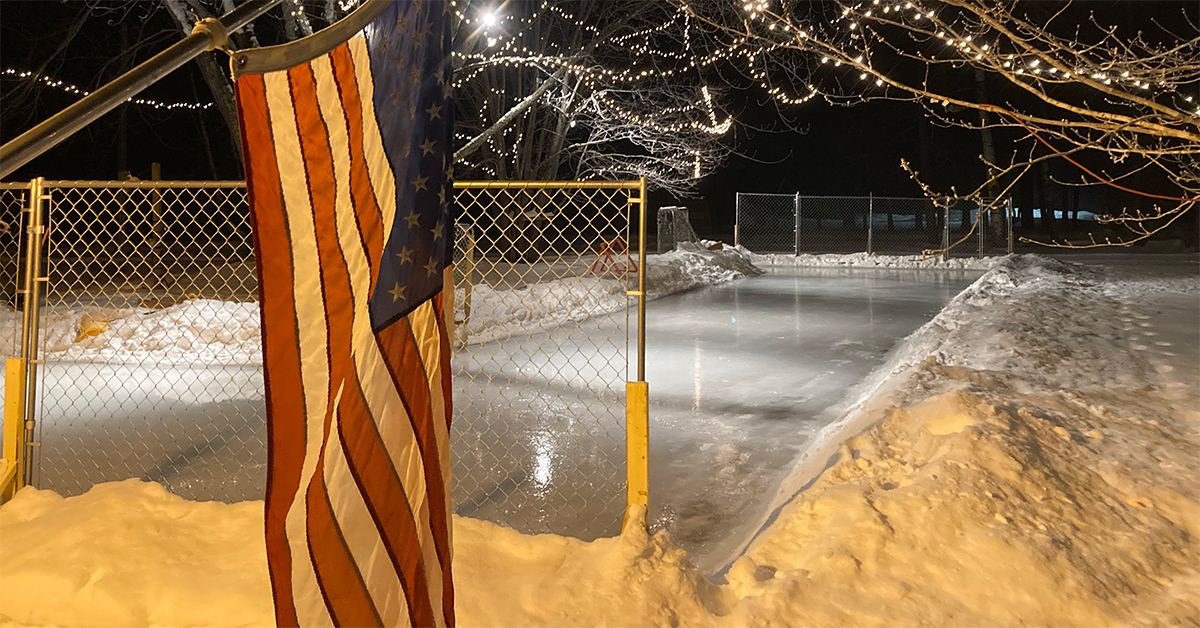
One of the hundreds of Backyard Rinks put up every winter in Hermantown, MN.
A group of kids of all different ages and skill levels, without a parent, coach or referee in sight, just enjoying the game of hockey in its most basic form.
Hermantown, a town of a bit over 10,000 people in northern Minnesota, is the pinnacle of outdoor hockey and the community based model.
These same kids dream of playing in front of 19,000 people at a State Championship as a member of the Hermantown Hawks High School team, but today, they just want to skate and play and make blind passes.
These kids will skate all night until their parents pick them up, they will get dropped off early and stay late on school days, they will put in full shifts on weekends.
They want to fall even more in love with the game.
But what they don’t know yet is that by being creative, by falling in love with the game, by spending hours and hours on the ice with their friends, they are becoming dang good hockey players.
And Hermantown has a lot of them.
================================
“The community-based model, hands down, is the way to go,” says Adam Wright, Hermantown Amateur Hockey Association President. “You are giving everyone the opportunity to play hockey. When you go to different states where it’s so expensive, you’re missing out on a potential superstar, who can’t play because of financial support.”
To play in the Hermantown Hockey Association, you have to attend school in Hermantown. You grow up through the program with the ultimate goal of playing for your high school team.
This is how hockey was delivered across the United States for decades, until the AAA model crept in and perceptively became the best way to develop players.
Nearly every state adopted that model, except Minnesota.
Why the general abandonment for AAA hockey?
Mike Snee, Vice President of the Minnesota Wild Foundation and Community Relations, a former long time Executive of Minnesota Hockey, explains.
“The most critical piece to the success of community hockey in Minnesota is a state wide culture in mandating public ice arenas,” Snee outlines. “The investor may be different – could be a school or a city or a county – but I believe nearly all full sized sheets of ice in the state are owned in a non-profit environment. But when a rink is privately owned, this model does not make people money.”
Of course, it’s all about money.
Our game has never been more expensive in so many different capacities and there are no signs of that dropping any time soon – there are too many people with too much money available to make it stop.
In a community like Hermantown, the tax payers see the ice arenas similar to parks or the community pool – it’s an asset of the community to serve the citizens and not to turn a profit.
In turn, if the community owns the rink, they go to the community hockey programs first, all the way up to high school and then to the high school. They get first crack at the ice, they get prime time ice, if there are extra locker rooms the varsity teams will get to use that space.
Snee makes a comparison to another industry of why this model does not work for those trying to profit.
“It’s no different than a restaurateur owning a restaurant, they are trying to make money, they are not giving food away,” Snee points out. “The rink owner’s priority is not the non-profit organization or the high school, it’s the programming that will make the rink owner money.”
The interesting thing about the model, which is a point of contention for those within the community based hockey community, is that this exact model is at the heart of nearly every other sport in the United States.
“Minnesota delivers hockey the same way Minnesota delivers football,” Snee acknowledges. “If you are a 13-year-old kid, you play for your community association. If you’re 17, you play for your high school and you do all of that on a municipally owned football field.
“Everyone is interested in how Minnesota delivers hockey but no one is interested in how Minnesota delivers football – because the football model is the same everywhere in the country,” Snee says. “Nobody ever questions how football is delivered and if it is good for development. However, the business of hockey wants people to question the Minnesota hockey model because they see those people as customers.”
When Wright took over as Hermantown Amateur Hockey Association President, he wasn’t trying to fix something that was broken.
Hermantown hockey is excelling and has been the focus of numerous articles and coverage before.
Wright came in with an agenda to create a hockey subdivision based on development, where coaches and players are trained regularly with the first priority to make sure these kids fall in love with the game, and the second being development.
Wright, and everyone else I spoke with, acknowledges the community for the success in delivering that plan.
“The passion is the big thing, our parents here are passionate and our coaches are so dedicated and so loyal,” Wright boasts. “One of the secret sauces we have here is the dedication of our coaches and volunteers. They are so valuable to the organization and execution of our model.”
The community based model also allows for Hermantown to make hockey as inexpensive as possible through fundraising initiatives and support. The registration price is essentially around how many hours each team will have access to the ice.
With so many kids coming out every year, they have the ability to make it affordable.
“We have 50 kids trying out for our Squirt A program,” Wright tracks. “These are all kids who did learn to skate in Hermantown, these are not move-ins or recruits or anything like that. These are home grown Hermantown kids who, right now, are fourth in the state in A and AA hockey.”
Snee agrees.
“Not only is it working, it’s working far better than anywhere else. It’s a flat out fact,” he directs. “If you dig deep into community hockey, one important aspect is that Minnesota has thriving small town hockey. Towns of 12,000 people are doing extremely well with hockey numbers and participation. In some other large metropolitan areas around the country, they may have one or two teams for their top 14-year-olds. The perception in parents’ heads is if you’re not on one of those teams then you are not on a team. Los Angeles has two, Dallas has one, St. Louis has one – in Minnesota, we have 140 of those teams.”
That’s right.
In Minnesota, there are 140 high school programs. So, that means you have 140 captains, you have 140 starting goalies and 140 power plays and penalty kills, which equates to so many kids getting these training opportunities instead of just one area AAA team.
The thinking is almost comparable to a small country in Europe, where hockey isn’t the most popular sport and the mindset of the club is that they have to develop everyone because they don’t have another kid they can just grab off the street and plug in.
“We focus a lot on the Hermantown system in the Squirt level, because we feel it’s the right way to develop, whether it’s break out, forecheck or neutral zone and we don’t just do that at the A level, we do that at all levels,” Wright shares.
As you go through the youth hockey experience at Hermantown, your eyes are set on one thing.
Sure, the NHL is always going to be there to dream about, but when you are in a small town and surrounded by that community embrace, skating outdoors with teenagers, idolizing them as if Crosby himself came out for a few laps, your focus becomes pretty clear.
You want to play for Hermantown High School.
================================
“I grew up here, I’ve been playing hockey since I was 4-years-old, so I’ve been raised in Hermantown hockey and that’s always been part of it.”
Patrick Andrews has been the Head Coach at Hermantown since 2017.
On top of coaching the program, Andrews is a history teacher at the school.
“My dad coached me when I was a youth and then he passed away when I was a sophomore in high school and so my coach at the time, Bruce Plante (who became a life long friend) really took me under his wing,” Andrews reflects. “It’s something I really wanted to do. I get to teach history during the day and then I get to coach hockey. That makes it really special.”
Plante is a legend in Hermantown parts, putting together a 547-197-23 record and winning three state championships.
I asked him if he can explain how Hermantown has continued to succeed in the state and across the country.
His response is simple – it’s the access to ice that a community-based model delivers.
“Because our rink is owned by the school and it’s not for profit, no one is renting the ice,” Andrews explains. “So, the ice is there and if you can get to the rink, the ice is free. On top of that, the outdoor rink environment is 99% of what Hermantown hockey is. It’s a rink rat culture, it’s an outdoor rink culture, whenever there is available ice, our kids are using it in an unstructured way.”
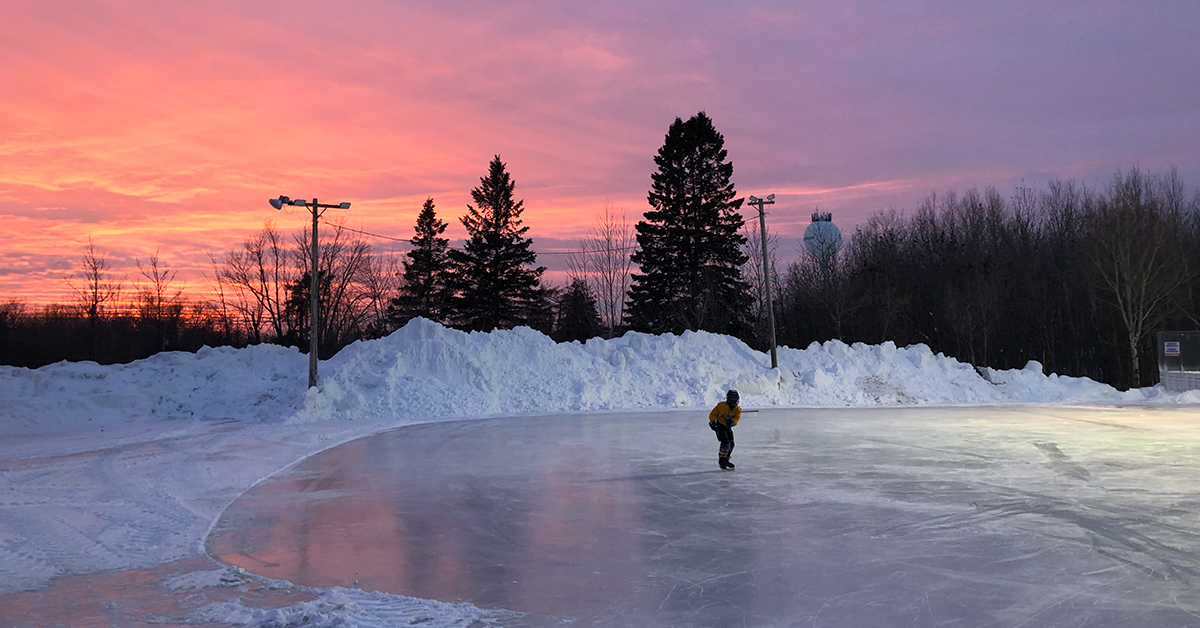
The sun sets on the Hermantown outdoor rinks as a lone Hawk youth skater gets in some rink rat time while the Hermantown water tower keeps watch.
Wright and Andrews work collaboratively throughout the process of youth development to high school. Wright describes that relationship as a blessing.
It’s the blending of the two ends of the spectrum that makes it such a special environment.
“The community supports our teams so well and we have really been able to create an environment where they are in awe of these high school kids,” Wright details. “The high schoolers are idols to those kids. We had our annual Skate with a Hawk Night, you should see these kids and the reactions they get when they get autographs from a high school player, to see the look in their eyes is incredible.”
Andrews will send out a flyer every year about his team’s culture and systems so the younger kids are playing that way right out of the gate, it saves them from getting confused by having to learn different systems and tactics at a young age.
“Coach Andrews doesn’t want to step on toes, he does a great job of balancing his role in the youth association and the Head Coach of the program,” Wright continues. “We don’t want these kids every year with a new coach who is teaching them a new system. We want it consistent through the entire program and Coach Andrews does a fantastic job with our coaches to show them what we want.”
At the Bantam and Pee Wee AA levels, Hermantown will start using non-parent coaches. The expectations of the coaches and what they want taught is laid out in great detail so the coaches can then get their players to buy into the system.
The program starts late in the season with breakouts, forechecks, neutral zones, etc, as an introduction in Mite II.
Once those kids reach the Squirt level, it’s full go.
From there, the hand off to high school hockey begins.
“When I get players coming up to high school, they all can skate,” Andrews relays. “Everyone is so skilled now, but our kids are hockey players. We are developing hockey players, the system works when the parents, players and coaches ‘trust the process.’
Andrews is pretty set on one specific rule, which again is created with development in mind. All kids in Hermantown will play two years of bantam, no matter what. They will get their chance to jump to the high school team in their sophomore year.
“We want our best kids to play bantam and be leaders and play with their group so when they come to high school, they are established in their peer group and their talent group,” Andrews explains. “One thing that’s hard with constantly elevating, it’s a fine line. We live in a world where everyone wants to get to the next level as fast as they can, but if you are never the master, ever, are you really learning to be ‘the guy.’”
The development model itself is pretty strict.
Andrews explained how in the late 80s or early 90s a book was put together for coaches within Hermantown with drills and skillsets to focus on for development.
Skating was always paramount. If you can’t skate, you can’t play in Hermantown.
“I don’t tell the Squirt coach or the Pee Wee coach what systems they should be running,” Andrews emphasizes. “We preach hard work and talk about a united group playing for something bigger than themselves and then we try to allow the players some creativity. We want to win, it’s a highly competitive environment, but we want our players to make mistakes with a growth mindset.”
Andrews notes that from that time, he doesn’t think there has been a huge shift in what Hermantown has preached, it’s more that the rest of the world has changed.
He, again, points to the outdoor rink as a benefit.
“All those things that used to be childhood norms are still happening in our outdoor rinks,” Andrews shares. “It’s what makes us special but also, our kids go to the rink, their parents aren’t there, it’s unstructured, it’s just an old school way of just figuring it out.”
The thing is, a lot of kids from a small town in northern Minnesota have figured it out.
And it’s taken them to the top of the hockey mountain.
================================
“In a small town like Hermantown, playing for the high school team is the pinnacle.”
Current Winnipeg Jets defenseman Neal Pionk was born in Omaha, but moved to Hermantown when he was 5-years-old, grew up there and was introduced to hockey there.
His father coached junior hockey and his first impression when arriving in Hermantown was that the access to outdoor ice was incredible.
“We were surrounded by it,” Pionk recalls. “I always tell this story, on the odd Saturday my parents would drop us off at the rinks at 9:00 am and they’d come and get us around 5:00 pm,” Pionk reminisces. “We were safe there, we had fun there. I mean, run that through your head, how often does that happen in other communities?”
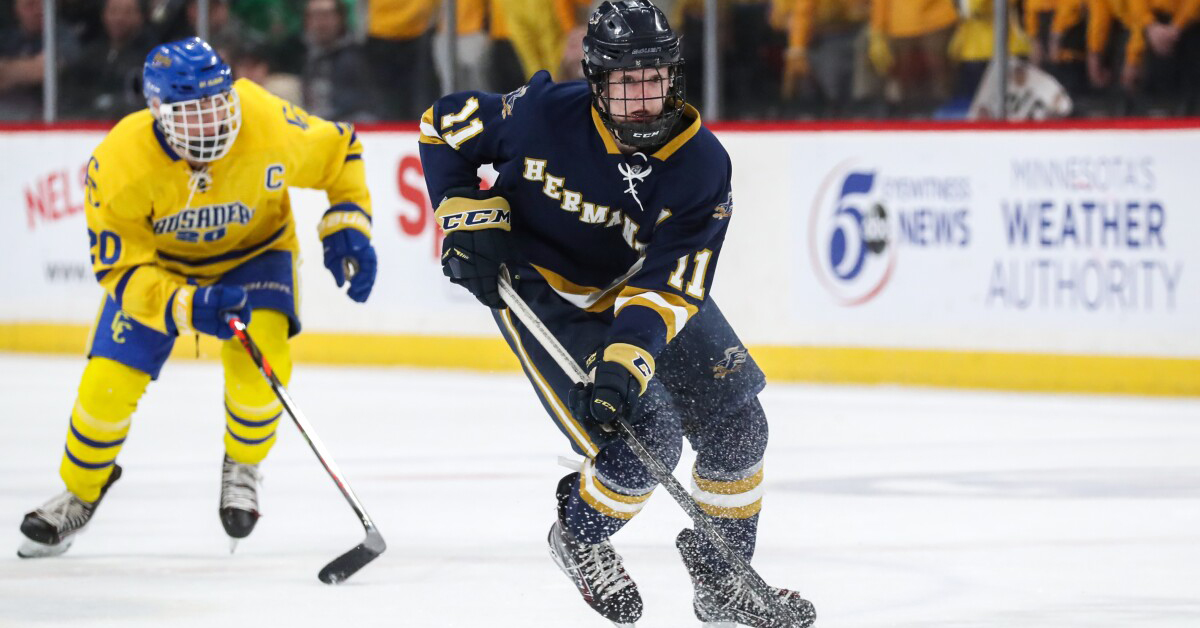
Hermantown's Aaron Pionk takes the puck down the ice during the 2020 Minnesota state semifinals.
Pionk still tells his NHL counterparts about playing a game in the Hermantown Arena and then going to the outdoor rinks afterwards and skating some more.
“There were no coaches there, there were no games, you’d make up your own games, to this day I remember some of the games we’d play,” Pionk laughs. “That is definitely where the creativity comes from. It’s all part of being a kid. From youth hockey, from the time you start until you’re a teenager, it’s supposed to be fun, and the outdoor rinks embodied that. If you made a mistake on the outdoor rinks, no one yelled at you.”
Pionk couldn’t tell you everyone he skated with on those outdoor rinks, some would be teammates, some would be older kids and some younger, some he didn’t even know.
One of them, in a unique turn of events, he’d end up sharing an NHL dressing room with.
Dylan Samberg grew up on those rinks as well, he moved to Hermantown when he was 2-years-old.
He remembers seeing Neal, four years his senior, playing in high school tournaments and wanting to be like him one day.
Future Bulldog and Winnipeg Jets standout Dylan Samberg patrols the blueline against Luverne in the 2017 State Tournament.
“The outdoor rinks in Hermantown were a huge thing growing up,” Samberg says. “Our parents would drive us to school in the morning, we would drop our bags off at the warming shack and then go to school for the day, come out after school and immediately get on the ice for a couple hours and then go to practice. It was instrumental to my growth as a player and that’s how Hermantown is.”
The two defensemen have crossed paths throughout their hockey careers.
Samberg was actually supposed to go to juniors after his senior year of high school but because Pionk ended up signing with the New York Rangers, a spot opened up at the University of Minnesota-Duluth and he got in instead.
In 2017, Samberg was drafted by the Winnipeg Jets in the 2nd round, 43rd overall.
In June 2019, Pionk was dealt from the Rangers (along with a 1st round pick) to Winnipeg for Jacob Trouba.
Two kids from the outdoor rinks were now paired up on an NHL blueline.
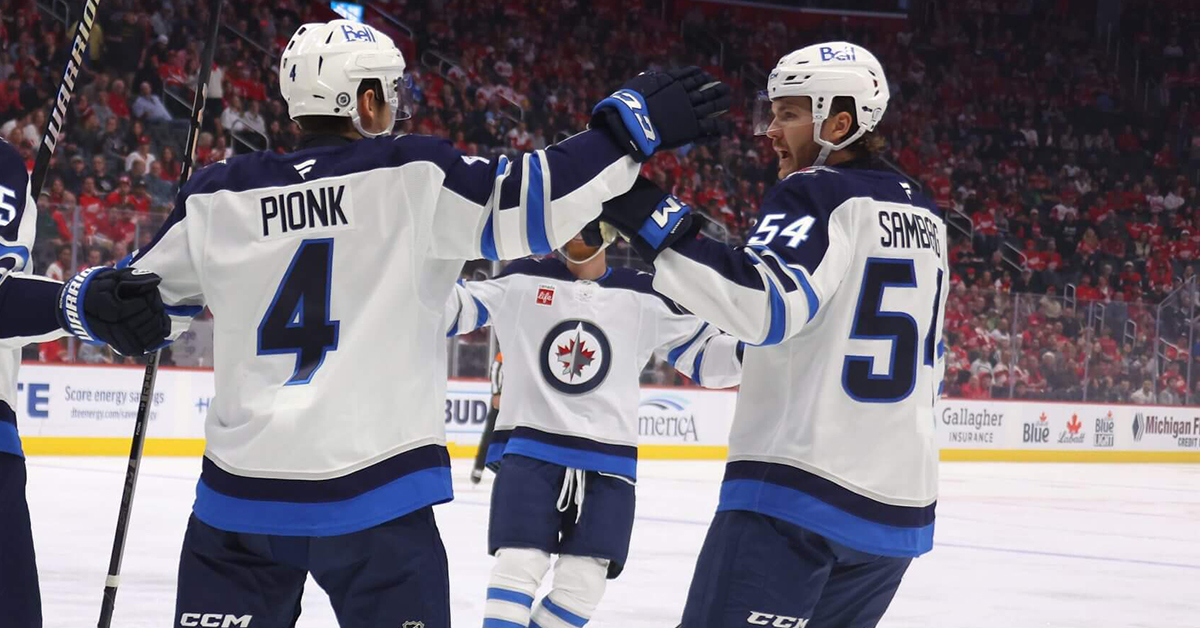
Making names for themselves in the NHL, Neal Pionk and Dylan Samberg celebrate a Winnipeg Jets goal.
“Neal was a bit older than me so I grew up with a couple of his brothers, but what are the odds we end up on the same team?” Samberg inquires. “It’s cool that we get to live on the same lake back home – Neal calls it his lake – but to experience the same thing is really special. In the Hermantown Arena both of our high school jerseys are up along with our Winnipeg jerseys, so that’s really cool.”
Pionk echoes that sentiment.
“Dylan and I talk about Hermantown all the time, I’m sure the guys are sick of it, but we don’t care,” he jokes. “With Hermantown being such a small community I knew who he was, I’m sure we were on the outdoor rinks together, I saw him play in high school and so when I was traded from New York to Winnipeg, we had that instant connection.”
Cole Koepke is no different.
The 2018 6th round pick of the Tampa Bay Lightning, has 82 NHL games under his belt, 59 of them (at the time of this writing) with the Boston Bruins.
Koepke estimates running down the hill from school to the outdoor rinks thousands of times.
“That unstructured play where there are no real rules and we are just out there playing is where we learned all of our creativity and you’d see what other kids could do and you’d pick up on that even if you’re not trying,” Koepke acknowledges. “Not being serious and joking around with your buddies playing hockey keeps that love of the game going, where at some point kids get too serious, this made you grateful to play.”
Koepke played three years of Hermantown high school hockey, Samberg and Pionk the same.
Where they landed next was also a similar path.
================================
A common thread weaves through Hermantown hockey.
As you grow up in the town, you learn the game on the outdoor rinks, you play youth hockey with HAHA, and you strive to play for the Hawks High School team.
After that? Your eyes are fixated on the University of Minnesota-Duluth.
“As early as I can remember, I wanted to play for the Hermantown Hawks and then play for the UMD Bulldogs,” Adam Krause, a former Hawk, Bulldog player and now UMD assistant coach recalls. “It was never really about the NHL because we didn’t have an NHL team in Minnesota when I was growing up. The foundation was laid, though.”
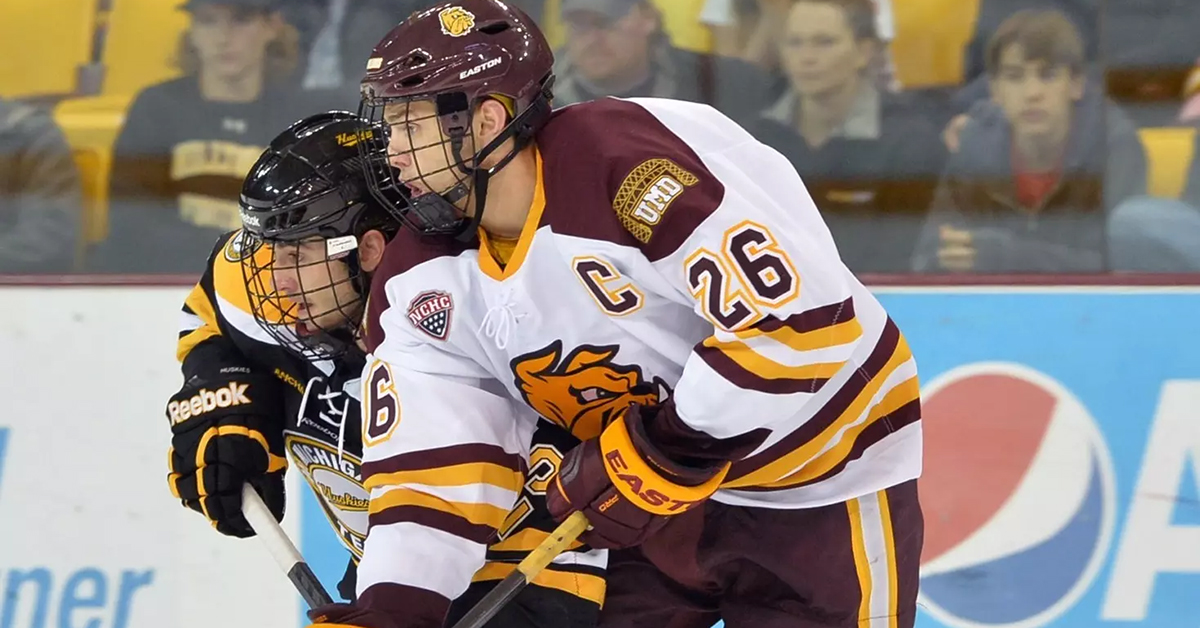
Adam Krause battles for position in a game during his tenure at the University of Minnesota-Duluth.
Krause points to player access as his biggest influence for carving out that dream. The high school players were role models while out on the outdoor rinks with kids much younger.
“It's accessible because growing up you see a realistic path seeing someone play in Hermantown and then play high school and move on to the Bulldogs, you can say to yourself ‘I want to do that’ and it feels attainable,” Krause details. “In the NHL, you cheer for Sidney Crosby but you don’t know him. When you see all these people who are doing what you did – it seems like something you can really do.”
Krause spent four years at UMD, serving as captain for two of them. He played 69 games in the ECHL and 75 in the AHL before an opportunity to step behind the bench presented itself.
“Coaching was never really something I thought about, I was playing in the AHL in Rochester and playing at a high level,” Krause remembers. “I thought I was going to play there again the following year. UMD won the National Championship in 2018, and I was told an Assistant Coach was going to be leaving. Coach Scott Sandelin called me and asked if I wanted to come back and coach. I realized it was very hard to get one of these jobs without going through junior hockey, my wife was from here and I was from here and I knew if this was something I was interested in there won’t be a better opportunity, so I decided to cut the career short.”
One of the players Krause currently coaches is on the same trajectory.
Joey Pierce and his family moved to the Hermantown area and thought the hockey program and school size were an ideal fit.
Pierce served as captain at Hermantown before landing at UMD.
“It was pretty special being captain in high school,” Pierce boasts. “At Hermantown, only seniors wear letters and it was a great group of guys who had played together for a long time and were best friends with. I’m wearing an ‘A’ this year at UMD which is a pretty special accomplishment.”
Looking back, Pierce feels very fortunate for the support he and all of his teammates received from the Hermantown community.
“The whole community is behind you, it’s a special feeling to put on a jersey and know that and that’s what college feels like too, having the whole school rooting for you,” says Pierce, finding the similarities between high school and college.
“There is a lot of pressure with both, but at both places we’ve said ‘pressure is a privilege’ and that comes from the people before me making both places such a prideful place to play. The jersey meant a lot more than just a jersey.”
Krause now sees Minnesota kids following the same path he has and continues to enjoy watching the program grow.
“Before I was there, there was a pride and level of success at Hermantown, but it really went to a stratospheric level after I left,” Krause follows. “The year before I went into high school they won the state championship and then in my senior year we started that infamous run of finishing second place for six years in a row. There was pressure, in high school, you were always involved in the community, so if you had a bad game you had to interact with it. I remember thinking “I’m going to have to see these people in class tomorrow, if I score a couple goals or if I have a bad game.” It felt like you didn’t want to let them down and it felt so much more personal looking back at that time.”
Krause is not wrong. The one big takeaway from the players I spoke with and how the environment was explained is that it sounds like a pressure cooker from day one.
I mean, how many 17-year-olds can say they played in front of a sold out crowd in an NHL arena?
The Minnesota High School Hockey Championships might be the most pressure packed sports experience any athlete can handle.
And these guys lived it as teenagers.
================================
“The Minnesota High School Hockey Championships are one of the best sporting events in North America,” Snee brags. “It’s better than you imagine. It’s thousands of kids walking around wearing their hoodies or hats or jackets and it says what community they are from. It’s a revival of community hockey and it is spectacular.”
In early March, the best high school programs in the state head to the big city and face off at the Xcel Energy Center, home of the Minnesota Wild.
The building is completely sold out. Student sections upon student sections, bands upon bands, parents, coaches, television broadcasts – the event has it all. The town, as you can see below, goes into a frenzy.
“The first couple times you do it, it’s terrifying but for so many kids in Hermantown, myself included, that was our dream to play in those tournaments,” Cole Koepke remembers with excitement. “It was such a big deal there. Even before my brother and I played in it, we went down to Minneapolis and watched some of the games at the Xcel Center in front of a sold-out crowd with the student sections cheering back and forth at each other. It was wild.”
Joey Pierce knows the feeling.
“Growing up we played where the University of Minnesota-Duluth played to get into the state tournament and I don’t remember that one hitting me too hard, but playing at the Xcel Arena, it felt like the whole building was on top of you. I remember feeling like the rink felt small with all the people on top of us. I think it took me until the 2nd period to feel comfortable.”
It feels like an incredible amount of pressure and you would think some kids could completely fold under it. But with the community support that is drummed up, not just from Hermantown, but town’s all over the state, the players need to be more reigned in than pushed to perform.
“The best comparison really is those movies that feature the Friday night lights atmosphere of high school football in Texas,” Coach Andrews envisions. “It never gets old and you always have butterflies. Ultimately, trying to get them to focus on what they can control. We tell them to enjoy the heck out of it and bring great energy and purpose.”
But players like Pierce say being in those environments have only helped him with his leadership capabilities and helped him prepare for playing at the D1 stage. It’s also hopefully prepared him for his next step in hockey, wherever that may be.
“The coaches always talk about my first varsity game, we were playing a big AA school with a lot of students and in warm ups I was just skating around and getting a drink of water and they were saying my eyes were bugging out of my head,” he laughs. “I was a 16-year-old playing in front of a full arena and I don’t think that was something I had imagined, so they always talk about how wide eyed I was. Obviously it’s still special to do it today, but that really set me up to get more comfortable in those big moment situations.”
For Koepke, being a part of a team that won the state championship after six straight years of the school finishing second, was a moment in time he’ll never forget.
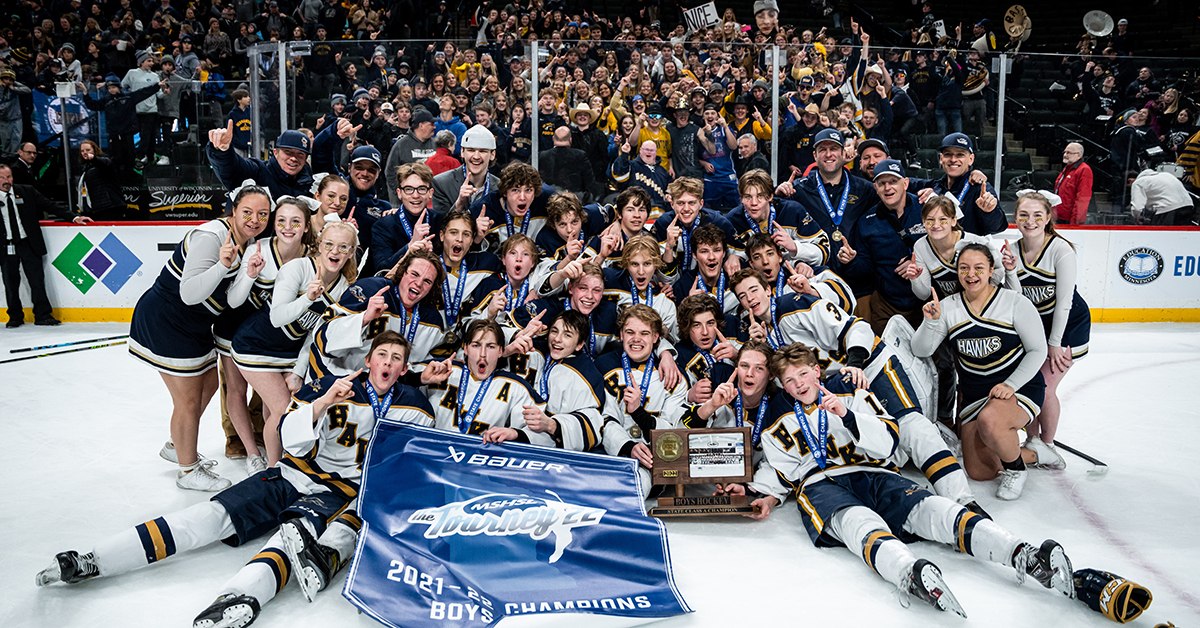
Hermantown celebrates as 2022 State Champions!
“When we won, all of those guys before us, it was incredible to celebrate,” he shares. “After we won we took our gear off and put our jerseys back on and it was such a great memory, we didn’t want to take those jerseys off.”
================================
We know why the community model doesn’t exist elsewhere and it’s difficult, after speaking with the people of Hermantown, to understand why it gets such a negative outlook from outside the state.
It’s also difficult to imagine the model fading away.
One of the campaigns Mike Snee and the Minnesota Wild are working on is called Skate It Forward.
Their mission: they want every kid in the state of Minnesota to try hockey and are hopeful that someday the first year they play will be free.
As Snee points out, they need the whole of community hockey to remain vibrant.
“Hermantown hockey only works if the seven or eight towns near Hermantown have thriving hockey too and that is state wide,” Snee believes. “Community hockey doesn’t have a marketing department, most families don’t know there are more high school hockey players in the NHL today than there ever has been. That’s part of what Skate It Forward is trying to do.
“If you look at the statistics, Minnesota continues to lead the way,” Andrews adds. “I don’t know that we’ve changed a ton, but when I was a kid it was Minnesota and places like Michigan and Massachusetts, but over time they went to the AAA model. We still continue to lead them in the sheer number of players enrolled and then numbers in junior and numbers in the pros.”
Remember, there are 140 clubs in Minnesota, where some major US cities have one or two AAA teams.
The numbers matter.
“It means more when you are growing up with these kids in your age group, instead of just up and leaving town for an all-star team that has players from all over the state,” Andrews continues. “For some, that’s great but I question whether they are learning to be a part of something bigger than themselves. I think our kids take such pride in putting on a Hermantown jersey from Mites to high school and that gets developed through a community based model.”
Snee boldly points the finger at other states suggesting it is easier for them to convince a kid from Minnesota to leave and play there than it is to develop their own players.
“I love that hockey has grown in our country, but it has grown in a for profit way with an attitude not just about developing players,” Snee passionately explains. “Instead of kids growing up and playing in their community, we have other cities that work harder to recruit from outside than to develop within. Now, they have a kid from Minnesota, living away from home in Iowa, potentially taking the spot of a kid from Iowa. It’s not good for anything other than the bottom line of that other team elsewhere.”
How does AAA hockey now seep through the walls of a community based state?
It’s the business standpoint of being a for profit arena that is competing with every other ice surface that is essentially free.
It’s a hard code to crack, but only because the state as a whole so deeply believes this is the best model to develop their players – just like every other sport.
“We are going to tell that story,” Snee says of Skate It Forward. “We need to make sure the families who like community hockey but their child is really good and they are hearing about places like Des Moines or Chicago or Detroit that play a national schedule and get the ‘iron sharpens iron’ speech know that story and get that information for them to make an educated decision that you can stay in Hermantown and may actually be better off. There are a healthy number of families that get their kids involved in hockey because it’s community hockey and they aren’t flying across the country every weekend for tournaments, they aren’t spending a ton of money and classifying themselves as a hockey family.”
”I think the biggest challenge we have for the community based model is everything else that is happening in the world,” Andrews considers. “Everyone wants to advance now and it’s great here but if players could play with the best 30 kids in the region they think that is better. At the same time, you lose out on the development piece because that’s not a model, that’s simply just taking the best kids from here and there and bringing them together. We have to develop our players from within.”
Andrews estimates for their program to continue to be successful, half the kindergarten boys each year have to play hockey. If 40 of the boys in kindergarten play hockey, by the time they are seniors, there will be on average, seven senior players left who have worked their way up the pinnacle of the high school team.
“Creating an inclusive culture and making people want to be part of it is huge and you have to develop everyone,” Andrews reiterates. “Everybody has to feel connected and make it feel like they are part of it. At the beginning you have no idea which of those 40 kids will be the 7 that last so you have to give everyone equal attention and opportunity.”
Which brings us back to the ‘no child left behind’ mantra that is Hermantown hockey and the community itself.
================================
It's in the bloodstream, it’s a big part of how Hermantown residents describe themselves and their community, through hockey.
As soon as a child can get on skates, they want to be a Hermantown Hawk, they light up getting autographs from their favourite players, who just so happen to be in their early teens.
Those players turn into the next generation, which fills D1 rosters, especially at the University of Minnesota-Duluth.
It all seems attainable, Adam Krause believes, because it’s happening right in front of you.
“Watching the Winnipeg Jets and seeing two guys that played together in Hermantown on that roster, it’s so surreal,” Krause shares. “It shows the model still works. These guys grew up that way too, it’s great seeing them have success but the validation of this not being just an old school mentality and still showing this model can have great success is awesome.”
With all that pressure, all those stages to perform getting bigger and bigger, each player, each coach goes back to the joy they had coming down the hill to the outdoor rinks.
“It’s really something you have to experience but it’s such a natural thing in that community,” Dylan Samberg reflects. “Everyone is willing to stick out their neck for you. Parents, coaches, everyone will volunteer or do what they can to make sure kids have the best hockey experience.”
Cole Koepke agrees.
“When the state tournament comes along it becomes chatter in the locker room with the Minnesota guys and you get to relive those memories from there. I still get up there in the summer and love to get on the ice, meet with the coaches and run a camp or two, so we try to keep making those memories as much as we can.”
“Hockey in Hermantown is a culture,” Neal Pionk adds. “That’s what we did on Saturdays. You’d get up Saturday morning and beg your parents to take you to the rink. That just doesn’t happen in a lot of places in the US, Canada or Europe.”
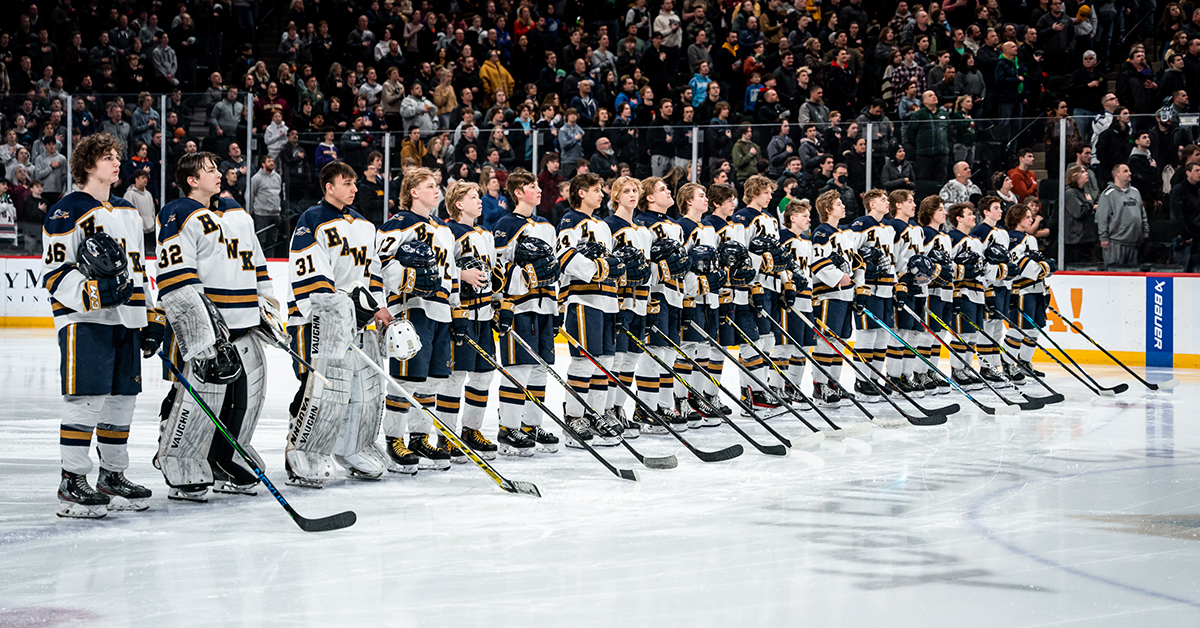
Hermantown listening to the national anthem before the 2022 State Championship game vs Warroad in front of a packed crowd at the Excel Energy Center in St Paul.
The town has recently agreed to start building a second sheet for the high school. It’s going to be a game changer for an already top notch facility.
One of the big decisions brought up after agreeing to that was what would happen to the outdoor rinks?
Some would have to be replaced to make up for the space the new rink will need.
The town didn’t blink an eye.
Those outdoor rinks may not be in the same place, but they are part of the new development.
“That just tells you how important those outdoor rinks are to this day,” Krause follows. “It’s so important, we can't lose that. It goes beyond hockey, it was just a good place to grow up. You could see the lights from the rinks in my bedroom window. It was an awesome childhood.”
It takes a village, some say.
For the community of Hermantown, the village is the way.
“I want them to have an incredible experience here. It’s all about positive culture,” Adam Wright talks about the players coming through youth hockey in the town. “Our outdoor rink culture is one of the best in the entire state of Minnesota. Our kids are so passionate about playing outdoors, they will walk down after school every day and skate from 3pm until 9pm. They will skate 8 hours a day on weekends. I want every kid to say this was the best experience of their life.”
Leave the program better than you found it is one of the mottos Coach Andrews preaches in his classroom and in his locker rooms. He wants his players and students to feel like they are part of something bigger than themselves.
“Never forget, yes it removes constraints being on the outdoor rinks – but it just makes it fun. It’s fun to go play 90 minutes of hockey without one adult saying a word,” Snee includes. “It’s just kids playing. 95% of what happens when you’re out on the rink should be you falling in love with the game because you’re having fun.”
It’s not cornfields that bring out the dreams of these Minnesota kids, it’s skating with idols, sharing laughs with friends, making up games and being on the ice.
Outdoors.
Where hockey dreams are first made.
“There is nothing we are doing that can't be done elsewhere,” Wright admits.
“It’s the passion and dedication we have to our culture, our accessibility to ice year round, the families we have that support us and the dedicated coaches and board members we have – you put those together and it’s a pretty special place.”
Check out this progression of the same concept and skill performed in three different settings - NHL, OHL and a skill development practice. The forehand is where you set up your plays, control the puck, and allow yourself to make hard plays with the puck.
Finding efficient ways to transition the puck out of your zone is crucial for a defenseman. Utilizing forehand plays increases the success rate of zone exits.
Key Takeaways:
Strong grip of the stick and hands in a fixed position
Early Scans to maintain eyes up ice
Getting inside dot lane with the puck
Deceptiveness to create separation
Quick, decisive movements to shield the puck while staying low in turns
Using the forehand to set up and finish plays under pressure
A good little warm up exercise especially for the younger players. It covers everything from basic outside edge control and progressions that involve transitioning.
The key is to keep the upper body quiet and focus on bending, pushing, and gliding. Skills that are often overlooked!
The power play is one of hockey’s greatest opportunities—a chance to seize control, come back, or secure a win. With the man advantage, the odds are stacked in your favor. But too often, power plays fall flat.
When a power play fails, the ripple effect is significant. The penalty-killing team gains a massive momentum boost, while your team loses valuable confidence. So, what’s the problem?
In my experience, the answer is often simple: passing.
Players on the power play can become overconfident. They rely too heavily on individual effort, abandoning the puck movement and teamwork that makes a power play effective. But there’s a straightforward drill I’ve used with every team I’ve coached that consistently improves power-play performance.
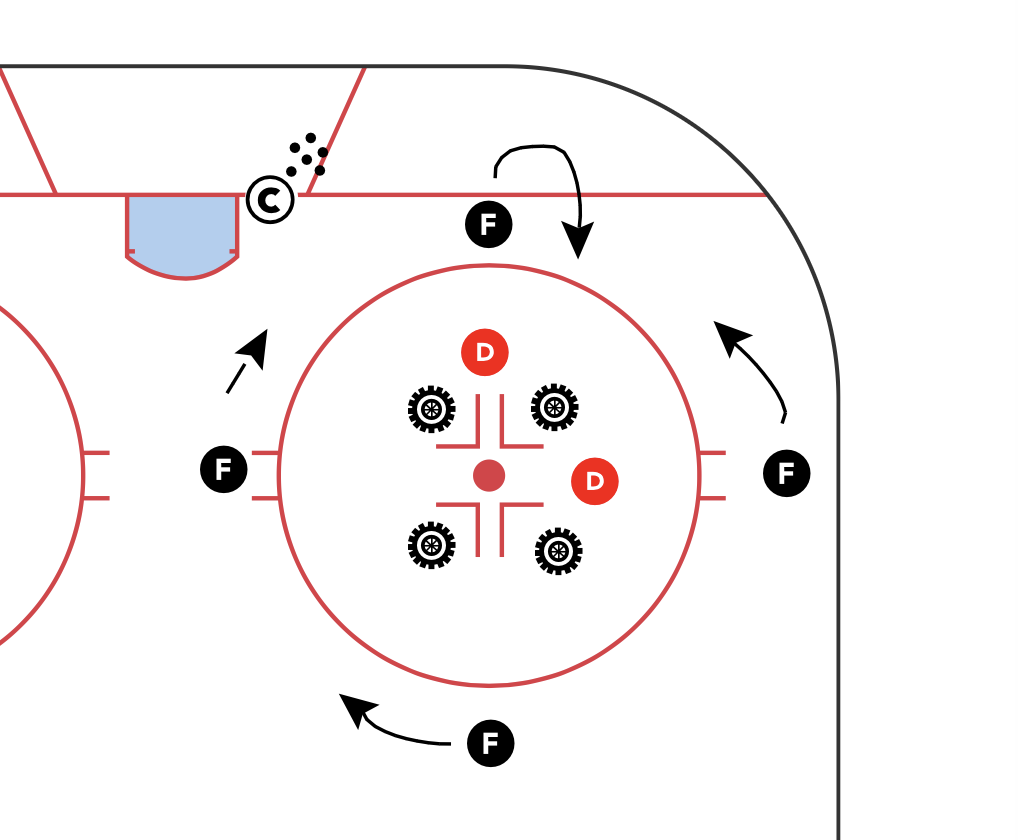
The Tire Passing Drill
This drill focuses on quick puck movement and exploiting defensive gaps, the backbone of a successful power play.
Setup:
1. Place four tires around the faceoff area in the offensive zone.
2. Position two defenders inside the circle. They must stay within the circle throughout the drill.
3. Place four forwards outside the circle. They cannot enter the circle but can move freely around it.
Objective:
• Forwards: Score points by passing the puck through the tires to a teammate.
• Defenders: Score points by intercepting passes.
Key Focus:
Encourage constant movement from everyone. Forwards should move quickly and make sharp, accurate passes to keep the defenders off balance. The defenders, meanwhile, must stay disciplined and adapt to the puck’s movement.
Why This Works
This drill replicates the dynamics of a power play. By moving the puck swiftly and decisively, forwards force defenders out of position, opening up lanes for high-quality scoring chances. It reinforces the importance of:
• Puck movement: Quick, smart passes are critical to creating opportunities.
• Positioning: Forwards learn to stay mobile and read the defense.
• Defensive pressure: Defenders sharpen their skills by challenging puck carriers and anticipating passes.
When executed properly, this drill demonstrates the essence of an effective power play: move the puck, pull defenders out of their structure, and create scoring chances.
Mastering the power play doesn’t require complicated systems. It requires understanding how to exploit the man advantage—and this drill is a great way to start.
Play starts with Shooter passing into the triangle. Puck is moved quick and sharp. Players should be challenged to do this with one-touch passing. Shooters should be encouraged to take shots with one-touch reaction as well.
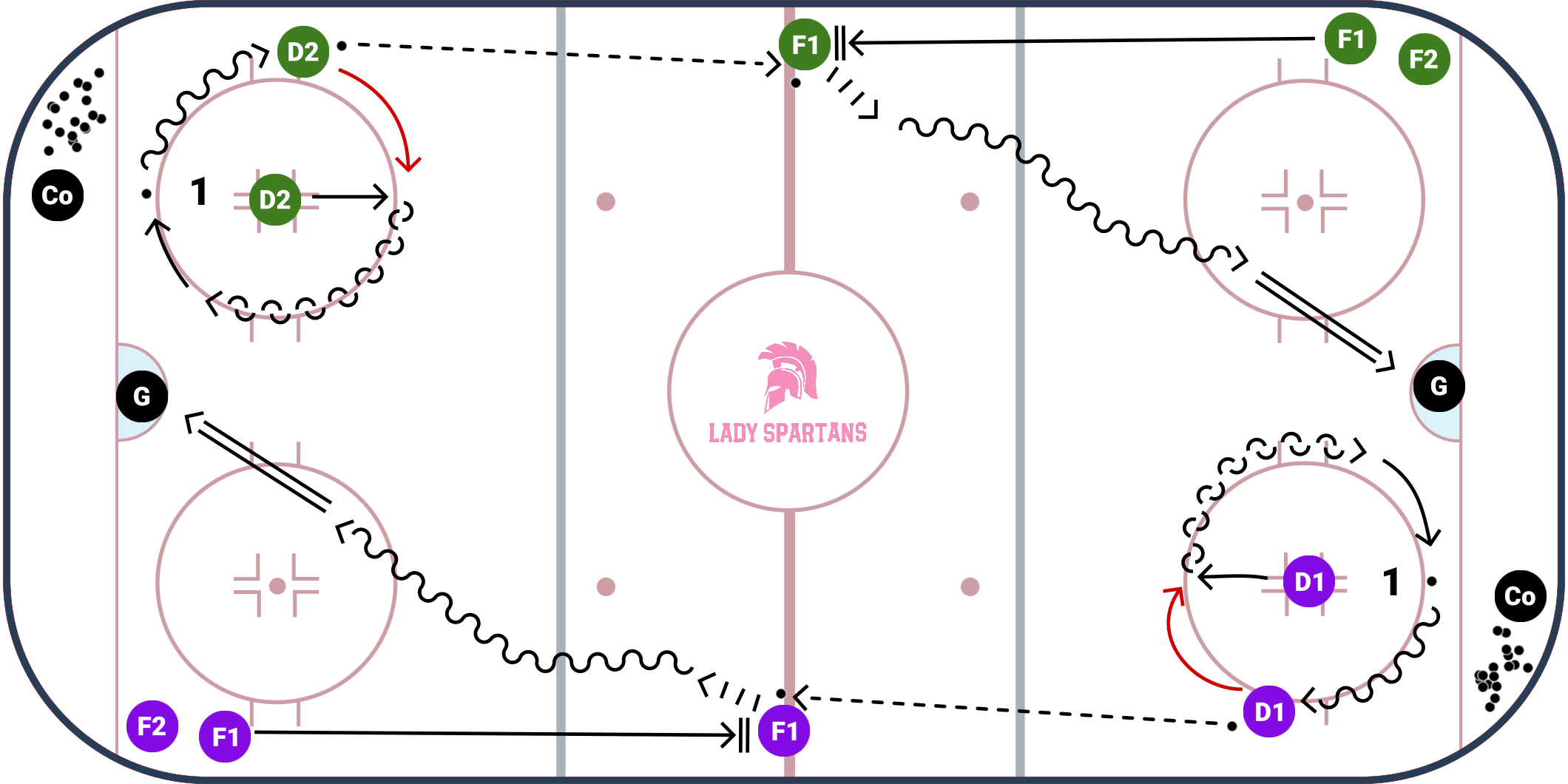
In diagonally opposing in-zone faceoff circles, 1 Defenceman starts on the dot facing the the top of the circle.
Two Forwards (F1 & F2) line up in the corner facing the defender that is at the other end of the ice. F1 starts behind the lower hash mark. F2 will be behind F1
Coaches are in the corners directly behind the defenders with pucks ready. Place a puck at the bottom of the defender's circle, have another puck ready to replace it as the defenders are going to be making 2 passes.
Goalies in net at either end.
Step 1: Strong Side Stretch To Post Up
**This is a timing drill that is gauged off the speed in which the D get to the bottom of the circle and move pucks up ice. Allow for them to get their bearings but push them to increase their intensity and sense of urgency as they work through their reps.**
On the whistle D will explode off the faceoff dot to the top of the circle then transition forward to backward motioning to the middle of the ice and following the faceoff circle toward the outside. D should open up their hips as they pass the inside hash marks. This is where they will pick up the puck sitting at the bottom of the circle and get up the wall.
On the same whistle F1 will race to get, ideally, to the red line. D are not to wait if F1 is not posted up at centre. The D are to make a hard, flat pass when they're set and ready. F1 comes to a full stop and should begin lateral crossovers as the puck is coming toward them to start momentum back up ice. F1 will head down and shoot, stopping at the top of the crease, when play is over F1 should be ready for F2's shot.
Coach places a second puck at the bottom of the circle for the D.
There are two incredibly important Coaching points to reinforce with your Defence here.
Gather Information - Have quick transitions and make sure you shoulder check to make a more informed decision. This is a habit that more and more players are getting away from when that simple act of looking over one's shoulder provides the most important component that any one player needs to be as effective as possible. That particular area and the route they are taking starts by heading into the one area of the ice we don't want to be, "The Cemetery". Coach Naurato has taught the importance of getting pucks out of that area as that's where plays go to die, meaning we are likely going to be met with pressure in a game. I understand this isn't the offensive zone but it is the principal of getting there fast and moving that puck with purpose, and for defenders we can be more effective at getting pucks up ice if we approach that area with a sense of urgency.
Keep Yourself Safe - Make sure that your defenders are making passes from this area of the ice with a strong base, meaning two feet planted. Reason being this is prime real estate for checks being finished hard. In a game, you're heading up ice, and your opponents will want to get above and head down ice at you to force a turn over by being physical. If you have your head down, are making passes while crossing over or even worse off one leg...it can facilitate injury.
Step 2: NZ Wheel Timing
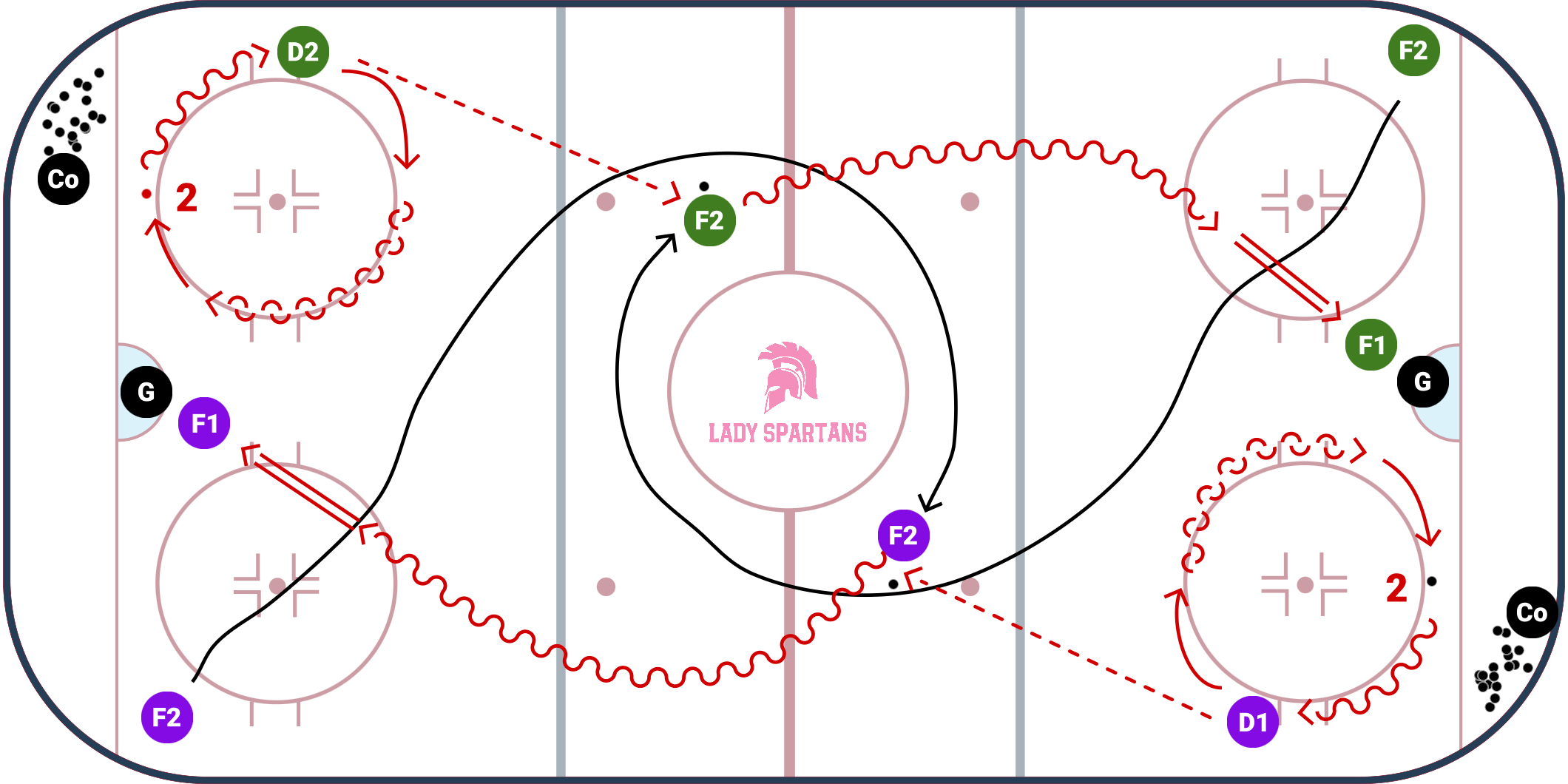
Off the first whistle, F2 will begin slowly moving up through the zone toward the middle and up ice, watching and timing as they gradually pick up speed heading around the far side of the centre circle and hit full speed wheeling through the neutral zone.
The timing taking place by F2 is based on the reloading of the D after they make the stretch pass. The D will back peddle around to the bottom of the same circle making sure to assess where F2 is before opening up to gather the puck and heading up ice.
Goal here is to hit the forward in stride and immediately follow the play, motioning toward the middle lane before breaking to the wall and stopping at the blue line.
F2, staying to the outside with speed, will head in and shoot as F1 screens.
Step 3a - Drill Finish Option 1 - D Follows Play / Shot From Point Off Rim Release
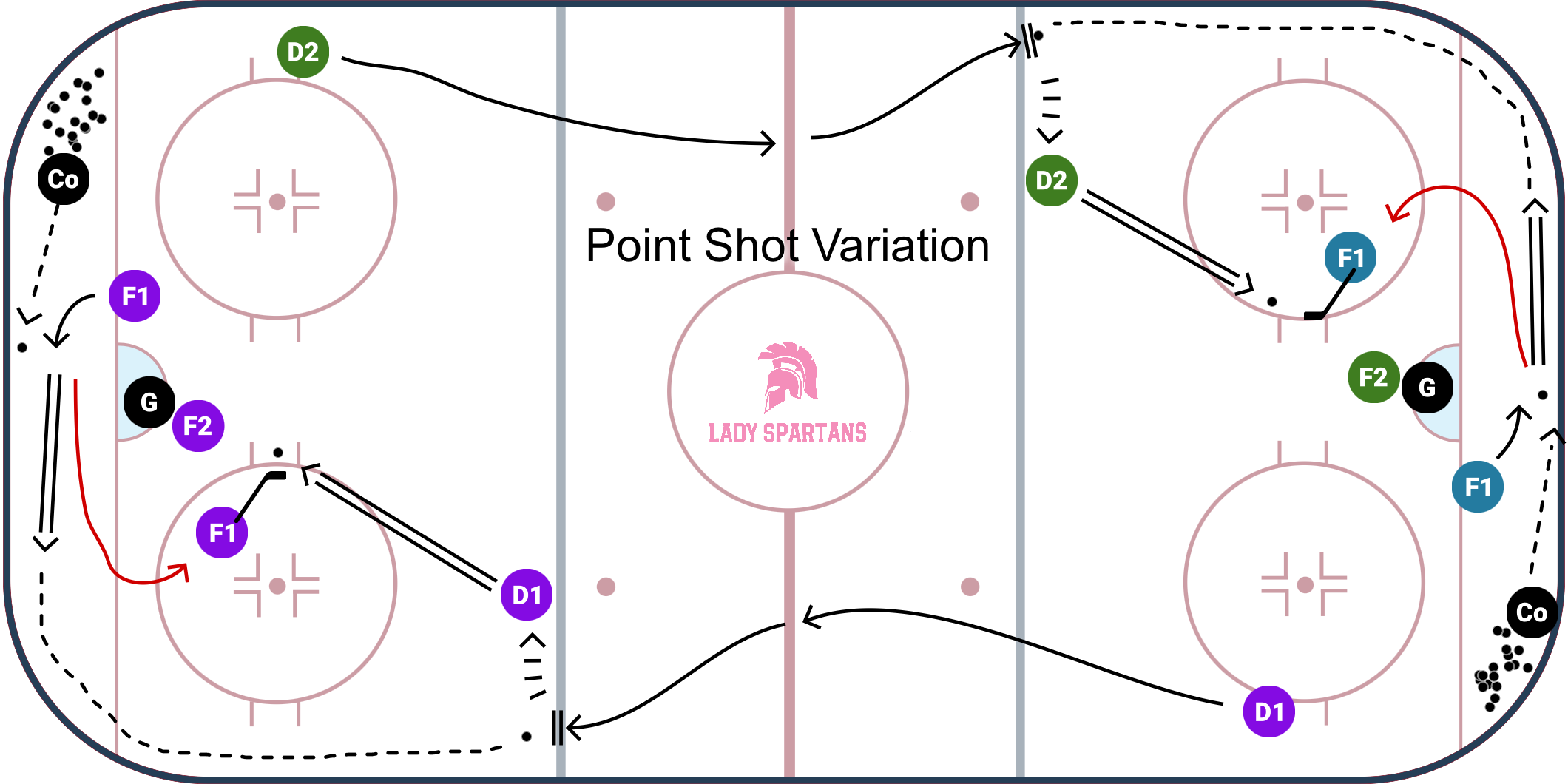
After F2 shoots, if there is a rebound or a skilled play to be made Coaches can allow for the play to continue at their discretion. If deemed over, Coaches will verbally give that signal and will proceed to release a puck off the end boards in such a way that it rests behind the net. F1 will then motion behind the net and hard rim release up to the D who followed the play.
It is now F1's turn to work on timing. In this case it is to time the shot coming from the point and getting a stick in the shooting lane to attempt a tipped redirect as F2 screens.
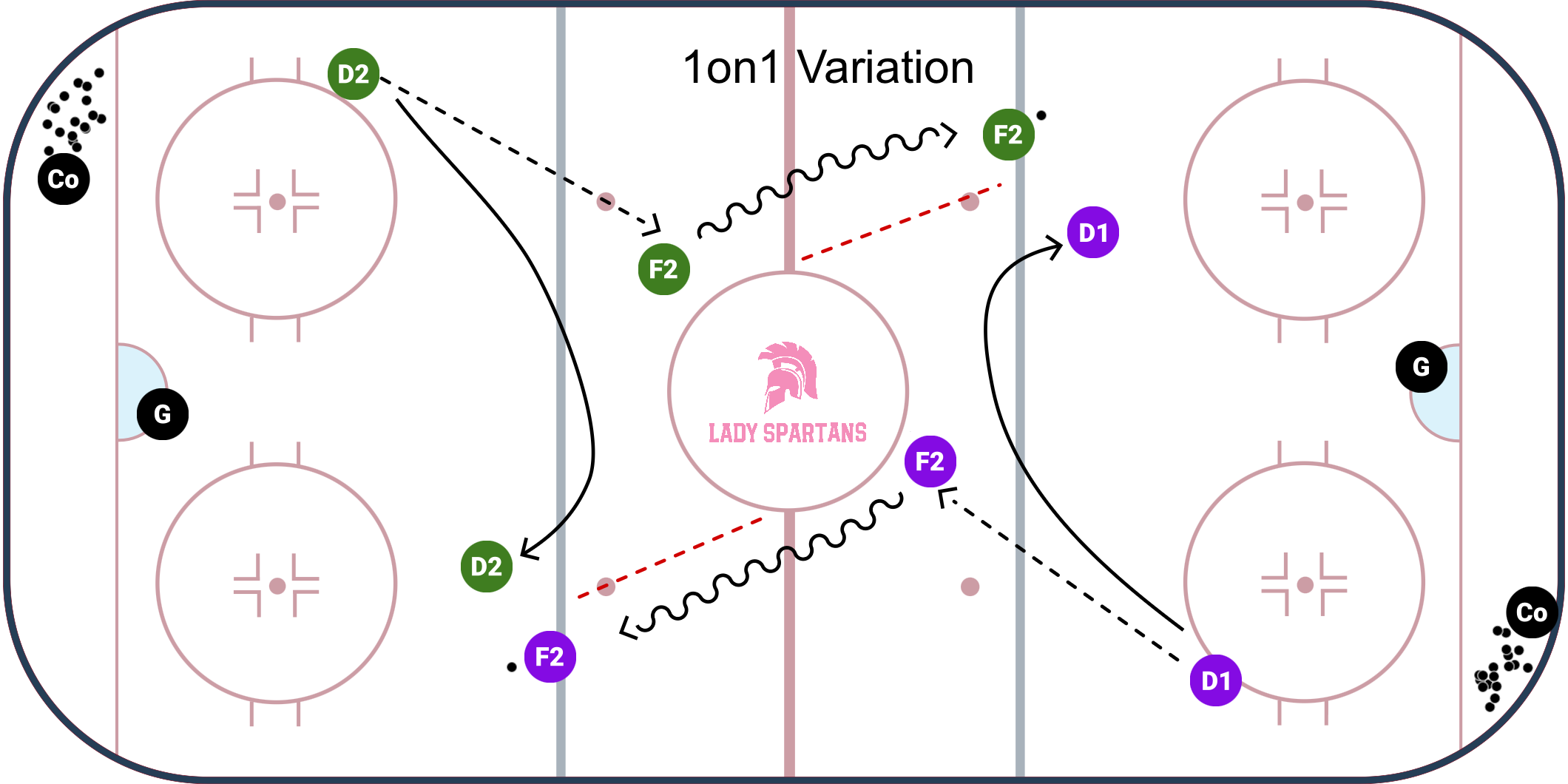
Step 3b: Drill Finish Option 2 - Angling 1on1
**Drill is shown below starting at the point where the D has made their second pass to a wheeling F2**
Note - In the 1on1 & 2on1 variations, F1 is done after they shoot.
In this 1on1 variation, after the D hit the forward wheeling through the NZ, they must work across to the opposite side and play out a 1on1.
F2 MUST stay outside the faceoff dots until they cross the blueline
Coaches can use a bingo dotter to show players the lane boundary. Cones shouldn't be used as they can effect the path F2 takes as they build speed around the centre circle.
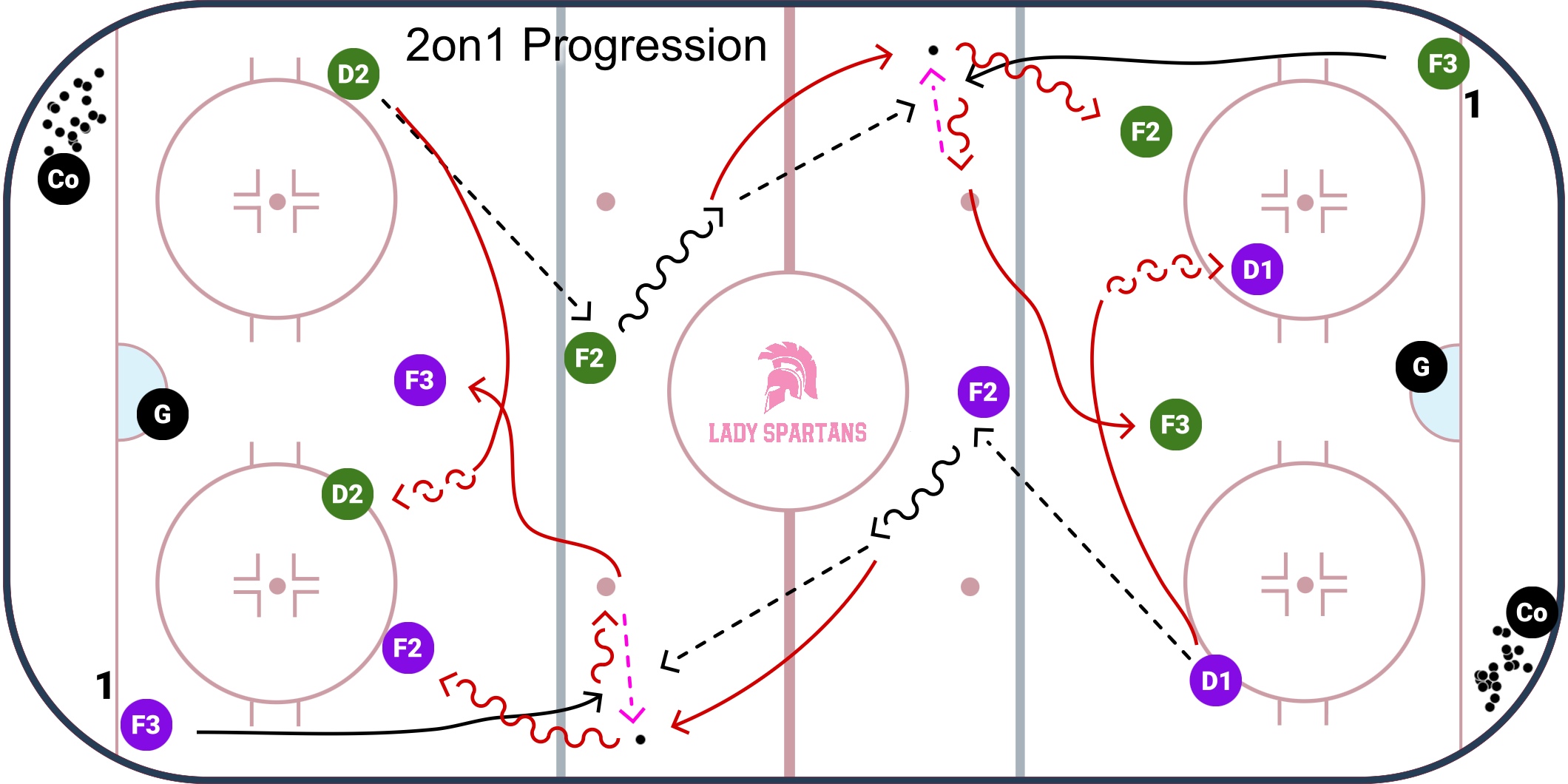
Step 3c: Drill Finish Option 3 - High Zone 2on1
**Drill is shown below starting at the point where the D has made their second pass to a wheeling F2**
Note - In the 1on1 & 2on1 variations, F1 is done after they shoot.
This 2on1 progression requires a third person. So F3 is remaining patient and will have to work on timing as they need to be just exiting the zone when they receive a pass from a wheeling F2.
When F3 receives that pass, they are working toward along the blue and middle lane and making a drop pass to F2 as they take F3's lane on the Zione
I am a huge advocate for practicing with pace and love when a good flow drill snaps the puck around, you can feel the energy, but I am also equally committed to practicing fundamentals that happen repeatedly throughout the game. I do this by breaking up into what I call "Indys," my players know this is where forwards and defense split up into their position groups to work on their skills within the position.
Typically we would have 2-3 practices per week, for one of those I try to fit in a solid 20 minutes for position skill work. Here are some of the drills I use:
Forward & Defense Shooting Indy
Break down individual skills and make sure the players are getting solid reps through these drills. Coaches don't be afraid to pull players aside and 1:1 coach here, this is skill development.
Forward & Defense Set Play Indy
Let the players rep the routes and use their creativity here. Keep the coaching limited to skill based items and let the players sort out their timing and decisions.