PP Option
- PK Formation 3 High - Diamond
- No Net Front
- 2 Players on the side of the Net
- Pass through the box
- Side of the Net positioning
 0:02:23
PP Option
 0:00:51
Trouble scoring in tight? Pucks bouncing over sticks?
Try this drill to help players locate, quiet and release pucks quickly!
Progression 1 is for feel & technique only
Progression 2 creates a stressed environment
Adjust spacing and angles as you see fit, the outcome goal is to keep the shooter's success rate around 20-30%
 00:00:00
The bag skate.
If you’ve played hockey, you’ve probably been put through one.
Maybe your team wasn’t focused. Maybe they weren’t working hard enough. Maybe someone stepped out of line and broke a team rule.
Maybe the coach was just having a bad day.
Whatever the case, the bag skate is the act of skating a team, without pucks, to the point of exhaustion.
The most famous type of a bag skate is a “Herbie.” It’s the famous skating you see in the movie ‘Miracle’ after a lacklustre loss to Norway. Herb Brooks yells “again” and Craig Patrick blows the whistle to start a Herbie.
“Herbie” = Goal line –> near blue line –> back to the goal line –> red line –> back to the goal line –> far blue line –> back to the goal line –> far goal line –> back to the goal line.
Perhaps this was an effective tool for a coach back in 1980. But now? Well it’s old school and we’ve come up with better ways to teach players a lesson.
The bag skate has traditionally been used to punish a team after a terrible performance or grossly breaking team rules. Other times coaches do a mini-bag skate to get their team’s attention when they are having a terrible practice.
Taking a quick jog back memory lane: when I was in high school I was asked to come practice with the local junior team. Before the practice, I am dressed and waiting by the door for the Zamboni to finish up while there was some commotion with a few players pacing back and forth. They were freaking out because the assistant coach had placed a puck bucket with a case of beer at the centre ice dot.
What I quickly pieced together was the team was very concerned they were about to be bag skated due to the fact one of the players was seen in a gas station buying beer under-aged with a fake ID by the team’s assistant coach.
Fortunately for me, the assistant coach was playing a prank and sending a message softly to the team. It would have been one heck of a way to be introduced to that team.
Some coaches believe they are valuable. I ask, why?
Normal responses:
Effectively, they are utilizing fear as the type of motivation. The goal would be to put the fear of a bag skate into the players’ brains in order to have them perform better and to avoid punishment.
It’s a terrible long term strategy. Bag skates chip away at the player’s enjoyment and take away from the excitement to show up to the rink. In most situations, it alienates the coach from the players.
By themselves, bag skates are a terrible idea. It’s time that could be spent correcting mistakes and developing skills needed to have success. Psychologically bag skates take away the enjoyment and excitement of being at the rink.
For coach longevity and keeping players engaged it’s a smart idea to avoid a bag skate practice.
From a physical standpoint, science tells us that sprints lasting longer than 10-15 seconds are counterproductive at all ages. This is due to muscle acids and a breakdown in quality of skating technique.
Lastly, a bag skate practice utilizes valuable ice times that takes away from opportunities to improve our players.
At the end of the day a straight up bag skate just isn’t effective. Players aren’t getting better and surely will build resentment and eat away at their energy levels. What is most effective is to go directly at the problem and work at it.
If you’re disappointed in the team’s compete level, put them in situations where they are competing. Play a game!
Are you upset at physical engagement? Play a 2v2 game in the corner where they can’t escape contact.
Was the conditioning an issue? Have drills at practice that involve lots of skating up and down the rink.
At practice, particularly with younger players, coaches can see them goofing off while they are trying to get work in. Instead of skating them, have a go-to game that can refocus players on competing and doing the thing they love most: playing hockey. This is something that the USA National Team Development Program does and had great success with.
Life lesson – Bag skating or yelling at your team is like yelling at your spouse. The more you do it, the less effective it becomes.
Mike Babcock said it best: “If you’re a minor hockey coach, your number one job is to share your passion for the game. They’ve got to love the game more when they leave than when they arrived.”
At the end of the day, it’s all about fostering a love and enjoyment for the rink, the locker room, the process, the games, and relationships that hockey builds.
 00:00:00
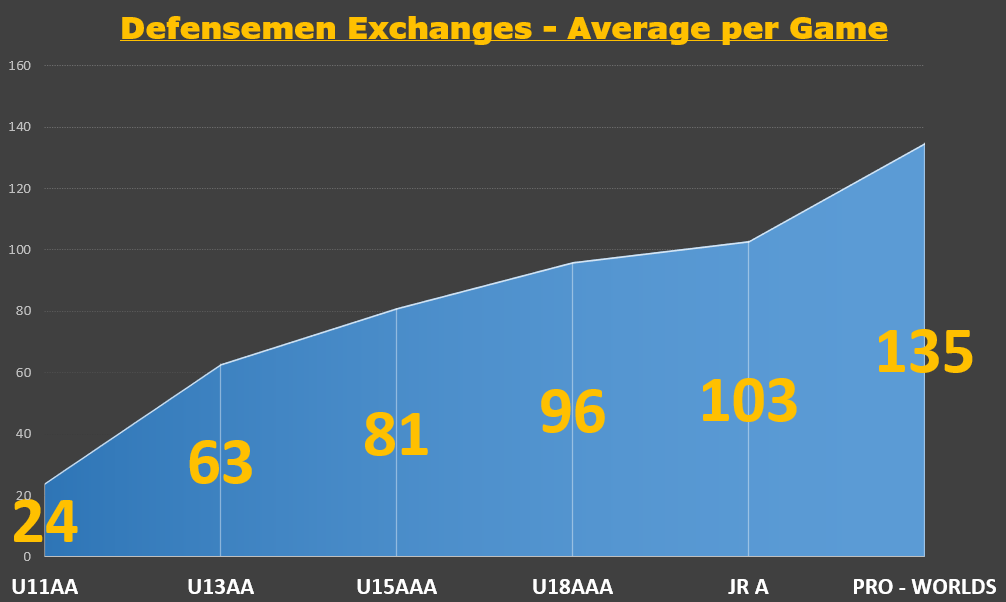
How many times do defensmen exchange the puck in a single game?
Is it the same at every level?
Is there a correlation between passing ability and # of exchanges?
Do better teams exchange more?
This study was initiated after watching numerous U13/U15 games in which teams forced the puck up the strong side over and over with no success. However the stronger teams in the division exploited the weakside of the ice with numerous "overs", which essentially moved the puck around the opposition rather than into/through them.
The study...Every time the puck was successfully exchanged between D partners it was counted/tracked as an exchange.
The 5 main exchanges were:
The chart shows an obvious correlation between the age/skill of the athletes vs the number of exchanges. In all of the games tracked there were no anomolies...the number of exchanges increased/decreased in relation to the age division. In each game tracked the team with more exchanges was the winner, however there are numerous factors in play here, a higher skilled team will generally move the puck more efficiently. The number of exchanges could simply be a by product of having higher skilled players or even better coaching with a puck possesion focus. The goal of the study was to help coaches believe that exchanges (specifically overs) are not something to avoid due to the risk of getting a pass picked off, but to teach your defensemen how to read the ice, communicate, stagger and be a good outlet for your partner at all times (puck support).
Data complied by Norcan Hockey using Hudl/Instat Hockey
 00:00:00
There are numerous potential nuances in the double-drop power play breakout, all designed to counter the penalty kill’s pressure points and coverage structure
After the drop, Anaheim executes a “slingshot” that quickly pushes the puck back up the ice to one of the stretch players. The PPQB and weak-side stretch player immediately sprint off the puck to provide support.
Combined with the stretch pass, this bypasses two Edmonton PK forwards, creating a 3v2 and a goal off of the rush
A couple of additional examples included show the same tactic by the Power Play
 00:00:00
1. Nobody Is Coming to Save Your Career: The game doesn't pause for your bad stretch. Waiting for your coach to fix your confidence, your mechanics, or your mindset is how seasons get wasted. You identify the problem, you find the solution, you get back on the ice.
2. Your Emotions Are Valid — They Just Can't Run Your Game: You're allowed to feel frustrated after a bad shift. You're not allowed to let that frustration dictate your next one. The athlete who learns to feel something and still execute becomes the player coaches trust in overtime.
3. Respect Is Earned Every Single Practice: It doesn't carry over from last season. The guy who dominated training camp but coasts in February doesn't get to live on that. Coaches remember who shows up consistently — not just when the lights are bright.
4. Hard Work Is Non-Negotiable: Talent without effort gets overtaken by average players who simply outwork you. A coach who lets you avoid hard things in practice isn't protecting you. He's setting you up to get exposed when it matters most.
5. Learn to Lose Without an Excuse Ready: The athlete who blames the refs, the system, or bad luck every time things go sideways carries that habit into every locker room he enters. Losing cleanly — owning it and moving — is one of the hardest and most underrated skills in sports.
6. Understand the Game Beyond Just Playing It: Skating hard without understanding structure is like filling a bucket with a hole in it. The athletes who stick at the next level don't just work harder — they understand why the system works and how they fit inside it.
7. Your Word in the Locker Room Is Your Reputatio: Every commitment you break is a small piece of your name gone. Teammates remember who showed up and who made excuses. Build the kind of reputation where people already know what you're going to do before you do it.
8. Comfort Is Where Careers Plateau: Every real breakthrough in your game sits just outside what feels easy. A coach who removes every difficult thing from your path is teaching you to stop at the edge of anything hard. That habit will follow you to every level you reach.
9. Not Every Teammate Who Smiles at You Is in Your Corner: Watch what people do when things get hard, not what they say when things are easy. Loyalty shows up under pressure. Build your inner circle on evidence, not vibe.
10. Treat Your Body Like It Has to Last 20 Years: The athlete who neglects sleep, nutrition, and recovery in his early years pays for it with interest later. The foundation everything else runs on isn't skill — it's the body that delivers that skill night after night.
11. Silence Is One of the Most Powerful Skills You Can Have: The player who reacts to every hit, every call, every slight is handing away mental real estate for free. Knowing when to say nothing — and meaning it — is one of the most controlled, powerful things an athlete can do.
12. You Won't Always Be Understood — Keep Going Anyway: Doing the work differently than everyone else often looks strange to people who aren't willing to do it. Stop chasing validation from the room. Do the work, hold the standard, and let the results make the argument for you.
13. How You Treat the People Who Can't Help You Defines You: The way you talk to the equipment manager, the trainer, or the rookie tells the full story of who you are. Coaches see all of it. Character isn't what you show when it counts — it's what you show when no one's keeping score.
14. Your Team Isn't Something You Wing: A winning locker room requires the same intention as your individual game. You have to show up, communicate, and keep choosing the guys beside you. The player who treats team culture like it maintains itself is the first one it breaks down around.
15. The Athlete You Become Is Entirely on You: Your circumstances, your injuries, your bad breaks — they're real. But at some point every player has to pick up what he was given and decide what to do with it. The ones who make it don't wait for perfect conditions. They build anyway.
This is the work most athletes skip
Its also why most hockey players plateau.
Victory Starts in the Mind
 00:00:00
The response to my recent Instagram post on “Go–No-Go” terminology within the penalty kill versus a 1-3-1 power play has been incredible. The concept itself is rooted in NASA’s launch protocol—where every system must be cleared as “Go” or held at “No-Go” before liftoff. That same clarity translates directly to the ice. When players know exactly when to pressure (“Go”) and when to hold structure (“No-Go”), it removes hesitation, sharpens decision-making, and keeps all four penalty killers connected. At the elite level, success often comes down to details—and communication is one of the most underrated details we can coach. This is an area I’m continuing to explore and refine as we look to give players simple, actionable tools that translate directly into game success. Go-No-Go Instagram Post
 00:00:00
*This game encourages offensive zone movement. D get comfortable going down into the offensive zone to make plays and F's get comfortable playing high in the offensive zone. It reinforces good offensive zone movement habits- the highest forward needs to have awareness and skate into the high part of the zone once a pass is made to the D and the D has to check to make sure a forward is in the high zone before they make the decision to skate into the low part of the zone. Scoring on either net encourages the devleopment of creativity, vision, and hockey sense.*
 00:00:00
Great Small Area Game that works on 1v1 attacking and defensive skills. The support players on the outside create a 3v1 situation that allows for creative play with tight scoring chances in close to the net.
'
 00:00:00
From Theory to the Game – Integrating Skill Acquisition Science into Modern Hockey Coaching
In hockey, we often talk about skills as if they exist in isolation: skating, puck control, shooting, puck battles, scanning, decision-making.
In reality, they don’t develop separately. They emerge through action — within a dynamic system where body, mind, and environment are in constant interaction.
Skill acquisition research has approached this process from multiple angles. While the theories differ in emphasis, they share the same fundamental goal: to understand how practice transfers to performance in games.
At Viima Hockey, our training philosophy is not built around a single method or buzzword. It is grounded in a scientifically informed understanding of how humans learn motor skills.
Good theory is not the opposite of practice — it is the foundation of it.
Learning itself is invisible. As coaches, we only see the outcome: performance.
Theories help us answer the questions that matter:
Today, three perspectives stand out for both research support and practical applicability: Information Processing Theory, Ecological Dynamics, and Predictive Processing.
They examine the same phenomenon, learning, from different viewpoints.
For coaches, understanding these perspectives expands our toolbox.
1. Information Processing: Building Reliable Foundations
Information processing theory views the athlete as a processor of input. The senses gather information, the brain processes it, and the body executes movement. Skilled performance is the successful retrieval and execution of previously learned motor programs.
This perspective underpins structured, repetition-based training — often referred to as deliberate practice (Ericsson et al, 1993).
At Viima, this approach is especially valuable when building or refining foundational skills. Clear technical models, targeted feedback, and purposeful repetition help establish an effective baseline.
However, this is only the starting point.
A technically correct movement in isolation does not guarantee success in a chaotic, time-constrained game environment.
2. Ecological Dynamics: Skill as Adaptation
Ecological dynamics shifts the focus from stored motor programs to interaction.
Skill is not something pre-packaged inside the athlete. It emerges from the relationship between:
Learning occurs through exploration, adaptation, and problem-solving.
In practice, this leads to nonlinear pedagogy:
Players improve when they are required to solve problems – not simply reproduce a model.
In hockey, where no two shifts are identical, adaptability is performance.
3. Predictive Processing: Training the Future
Predictive processing is one of the newest additions to the skill acquisition conversation.
According to this framework, the brain is constantly generating predictions about what will happen next. When reality differs from expectation, the brain updates its internal model.
In hockey terms, this is the ability to:
The difference between good players and elite players often lies here in how effectively they anticipate and adjust.
One of the clearest distinctions between theories lies in how they interpret mistakes.
In our daily work, mistakes are not treated as failures – they are treated as information.
But acknowledging the value of errors does not mean abandoning coaching.
Feedback must align with intent.
In some drills, immediate correction is appropriate. In open, game-like environments, the environment itself often provides the feedback. In those moments, the coach’s job is not to supply answers, but to guide attention – through questions, constraints, or video – and allow the player to discover.
That restraint is one of the hardest skills in coaching.
Parents and even coaches are sometimes surprised to see a player solving math problems while performing puck-handling drills off the ice.
This is not a gimmick.
Dual-task training – combining cognitive load with motor execution – intentionally shifts conscious attention away from controlling the movement. When the athlete’s focus is directed toward a secondary task, the motor system is forced to self-organize.
Research supports this approach: automated skills are more resilient under pressure, distraction, and chaos.
Hockey is played under cognitive load. Training should reflect that reality.
At Viima, integrating sport-specific motor tasks with cognitive challenges is not an exception – it is a principle.
These theories also differ in their time orientation:
Hockey demands all three.
Therefore, practice must integrate all three.
Modern coaching is not about choosing the “best” theory.
It is about knowing when and how to apply each perspective.
The skilled coach understands the theories but does not become trapped by them.
They are tools – selected based on the player’s needs and the performance context.
Ultimately, all perspectives agree on one fundamental truth:
There is no substitute for practice.
Skill acquisition requires time, repetition, and a high-quality learning environment. But practice only has value if it transfers to performance.
Everything must point toward the game.
That integration – deliberate, adaptable, future-oriented training – is the core of modern player development, and our coaching philosophy at Viima Hockey.
____________________________
Viima Hockey is Europe’s leading provider of individualized ice hockey coaching and player development services. From youth players to NHL professionals, we help athletes become the best version of themselves – and perform where it matters most, in the game.
Trusted by top talent and organizations, including NHL players like Miro Heiskanen and clubs such as Jokerit Helsinki, Jukurit Mikkeli, and the Swiss Ice Hockey Federation, Viima offers world-class skills training, skating development, shooting and scoring coaching, goaltending training, strength and conditioning programs, and coach education.
For more information, contact Jarno Kukila at jarno.kukila@viimahockey.com
End of content
No more pages to load
copyright (c) 2026 The Coaches Site