
Correct technique is everything! Proper body alignment, correct muscle activation and more!
 00:00:00
Common Dzone Mistakes In the WHL
I hold Dzone in high regard and usually spend the initial three months of the year consistently discussing it with my players. Before critiquing my home team, the Brandon Wheat Kings defensive zone, I recognize that various kinds of D zone strategies exist, and this is merely my viewpoint.
Positioned directly in line with the breakdown shown in this video clip, it was pretty evident in real time why the Blades managed to score this goal. I immediately texted my coaching partner, who was also watching the game. "The winger didn't create a barrier," I wrote, and almost instantly, he responded, "I was thinking the exact same thing."
We all know hockey is a sport full of mistakes! It's the fastest game played on foot, so naturally, mistakes will occur. My coaching partner this year summed it up perfectly: "It typically takes three consecutive breakdowns in our zone for the other team to score." When I explain our Dzone coverage to my players, I emphasize that it's designed to absorb mistakes against us by ensuring the next person is always there for support.
I've received numerous passive-aggressive comments from parents criticizing having the wingers play lower in our zone. My perspective is this: Goals are primarily scored in the slot, so we need the strongest protection there. If our goalie can't stop a shot from the point with all that expensive gear, we have much bigger issues. Ultimately, it comes down to statistics. The probability of scoring is significantly higher in the high-danger area than from outside of it. So let's trust what Under Armour keeps telling us and PROTECT THE HOUSE!
Your positioning on the ice depends on who controls the puck! Is it a:
- 50/50 battle?
- Do they have it?
- Do we have it?
How using Hudl helps break down our D zone coverage on the half wall
In this clip, if you observe our strong-side winger, depending on puck possession, she adjusts her position for a breakout or she "creates a barrier" near the faceoff dot to secure the side of our high-danger area!
 00:00:00
4 Mistakes Youth & Teen Athletes Make in the Off-Season
Off-season is a great time for athletes to build strengh, speed, and skill. Unfortunately, too many of them are blowing the opportunity with 4 common, but critical, mistakes that can negatively impact their game even into their next season.
It doesn’t matter how hard young athletes train, how many games they play, or what level they're playing, If athletes aren't giving equal (or more) attention to their fuel, hydration, sleep, and mindset-
their potential is limited… or even diminished.
These four mistakes aren't doing their performance or recovery any favors:
1- Trying to gain 10-15 lbs. of muscle in a couple of months.
Why?
- Most kids (or their parents) don't know the difference between fueling consistently & eating constantly
- Most kids haven't reached the necessary peak hormone levels for fast (approx. 2lbs/month) muscle gain
- Both can result in weight gain that reduces speed and strength.
2- Relying on protein supplements.
Why?
- Focusing on, and prioritzing protein can mean missing key nutrients essential for muscle strength, energy, & growth.
- The majority of supplements aren't tested on bodies under 21 years old, the short- and long term- affects on adolescent developing bodies is widely unknown.
- Athletes with food allergies, food sensitivities, and/or banned substance regulations are at increased risk for adverse reactions or positive testing.
3- No break in sport intensity.
Why?
- Until mid-teens, developing joints are still unstable for year-round, intense repetitive motion leaving athletes more susceptible to injury.
- Year-round high intensity training also puts kids at greater risk for burnout.
4- Sacrificing sleep.
Why?
- Sleep is when the body recovers, repairs, and grows (for sport & development)... specifically in the 3rd stage of sleep.
- Without quality sleep, and meeting sleep requirements, athletes are at greater risk for injury, burnout, decreased accuracy, poor recovery, and poor focus.
Let's make sure your athletes aren't making these mistakes!
Rock Performance is dedicated to equipping youth & teen athletes (and their parents) with the RIGHT information for fueling age-appropriately to optimize performance, recovery, & mindset.
Reach out now with questions about talks and programs available for your team & organization.
 00:00:00
The Case for a Structured 50/50 Split Between School and Club Hockey
In Pittsburgh, young hockey players often find themselves juggling commitments between their school and club teams. This dual participation, while beneficial in some aspects, can also lead to scheduling conflicts, player burnout, and diluted team performance. Some players who play for their school teams and are on the call-up roster could end up playing for three teams during the season. A structured 50/50 split—where players dedicate half the season to their school team and the other half to their club team—could offer a practical solution that benefits players, teams, and families alike.
The Value of a 50/50 Split
A clear division between school and club hockey seasons could provide numerous advantages for everyone involved. Here’s why this approach could be a game-changer:
1. Improved Player Development
- Consistent Ice Time – Players remain active throughout the year without the stress of overlapping commitments.
- Diverse Competition – Exposure to varying playing styles, coaching philosophies, and team dynamics enhances overall skill development.
- Better Focus – Players can fully engage in training and games without the distraction of managing multiple team obligations at once.
2. Reduced Scheduling Conflicts
- Eliminates the common struggle of balancing school and club schedules, preventing missed practices and games.
- Allows coaches to plan more effectively, knowing players are fully committed during their respective seasons.
3. Strengthened School Hockey Programs
- Currently, club hockey often takes precedence, leaving school teams with depleted rosters.
- A structured school season ensures top players participate, elevating competition and team quality.
- Boosts school spirit and community engagement by fostering a more competitive and committed roster.
4. Club Teams Retain Talent Without Burnout
- Year-round club hockey demands can lead to player fatigue and increased injury risk.
- A defined break before the club season begins in January allows players to rest, recover, and re-energize due to the reduced travel involved in school hockey.
- Reduces overuse injuries and the strain of excessive travel.
5. Financial and Family Benefits
- Parents wouldn’t have to juggle conflicting team schedules, making logistics easier and reducing stress.
- Travel costs, practice fees, and overall expenses could be more manageable when commitments are separated.
- Families can plan their lives better with a clear start and end to each season.
6. Encourages Multi-Sport Participation
- A structured schedule might allow athletes to explore other sports in the offseason or while playing for their school or club team, leading to better overall athletic development.
A Necessary Change
It’s evident that something needs to change in our area. The current system is pushing kids and parents to the brink—physically, mentally, emotionally, and financially. During my junior year of high school in 1997, I played over 120 games that year between my school and club team—showing that this issue has been going on for years!
A well-defined 50/50 split between school and club hockey offers a sustainable solution that benefits the hockey community. Implementing this structure could enhance player development, improve team performance, and create a healthier balance for families navigating the demands of youth hockey.
It’s time to rethink how we structure the hockey season for the betterment of everyone involved.
 00:00:00
F3 Poistioning When Tracking
When backchecking, players need to assess the evolving situation in front of them. They should determine whether, as an F3, is there position above or below their F3. In youth hockey, it's common to see forwards either overcommitting to the puck carrier or leaving an opponent unmarked, often mesmerized by the puck and failing to contribute effectively to the backcheck. If your F3 is positioned above their F3, the goal is to create three one-on-one matchups, as illustrated in the video clip above. However, if tracking below their F3, the task becomes more challenging. The F3 must work to catch up with the play, communicating with the defense to identify the least threatening attacker and marking that player while retreating into the defensive zone. Ideally, maintaining an above position in the offensive zone is preferred for the F3, as it helps establish proper positioning for the team's transition back into the defensive zone.
Strip & Go Tracking Warm Up Drill
Description;
- F1 starts with a puck in the corner and takes off at half speed.
- F2 is going to backcheck, and once they enter the neutral zone he is going to create separation from the body and puck by cutting off F1's hands.
- After F2 creates separation, he quickly transitions the puck and looks for F3 who is beginning to gain speed on the weakside of the ice.
- After F1 gets attacked, he now becomes the weakside transition player in the neutral zone.
- Once F3 receives the puck, he drives the puck in the wide lane
- After F2 passes the puck, he begins to drive the net as the middle lane driver.
- As soon as F3 shoots the puck, he and F2 can play the rebound for a split second, but then F3 has to turn and begin to backcheck F4 who is starting the drill over again. F2 goes back to line.
Keypoints;
Have the tracker create separation from the puck carrier and the puck by disrupting the "triangle" that is made from the player's stick, puck, feet, and hands.
Make sure the weakside release player is gaining speed prior to receiving the puck for the rush.
After the back checker moves the puck, they have to transition from defence to offence and become the net quickly driver
 00:00:00
Creating 2v1's For Successful Breakouts
Time and again, practice drills are conducted without any pressure on their breakouts. Coaches instruct their defense to execute plays such as:
- Reverse
- Up
- Over
- Wheel
When you observe the most effective breakouts during games, you'll notice that the centermen frequently plays a crucial role in supporting the play below the goal line. In a game, there are generally three scenarios when attempting to gain or keep possession of the puck so you can smoothly exit your defensive zone:
Red pressure - occurs when the opposing team has possession deep in your zone, or there's a 50/50 race for the puck.
Yellow pressure - happens when your team reaches the puck first in your zone, but an opponent is within 3-5 stick lengths.
Green pressure - the other team is making a line change and might have only one forechecker advancing.
Red and Yellow pressures are typically the most frequent during games. The key to executing a successful breakout under these conditions begins with excellent defensive zone positioning, allowing players to create a bunch of little 2-on-1 situations throughout the zone. When facing Green pressure, the puck carrier must create a 2-on-1 advantage by attracking a forechecker into a poistion that he or she isn't a threat or by engaging the opponent's F1 before passing to a supporting teammate.
Low Defensive Zone Breakdown
Here is a clip using Hudl to breakdown our Facebook live stream. You will notice we failured to start our break out when we had yellow pressure, therefore, we are in a red pressured situation. As both our players in the corner (team black) overcomit to the puck carrier, and our weakside D failures to favour the strong side of the ice. Once the other teams F2 gets full possession of the puck, he has lots of open ice to fire the puck for a beauti of a goal!
How Do We Work On Creating 2v1's?
Quick Kill To Attack Drill;
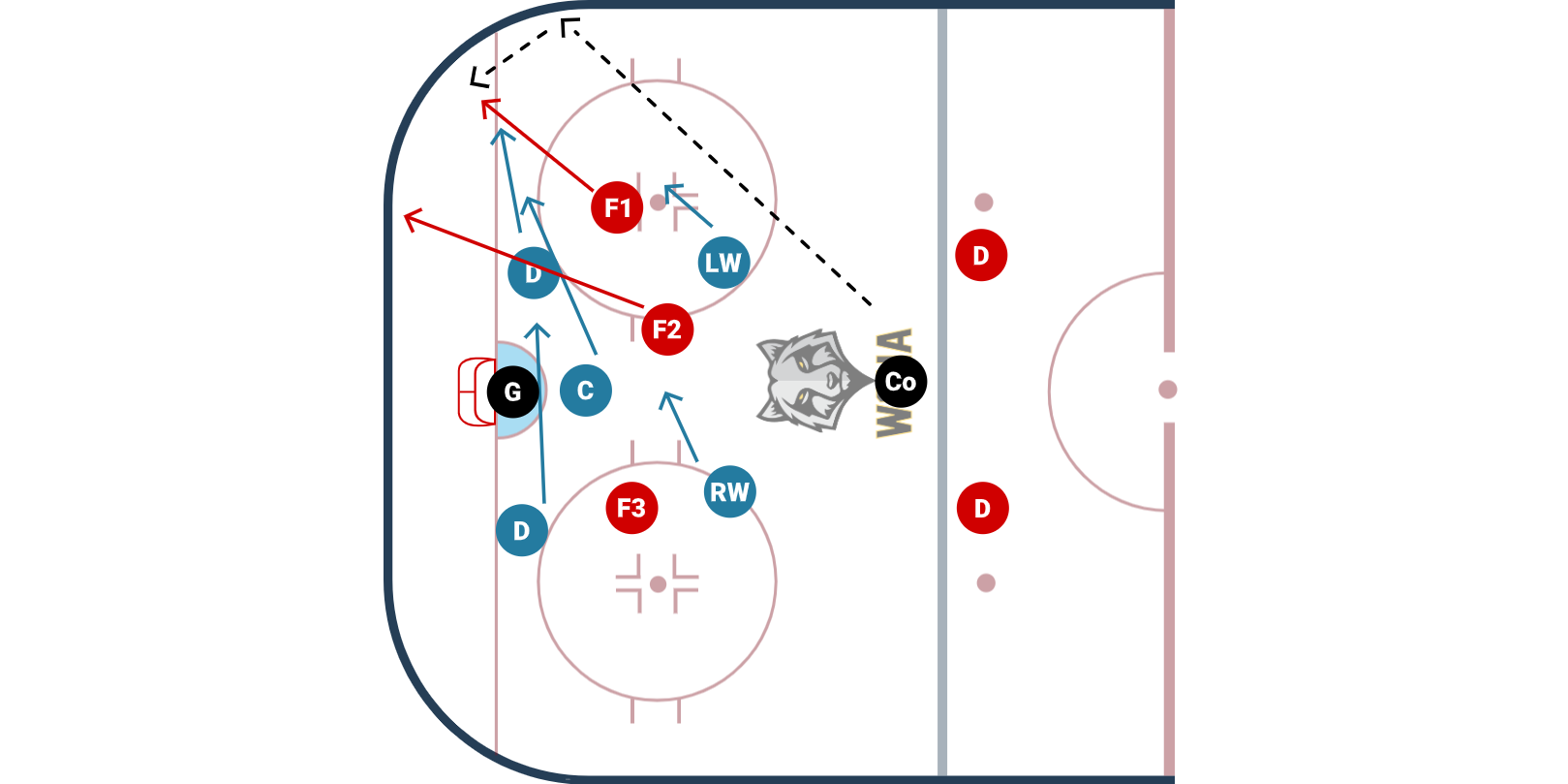
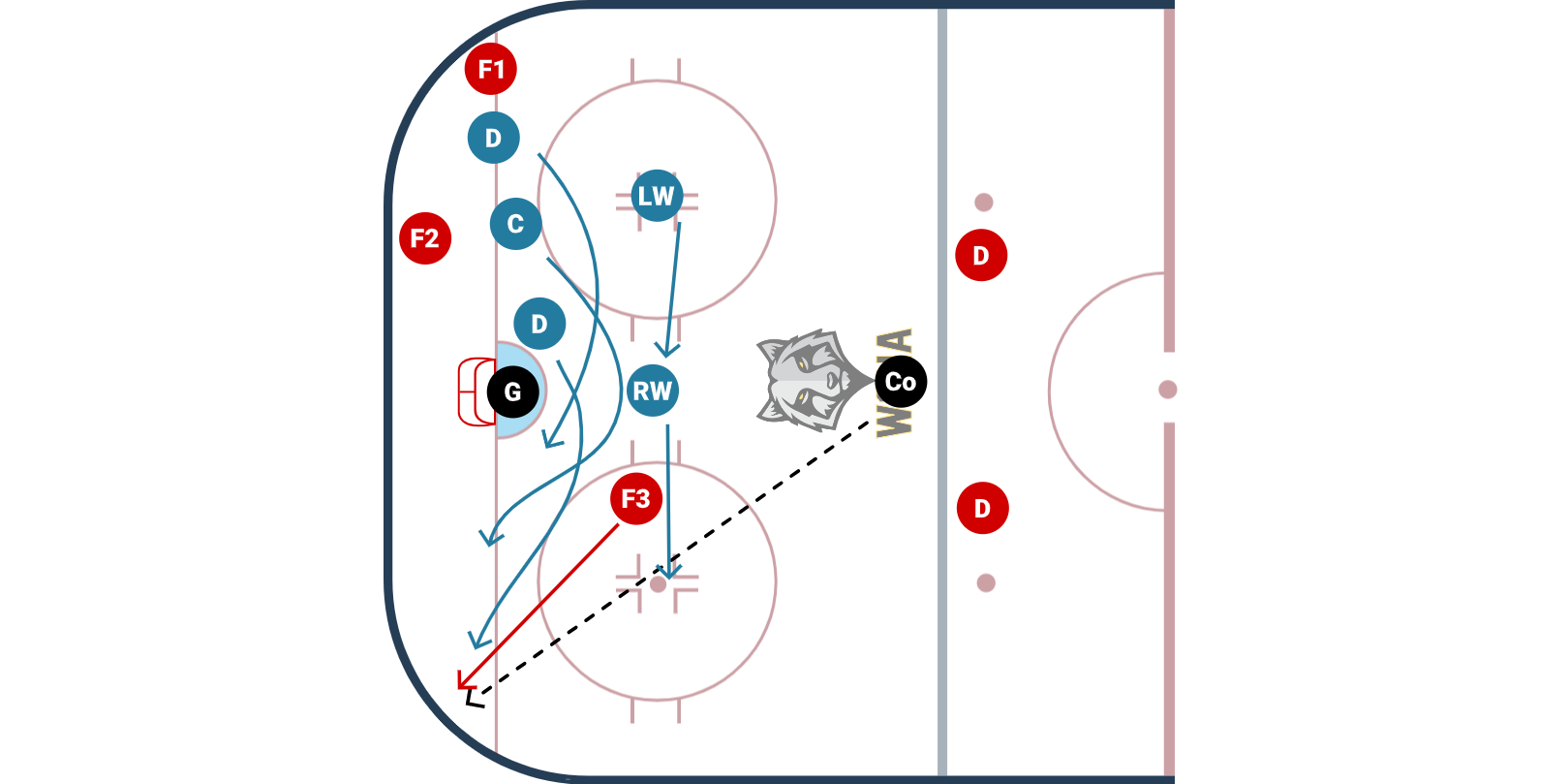
Dzone coverage drill, to kill plays and begin your breakout
- coach will spot a puck in the corner
- F1 and F2 from the red team will go and get it
- the defensive team will slid over and attack the two red players (5V2)
- after about 5 seconds, the coach will spot a second puck in the oposite corner where F3 will now attack and F1 & F2 are now out of the drill. Now F3 will have to play against the defensive team will have to adjust to the play in the oposite side
- The defensive team will have to kill the play off of F3, get the puck, breakout, and attack on the two D in the neutral zone
2nd Quick Improvements
In this clip we have two 50/50 races for the puck. The first one are from the two players that start the clip behind the net. Our defenseman reaches the puck first and attempts a reverse bump pass, but unfortunately, our second player isn't quick enough on the backcheck. This situation sets up another 50/50 race for the puck, which turns in our favor. Our defenseman disrupts the opponent's player by separating the puck from their body. Simultaneously, our second player swiftly picks up the puck and initiates our breakout on the weak side of the ice.
 00:00:00
Lessons From the Playoffs: Tracking vs. Forechecking
Playoff hockey magnifies and throttles everything we love about our game. There’s less time and space for defencemen to make plays on the breakout, so the the D with the best habits (shoulder checking, getting their feet around the puck, under-handling) make positive contributions to winning efforts. The best defencemen really stand out, so if you’re playing a team with good D, you have to do something to slow them down.
D who move the puck usually play on teams with an effective rush game. Because they’re competent puck movers, the result is a forward group that gets the puck and turns north quick.
Teams with a heavy mid-lane drive conscience get more scoring chances in the middle of the ice, but it’s important to note that it starts in the defensive zone or at the least deep in the neutral zone.
So how do you stop them? How do you stomp out those dangerous rush chances before they start?
Track: tracking is another word for backchecking, which was basically a curse in the 1990’s.
Forecheck: literally stop rush attacks in the offensive zone before they have a chance to materialize
You’re going to face chances against in the playoffs. Your team can control the severity of these chances by forechecking or tracking. Most teams would prefer to forecheck since it keeps the puck in the offensive zone and puts your team into your offensive play.
Forecheck or backcheck. You choose.
 00:00:00
PWHL vs WHL - Do's & Don'ts of Slash Supports
Imagine this scenario: your strong side winger has his back to the oncoming pressure on the half-wall during a breakout, this is what I call a yellow pressure situation. A slasher is when the weakside winger cuts across the royal road, attacking through the opposing strong-side defensemen. This movement forces the strong-side defencemen to retreat, creating time and space for the strong-side winger. But when done wrong, the slasher will find him or herself way above the play, not being a viable option for any of their teammates. But rather find themselves high in the neutral zone, waiting for the rush to catch up which creates inverted rushes and neglecting their responsibilities in the Dzone.
While watching several WHL games, I've noticed how the wingers strive to increase the tempo by forcing the opposing team's defensemen to retreat and setting up long passes from their teammates. When executed properly, this strategy opens up the ice for the defensemen to make plays, facilitating the team's entry into the offensive zone during a rush. However, the wingers often failed to anticipate the pressure on their teammates and did not work hard enough to find passing lanes to support their defensemen. This frequently left their teammates vulnerable, resulting in turnovers in the defensive zone.
The PWHL clip demonstrates how the weak-side winger reads the play of the strong-side winger. Depending on her partner's positioning, she chooses her route accordingly. Ultimately, she forces the opposing team's strong-side defenseman to retreat, helping her team gain the offensive Ozone for an attack.
 00:00:00
Discovering the Path to Elite Goaltending, with Mike Valley and Justin Goldman
Subscribe: Apple Podcasts | Spotify | Linktree
In episode 297 of the Glass and Out Podcast we're joined by former NHL Goalie Coach Mike Valley and founder of The Goalie Guild Justin Goldman.
Valley and Goldman are good friends who collaborated on the books The Power Within, which includes 3 volumes, and Embracing the Grind. Each book shares personal interviews and stories from the best goaltenders on the planet and provide a guide for aspiring goalies looking to navigate what has generally been an undefined path to the top of the profession.
While the books focus on goaltending, they also provide real world solutions for dealing with the tough stuff that comes with reaching any noteworthy goal or achievement.
Valley played professionally as a goaltender and had the role of Goalie Coach for the Dallas Stars from 2009-2017. He is also a former presenter at TCS Live.
Goldman is a former goaltender, writer for NHL.com and Founder of The Goalie Guild, the world’s only non-profit organization dedicated to developing goalies and goalie coaches of all levels.
Listen as they share how the position of goaltending has evolved, why we need to redefine what "winning" is, and how to find your power within.
Video Timestamps:
- 0:00 Collaborating/Building a goalie community
- 4:35 How goaltending has evolved
- 7:40 Fundamental changes to the position
- 11:05 Passing along wisdom/love for goaltending
- 16:35 Making the jump to full-time goalie
- 22:25 Complimentary activities for goalies
- 24:55 Developing other passions/short memory
- 28:15 Skills to look for in successful goalies
- 32:20 Controlling what you can control
- 39:10 What we can learn from goalie coaches
- 46:45 Goalie communication
- 55:00 Spirit
- 58:35 Walking the line of ego
- 1:08:00 Confidence is earned
- 1:14:35 Working on uncomfortable skills
- 1:22:15 Advice to non-goalie coaches
Presented by State and Liberty Clothing. Visit https://stateandliberty.com/tcs and save 15% on your first purchase with the code TheCoachesSite.
 00:00:00
The Evolution of Analytics in Hockey - How to Setup and Use the Digital Twin
Our first article, “The Evolution of Analytics in Hockey – The Digital Twin,” explored how a digital twin can replicate players, tactics and even the ice surface itself, giving coaches a laboratory in which to analyze, predict and optimize performance with remarkable precision. This follow‑up explains how to build that twin and use it to craft winning game strategies for your next upcoming opponent.
How do we go about setting up the digital twin and how can it be used to determine and optimize game strategy for an upcoming opponent?
Let's start with the Data Collection process. We will focus on three types of data that the digital twin needs to simulate an upcoming game.
-
Athlete Data:
Historical data on player performance against the upcoming team, historical game data of the upcoming team and even physiological sensor data (heart rate, speed, movement angles, fatigue patterns) if available. Sensor data is not needed to produce a digital twin but the more data points that are available for analysis, the more accurate the simulation will be with a higher confidence factor of the predictive capabilities of the model.
-
Environmental Data:
Data about the playing environment (e.g., ice conditions).
-
Game Data:
Player positions, game strategies used (e.g., breakouts, power play, penalty kill, neutral zone), shots per shift, goals per shift and other game-related data using manually tracked statistics, or even computer vision systems or tracking technologies.
Once all the data is collected, we can begin the Data Processing and Modeling step. Data modeling is the process of representing data objects and the relationships between them in a structured form that allows the digital twin to utilize the collected data to simulate a real-world event such as a hockey game.
-
Data Integration:
Merge all data sources into a single, version‑controlled data lake (on premise or off premise) that maps every event to players, time and location.
-
Model Creation:
Encode past player performance versus the upcoming opponent data using a simulation or analytics platform (dedicated sports‑twin engine, Power BI, Tableau). Use reduced‑order or machine learning surrogates so simulation runs finish in <1 s, fast enough for bench‑side queries.
Once the data stores and modelled, we can begin using the digital twin for Game Simulation and Analysis.
-
Scenario Simulation: Run simulations to test different game strategies. Stochastically vary 5–10 % of the model parameters on each simulation run to explore what‑if spaces: new breakout sequences, power‑play formations, unconventional line match‑ups.
-
Performance Analysis: Quantify the effect of each simulation on KPIs like shots‑per‑shift, expected goals, and zone‑exit success; convert these findings into targeted practice drills prior to the upcoming game with the specific opponent.,
-
Predictive Insights: Deploy the model to surface final in‑game recommendations—e.g., optimal face‑off alignment given score, zone, and fatigue state of players. The digital twin can predict potential game outcomes and risks at the play, system or overall game level. These predictive outcomes allow for proactive decision-making prior to the game and even on the bench during the game.
After using the digital twin and analyzing the output, we can begin the step of Continuous Improvement to improve the accuracy of the model's simulation capabilities and its ability to predict upcoming game outcomes by varying game strategies and player combinations.
-
Real-time Monitoring:
Continuously monitor the performance of the digital twin and compare it to real-world data. Were the Digital Twin game strategy suggestions effective against the specific opponent? Which predicted events were over or under actual performance? Identify model issues and determine how the model can be modified to make a more accurate prediction in the future.
-
Model Refinement:
Refine the digital twin based on new data and insights to ensure its accuracy and effectiveness. Feed discrepancies back into the twin, retraining weekly (or sooner) to keep pace with roster changes and tactical evolution. Model refinement would be done over the entire length of the season.
-
Optimization:
Use the digital twin to identify training programs and practice strategies prior to an upcoming game that have the highest simulated ROI. The idea here is to use practice and training to maximize your team's performance based on game strategy suggestions prior to the actual game.
In the end, the Digital Twin will produce a comprehensive upcoming game strategy that can be used to place players in the best position to maximize shots per shift and goals per shift while considering various line combinations and overall playing time (e.g., Time On Ice). Remember, the twin is a decision‑support tool, not an autocrat; final strategy calls rest with the coaching staff’s experience and intangible reads. Used judiciously, the digital twin becomes the most powerful instrument in a modern coach’s toolkit.
Athlete Data:
Historical data on player performance against the upcoming team, historical game data of the upcoming team and even physiological sensor data (heart rate, speed, movement angles, fatigue patterns) if available. Sensor data is not needed to produce a digital twin but the more data points that are available for analysis, the more accurate the simulation will be with a higher confidence factor of the predictive capabilities of the model.
Environmental Data:
Data about the playing environment (e.g., ice conditions).
Game Data:
Player positions, game strategies used (e.g., breakouts, power play, penalty kill, neutral zone), shots per shift, goals per shift and other game-related data using manually tracked statistics, or even computer vision systems or tracking technologies.
Data Integration:
Merge all data sources into a single, version‑controlled data lake (on premise or off premise) that maps every event to players, time and location.
Model Creation:
Encode past player performance versus the upcoming opponent data using a simulation or analytics platform (dedicated sports‑twin engine, Power BI, Tableau). Use reduced‑order or machine learning surrogates so simulation runs finish in <1 s, fast enough for bench‑side queries.
Scenario Simulation: Run simulations to test different game strategies. Stochastically vary 5–10 % of the model parameters on each simulation run to explore what‑if spaces: new breakout sequences, power‑play formations, unconventional line match‑ups.
Performance Analysis: Quantify the effect of each simulation on KPIs like shots‑per‑shift, expected goals, and zone‑exit success; convert these findings into targeted practice drills prior to the upcoming game with the specific opponent.,
Predictive Insights: Deploy the model to surface final in‑game recommendations—e.g., optimal face‑off alignment given score, zone, and fatigue state of players. The digital twin can predict potential game outcomes and risks at the play, system or overall game level. These predictive outcomes allow for proactive decision-making prior to the game and even on the bench during the game.
Real-time Monitoring:
Continuously monitor the performance of the digital twin and compare it to real-world data. Were the Digital Twin game strategy suggestions effective against the specific opponent? Which predicted events were over or under actual performance? Identify model issues and determine how the model can be modified to make a more accurate prediction in the future.
Model Refinement:
Refine the digital twin based on new data and insights to ensure its accuracy and effectiveness. Feed discrepancies back into the twin, retraining weekly (or sooner) to keep pace with roster changes and tactical evolution. Model refinement would be done over the entire length of the season.
Optimization:
Use the digital twin to identify training programs and practice strategies prior to an upcoming game that have the highest simulated ROI. The idea here is to use practice and training to maximize your team's performance based on game strategy suggestions prior to the actual game.