skating edgework progression with puck carrying.
- transition skating forward to backward
- backward only
- heel-to-heel edge turns
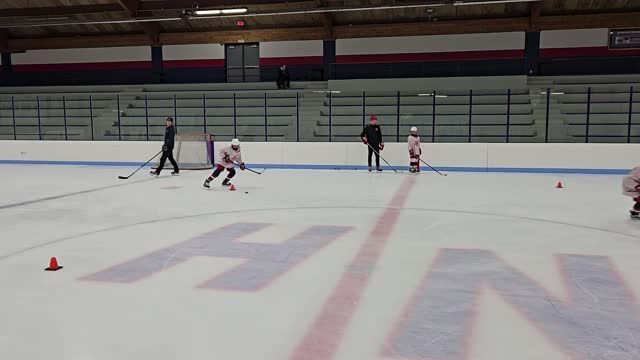 0:00:42
skating edgework progression with puck carrying.
 0:00:39
Skater should focus on quick sharp passing. Drill starts with a fast give&go pass. Skater should then utilize the space to circle around the group adding some traffic to the pattern, working to get head up and vision on the passer before making net drive.
Shooting should be on-the-tape/off-the-tape mentality.
A good progression would be to have skaters transition after give&go to face the passer the whole time and add some backward skating to the drill.
 00:00:00
“You are the greatest source of competitive advantage available to your team right now.”
Great news! Show up, say a couple things, and put the two points in your pocket, right?
Sorry coaches, it's not that easy, but it is that natural. For Cody Royle, the magic of coaching exists in the personality, knowledge, and experience of the human being behind the whiteboard. Every time we're coaching we're performing, so how you show up really matters.
As coaches we recognize patterns in the game, but we're putting that knowledge to work in high pressure arenas (literally). We're charged with communicating, making decisions, and interacting with players, coaches, and officials during games or practices.
For Cody, it's important to understand that everyone looks at the game through different lenses. Hockey can get stuck in a myopic view - not everyone on planet earth holds ice hockey as the most important sport in their world. The fact that it's widely known as ice hockey lends weight to that fact. People literally speak different languages and still find a way to improve their on-ice skills - think of Detroit's Russian 5 in the early 1990's. People also come from different backgrounds, which means they might as well speak different languages. It's these differences that make coaching necessary at all. Think about it - imagine every one of your players functioned as intended without any need to speak or communicate. What if they knew where to go because they understood how to read the play and predict what was going to happen?
You'd be out of a job. Coaches connect players with concepts and knowledge, and the result is performance during games. The result is something we don't have control over. We do have control over the process.
And the players don't function as intended. They make mistakes, the puck bounces, the staff wants more money, the volunteers don't show up. Coaching is leadership, and it's all encompassing. We need help and it's not easy to find.
Thus, coaches deal with stress and confusion just like athletes.
"Coaches weren't able to go to anyone and identify that because it would impact their future employability."
Cody points out that coaches impact an athlete's ability to perform, which is a tall order when coaches arrive at an event already exhausted and with low mood. This system isn't working, and we need to fix it. We can do that by turning the mirror on ourselves.
My favourite part of Cody's presentation is about learning how to nap - I think I actually have that part down to a science. Every game day I leave the rink after morning skate or morning meetings, I walk tht dogs, I make food, and then I climb into the sheets and turn the lights down like I'm going to bed. Usually this is around 2 or so in the afternoon. No alarm, just sleep, and I'm usually up in 45 minutes and ready to go. Three games a week, and that's almost two and a half hours of additional sleep every week. Not insignificant!
You owe it to your players to be the best version of yourself. Coaching is not a 9-5 job, it's 24/7. That means that when you're working on yourself - spending time in the gym, walking the dogs, hiking, or making time to make memories with your family, you're improving as a coach. But first, you're improving as a person.
Your players will benefit from it, and so will you. Coaches are human beings, too.
Check out this snippet from Royle's presentation and view the full video here a membership to The Coaches Site.
 0:01:02
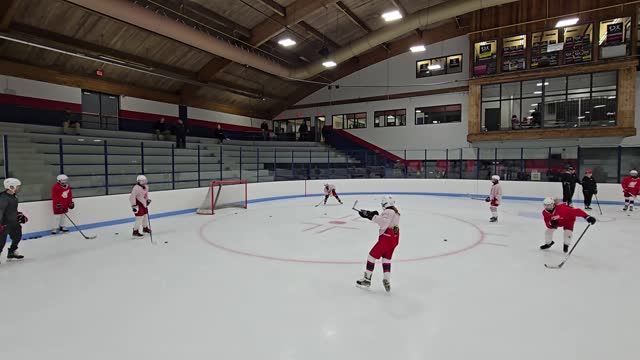
Players focus on moving pucks quickly, snapping passes. Focus is on keeping ready position and turning body angle to address passer and target. Passes should be sharp, on the ice, and passer has to pay attention to which hand the receiver is.
Variations can be made:
 0:00:18
Upper Canada Cyclones U14 - In-tight Variations
Filmed at The AMPED Sports Lab. Ottawa, Ontario
 00:00:00
Subscribe: Apple Podcasts | Spotify
In episode #278, Kim Weiss, Video Coach of the Colorado Eagles, stops by to chat.
She is a trail blazer who has relied on one tried and true method to advancing in her coaching career: learning how to make the players better.
Previously, she would become the first female to earn a win as a Head Coach in North American junior hockey with the Maryland Black Bears and was also named an Assistant Coach with the mens team at Trinity College, her alma mater, making her the first female to coach at the NCAA level on the male side.
In addition, Weiss is a two-time TCS Live presenter, covering Strategy for OT and Shootouts and Incorporating Wall Play into Practice.
Listen as she shares advice for aspiring female coaches, why coaching is all about helping players get better and why wall play is an undertaught skill.
Video Timestamps:
Presented by State and Liberty Clothing. Visit https://stateandliberty.com/tcs and save 15% on your first purchase with the code TheCoachesSite
 0:00:18
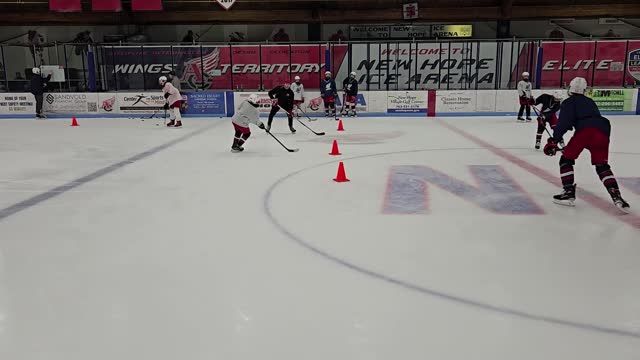
Quick puck touches. Working with eyes up. Good communication. Can be a good warm up drill for entire team.
Lots of variations on this drill. Pairs can work in different patterns or from one side of cones to the other weaving through obstacles.
 0:01:43
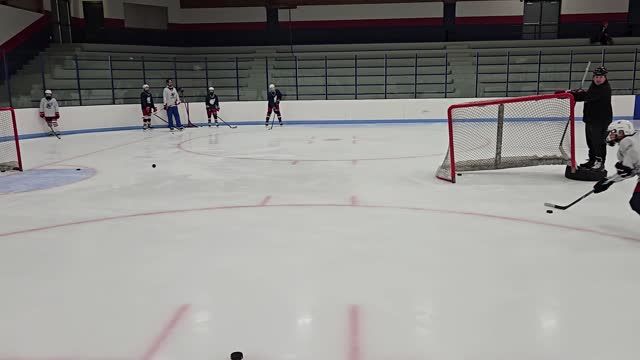
Work with speed. Players have to develop a touch to not slip the puck to hard and end up chasing it out the other side. They should also be thinking about placing the puck on the other side in a spot that allows them to pick the puck up quickly on their forehand, to allow for quick release shooting. Object is to meet the puck on the other side, with puck in the pocket and ready to fire.
Discourage any stickhandling or dusting the puck off before release.
 00:00:00
Here is a practice plan I had put together for the start of of our Second Block. As you can see a key focus for our group was offensive zone play.
Feel free to use any or all at your next practice!
 00:00:00
Daniel Broberg is the Founder of DB Hockey Factory and one of the most renowned development coaches in the game. It’s why NHL stars seek him out in the off-season, and trust him to sharpen their skills, and help enhance their ability to make plays in critical moments. It’s why Broberg travels the world throughout the season to work with players of all ages and abilities through his Hockey Factory camps.
Until now, Broberg’s coaching philosophy, process and teaching progressions have been kept private. But now you can learn how he breaks down fundamental skills and builds them back up into what he calls Smooth Power. What is Smooth Power? It’s the feeling a player has when they are playing at full confidence, have trust in their abilities, and are able to read and react to the flow of the play.
In his course, 7 Steps from Basic Skills to Smooth Power, you will gain access to 33 video lessons, covering in great detail, the steps required to go from Basic Skills to Smooth Power. Specifically, Broberg will teach you:
Each video lesson includes drills, key teaching points, and mechanical adjustments Broberg uses to help his students reach their full potential. He’s essentially handing you the playbook he has refined over his 35 years in coaching.
Most importantly, you’ll see the drills performed by players at different stages of their development, and how Broberg communicates and transfers his knowledge to each individual athlete. Broberg’s passion for teaching and love for the game is on full display.
Don't miss this exclusive opportunity to go behind the scenes and learn what has made Daniel one of the most sought after development coaches in the world.
End of content
No more pages to load
copyright (c) 2026 The Coaches Site