Details in the Clip
Breakout Under Pressure with
- Triangle Support - Inside and on the Wall
- WSFW pushing back D-man and creating ice
- WSD joining the rush inside
- On Zone Entry 2 players driving the net and again opening ice
- Seams are opening up
 0:00:35
Details in the Clip
Breakout Under Pressure with
 00:00:00
Being part of a team is a special honour. As a player, you can expect to contribute to the team by sharing your strengths. You are unique and valued. That is why you have been selected. You can also expect to reveal your weaknesses. This will take courage and the support of your teammates. Never be afraid of getting better by showing where you need some help.
When you are on a team, all your words and all your actions – before, during and after practices and games – reflect not only on you but also on your teammates, coaches, staff and your team. Act towards the ideal. Find teammate examples of excellence and treat others how you'd like to be treated. Do this by being encouraging and supporting each other on and off the ice.
Making yourself a better teammate – Here’s how you can tell:
Making my teammates better – Here’s how you can tell:
Making my team & school better – Here’s how you can tell:
 0:01:44
Offensive Zone
 00:00:00
Subscribe: Apple Podcasts | Spotify | Google Podcasts
In episode #236 of the Glass and Out Podcast, we're joined by Sheri Hudspeth, the Director of Youth Hockey Programs and Fan Development for the Vegas Golden Knights. She is also a coach in the Jr Golden Knights program.
Not every NHL team has a role in its organization like the one Hudspeth occupies, and her hockey journey is unique in and of itself. The learning she has done on the ground in Vegas is invaluable because hockey wasn’t the natural choice there when it came to parents selecting what youth sports program they had to sign their kids up for.
Listen as he shares why it's important to have strong coaches for our youngest players, why parents need to let coaches do their job, and how we can empower women coaches.
VIDEO TIMESTAMPS:
 0:00:18
TBL#38 with a perfect example of gathering the required information before arriving at the puck. There are times a "no-look" pass is acceptable, top players can generally predict 🧠 the future a few seconds in advance.
In most scenarios the player will look at the intended pass target before delivering the puck to them, this clip reinforces there are exceptions to that rule. Using the "proximity radar" analogy, the passer will have a hunch on the direction and speed of their intended pass target. When using no-look passes pre-scans and the ability to "predict" are a must!

#never say never and never say alyways
 0:01:19
The 🥊 turn/jam turn/jab step has become really popular in the last 5 years, most players have been exposed to it through power skating or a skill camp/coach.
This video highlights a few areas where this technique can be applied. There are many more scenrios, but these might help players visualize the WHY/WHEN 🧠
 0:01:29
Offensive Zone
 00:00:00
Studying many scientific works of psychologists lately, I deeply immersed myself in the study of the importance of the nervous system of athletes. And I found it extremely useful!
According to Dr. B.Vyatkin in his study, athletes with weak nervous systems (WNS) tend to show better results in training and exhibition games, but don’t show their peak performance during important competitions. Athletes with strong nervous system (SNS) perform better in official matches and important games. The key fact is: for WNS, an important match is an unnecessarily strong psychological stimulant, which leads to constraint. For the SNS an important match is an optimal environment, but exhibition game/practice is an insufficient stimulant and leads to laxity or laziness.
During an important game, athletes with WNS try to do more than they can, complicate their goal and look insignificant. Thus, they do not show their maximum capabilities. On the other hand, SNS athletes show a lot of flaws in games that are not important. Moreover, the importance of the game is determined individually, inside player’s head; for some athletes, matches of local importance may be more important than the final of the national championship.
Does this mean that you need to make a team only of hockey players with a SNS despite their hockey skills?
No! And here’s why:
1. According to statistics, people with a WNS have better innate speed abilities. And yes, it’s the speed of thinking as well. (It is very difficult to compete without speed in our sport, isn’t it?)
2. Due to the correct choice of the playing style and player’s role in the game, WNS guys can achieve results no worse than people with a SNS.
3. An athlete with a WNS can be properly attuned to any important competition using psychological tricks. A competent approach from the coach is very important. (For example, if you downplay the significance of the result or if an athlete is battling not against an opponent, but trying to reach his individual goal set by the coach)
4. Improve the WNS-athlete’s performance with psychological training. Train the moral component of will, the ability to restrain emotions, manage oneself in a tense situation. Experienced psychologist may help.
This topic is very important in professional sports. Many players do not realize their potential when faced with psychological problems.
Our #1 coaching job is to help them by setting goals correctly and providing a comfortable work environment. An individual approach is the best tool. For athletes with a WNS, it is better not to strain with excessive motivation, but to focus on small technical details. It is important not to demand super-efforts from them, otherwise we will get the opposite effect. Fpr athletes with a SNS, we need to give them extra motivation, find additional personal meaning to them in order to get the maximum effort from them.
How to determine player’s nervous system type?
I promised to tell you in more detail how to determine the type of the player's nervous system. For myself, I use a small test, which I fill out based on observations of a player on and off the ice. You should definitely work with the player for a while before evaluating. The true face is usually shown during tough matches and tense situations.
Each question is evaluated from 1 to 5 points where «1» is the worst possible mark and «5» is the best:
1. Ability to do something for a long time without interruption (for example, for several hours).
2. Ability of sustained concentration on something.
3. Ability to endure failures.
4. Willingness to undertake responsible and important work.
5. Ability to perform in stressful situations / under pressure.
6. Ability to follow the plan when faced with serious obstacles.
7. Easiness/tension of acting (discussion) in the presence of the coach (GM).
8. Nervousness before an important match.
9. Willingness to take on work that requires a lot of physical effort.
10. Ability to overcome temporary mood swings and bad moods.
40-50 points: Strong type of the nervous system.
21-39 points: Strong-weak type of the nervous system, approaching one or the other pole indicates the predominance of strength or weakness of the nervous system.
10-20 points: Weak type of the nervous system.
After I determine the psychological type of each player then it’s easier to communicate with players, find better line combinations and build good chemistry in the dressing room which most likely will transfer onto the ice. Good luck!
 0:01:19
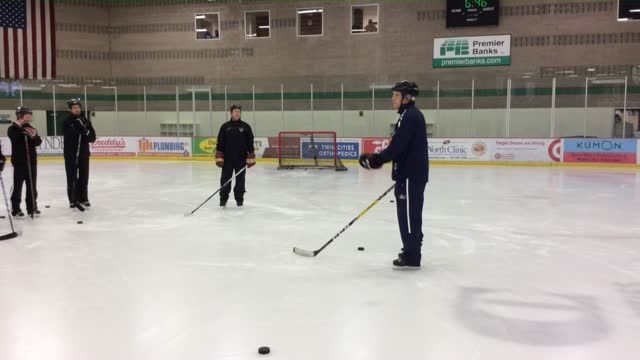
Powerplay Breakout - PP Entry
 0:02:05
End of content
No more pages to load
copyright (c) 2026 The Coaches Site