In contemporary sports, in a culture of professionalism and the early specialization of youth, many would argue that the true nature of sport has been lost.
With the pervasive win-at-all-cost attitude, a distinct lack of respect often occurs when observing hockey. Lack of self-respect, for other players, officials and the limited care given to teammates, coaches and the game is often cited as the norm in today’s game.
If there is evidence that a culture of disrespect exists in modern hockey then unsportsmanlike, illegitimate and unsafe practices tend to follow.
Yet somehow, we are surprised by violent and irresponsible acts when they occur in the game. Consider the outbursts of professional players and aggressive rule infractions (questionable body checks from behind in multiple games) in the World Junior Tourney…but rather than cast judgment and condemnation on players, their coaches and the teams they play for...and rather than dismissing the great game of hockey as violent, unsafe and risky; We must look at how we coaches can better teach Sportsmanship!
“Those who can ensure sport retains its value as a humanizing experience are those who care about it the most.”
By teaching Sportsmanship, I assert that a more respectful player must be nurtured and taught just what, why and how they can act ethically. The result is a safer game and the ancillary benefit is that the player is a better citizen and person.
A quick review of literature specific to hockey suggests practical examples of teaching sportsmanship are mostly absent.
Here is how you (Coaches) can begin to teach Sportsmanship in Hockey
Model positive sporting behaviours – As a coach your role as a leader and teacher demands mentoring players. Leading by example produces profound results. Act accordingly…your players are watching every move you make.
Emphasize Sportsmanship – In all team activities, and events. On–ice and off-ice positive behaviours become best practices. Over time best practices become team and organizational standards. These standards then become norms entrenched in codes of conduct and organizational values. Positive sportsmanship and behaviours do not just happen. They must be used, re-used, observed, rewarded and reflected on.
Use positive language - Use language that promotes respect and discipline. Use language that is courteous and kind, that is inclusive and that promotes favourable values. Promote the game's codified rules, and support an ethical standard of play.
Reinforce and reward “competitive play” – Hockey and all organized sport follows a continuum between seriousness and recreation. Organized games, like hockey, have a purpose. Playing hard, giving best effort, and striving for personal best demonstrate respect for the game, respect for self and respect for others. This notion must be rewarded and reinforced by coaches. As a coach and as a team find ways to create and build respect into your teams’ vocabulary.
Sportsmanship & success – Discuss and link sportsmanship to success in performance and achievement. Use role models from your community, from other sports and the NHL. Give players perspective and allow empathy towards opponents.
Establish team rules – Codes of Conduct (for players, coaches, officials, administrators and parents) should be circulated for your team. Coaches should promote these rules and traditions for their teams.
Add historical perspective – Give players the knowledge that they belong to a “fraternity” of sorts…a lineage, and that they are unmistakably linked to the game’s past. This concept builds reverence and responsibility for the game.
Teach the rules of the game – Teach the rules of the game. By doing this you will recognize and value the discipline required in sport and acknowledge the limits of competition. Discuss safety and all its aspects and the reasons that rules exist.
“Therefore Junuh, love your opponents. When I say love, I don’t mean hand them the match. I mean contend with them…to death, the way a lion battles a bear, without mercy but with infinite respect. Never belittle opponents in your mind, rather build them up for on the plane of self there can be no distinction between your being and his. Be grateful for your opponent’s excellence. Applaud their brilliance. For the greatness of the hero is measured by that of his adversaries.” Bagger Vance – Randolph Junuh in the Legend of Bagger Vance
Lessons of Sportsmanship in Hockey
Respect Opponents
Encourage players to watch the game from the bench cheering on good plays by both teams.
Discourage “jeers” by replacing statements with positive examples.
Shake hands (when allowed to do so), use taps, nods and encourage others. Reward players who respect and appreciate good athletic accomplishments and efforts on the ice.
Always treat other coaches and game officials with respect.
Encourage confidence, enthusiasm and celebration; do not tolerate cockiness, showboating and overzealous “rub-it-in-your-face displays.”
Try to maintain a positive play emphasis regardless of the score.
Never whine after a loss or make excuses. Accept defeat graciously. Win with even more graciousness.
In lopsided contests avoid running up the score.
When opponents are “vulnerable”, only use safe techniques and tactics within the rules.
“To develop a society of players and a culture devoted to playing is to contribute to a civilized humanistic future”. D. Siedentop
Respect for Team & Teammates
Praise and recognize the player’s engagement and awareness of the game especially when they are not on the ice.
Reward and encourage – encouragement; cheering, and congratulations build mutual respect amongst a team. Seek out examples of these behaviours.
Create a positive learning environment – have parents, siblings and others not on the team surrender the dressing room before and just after games and practices.
Ask parents and others (through codes of conduct, and formal meetings) to not “coach” their kids.
Create team rituals and customs like off-ice uniforms and/or dress codes etc. Use dressing room circles, team builders, sitting players in line combinations or pairings in the dressing room, and foster pre-game rituals.
Use terms of respect towards teammates, coaches and all volunteers. Yes sir, no sir, please and thank yous.
“The sense of mastery gained from increased competence may also generate feelings of self-worth that enable individuals to cope with life in our increasingly complex world. Lauder –Play Practice 2001
Respect Officials
Address officials positively in a non-emotional manner.
Have player designates (Assistant Captains, Captains) introduce themselves to officials and have them shake hands with the officials before the game starts.
Ask officials to meet with your team pre-season to discuss rule changes, and rule emphasis, and offer the referees perspectives on league play and the game.
Congratulate the referee & linesman (Coaches) with a pre-game handshake or fist bump. Sincerely, appreciate excellence in officiating with your team… “Wow, that ref had a great game.”
Apologize if emotions flare by attending to the ref's room after the game (ask permission before entering). Have players do the same if they “lost it”.
Address language or conversations blaming officials for a loss stressing that it is an acknowledged part of the game... that human judgement presides. Explain that human judgement is not perfect.
Respect the Game
Teach players customs, values, and ethics found in the game. Simple gestures like “goalies out first” from the dressing room, neat uniforms… sweaters hung up not on the floor” go a long way in building a team.
Players should always show "hustle". Playing hard, and striving for personal best effort shows respect for self, the team, the game, and opponents. It reflects the attitude that it is a privilege to play.
Encourage knowledge and a study of the game.
Talk about sports and hockey icons, innovators and leaders in the game…tell stories about them and others in sports.
Encourage acceptable behaviours “within the game”; discouraging behaviours when players act as if they are above the game; acting cool or that the game owes them something.
Respect between Players and Coaches
Ask players to call you Coach…this role comes with respect.
Expect and create situations where players can and will have to listen to instructions. Eliminate distractions. Do not tolerate non-listening. Use good teaching techniques.
Deal with signs of disrespect immediately; eyes rolling, brooding, lack of hustle, challenging authority, talking back; these erode trust, and acceptance and show disrespect to coaches (and others).
Demonstrate your respect for families, other players, and other coaches. Showing respect, and trusting others is to be trustworthy.
Model sportsmanship and teach sportsmanship through example, instruction, rules, routines and habits.
In episode #242 of the Glass and Out Podcast, we're joined by Mark Poolman, the Head Athletic Trainer, and Strength and Conditioning Coach of the University of North Dakota men’s hockey team.
Poolman's reputation precedes him and it’s no secret that UND is a pipeline of NHL talent. The alumni list includes the likes of Jonathan Toews, Zach Parise, TJ Oshie, Jake Sanderson, Ed Belfour and Brock Boeser, just to name a few. To put it in perspective: last season alone, 23 former UND players suited up in the NHL.
Listen as he shares off-ice training tips for youth players, why sleep is critical to player performance, and how to deal with stress as a coach.
I love 2v2 games because no one can be a "passenger" - everyone has to be engaged in the play in order for the team to succeed!
I've include 11 of my favorite 2v2 games in the plan below for you to try with your teams to bring the compete & engagement level to the next level.
Try these out, share it and let me know how it goes.
If you want even more great stuff from Coach Kim, joinThe Orange Machine! The Orange Machine is an exclusive HOW TO, NO FLUFF weekly newsletter created by world-renowned development coach Kim McCullough. Each week, Coach Kim will give you the exact tools you need to take your skills, team play, hockey IQ and mental game to the next level AND show you exactly how to use them in a step-by-step, easy to understand way. With over 30+ years experience playing & coaching at all levels of the game from U9 to the national teams, you can be sure Coach Kim is giving you the tools that are right for you and your game, no matter your current age group or level. If you want to dramatically transform your game, then The Orange Machine is right for you! CLICK HERE TO LEARN MORE
This is a simple drill that allows players to work on acceleration off of pass reception. Players quickly take 3 cross-overs off of the reception of the puck before either passing back to their partner or shooting the puck on net.
The ability to block out the ‘noise’ is key to having a clear mind and playing free.
But this is easier said than done – many athletes have trouble blocking out the ‘noise’ and end up:
Overthinking
Doubting their abilities
Worrying about things out of their control
When you lack alignment within your thoughts, feelings, and actions, you end up losing the ability to play in the flow state.
The best strategy to clear and block out the noise is a Reset Routine.
The problem with blocking out the noise and clearing your mind is that it is not tangible. You can’t just hit a switch, throw away the distracting thoughts, or just forget about your worries. It doesn’t work that way.
However, the Reset Routine provides a repeatable and reliable solution by pulling together three crucial psychological concepts to feeling free and in the moment.
The magic is not in the routine itself, but in what the routine represents.
Here are the ABC’s to creating an effective and personalized Reset Routine:
STEP 1: Accept
This is the most important step, yet it’s the most misunderstood.
For example most athletes get caught in the ‘need to, have to, and shoulds’ of performance – this leaves them:
Feeling the burden of expectations
Distracted by the results that are not in their control
Primed to be frustrated if they fall short of their expectations
The key to letting go of this noise is acceptance, but the problem is our society thinks acceptance is a weakness.
It’s misconstrued to be this fluffy lovey dovey concept best reserved for hippies.
However, if properly understood and effectively used it is one of the most powerful tools to getting centered, grounded, and becoming the hero of your own story.
That is why this step is the most important – without it your Reset Routine will not be effective or reliable.
The Pink Elephant and the Bubble
One of the analogies we like to use is the pink elephant and the bubble.
If I say “don’t think of a pink elephant.”
What do you think of?
A pink elephant…
This is not an effective strategy, yet that is exactly what most advice is for athletes:
Don’t worry about it
Forget about it
Be positive
These might be the results we want but they do not tell us how to get those results.
Think of your focus and awareness as a bubble, and what we want is to have a clear bubble – where you are dialed into the process.
But the problem is pink elephants show up – aka distracting thoughts and feelings.
You can’t run away from them, they stay with you. You can’t ignore them and look away, they are still there and you will feel them weighing on you. You can’t fight them off, they will just get bigger and louder.
The solution is to go to them, to understand them, to embrace them, to accept them.
By doing this the pink elephant is not necessarily gone forever, but it will move outside your mental bubble, and your mind will become clear and free.
The pink elephant could come back, but with practice you can clear it faster and faster. Over time, you can also learn how to use the Reset Routine to block it from coming into the bubble altogether.
Accepting the Range of Results
My favourite example of acceptance is the Samurai.
They were great warriors that were well prepared for battle, but before they would leave they would say good-bye to their families as if they might not see them ever again.
They accepted the possibility of death.
By doing this they could fight free and fearlessly.
This acceptance does not mean they wanted to die, they most definitely wanted to live.
What it does mean is they accepted the reality of the situation despite how well they were prepared.
If they could not accept dying at war, then they shouldn’t be going to war – they could have just run away.
The good news, when sharing this with athletes, is that it is not about life or death – it’s about winning and losing a game or making a mistake vs succeeding.
I recently started working with a surgeon and we were reviewing this concept. The reality is not every surgery will be successful given the challenging nature of the surgeries they do.
So that was a different type of conversation for me, but the principles held true.
I don’t want the doctor to be indifferent to the life and death of his patients, but unfortunately if he is not willing to accept that his patients could die then he should reconsider what types of burdens he is willing to carry as a surgeon.
He said this was a light bulb moment for him. No one had ever said that to him before.
They spend years and years refining how to be a surgeon, but they are not trained and how to manage the emotions and fears associated with it.
As a result – he has been able to stay calmer in surgeries with a measurably lower heart rate – which will help him continue to be an even better surgeon.
Finding Your Pink Elephants
The hardest part of acceptance is knowing what to accept.
There are two common problems:
The pink elephant is in your blind spot You can feel it but have a hard time seeing it and understanding it – which therefore makes it hard to accept and clear.
A lack of perspective When you are too zoomed in on the situation, you often have a hard time seeing the bigger picture. It’s like only seeing part of the pink elephant, but you can’t clear it unless you can see and understand the whole thing.
So the quickest solution to these two problems is to get help from an outsider. It’s a lot easier for someone else to see your blindspots and to look at your situation with a different perspective.
But you won’t always have the time or availability to do so.
Therefore you need to learn how to feel your way around to find the root of the noise. Then have the ability to zoom out and get perspective, so that you can be willing to accept it.
This is a skill that takes a lot of practice.
That is why the Reset Routine should not be a sometimes thing. It should become a regular part of how you mentally prepare. You use it every day so that you can continuously get better at clearing the noise.
Associate an Action
Everything we covered under step 1 so far has been about the concept of acceptance.
Acceptance is just a willingness problem and the above can help you be more willing to accept the noise.
But we want to turn this concept into a practice and habit – so pairing it with an action is one of the best ways to make it stick.
The most common example we share is a hockey player spraying water in the air and watching it fall.
It reminds them to accept and let go.
This obviously won’t work for every sport, so your job is to find something that works for you.
Sometimes athletes will actually use breathing (step 2) as the action for step 1.
STEP 2: Breathe
There are a vast amount of strategies on the importance of using your breath to help you get relaxed, calm and centered.
“An anxious mind cannot exist in a relaxed body.” Dr. Edmund J. Bourne, Clinical Psychologist
Regardless of what strategy you use – breathing is a fundamental strategy for managing your physical and mental state.
Here are some of the top breathing & relaxation strategies that you could integrate into your Reset Routine:
Deep Belly Breathing Also known as diaphragmatic breathing – it is simply making sure you are taking slow, deep breaths, and controlled breaths. It is also important to count how long you inhale and exhale while belly breathing. This is probably the easier and most common choice.
Box Breathing The breath should still be deep in the belly. The difference here is focusing on the cadence. A common example would be 4 second inhale – 4 second hold – 4 second exhale – 4 second hold. This completes one breath cycle and makes an even box when looking at the four parts of the breath.
Physiological Sigh
This strategy is strictly about helping you relax. First take an 80% inhale, a quick pause, then finish your full inhale before a nice long exhale. This pattern helps replicate an actual sigh and is another proven strategy for helping you get relaxed.
Progressive Muscle Relaxation PMR works by contracting and relaxing one muscle at a time. The contractions last for 7 seconds each and are usually at about 50% intensity. By putting your attention on the contrast in the muscle tension it helps you further relax.
Pick the one that you feel is best for you – you can always come back and adjust.
It is important to be specific – for example: 3 deep belly breaths. This keeps your Reset Routine more tangible and transparent.
Disclaimer – it doesn’t matter if you do all the deep breathing in the world – if you still don’t accept and clear the root of the noise, then the benefits of breathing are limited. Breathing is not an alternative to acceptance, it is an addition.
STEP 3: Commit
Steps 1 and 2 will help you clear the noise and get centered, but the last piece of the puzzle is to direct your attention back to the task at hand.
If you don’t commit to the process you might end up letting another pink elephant get back into your bubble.
So in this step we often have the athlete close their eyes for a brief moment (if applicable) and imagine how they want to show up in the next play. It is not just what they want to do, but how they want to feel while they do it.
Setting a clear intention of how you want to move forward helps activate the best version of yourself.
This is also a great time to use a totem or anchor.
A totem comes from Todd Herman’s Alter Ego work – which is about creating a personalized narrative that clicks for you. The totem is then something tangible that you can touch, hold, or wear, and use to help associate that narrative. It’s a really powerful way to finish a Reset Routine.
Similarly, an anchor represents something you do or look at that anchors you back to the game and attacking the next play.
The combination of Acceptance and Commitment is well established as an effective one two punch – also known as Acceptance and Commitment Therapy (ACT). Although this approach originated in the clinical psychology setting – this can be a game changer for high performance.
At this point you should have a pretty good idea of how to build your own personalized Reset Routine to help you block out the noise and play free.
You know you are doing it effectively when you feel the alignment in your thoughts, feelings, and actions – you will stay composed under pressure, bounce back from mistakes, and able to get into the flow state.
Now remember the routine and the actions are not what make it work – the ability to accept is the key. So if your routine is not working well – the solution is often about doing a better job of finding your pink elephants, getting to the root of the noise, and fully embracing it.
Here is the summary of the 3 ABC’s of the Reset Routine:
Accept: Embrace and deal with any distracting thoughts and feelings.
Breathe: Get present and manage your internal arousal level.
Commit: Set a clear intention, move forward, and activate your best self.
Make it a tangible routine that should only take about 10-15 seconds. You can make variations that are shorter or longer.
The bottom line is you need to personalize it and find what works for you.
I hope you found this helpful.
Please share this with anyone you think could benefit.
Check out these drills from Justin Selman's 2023 TCS Live presentation on The Next Generation of Offense from the Blueline.
Following a four year collegiate career at the University of Michigan, Justin Selman spent time with the St. Louis Blues organization playing for the AHL’s Chicago Wolves. After retiring, Selman founded Topline Hockey, a hockey development company working with players ranging from ages six through current NHL players.
Selman’s TCS Live presentation on The Next Generation of Offense from the Blueline provided a guide on creating time and space as a defensemen in all three zones. Starting with retrievals to escape pressure in the defensive zone and working towards deception/blue line footwork and cutbacks, these drills will help all aspects of the modern defender.
TOUCH AND GO REACTION
DESCRIPTION
Coach will lead with initial pass to D1. D1 touches back to coach and drill is now live.
Coach passes back to D1 and forces immediately. Coach forces D1 to make a quick decision under pressure while the second F1 reacts and forces D1 to make a second decision under pressure.
KEY POINTS
Make D move in different directions each time.
Vary the pressure.
NEUTRAL ZONE TRANSITIONS X2 + JOIN
DESCRIPTION
Both Coach and players start with a puck. The rep starts with an exchange of pucks between coach and D.
D mans intention is to retreat with his new puck and work on his deceptive head fake, top hand pump and weight shift to escape or transition followed by a pass to coach.
Repeat on the other side (second cone).
After the player hits both cones he’s going to pass to coach and explode up ice to join the attack on the strong side, however we are adding another small skill by forcing a late awkward catch of the pass forcing a hip open weight shift before escaping to the wall and finally attacking for a shot.
KEY POINTS
D work on deceptive fakes to both left and right.
Quick crossover turns when coming around cones and pass with feet moving.
EASY EXITS
DESCRIPTION
D starts with puck, pivots, passes to Coach then retrieves the puck that was chipped behind him by F from wall.
1st puck take half net jab step and cut back for a quick up to the Coach or F on the wall.
2nd puck attempt to collect and get toes up ice ASAP by weight shifting to fake and strong side quick up or center outlet, hold the puck and take the net exit by skating or quick up to coach.
3rd puck coach applies pressure, forward stretches through middle, one move to beat coach and find ice to skate or outlet to the stretch player.
KEY POINTS
Work on deceptive moves involving jab turns, weight shifts, head/shoulder fakes and tight turns to escape fore checker.
3 PUCKS 3 TUCKS
DESCRIPTION
Focus here is on 3 distinct attacks off of retreating with the puck and re-attacking as D man.
D1 starts with a puck as well as the Coach.
As D comes towards coach they will exchange pucks on the first rep. Retrieval, weight shift, single leg stop, to front foot sliding fake shot- shot.
On the second puck, Coach will flip or give the D a bad pass along the wall. D collects it then has his feet outside the blue line and stick inside to create more space while sprinting across the blue line. Cross middle ice, jab step and cut back for a second shot.
Collect 3rd puck, weight shift fake to the wall, cut back and do a fake shot before taking final shot.
KEY POINTS
Work on smooth pivots and weight transfers to deceive checkers to create time and space.
Every August I do an agility camp with a lot of quickness and on-your-toes skating. But for the first part of each ice session, I warm up with zone-to-zone stickhandling with a focus on heel edges. I get the players to sink into their heels, put the puck on the heel of their blade, and work on numerous drills that include upward of a thousand reps. If you watched Tyler Dittmer's on-ice presentation at TCSlive a couple of weeks ago in Ann Arbor on deception shooting, you would have noticed the player's amazing heel edges pre and post-shot releases. Utilizing heel edges effectively can transform your game, allowing for better stick handling and control on the ice.
Slowing Down the Play with Strategic Heel Edging
By expanding your stance beyond shoulder width and applying pressure to your heel edges, you effectively manage your momentum while keeping the puck securely on your blade. Aligning your top hand at your body's center enhances your stability, allowing for precise control over the puck's movement. This stance not only prepares you to absorb and evade incoming pressure from opponents but also enables you to survey the field for optimal passing lanes or shooting angles.It's a tactical method that leverages your heel edges to dictate the game's pace, giving you the upper hand in developing plays and setting up scoring opportunities.
In this clip, you can see how he "slows" down by setting back into his heels to make an agility move around the defender. Once he gets around the second defender using his heel edges, he continues to get into his heels and head on a swivel to make the pass across for a goal.
Positioning the Puck for Maximum Control
The puck should rest on the heel of your blade to facilitate a broad range of movements swiftly. Adopting a stance that is slightly wider than shoulder-width with knees bent ensures stability and readiness for action.This position not only offers solid footing but also primes you for passing, shooting, or advancing with the puck.It’s about creating a balance between control and preparedness, enabling you to transition smoothly between maneuvers. Engaging in this specific puck positioning allows for enhanced maneuverability, setting you up for effective gameplay and strategic advantage on the ice.
Maintaining Agility Under Pressure
When opponents close in, the ability to swiftly change your course or adjust your speed becomes invaluable. Utilizing your heel edges for these quick transitions can give you the upper hand, allowing for seamless direction shifts without sacrificing puck control. Keep your gaze forward and constantly assess the play, ready to dodge defensive efforts with grace. Practicing tight turns and sudden stops while keeping the puck secure enhances your capability to react under duress. This skill set not only aids in evading challengers but also in creating unexpected opportunities for your team through your adeptness and agility.
Practice Drills to Improve Heel Edge Skating and Stick-Handling
One beneficial drill is navigating a series of cones arranged in a slalom layout while focusing on keeping the puck at the heel of your stick blade. This exercise challenges your balance and precision, promoting greater puck control. Another effective drill involves alternating between rapid sprints and abrupt stops using your heel edges, then quickly resuming motion. Thisnot only sharpens your ability to swiftly decelerate and acceleratebut also strengthens your overall skating agility. Incorporating these drills into your training regimen will refine your coordination and finesse, which arecrucial for excelling in dynamic game situations.
A recent question sent into The Coaches Site really spoke to me as a coach. While the question itself is aimed at a specific age, I think its answer can apply to many ages.
"Can you teach a child 6 year old effort? Can children be taught how to compete hard or is it something they either have, don't have or with grow into or not?"
Effort is tough to measure. I have coached kids whose 100% effort looks like someone else’s 65% effort, and I have seen this at every level.
However, I think you can learn a kid's baseline and work within that, knowing that all kids develop at different speeds so you can’t force some of it, but you can encourage it.
The second part to this question is about teaching compete. I think these can go a bit hand in hand. It’s about motivating a player to do nothing more than try.
The first step in all of this is fun. I have written more than once about keeping practices game-like, moving away from box drills and using small area games and station based practices to keep practices fun.
An element you can add to any game to keep it motivating is keeping score. This isn’t always scoring goals, but it could be the number of passes you make, shots you block, etc.
Keeping score, and keeping the energy high will motivate players to compete to try and beat each other. Rewarding non-goal accomplishments also instills in players the importance of those types of plays.
Too many times, I have had players who played incredible shifts come to the bench upset because they didn’t score. They have erased all the good they did and equated a good shift with points, rather than the great plays they created, the goals they stopped, or even the play that motivated the bench to keep fighting.
When coaching the Pittsburgh Penguins, Dan Bylsma would often ask his players, “what can you do on the ice to give your teammates a boost?” This could be a big hit, a blocked shot, a rocket of a shot, you name it.
Now, with kids, I ask them the same thing: can you find ways to motivate each other? You can extend this to practice too. After the skate, have kids stand in a circle, and each player should go around and tell the person next to them something they saw them do at practice that stood out positively.
Allow them to motivate each other.
On the opposite side of this, I also want to touch on how not to motivate players, as you may see a quick return, but long term damage.
I cannot count how often I hear, “my dad said he will give me $5 for every goal I score.” And what you will see is a player who is motivated as ever to score a goal. You will also see a player motivated as ever to not pass and take shots from every angle they can find.
I will warn against paying for assists too. You will find a kid who won’t take a shot.
Instead, talk to players and parents and remind them that scoring is reward enough, we don’t need financial or other outside motivators. I also remind them that paying for goals teaches them that only goals are worth something on the ice.
In the end, the only players who aren’t motivated and won’t compete are the kids who don’t want to be on the ice. Those players stand out pretty quick as they don’t seem to lack compete, they lack a desire to even go in a drill, or ask to leave the ice a lot.
If you keep practice fun, and make the games rewarding in their own right, you will find that kids effort and compete level increases each time they step on the ice.
There has always been a perception of Dallas, and Texas as a whole, that they’re larger than life.
Who hasn’t heard the saying “Everything is Bigger in Texas?”
After all, Texas is the second largest state in the United States, roughly twice the size of Germany.
It’s known for big ranches, big belt buckles, big hats and big money.
Can you think of Dallas without images of Troy Aikman, Emmitt Smith, Michael Irvin and the Dallas Cowboys blue star popping into your head?
Who hasn’t seen Friday Night Lights or heard about the madness that surrounds Small Town, USA, when two rival high schools face off for gridiron glory?
Yes, Dallas and the state of Texas have many stereotypes, but where does hockey fit into the booming market?
My Google skills revealed 14 NHLers hail from the state all-time, highlighted by one of the greatest defensemen of in league history, Brian Leetch. He’s from Corpus Christi, a city in Texas on the Gulf of Mexico.
So, how do you develop hockey in a non-traditional market?
The short answer is a long term plan.
WILD, WILD WEST
The Dallas hockey market lived up to it’s perception for a long period of time. It really was the wild, wild west.
See, there were a few different AAA hockey centres in the city and what would happen, as we hear all too much in the youth hockey world we live in now, is it would become political and then parents and kids would get upset.
The parents with money, the ones upset with their kid’s ice time or their kid’s coach or whatever it is, would do what any logical hockey parent would do: they’d start their own AAA club.
This was happening to the point that there were a handful of AAA centres in Dallas, and 10-12 AA centres.
As Eric Silverman, the Dallas Stars Elite’s Director of Hockey Operations and U16 Head Coach, explains, it was very hard to develop anything that way.
“If you tried to hold a 12-year-old accountable or to be a good teammate or something like that and the parent didn’t like it, there was someone 10 minutes down the road waiting to let you do whatever you wanted.”
Player development was suffering. Coaches were suffering. Hockey in general was suffering.
The work environment around hockey was not good.
Silverman and his group wanted to change all that.
He had built out relationships with a number of the top coaches in the area and had talked to them about the vision they had of building a player first development model.
Those coaches agreed, this was going to be the way the program was going to be run.
“It’s been a total group effort,” Silverman repeats numerous times in our conversation. “The cool thing about the ecosystem here is everyone is pulling in the same direction and working together. It is really unique in the youth hockey landscape.”
When Silverman says everyone was involved – he means everyone.
The Texas Amateur Hockey Association (TAHA) got involved to stop one-off organizations from popping up; TAHA made it more difficult to get AAA or Tier 1 status.
Silverman and company were able to use the StarCenter Valley Ranch as their primary facility and build it into a state of the art area for youth hockey.
And they were also able to use the Dallas Stars’ name.
“The Stars had let their name be used before and it didn’t go very well,” Silverman recollects. “For them to put the trust in us and for us to stick to our guns and not look for a quick smash and grab, we went in with the long game in mind and we are going to just do things right.”
A long term development plan is the smart money way to go, but in a market where families would jump from one centre to the next based on what they were promised, it seemed like it would be a tough draw.
Silverman admits it took some time, but explained it almost like a cleansing process.
“The first couple years you take your lumps, but over time our coaches did a great job, people bought in and when you do the right thing eventually you’re going to be successful,” Silverman recounts. “Yeah, it took time, but slowly all the top kids started gravitating to us and the competition couldn’t really match it.”
You aren’t going to please everyone. Believing in their philosophy was paramount to the program getting off the ground.
That meant some people had to go.
“We lost a bunch of players the first few years,” Silverman admits. “I remember meetings where I was told by a parent ‘we were offered this much to go play here and if you match it we will stay, otherwise we are leaving’ and our answer to that was simply ‘see you later’.”
“I would hear ‘You’ve got to promise me my kid is going to be on the first line, first power play or we are going somewhere else’ and they’d hear the same thing – ‘see you later’. We were determined to do it right.”
A HEALTHY CULTURE
One factor that made it easier to get through the leaner years was the culture that was being built.
That stems from the coaches in place.
Many coaches within the Elite program are full-time coaches. Hockey is their livelihood.
That also means they have a huge part in setting the tempo of the program, sticking to the philosophy of the organization and being able to add their own creativity into the mix.
“Our staff was a huge part of the conversation around our core principles. We created them as a staff and told our coaches this is what 80-85 percent of your time should be spent on,” Silverman tells. “They all know, at the end of the year when you are evaluating your players and your team, this is what they should be evaluated on. It also puts the responsibility on the coach at the end of the year, because that’s how they are evaluated as well.”
Through his time as a coach and all of his previous hockey experience, Silverman and the group have found five key points that make up the nucleus of their philosophy: skill, compete, the love of hockey, being good overall athletes and puck movement/puck support.
“By the end, we want our players to be as well rounded as possible so they can play in any system or any style and have success,” Silverman states. “If you give me a kid that has talent and sees the ice well and supports the puck well and he competes, loves hockey, he’s a good athlete and he’s a good kid, I can do anything with that kind of hockey player.”
As a player goes through the Elite system, they will be coached by four or five individuals who each have their own skill sets. That is part of the selling point of the program, according to Silverman.
“We tell parents their kid might pick this part of the game up from this coach or if that’s not his expertise, you’ll get that from this coach down the road,” Silverman boasts. “Hockey is such a read and react game that there is no one way to teach it, so we want to cover as many different ways as we can.”
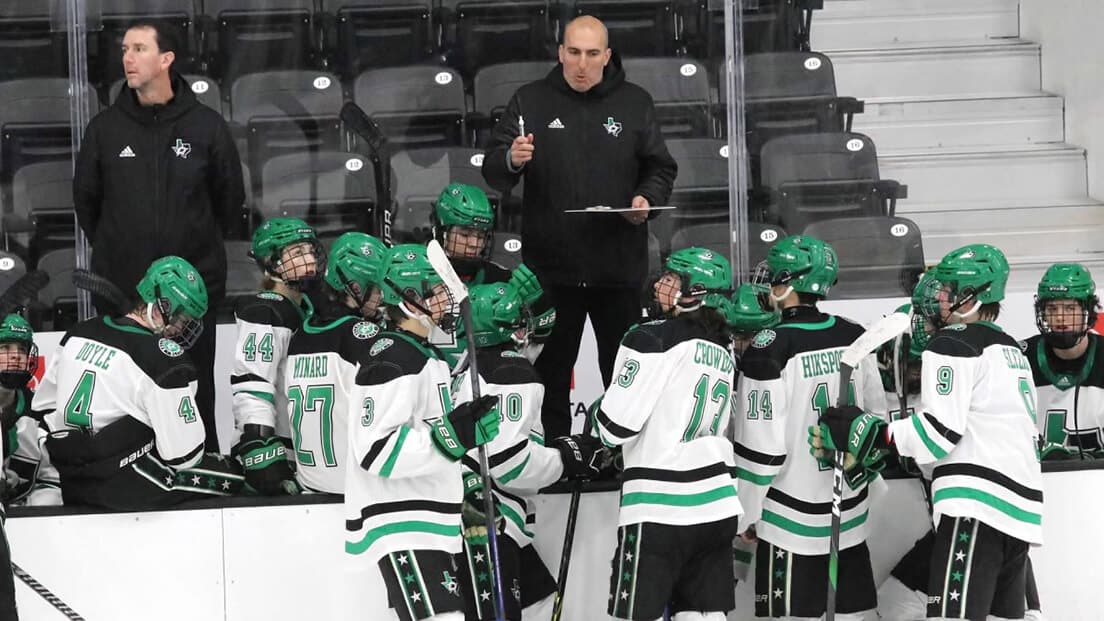
Michael Young is a coach who has been with the club since inception.
He’s currently with the 2008 birth year program, one that has been recognized in the Top 5 in the United States.
Young, like all coaches in the program, has an eye on a specific part of the game with his age group.
At their age, it’s as important off the ice as it is on.
“At this point, we continue to focus on skill development, we try to look at everyone differently and see what they need for their skills,” Young explains. “For some it’s mental, for others it’s more strength and conditioning. We focus on character and holding players accountable, continuing to do the right things. We have a lot of team rules and habits which we are really hard on to make sure they are bought in and reward the guys who have bought in.”
Asking Young what it has been like to see the growth of not only his team, but the program as a whole, brings about a sense of pride he shares with everyone.
“The parents didn’t know any different when we first started, so they were just trusting the process,” Young shares. “We were fortunate to have a track record as coaches to move players along. We have a great team and support throughout the organization and the Dallas Stars. It’s exciting for me to see us get recognition at the national level and see our players move on and continue their careers all around North America.”
Turnover amongst staff is not something you would see or expect from a program like the Elite. There hasn’t been a new head coach that has come in within the last six years.
Some of their assistant coaches have been very impressive, including guys like Vern Fiddler, Joe Nieuwendyk and Craig Ludwig, to name only a few.
“When we first started, we had some younger guys behind the benches, so we did some mentoring stuff, like pairing a young coach with an older one type thing,” Silverman remembers. “We do a lot of getting together and talking hockey and getting ideas from each other. It has helped our entire organization really build out the three phases of how we see player development.”
WHERE TO BEGIN
The first introduction into the Elite program starts at U9.
From U9 to U12, the focus is on skill development and the five core philosophies mentioned earlier. At that age, Silverman points out, players are still developing those habits and behaviours. They’re essentially building that foundation.
Checking is introduced at U13; from there you start introducing some concepts and take it to the next level.
By 14, it’s like running a hockey team. There are a lot more tactics.
At U15 and U16, it’s still those five points with habits, puck skills and shooting skills all built in.
Like any long-term development model, Silverman and his team are not looking to create the best 10-year-olds.
“On a week we don’t have games it’s more skill work, more small area games but if we have games coming up then we will work on our penalty kills and our powerplay or our breakouts,” Silverman details. “Even at the older levels we try to build on those core traits but you can’t get away with just being talented when you get to a certain level, there has to be some substance to your game.”
“What’s important to explain is, unless you get granted exceptional status, you have to play youth hockey until you’re 16,” Silverman emphasizes. “Until then you don’t even worry about that next step.”
“We try to help our kids get to the highest levels they want to, whether it’s the USHL, WHL, college, national teams, as quickly as they can,” he continues. “In reality that’s more of a 17-or 18-year-old goal, but we want to ultimately get them to the next level.”
With the 2008 age group on his plate, Young knows this is a key time in their cycle with the Elite, being the first year they are eligible for the WHL Bantam draft.
“We have always tried to put players in situations to be successful where development is number one and trying to create cultures and mindsets that are team first mentalities,” Young says. “If that means we are focused on their attitudes and body language, we’ll work on that. This is the first year when they transfer from minor hockey to ‘big boy’ hockey.”
COACHES ARE KEY
Trevor Hanas started coaching in the Elite program when there were multiple programs trying to say they were AAA hockey.
Once the Elite started making its mark in the area, it started getting the best birth kids from each AAA center and started to separate itself from the rest.
In those crucial years when players are just entering the program, Hanas doesn’t underemphasize the role of coaches.
“The coaches, to me, create the environment for the year for these kids,” Hanas replies. “We work a lot on individual skill development and positioning and different types of breakouts. I had a Pee Wee Minor team, so we were working now on our PP and PK and they can move the puck around. The first couple years it’s really individual skill stuff – passing, receiving, skating, learning how to shoot the puck properly, all that stuff.”
He describes the coaching staff and organization as a whole as one heartbeat. No one being bigger than anyone else.
“We all have our teams and we create those environments, so I would say the nucleus of our coaching staff is what makes it,” he continues. “We’ve been together maybe 7 or 8 years, we are passionate about developing kids.”
Hanas gets the fortune of wearing two hats – the coach and the dad.
When his son Cross came into the program as an ’02 birth year, the Elite as we know them now were still in their infancy.
“Cross had the hockey sense and had a passion for the game, but he really worked on his skill sets through those eight years and became a good player,” Hanas says of his son. “The first four years is a great stepping stone for their skill development and then after that is when they start taking off.”
And take off he did.
“It was pretty crazy being one of the first years it started,” Cross shares. “When we are younger, no one really needs to know the game that well because the ice is so open, so you start working on your individual skills like skating and shooting.”
“The guys who want to get better get really good because we have great coaches in every age group who emphasize that skill development.”
Cross knew, even at a young age, what they were doing in the Elite program was different.
He had a lot of people around him that could see it too.
“I’d talk to buddies from other teams and our practice days are 20 times harder than theirs, and our workouts are 20 times harder than theirs,” Cross laughs. “We had practice, we had dry land, we had the shooting room and we got pushed a lot. You strive to be winners and you create winning habits by working hard.”
After his run through the Elite program, Cross was drafted by the Portland Winterhawks in the 4th round of the 2017 WHL Draft.
Portland, which has deeper Stars Elite roots we will discuss later, got itself a truly gifted offensive talent, who exploded with a 26 goal, 60 assist campaign in the 2021-22 season.
That output was coming off what Cross calls one of the best days of his life.
A DAY HE’LL NEVER FORGET
Cross was at home with family and friends watching on TV when the Detroit Red Wings selected him 55th overall in the 2020 NHL Entry Draft.
We’ve talked about how the Elite program is cooperative, very player centric and strives to use one heartbeat.
It’s a culture that was laid before anything else.
If you want to hear what makes hockey in the Stars Elite program special, you look no further than the story of Cross’s draft day.
“Something really cool that my Dad and I talked about was bringing some of the kids in the Stars Elite program that were younger that we know have a chance to go far in this game,” Cross says. “To have those kids there to experience the emotion of it, maybe put a little more fuel on their fires and for them to see someone born in the south, who played all their youth hockey in Dallas, getting drafted into the NHL and maybe they could do the same thing.”
Trevor picks up from there.
“We wanted to bring some of the other kids in the program over to our house; hopefully they’ll get their names called one day too.”
JP Hurlbert and his father, Jeff, were at that party. They lit up when asked about Cross’ draft party.
“I was in the room when he got drafted to Detroit,” JP recalls. “He was so pumped up; I’ll never forget that. It was a great experience.”
“Trevor was JP’s coach for two years,” Jeff fills in the blanks. “He was nice enough to invite us to that. I can still see it, everyone jumped up before they could even get his name out. I’ve never seen anything like that. It was a lot of fun.”
JP also dreams of one day hearing his name get called.
Until then, the ’08 birth year forward is making sure his name is known already.
“JP last year was an under age guy, but you could tell there was a lot of hockey sense there,” Young – JP’s current head coach explains. “Where he really separates himself is his passion and work ethic. We could be at a tournament and go 6-0 and get home Monday morning at 2 am and he’s at the rink before I am shooting on the goalie before he’s got to go to class.”
“I’ve loved it every day. I thought it was great from the start,” JP begins as we talk about his run through the Elite program to date. “When we were young, we were always competing against each other and challenging each other and now that I can reflect on it, it was great from Day 1.”
Jeff gives a lot of credit to Silverman and his staff, not just for helping streamline hockey in the Dallas area, but to have the structure to build the upward mobility within the program.
“It’s a long process, but it makes it great for everybody,” Jeff regales. “Kids can sign up for a few different showcases during the year to show off their abilities, the coaches know what they are getting, and it lends it hands to kids that develop at different ages and different paces.”
JP also credits his coaches for his development to this point, knowing this process was not an instant result. JP admits he’s loved this process.
“When we were younger, they introduced us to our positions, but they didn’t expand on that,” JP remembers. “Now that we are older, we get more detailed on our strategy, our positioning, our structure. It comes year by year, it’s a gradual process. The coaches here have helped me learn structure, I’m very grateful for them, they’ve done a tremendous job.”
JP makes a point in the conversation to explain how they role four lines in Bantam Major and up, how you get to play in different roles and get to experience different things.
There is a delicate balance between wanting to win, but not wanting to win at the expense of long term development.
“I’m as intense as the next guy, coming from the University of Michigan where there is only one thing and that is winning, to turn that switch off was challenging when he was 8-years-old,” Hurlbert admits. “There were definitely games that we didn’t win that I thought we should have won, but in hindsight, it was without question the right approach.”
“Do you really want to be the best 10-year-old team in the country, or do you want to be the best 15-to-16-year-old team in the country and be ready for junior hockey and that next step in your careers?”
Look no further than two rising NHL stars for that answer.
When Seth and Caleb Jones moved to Texas, the Elite program wasn’t around yet.
Seth started U14 with the Elite, which had finally amalgamated the best kids in the Dallas area and gave them the opportunity to play against the best in the country.
“It was a great learning experience,” Seth says. “I think the coaches know where you stand going into some of these tournaments, so they prepare you, but it’s good to understand the level of competition that’s out there.”
Caleb has a more honest view.
“I actually think playing in those tournaments in some big markets was great for us,” he discusses. “We would get killed in some of these games, I’m not gonna lie. Some of those tournaments, they didn’t go well, but it would be an eye opener for us to see how much more we had to work to catch up to those kids.”
In the 2009 WHL Bantam Draft, he went 11th overall to Everett, but before he ever played a game for them, he was traded to the Portland Winterhawks.
Jones was a star in Portland, helping lead the team to an Ed Chynoweth Cup as WHL champions. He then heard his name called 4th overall by the Nashville Predators in the 2013 NHL Draft.
Caleb, who is three years younger, followed a similar path, but was with the Elite when they had become a bit more established.
“I don’t think hockey was a big thing in Dallas when we first moved there,” Caleb recalls. “There was one kid who may have been able to play at the college level. I was in the program a lot longer than Seth, so it’s crazy now to see all the kids getting college scholarships and even higher levels. It all started when we first got there, and they started narrowing down the number of teams.”
Caleb was drafted in the 3rd round by Portland in 2012 and by the Edmonton Oilers in the 4th round, 117th overall, in the 2015 NHL Draft.
The Jones brothers know their hockey roots are sewn in Dallas. They return every summer and speak with members of the organization almost daily.
So, when it was time to gave back, the Elite program entered the affectionately nicknamed “Jones Zone.”
ALUMNI GIVES BACK
“The program has done so much for us. To this day, Eric has an important role in our careers,” Seth recalls. “The shooting room has always been there, but it’s gone through phases of being usable and not usable, so that was something we came up with last summer.”
“We redid that room, made it nice and made it a good space for kids to go in and work on their shots and stick handling and we got some insight from Eric and some of the other coaches on what they thought would be good for their kids to work on. It’s complete now and we are really excited about it.”
The past is as important as the future with the Stars Elite.
The alumni is as valuable as the next family coming through the program.
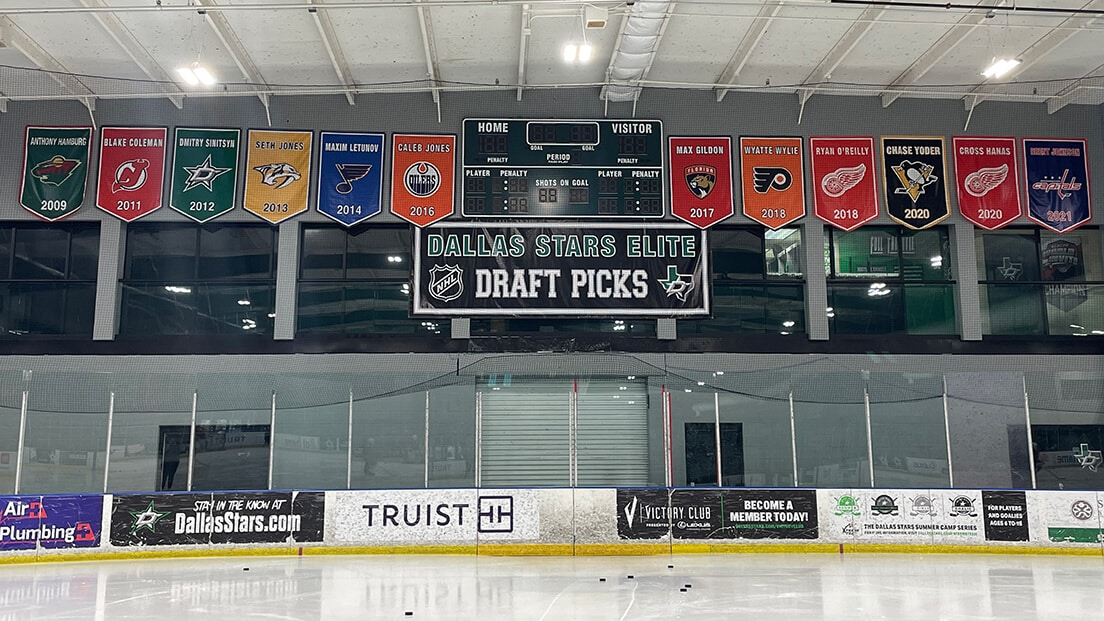
“Our building is almost a shrine to our alumni,” Silverman brags. “There are banners for our NHL draft picks, every kid that plays junior has their name on the wall in our area, pictures everywhere. We want to those young players to aspire to get their names on the wall. It’s a very player focused and player driven place. We love our team accomplishments, but we are more proud of where the players go and helping them get there.”
That wall is something that is spoken about often.
It’s a target, it’s a goal, it’s a mission for the players in the program today – they want their name on that wall.
“Looking at those banners around the arena is great motivation on the days you are fighting it,” JP Hurlbert shares. “You know those guys came to work every day and you want to get your name on that banner one day too. In 10 years, you want another kid to be walking through there and see your name and be motivated by that, so there is definitely some fuel there.”
“When I was super young, we didn’t have the posters on the wall, but when they put them up, I thought ‘wow, this is really cool, I want to be up there too,’” Cross Hanas details. “One day I was on the ice with my dad and a couple other guys and the rink guys were putting my name up there. To look over and see my name, it was pretty amazing.”
“All of our staff is really proud there is a real sense of pride for our alumni coming back,” Silverman exclaims. “We’ll bring our alumni back in the summer and there’s a real sense of pride of where they came from. We are so proud that we’ve been able to build this kind of culture.
“We would rather talk about where our players end up than our national championships or team accomplishments – that is just our philosophy.”
A HOCKEY HOTBED
The other thing I think is very clear to an outsider is the people of Dallas and the state of Texas are proud of where they come from.
It means a lot to the people of the Stars Elite program that not only have they created a hockey hotbed in their city, but the locals have embraced it as well.
“We’ve had families that have wanted to relocate to our area just because they like what we are doing down here,” Silverman boasts. “People have a lot more flexibility now coming out of COVID of where they want to live and working remotely, so it’s been interesting to see some high end players from across the country say they really like what we are doing, which is something you would have never thought in a million years.”
Former players feel it too.
“When we first moved to Texas, you’d have to travel to Chicago, Michigan or Minnesota to play against the best players, that’s where the best tournaments were being played,” Seth Jones says. “Now, you see these big tournaments in Dallas and in Texas.”
“Eric does a great job recruiting kids to come play with the Elite, so now you actually see kids coming to Dallas from those big hockey markets like Michigan, coming to play for our program. That’s just a clear sign that what they are doing is working.”
“Being a part of the whole ‘everyone staying at home to play in Dallas’ is really cool to see,” Cross Hanas brags. “I’m big on the whole loyalty thing, I don’t get why people would want to leave and go to other organizations, I mean, what do you not have in Dallas? Dallas has it all.”
Silverman recalls a conversation he had with a D1 college coach that put things into perspective.
“He told me, ‘Dallas was a market where they had all these kids that looked like a million bucks, but when you see them at a higher level they couldn’t play. So we would stay away from the Dallas kids. Now, it’s the complete opposite, that they seek out the Dallas kids.’”
Members of the Elite staff have been to recent conferences and actually presented themselves and their philosophy to the board, because it’s in lock step with where they hope every hockey centre will be.
“We have had a good relationship, because we have great relationships with the individuals in the Stars organization and the Elite,” Joe Bonnett, the Manager of Player Development with USA Hockey.
“What they have done is invested in knowledge. They have used the American Development Model to find ways to interpret that for themselves and their market. They really rolled their sleeves up to learn what development is all about.”
Bonnett recalls a conversation he had with Silverman about the Elite program’s coaching and how it is an immediate separator.
“He’s got Vern Fiddler, Joe Pavelski, NHL guys who understand player development,” Bonnett flatters. “They are telling me how on board they are to get more kids playing for a longer period of time and how it has populated the Elite program is a true testament to long term development, cooperation, leadership and an understanding of what player development really is to get to the end product.“
The Elite program is always building. The core philosophies will stay the same, but now the challenge is how to get better.
“We had a coaches meeting about a year ago where we said ‘ok guys, we think it’s time to take the next step,’” Silverman explains. “For us, our two bantam teams have both been in the top five in the country this year, our 2011 group had five or six impact players that were in the Brick Tournament that made the finals. We have the guy who was named top forward at the Brick and top goalie at the Brick. That doesn’t just happen.”
Silverman admits the first few years it was mayhem, but the way he sees it now, their goal is to dominate.
“We want to be the best across the board. We want to get the best players, we want to develop the most players, we want to be considered a powerhouse in not only this country, but this continent. We want to have a day where they are five kids going high in the NHL draft. That is what we strive for and we are heading there.”
“Texas hockey is really a model for a lot of states in the country, or it should be,” Jeff Hurlbert concedes. “Everyone is in lock step here, with the same belief, and without that I don’t think you could do what the Elite are doing right now.”
Throughout our Hockey Factories series, we’ve talked about programs that are rich in history, with alumni lists longer than the ice surfaces themselves.
The Dallas Stars Elite program does not have that yet.
But you better watch out.
“It’s really cool to turn on the TV to college, juniors, whatever level and see your former players playing at that level,” Silverman reflects. “The exciting part for us is we had that before we’ve really been clicking on all cylinders. The ’07 class is only 15-years-old right now, that’s what I keep telling people.”
With a player like JP Hurlbert, and dozens of others like him, it’s easy to get excited.
“Being in a non-hockey market we don’t get the respect we think we deserve, but the skill and development at our level is a lot of fun,” Young touts. “The ’08 group I have now is a lot of fun to watch. It’s really hard to score in this game, but our team has that creativity to excel.”
Everyone has a perception of what Dallas, Texas is like.
Everything is bigger, everything is better.
As far as their hockey is concerned, they might be right.
“There have been a lot of cool things that have happened here,” Silverman admits. “But what we are about to see is going to be wild.”