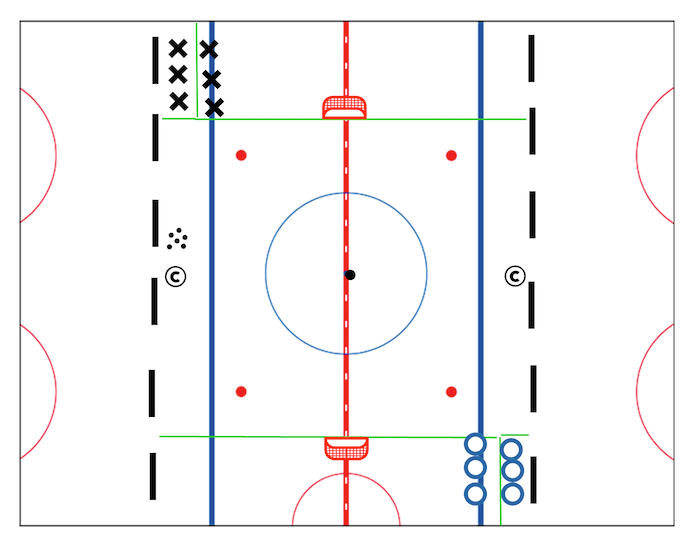
3vs3 Blast Off is a great game to get players sprinting up the ice. Encourage players to attack the net with speed and go for rebounds.
Description
Coaches set up the nets and mark benches for the players not playing and then draws a line across the ice at the net.
Players start in the benches.
On the whistle teams play 3vs3 at are trying to score on the opposing net.
After gaining possession teams must pass to a player on their own team before they can score.
If a puck goes behind the line across the ice or a goal is scored that defending team now leaves the ice. 3 new players from that team leave from line and one of them receives a pass from the coach.
This game is to encourage plays off the rush, identify checks as they come off the bench and head to head one vs ones.
A great overview of the Ducks LTP program, focusing on one of the active family participants and what they've been given and experienced from the Program, especially their two kids. Former Ducks player and Ducks Alumni Bryan Allen is mic'd up, as is LTP coach David Batson as they have fun with the kids throughout session highlights.
If a proper pre-game meal is eaten with carbohydrates, protein, and fluid, then the blood sugar will be at the right level to provide important energy for the brain during the game.
Introduction
The 3-4 hour pre-game meal is important for preparation of a game. This meal should consist of carbohydrates to “top up” what was eaten 24-hours prior and in previous meals during the day. Relatively smaller portions of protein (chicken, fish, beef, etc) are also important, as well as fluids. The 3-4 pre-game meal should be easy on the stomach so that there is no, or limited, bloating and flatulence.
This story is one from our six-part series on the importance of nutrition and hydration.
In the previous article in this series, we talked about the importance of eating a nutritious meal 24-hours before a game. If this is done, the muscles and liver will have lots of stored carbohydrates (glycogen) and there will be some glucose in the blood. The 3-4 hour pre-game meal is important to “top up” carbohydrates and make sure there is plenty of glucose in the blood. In particular, blood glucose (blood sugar) is very important, because it is the only source of energy the brain can use. If a proper pre-game meal is eaten with carbohydrates, protein, and fluid, then the blood sugar will be at the right level to provide important energy for the brain during the game.
Timing of the pre-game meal
It takes about 3-4 hours for food to empty out of the stomach. Therefore, the 3-4 hour window for a pre-game meal is consistent with most players. However, some players digestion is different (slower or faster). As such some players may like to eat their pre-game meal sooner, while other players may like to eat 2-3 hours before the game. To each their own.
Some players prefer to eat closer to game-time because they get hungry when they eat too early. If this is the case, there is always the option of having a 3-4 hour meal, then eating a small snack 1-hour before game time.
What foods are good for a pre-game meal
Carbohydrates are easy to digest, taste good, they’re easy on the stomach, and provide important energy for the muscles and brain during a game. Therefore, they are a good choice for a pre-game meal. Generally speaking, pre-game food should be rather bland so as to not upset the stomach or produce excessive flatulence.
Pasta, bread, fruits, veggies, potatoes, rice, fruit smoothies, etc. are all great foods to eat for a pre-game meal (for a comprehensive list of carbohydrates see the previous article: Nutrition & Hydration: 24-hour pre-game meal). It is also important to have some protein in a pre-game meal: chicken, turkey, cheese, low fat milk, smaller portions of beef and pork with the fat cut off, fish, etc.
What a hockey player should not eat for a pre-game meal
Spicy foods should be avoided, such a Mexican, Indian, Sichuan, Hunan, Ethiopian, and certain Thai dishes. They could stir up trouble. However, the same goes for beans which produce gas in the stomach, regular milk can cause bloating in athletes who are lactose intolerant, and vegetables such as cabbage, brussel sprouts, broccoli, cucumbers, radishes, celery, and asparagus can cause gas and bloating.
As a general rule, players should not experiment with new foods on game day. The days to experiment with new or different foods are on practice days when less is on the line if something goes wrong. For the pre-game meal, players should eat food they are familiar with and know will not cause an upset stomach. Generally speaking, the 3-4 hour pre-game meal should be relatively bland.
How big can a pre-game meal be?
The size of the pre-game meal is dependent on the player. It is also dependent on how hungry the player is and when was the last time the player ate. If the meal is being eaten by a younger player whose parents prepare it, then the player should eat what is on their plate (unless already really full). If the player is older (Jr, college, pro) the size is determined by the experience of the player having eaten hundreds of pre-game meals.
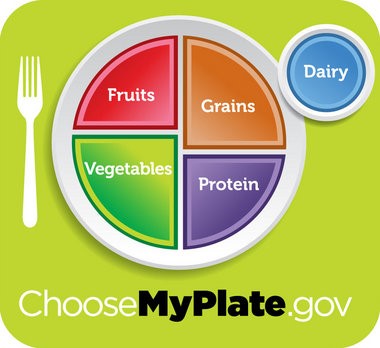
Without getting into portion sizes in grams, perhaps the best way to determine pre-game meal size is to use the “Choose My Plate” diagram published by the US Department of Agriculture, see below. You can see that ¾ of the plate is carbohydrates (vegetables, fruits, and grains) and ¼ of the plate is protein, with some dairy.
Source: USDA/ChooseMyPlate.gov
Get a good handle on your pre-game meal to be at your best and increase the odds you’re discussing your team’s victory during the post-game meal.
In episode 216 of the Glass and Out Podcast, Ryan Blanck, Performance Coach and upcoming TCS Live presenter, stops by.
Blanck is the founder of the performance coaching company Deviate. To date, he has worked with over half of the team’s in the NFL, including the league itself, the iconic entertainment industry agency the William Morris Endeavor, professional athletes, leading universities such as Penn State, Clemson, Vanderbilt and Stanford, along with executives from major corporations to start-ups.
As Josh Torris, Vice-Presient of the LA Chargers puts it, “Simply said, he’s ‘The Horse Whisperer’ for NFL Executives.”
You can expect him to dive deep into the topic of leadership, while providing strategies and best practices for developing critical skills like empathy, which he believes is the number one neglected tool by all leaders.
“We define empathy as perspective taking. Most people get it confused with sympathy…No. There is one major component that erodes leadership, and it’s poor communication behaviour. Players need to be heard before they can start to listen.”
Listen as he discusses why empathy is the number one skill needed by leaders, what erodes culture, and what it takes to be a leader worth following.
In episode #206 of the Glass and Out Podcast, we’re excited to be joined by Owner and Head Coach of the WHL’s Tri-City Americans, Stu Barnes. He is currently in his second season behind the bench with the Americans and has been an owner of the franchise since 2005.
If there is one word to describe Barnes’ journey through hockey, it would be adaptable.
Prior to his coaching career, Barnes had a prolific junior hockey career in the WHL, scoring 386 points in 204 games split between New Westminster and Tri-City. That would lead to being selected 4th overall by the Winnipeg Jets in the 1989 NHL entry draft, and a career of 597 points in 1,200 games with five teams. Like many top junior scorers, Barnes had to adapt to not being the top offensive player on his team and carve out his own role in order to be an effective player.
He credits coaches like Roger Neilson and Dave King, who helped develop his skills as a two-way checker and his mentality of “finding a way to get over the boards.” It’s something he’s carried into his coaching philosophy and tries to stress with his players today.
“I always tell our guys, find a way to get over the boards. If you’re a centermen who can play the wing, then you get a chance to get over the boards. if you can win face offs, you get over the boards because we need you to win a draw. If you’re a defencemen who’s a good shot blocker, you get out on the PK.”
Listen as he shares the type of relationship playersvalue from their coach, how he collaborates with his coaching staff,and what he’s picked up from so many coaching greats.
Carla MacLeod, Head Coach of both the University of Calgary Women’s program as well as the Czechia National Women’s team, joins us for episode 197 of the Glass and Out Podcast.
MacLeod is currently in her second season with the Dinos program, and will be leading Czechia at the upcoming World Championships after guiding the team to its first ever medal at the 2022 event in August. Her unique ability to inspire what some may consider underdog programs have helped her gain notoriety in the hockey community.
From 2011 through 2014, MacLeod was an Assistant Coach with the Japanese National team and helped it qualify for the 2014 Sochi Olympics. It was the first time they had done so since hosting the first female Olympic tournament at the ’98 games in Nagano.
MacLeod got her coaching career started with the Edge School’s U18 Female program. In 2020, the program captured the first ever Canadian Sport School Hockey League Female U18 Prep division Championship. During her tenure, the team upheld an average GPA of 89%, 98% of her players went on to pursue post secondary studies and 88% continued their hockey career.
As a player, she patrolled the blueline for Canada’s National Women’s team for five seasons, capturing two Olympic Gold Medals, the second of which was at the 2010 games in Vancouver. She is also a member of the University of Wisconsin Athletic Hall of Fame, as well as the Alberta SportsHall of Fame.
In this episode we discuss why it’s important to keep joy in the game, when you should focus on one thing with your team, and how she approaches inspiring and instilling confidence in her players.
This week’s guest isn’t a household name in the hockey world quite yet, but if you follow or are a member of The Coaches Site, then you’ll recognize the name.
Dan Arel has quickly become one of the most popular TCS contributors. In addition to his writing, Arel is the Director of Coach & Player Developmentfor the San Diego Oilers Hockey Club. In our world, that’s a potent combination,because while there are lots of experts out there when it comes to developingelite players or leadingprofessionalteams, there are few experts, atleast fewof them who are willing to share theirexperiences,atthe grassroots levels.
Andthat’s Arel’s wheelhouse. Coaching and developing programs focusedon playerswho have yet to turnprofessional and likely never will.
In addition to his Director role with the San Diego Oilers, he is also the Head Coach of theprograms U12 Ateam, where he coaches his son. He holds his Level 4 certification through USAHockey and in 2020 was named theSan Diego Gulls Foundation Coach of the Year.
In today’s episode, we’ll discuss making the most out of half ice practices, the challenges of being a parent-coachand how he believes we can keep kids playing the game, regardless of skill level.
The hockey season is finally here and we’re happy to return for season 5 of the Glass and Out Podcast.
Tokick things off, we welcome Dr. Jody Carrington.
Dr. Carrington is a Clinical Psychologist who has spent most of her career working with children and families who have experienced trauma. Having grown up inViking,Alberta,home of the Sutter brothers,she worked on the Mental Health Inpatient Units of the Alberta Children’s Hospital in Calgary for 10 years.Through herexperienceshe’s developed an affinityfor helping teamsand organizations solve their most complex, human centered problems.
Today, a lot ofher work is focused on the Big People, as she describes them, who are in a position to look after the little people, or kids.As she puts it, through the relationships that young children have with their caregivers, they begin to develop the “story” of themselves and others around them. They decide two things: if they are worthy of love and support and if they are capable and competent beings. When they have these things in place, they have a much greater chance of developing into strong and healthy adults.
If youhaveever questionedthe importance of your rolein the lives of the players you coach, you won’t after today.
Listen as she shares how we connect with our players, the importance of staying regulated and self-care, and why “lighting up” is every coaches superpower.