In episode #152 of the Glass and Out Podcast, we welcome Cara Morey, head coach of the Princeton University’s Women’s Hockey team.
After a playing career that included a stop at Brown University and time with Canada’s National Team program, the Hensall, Ontario, native joined Princeton, spending six seasons as the program’s assistant coach before taking over as coach prior to the 2017-2018 season. Under her leadership, the program has established itself as one of the top programs in the NCAA, which includes a ECAC championship in the 2019-20 season.
Morey recently presented at our College Hockey Inc. Virtual Coaching Clinic on creating a culture of excellence, in which she details her team’s championship run and how she’s helped create an environment that is based on humility and embracing every member of the team.
Find out why she feels humility is critical to team success, her unique experience as a coach at the Philadelphia Flyers Development Camp, and how the hockey community can continue to help support the growth of the women’s game.
Growing the game of hockey to reach new families will benefit the sport.
That’s the mindset of Glen Andresen, the Executive Director of Minnesota Hockey, one that echoes the sentiment of hockey bodies around the world.
When Andresen realized it was no longer automatic that all kids play hockey in the winter, he knew Minnesota Hockey had to do something to attract those new players. He credits the Jr. Wild program, assisted by the senior NHL franchise, for helping facilitate the four-week learn to play program. It is now featured in over 20 locations in the state, and is run for kids who have never played organized hockey before. Held over eight sessions of ice, the program also provides starter gear, head-to-toe, for participants.
From there, Minnesota Hockey helps find them a place to register so they can continue building their skills during the season.
“At least they have some basic skills to get along on the ice,” said Andresen. “They’re not going to make the top team in their association, but I don’t think they care. The feedback is they don’t care about that. We also have a rec league that a lot of those players will go to.”
One takeaway that Andresen has from the program is that we don’t need to always push kids to play at a higher level. Some play just to have fun, and that’s okay.
“We see the craziness that overcomes hockey and youth sports. There’s a lot of focus on those top kids, and keeping up with the joneses. If you want to get that feeling of ‘here’s why I do this’ again, you see that again at a camp like this. These 9 to 13 year olds, they’re all out there with kids of similar abilities, so they’re all having fun. The innocence comes back, because you know that these kids aren’t doing this with aspirations to make the NHL. Hockey seems fun, I want to do it, and they go out and do it.”
The program also helps overcome some of the misconceptions about the sport. Not every practice is at 7 am on a Sunday morning, and not every family has to dish out the extra costs to register for hockey schools. There are programming options that exist based on the level you want to play, and the time commitment you want to make each week.
"Creating motion allows them to be instinctual. A lot of that comes from shooting the puck, retrievals, obviously motion, and all that creates unpredictability."
In episode 224 of the Glass and Out Podcast, we’re joined by good friend of The Coaches Site and former five-time TCS Live presenter, Glen Gulutzan.
Gulutzan has overseen the Edmonton Oilers power play, which has led the NHL in efficiency the past two seasons. In the first two rounds of these playoffs it was especially lethal, humming along at a clip of 37.5%. And while having two of the best players in the world doesn’t hurt, he believes it’s all about allowing your players to play to their strengths and instincts.
“It’s structured road hockey. We have the most dynamic players in the world. We need to have them in motion. Creating motion allows them to be instinctual. A lot of that comes from shooting the puck, retrievals, obviously motion, and all that creates unpredictability.
Listen as he discusses coaching two “hockey geniuses,” cutting his teeth as a coach in Las Vegas, and how he’s learned from all the coaches he’s worked with throughout his career.
A good posture is the foundation of many different skills.
Quite often, to find the good defenders on a team, all you need is a picture of them standing in the defensive zone. A picture doesn’t allow you to judge a player’s rotations or anticipation, but it reveals a crucial element of defensive play: posture.
A good posture is the foundation of many different skills. A player who maintains tension through their body, bends their knees and ankles, and centres their weight over the middle of their skates, earns a significant advantage over one who stands passively, straight-legged.
There are multiple benefits of a low, athletic stance:
Increased defensive range
Help correct mistakes
Improved reaction time
Creating more leverage
Let’s go through those elements one by one.
1. Increasing defensive range
The defensive range is an imaginary circle around a player. That circle delimitates the area that this player can reach in approximately two seconds. The better the stance, the larger the circle becomes.
Why? Because a deeper posture creates more potential for acceleration. It allows players to cover more ground and do so faster, to rapidly influence, and break plays on a larger area of the surface.
A great posture, like the one of Minnesota Wild defenceman Jonas Brodin in the video above, enables players to dash toward an opponent to separate them from the puck when they commit to a move, when their head drops or their back turns to the play. It also enables defenders to rapidly reposition to cut passing lanes and make plays outside of their immediate responsibility, like doubling the pressure on an imbalanced opponent.
Off the rush, that deeper posture translates to more agility; defenders can better match and cut-off attackers, retaining speed in their pivot as they transition to in-zone defence.
2. Correcting mistakes
Despite players’ best intentions, mistakes inevitably happen on the ice. As long as they are corrected fast, however, you can usually minimize their impact. Defenders in a ready, athletic posture can better recover from their own errors or those made by their teammates.
They can adapt, rotate, and clog holes in the team’s structure before it sinks.
In the clip above, Montreal Canadiens forward Tyler Toffoli is the weak-side defensive winger. He stands at the top of the zone and foresees an attacker escaping from his teammates on the far boards. As he adopted a low, speed-retaining posture, a simple lateral cut on his edges is enough for him to block the attacker’s path.
3. Improving reaction time
A strong defensive stance locks players in a ready state. It improves their reaction time and slows down the game for them.
Straight-legged defenders have to anticipate and proactively react to the move of the opposition as to not get instantly beat. They are more susceptible to deception and to large overcorrections, which can make the situation worse.
Defenders with more knee-flexion gain a bit more time to react. They can out-wait an attacker’s attempt to deceive, let the gap close, and counter the real play. They can also leave a passing lane open for a split-second to bait opponents into using it, their dynamic posture enabling them to quickly reposition inside it to intercept the puck.
Here, Team Russia defenceman Alexander Romanov is pitted against two attackers on his side of the ice. He blocks the shooting lane of the puck carrier with his body, but doesn’t overcommit; he gets even lower on his stance, increases his defensive range, and out-waits the fake. When the opposing carrier switches to his real play, a pass to his teammate standing at the far-post, Romanov extends his stick and deflects the puck away.
Overall, a deeper stance allows defenders to better read and dictate the flow of the play, to funnel it where desired, and trap attackers.
4. Gaining more leverage
An athletic position or a lower centre of gravity allows players to get more leverage, balance, and strength in one-on-one battles. Defenders become more compact and harder to move while improving their own ability to displace opponents, to box out them out from the front of the net, take away their sticks, and pin them on the boards.
Players who dominate the physical game often force the opposition to change their offensive plans, to take new, less-effective routes to bypass the threat of pins and hits.
Watch Team Canada (Red) defenceman Kaiden Guhle in the video below execute a perfect pin. He approaches the player in a low stance, with his knees bent, which allows him to apply pressure on the hips of the opponent, gluing him to the wall.
Shift length
We can’t talk about dynamic posture without mentioning shift length.
Maintaining constant tension through the body drains energy faster. The longer the shift, the more straight-legged players get, especially in the defensive zone. As a result, their defensive gap enlarges and the opposition gains the time and space to continue their cycle, which further fatigues defenders, leading to breakdowns.
All in all, by promoting short shifts and, in turn, dynamic postures for their players, coaches will help them maximize their defensive recovery and effectiveness.
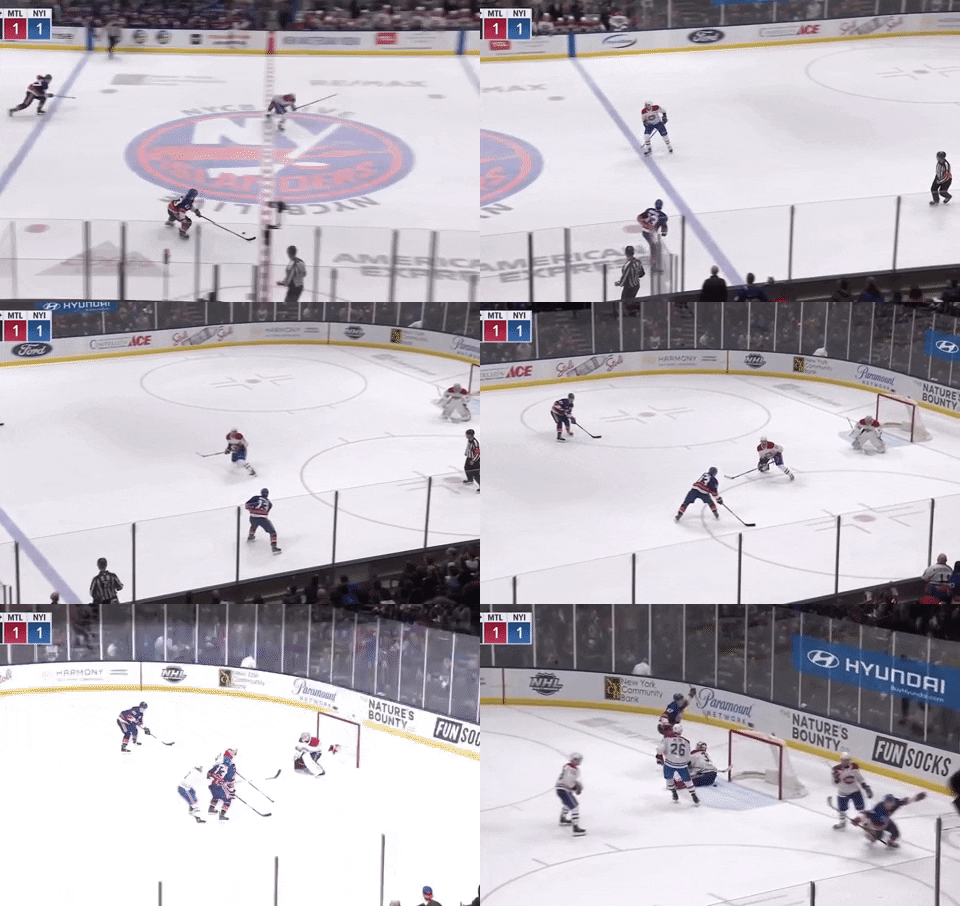
One of the most dangerous plays in hockey is a 2v1 rush chance.
According to Dom Galarmini of Stathletes, the probability of a 2v1 turning into a goal is 22%. These are dangerous situations that need to be converted.
Expected Goals by situation (includes string of rebounds leading to goal)...
Let's dive into 2v1 rushes from the offensive perspective to understand how to best maximize the effectiveness for the attacking team.
Puck carrier
On an odd-man rush, the puck carrier is the key decision-maker. They are the ones who choose to pass or shoot. Having their head up and reading the defender is of utmost importance. Ideally, the puck carrier wants to do two things:
1. Work to and stay inside of the dots.
Puck carriers want to remain a dual-threat capable of releasing a shot or pass. If the puck carrier does not remain a shot threat, the goalie and defender can cheat to the pass option. Keeping opponents honest is key. Often in youth hockey, you’ll see players that skate themselves into the corner, killing their shooting angle and limiting their options. Here is an example of Mathew Barzal doing it right.
2. Slow down
Slowing down allows players to create time to make the best decision as to whether to shoot or pass depending on what the defence offers. Think back to the Mighty Ducks movie when Coach Orian was talking with Charlie Conway when teaching him defence: "Make him make the first move, Conway!" When in a 2v1 situation, whomever makes the first move usually loses, as they tipped their hand. Slowing up, staying a duel-threat challenges the defender to make the first move and for the puck carrier to make the best play possible. This isn't a trivial matter... here is a great example of Patrick Kane working on slowing up on the rush while in a duel-threat position.
Passing option
Non-puck carriers must prepare themselves in a ready position to catch a pass or one-time a shot on goal. This requires an open body position -- front foot toe cap toward the end boards and loose back knee/skate. Thus, allowing for the largest possible range for a player to get them a useful puck (also known as a player's "wheelhouse"). Sometimes players will even skate backward before opening their front skate. Sometimes players glide on the front foot awaiting the pass. Both work and create larger than normal wheelhouses for a one-time shot. https://twitter.com/CoachRevak/status/1227236661962166274?s=20
Clip of the day - Shooting, Open up for 1-timer
When on the rush it’s advantageous to open up your body to prepare for a pass
Keys 🔑 - Open up hips - For power and large sweet spot - Soft strong side knee to drop body weight down into the stick - Stick in a ready position pic.twitter.com/sfHhx3HBSK
Alright, we have the basics down... now we move onto the macro-level tactics. In a straight forward situation with only option A + option B, the defender can have an affect over what the offence truly wants to do. Just like in magic and in poker, we want players to add wrinkles into the situation. “Looking off” what they really want to do is a great start. Examples of faking a pass before shooting:
Locking the goalie into respecting the shot then dishing to a teammate.
These players do a great job looking like they will shoot then rolling wrists and/or contorting their bodies to move pucks to high percentage shots and tap-ins. pic.twitter.com/XMudWW1M3t
A recent trend that we heartily endorse is passing before the top of the circles. The goal is to disrupt how a defender plays the rush. Often, this leads the defender into an earlier and more difficult decision, thus creating more space and options for the attacking team. As an added bonus (particularly at the lower levels) goalies that have to adjust their angle multiple times on the same rush are less apt to be square to the eventual shot.
Clip of the day - Odd man rush, Passing early
Passing before the top of the circles disrupts the defender’s read + play
They are setting up to play a rush and have to switch their looks due to early pass. Same with goalies
It's a constant battle of evolution among goalies and shooters.
You might be asking yourself, “What’s with all of these short side goals going in during the 2020 Stanley Cup playoffs? Aren’t those supposed to be low percentage shots?”
You are correct, they are shots from bad angles and should be low percentage shots. Right now they aren’t as low as they have been in the past due to a newer goalie technique called the RVH.
Why are goalies using the RVH?
To fully answer that question, let’s talk about a tale that is old as time itself… the battle of cat and mouse. Or in our case, the constant battle of evolution among goalies and shooters. Let’s dive into the goalie side of the battle.
Understanding goalie language
Before we dive in we need to understand some goalie terminology.
Save selection: The goalie’s proper save choice in a given situation.
Blocking save: A save in which the goalie does not have the time or ability to react to the shot. Goalies attempt to block off as much space as possible due to the fact they cannot react to the puck.
Reactive save: A save in which the goalie has the ability to react to the shot.
Post play: Goalie’s play into, at, and off of their goal posts.
Hockey is not a game of shots. It’s a game of situations.
“Beer pong is a game of shots. Quarters is a game of shots. Playing goal is not a game of shots. It’s a game of situations and every situation you have to figure out.” – Mitch Korn (World’s best goalie coach)
Just like players, goalies have to acquire and utilize their hockey sense. They need to consciously make decisions when choosing their save selections.
Goalies want to make saves (no duh). In order to accomplish that they want to give themselves the best chance at making the save while being able to react to the changing situations. When we talk about RVH we are talking about post play situations when pucks are coming from dead angles when a blocking save will likely be most appropriate.
History lesson in dead angle play
There has been evolution in post play save selections through the decades.
Stand up: Pre-mask days and into the 1980s. There are many issues with mobility and rebound control.
Butterfly: When the butterfly came into existence and wide use, it was a massive win for the goalies in the 1990s. There is an issue with the overlap beyond the net and rebound control.
VH (Vertical Horizontal): Developed by Francois Allaire and Jean-Sebastien Giguere in Anaheim with the Ducks in the mid-2000s. Again there are mobility issues, especially with a goalies hands and edges.
RVH (Reverse VH): Developed in Sweden and made famous during Jonathan Quick’s Stanley Cup winning playoff runs in 2012 + 2014. He even won the Conn Smythe as playoff MVP in 2012. This was much better at rebound control and mobility.
The good
There are some big advantages for goalies using the RVH:
A goalie can be quicker to move into their butterfly. Their pads are already down and ready to handle low shots.
Rebounds will stay on one side of the ice more often and limit the holes offered to shooters.
Their hands are more free to move and make saves are to earlier common save selections.
They are able to keep more of their body in the net.
Goalies must worry about quick in-tight plays around the net such as wrap-arounds and jam plays. Those situations generally result in a low shot or on-the-ice shot. The RVH allows the goaltender to be in a blocking position with pads already sealed to the ice. Think about how many pucks take deflections off a goalies own defender’s skates or extremities — the RVH allows for a greater chance at making those saves.
RVH is a really useful tool in the goalie’s toolbox for many reasons, but because of it’s many benefits every goalie is being taught it and allows shooters to have predictable spots in which to shoot.
Like anything in life, there is give and take with the RVH. No save selection is perfect in all situations. RVH allows the goaltender to be in a blocking position for dead angle shots while also providing the mobility to explode off the post to react to in-tight cross ice plays, an element the previous favourite VH lacked.
“There is no other body position in the history of the game that allows us to dynamically connect everything we do away from our post to everything we do on our post.” – Ian Clark
The bad
The problems start to arise when the RVH becomes the default and thoughtless. These are situations where goalies drop into the RVH too early or places where they shouldn’t move into it to begin with. While not often a problem at the professional level, many youth goalies have used the RVH as a resting position and position that they play for majority of the situations they face.
With almost every goalie learning and playing the RVH there are consistent spots where shooters are able to exploit. If a current adult league player like myself is looking for and picking those spots regularly, you can safely assume that NHL players are doing the same.
Now goals are being scored high short side with regularity. High short-side goals so far — Petry on Murray (Game 3), Bjorkstrand on Vasilevsky (Game 1), Highmore on Lehner (Game 4), Staal vs Markstrom (Game 4), and Armia on Hart (Game 5).
Those aren’t the only spots to attack. Watch at players attack right over the leg pads on the goalie’s hip… Foudy on Anderson (Game 5), Ovechkin on Varlamov (Game 2), Kunin vs Markstrom (Game 4).
Or you might say, “just stand up”… there are issues with that as well. Goals scored while goalies are standing up — Bergeron on Mrazek (Game 5), Beauvillier on Bobrovsky (Game 4), Virtanen on Allen (Game 4)
The RVH requires discretion, not automation. Coaches should be receptive to the RVH as a tool in the goalie’s toolkit, but also let your shooters know where to look when firing shots at the net. There will never be a perfect, catch all way of doing things.
Goalies made their change and shooters are responding. The battle of cat and mouse continues to rage on.
Fun-first coaching that builds skills without losing smiles.
At U7, it’s all about fun, friendship, and learning the basics. This U7 Minor Hockey curriculum gives you playful, easy-to-follow drills and activities that keep kids smiling while building skating, puck control, and teamwork skills. Set the stage for a lifelong love of hockey—right from their very first shifts. Turn beginners into confident young players who can’t wait for the next game with simple, engaging practices that spark a love for hockey.
This curriculum, free for TCS members, features:
First Skills, First Smiles
Fun games and activities that teach the basics while keeping players engaged.
Confidence From the Start
Simple, achievable challenges that make kids proud of every step forward.
The Ultimate Teambuilder
Teach players to share the puck, work together, and cheer each other on.
The perfect blend of play, practice, and progress.
At U8, players are still discovering the joy of hockey while starting to develop the skills that will carry them forward. The U8 Minor Hockey curriculum gives you fun, engaging drills and simple practice plans that teach skating, puck skills, and teamwork—helping young players take the next step in their hockey journey with confidence and excitement.
This curriculum, free for TCS members, features:
Skills Start Here
Engaging drills that make learning core hockey skills exciting for young players.
Confidence On and Off the Ice
Activities designed to help kids feel capable and proud of their progress.
Team Spirit From the Start
Fun, cooperative games that teach players how to support and play with each other.