Simple Defenseman skill drill to finish a practice, use as a station or have the D's use during their skill work or independently.
For more content and Andrew's substack, follow here- (4) The Hockey Planner | Andrew Trimble | Substack
 00:00:00
Simple Defenseman skill drill to finish a practice, use as a station or have the D's use during their skill work or independently.
For more content and Andrew's substack, follow here- (4) The Hockey Planner | Andrew Trimble | Substack
 00:00:00
4 lines. Middle line picks up the puck and hits the swinging player with an outlet pass. They then go in and shoot (stop on the net). Player that passed, continues and does a full circle before entering the zone and getting a long pass from the line for their own shot.
For more content from Andrew Trimble, follow his Substack- The Hockey Planner | Andrew Trimble | Substack
 00:00:00
Try these 5 simple drills that increase in difficulty as a warmup for your off ice puck skills work. All you need are some cones or obstacles and you will much improve your range of motion, hand speed and much more. For more content from Andrew- https://andrewtrimble.substack.com/
 00:00:00
You've all seen this. Lived it.
"New season ahead. Let's put last year behind us."
First problem.
"Here's how the off-season will look."
Second problem.
"I want to see competition every single day."
Third problem.
"Last year we trained X hours. This year we do X+1."
Fourth problem.
The S&C coach is fired up with new programming. The head coach sets the mindset. The GM casts the vision.
Everyone doing their job.
But is it the right job?
Or are they all just looking through a straw—each seeing their piece, missing the whole picture?
Stay with me.
This is worth unpacking.
If the standards inside the performance team are genuinely aligned, the concept of an off-season begins to lose its meaning.
Not because the demands stay the same. They do not. The schedule changes. The constraints shift. The stress profile looks different in July than it does in February.
But the athlete does not reset.
The nervous system does not reset. The soft tissue does not reset. The movement patterns do not reset. The adaptations—good and bad—do not reset.
They carry.
And yet, in many environments, the system behaves as if they do.
The season ends, and with it, the context disappears. The accumulated information from eight months of exposure—how the athlete responded to load, how he moved under fatigue, where the small compensations started to appear, what held up under pressure and what did not—gets reduced to fragments.
Notes in different systems. Observations held by different people. Pieces of a picture that are never fully assembled.
Then, two or three weeks later, the process starts again.
Testing batteries are introduced. New baselines are established. Conversations begin around what needs to improve—often without a clear connection to what actually happened during the season that just finished.
It is not that the intentions are wrong. It is that the continuity is missing.
And without continuity, the work becomes disconnected, no matter how well executed each individual piece may be.
The general manager sits slightly outside this daily process, but carries the long-term consequence of it.
Contracts are signed based on projections. Development curves are assumed. Players are expected to become more than they currently are—not just maintain.
But if the system resets every year, what exactly is being projected?
A player is not just a talent asset. He is a development trajectory. And that trajectory is either supported by a connected system—or distorted by fragmentation.
From that lens, the off-season is not a training phase.
It is a reflection of whether the organisation understands what it is investing in.
Because if the internal model of development is inconsistent, the external decisions will eventually mirror that inconsistency.
Quietly at first.
Then all at once.
Hours are the easiest metric to talk about. The simplest way to sound serious.
But hours without context are meaningless.
Two teams can train the same hours and produce opposite results.
What matters is what happens in those hours. How they connect. What they build toward.
Quality compounds. Volume alone just accumulates.
And when the focus stays on hours rather than alignment, you get environments where everyone feels busy—but the athlete stays exactly where he was.
The irony is that the most important development window in the year is not the off-season.
It is the season itself.
Eight months where the athlete is exposed to the highest level of specificity available. Where decisions have consequences. Where the nervous system is consistently challenged in a competitive context. Where physical, technical, and cognitive demands are layered together in a way no off-ice environment can fully replicate.
And yet, this period is often treated as maintenance.
Survive. Manage. Get through.
Keep players available. Keep them fresh enough. Try not to lose too much.
That mindset leaves an enormous amount of development on the table.
Because the same period that tests the athlete is also shaping him.
Every shift reinforces movement patterns. Every game places the body under repeatable stress. Every week provides information about how the athlete tolerates load, how he recovers, how he adapts.
Speed is expressed here. Power is expressed here. Efficiency—both mechanical and neurological—is either refined or eroded here.
If the system is paying attention, this is where the most relevant feedback lives.
Not in a controlled test environment in May, but in the accumulated reality of January.
For the head coach, this shows up differently.
It is not framed as "development models" or "continuity gaps."
It shows up as availability.
As inconsistency in execution. As players who can perform on Tuesday but not sustain it through Friday. As details that break down late in games, late in stretches, late in seasons.
And at that point, the question becomes simple:
Can I trust what I am putting on the ice?
That trust is built long before the game.
It is built in how aligned the system is around the athlete when no one is watching. In whether the physical preparation, the recovery strategies, and the on-ice demands are reinforcing each other—or quietly competing.
Because game model and performance model are not separate discussions.
They are the same system, expressed under pressure.
This is where the gap between roles becomes visible.
Not because people are not competent. Most are.
But because they are not always connected.
The strength coach sees force production, asymmetries, output. The physio sees tissue quality, restrictions, pain patterns. The skills coach sees timing, coordination, efficiency on the ice. The head coach sees execution under pressure, decision-making, reliability.
Each perspective is valid.
But if they are not integrated, they remain partial.
This is also where professional identity can become a hidden constraint.
Each role has its own education, its own language, its own definition of success. Strength is measured one way. Health another. Skill a third.
Individually, this creates depth.
Collectively, it can create distance.
Because without a shared frame, expertise does not automatically integrate. It specialises.
And specialisation, without connection, leads to protection of territory rather than contribution to a system.
Not intentionally.
But structurally.
The shift required here is subtle, but significant.
From "my area of responsibility" to "my contribution to a shared outcome."
That shift is where high-functioning performance teams separate themselves.
The athlete feels it when the advice shifts depending on the room he walks into. When the definition of "ready" changes depending on who he speaks to. When the progression he follows in one context is quietly contradicted in another.
He adapts, as athletes always do. He learns where to go for which answer. He learns how to navigate the system.
But adaptation at that level is not a sign of a strong system.
It is a sign of a system that requires navigation.
And navigation always introduces friction.
From the athlete's side, this is rarely verbalised—but it is deeply understood.
He does not experience departments.
He experiences signals.
Signals about what matters. About what is reinforced. About what is negotiable.
If recovery is emphasised in one room but bypassed in another, he notices. If movement quality is corrected in training but ignored in practice, he notices. If "readiness" changes depending on context, he notices.
And over time, those signals shape behaviour.
Not always in the direction the organisation intends.
Because consistency builds trust.
And inconsistency builds strategy.
The athlete will always find the most efficient way through the system presented to him.
The question is whether that system is designed—or simply assembled.
The off-season, in that context, becomes less of an opportunity and more of a reset.
A reset that should not be necessary.
Because if the season had been fully captured—if the information had been shared, interpreted, and agreed upon—the transition out of competition would not require rediscovery.
It would require continuation.
The questions would already be answered.
Not in theory, but in evidence.
What did this athlete tolerate? What broke down under load? Where did his movement lose efficiency? How did his recovery actually look across congested schedules? Which qualities held, and which ones drifted?
Those answers exist.
But only if someone has been responsible for connecting them.
This becomes even more important when a new player enters the group.
A new player does not arrive as a blank slate.
He arrives with a history.
A different load profile. Different coaching language. Different movement habits. Different experiences of what "hard," "fit," or "ready" actually mean.
That means the approach has to be slightly different when he comes into the team setting.
Not because he should be treated differently in principle, but because he has not yet been fully read in your context.
And that reading becomes much better when the information is shared properly.
What does the GM see in the player?
What does the head coach see?
What does last season tell us?
Were there missed games? And if so, why?
Was it purely physical, or was it a recurring pattern?
Was the player protected, underused, or simply misunderstood in parts of the process?
And above all: what does the player say?
Because that conversation matters more than many want to admit.
The player will often reveal what the data cannot fully explain. What was felt, what changed, what he avoided, what he pushed through, what he could no longer ignore.
That is not soft information.
That is essential information.
And when the GM, head coach, performance team, and player are all contributing to the same picture, the integration of a new athlete becomes far more accurate, far less reactive, and far more respectful of what he actually brings into the building.
Transitions are where flawed thinking is exposed.
An athlete who has spent eight months in skates, operating within a very specific movement pattern, is suddenly exposed to new demands. Running volumes increase. New exercises are introduced. Different ranges of motion are stressed—often aggressively, in the name of "building a base."
The intention is logical.
The execution is often disconnected from context.
Because the body does not interpret intention. It responds to stress.
And when that stress is introduced without respect for what came before, the response is predictable. Compensation. Irritation. In some cases, injury.
Not because the exercises are wrong.
But because the timing, the progression, and the connection to prior exposure are missing.
The same applies in reverse.
When players return to the ice after weeks of off-ice focus, the expectation is often immediate transfer. That the qualities developed in isolation will express themselves seamlessly in a complex, dynamic environment.
Sometimes they do.
Often, they do not.
Because transfer is not automatic. It is built.
And it requires that the two environments—on-ice and off-ice—have been speaking to each other all along.
I will not get into specifics here on training methodologies, systems, or what exact exercises support each other. That is a different discussion—one that requires sitting down 1-on-1 with the people who need to implement it.
What matters more is the principle: baselines need to move forward each year, but never blindly. Training age matters more than chronological age. Some athletes need volume. Some need precision. Some need both.
It comes down to what we have seen, what we have learned, what we understand about the athlete in front of us.
Grit is not always the answer—though yes, it is part of every system. True resilience for competition is built through understanding what level each player needs to operate at each day.
And here is the reality most miss: even in a team sport, players do not always need to train as a team.
Identical blocks develop some players and hold others back.
Team chemistry is not built through synchronized reps—it is built through shared purpose, clear communication, and trust in the system.
There are better ways.
Testing sits in the middle of this.
Used well, it provides clarity. Used poorly, it creates noise.
The problem is not testing itself. The problem is how it is interpreted.
Introduce a new test, and performance will improve quickly. Not necessarily because the underlying quality has changed, but because the athlete has learned the test. The coordination improves. The timing sharpens. The familiarity reduces friction.
I can often improve those numbers in seconds—teaching the athlete the right jump pattern, resetting the nervous system, getting him to fire the muscles in proper sequence.
It looks like development.
But it is not development of the test motion.
It is development of movement understanding. Of expressing force and capacity the right way.
And that is exactly what we are talking about.
This is why it is so critical that the team around the team speaks the same language—and does this as a regular practice. Not as a one-off fix, but as the standard way we observe, correct, and develop movement patterns. When everyone understands force expression the same way, we don't need to relearn these patterns year after year.
Without continuity—without the ability to compare across time in a meaningful way—the data becomes difficult to trust.
And when the data is difficult to trust, decisions become reactive.
The focus shifts to what is measurable, rather than what is meaningful.
And when that shift happens, it does not stay within testing.
It moves into decision-making.
Return-to-play timelines become anchored to numbers that may not reflect the demands of the sport. Progress is defined by improvements in controlled settings rather than transfer into performance environments.
The system begins to reward what it can see easily.
Not necessarily what matters most.
And that is where misalignment becomes expensive.
Because the cost is not in the test itself.
It is in the decisions that follow it.
There is also a cultural layer to this.
The idea that every day must be competitive. That progress is defined by constant improvement. That each session is an opportunity to push limits, set records, prove something.
It sounds strong.
It is not sustainable.
Development and competition are not the same thing.
Competition expresses capacity. Development builds it.
Confuse the two, and the system starts chasing outputs it has not prepared the athlete to handle.
Intensity becomes the goal, rather than the result.
And over time, that approach narrows the window the athlete can operate within. The ceiling may be touched more often, but the foundation underneath it becomes less stable.
A well-functioning system understands this balance.
It knows when to push, and when to build.
It knows that not every day needs to look impressive to be effective.
What separates environments that consistently produce from those that fluctuate is not access to better exercises, better technology, or better individual practitioners.
It is alignment.
Not identical thinking. Not one voice dominating the rest.
Alignment.
A shared understanding of what the athlete is, what he needs, and how each part of the system contributes to that.
In those environments, the conversation changes.
The strength coach is not programming in isolation. The physio is not reacting in isolation. The skills coach is not developing patterns disconnected from physical capacity.
They are all working from the same picture.
A picture that has been built over time.
Updated continuously.
Understood collectively.
In that context, the transition out of the season is not a reset point.
It is simply a shift.
The constraints change. The opportunities expand. But the direction remains consistent.
The athlete does not start over.
He moves forward.
There is also an organisational layer to this.
In connected environments, knowledge compounds.
What was learned about a player this season informs the next. What was learned about the system informs how it evolves. Patterns are recognised earlier. Adjustments are made faster.
The organisation develops memory.
In fragmented environments, that memory resets.
Staff changes, systems change, language changes—and with it, the understanding of the athlete starts over.
Not because the information never existed.
But because it was never fully integrated.
And without integration, there is nothing to carry forward.
Zoom out further, and the yearly structure itself begins to look different.
Instead of cycles that reset every twelve months, you start to see layers.
What is built this year supports what is possible next year. What is addressed now prevents limitations later. The timeline extends beyond the immediate.
This is obvious in individual sports preparing for major events over multiple years.
Less so in team sports, where the pressure of the next game, the next season, the next result often compresses the perspective.
But the principle does not change.
Development is cumulative.
Or it is inconsistent.
So the question is not whether the off-season should exist.
It is what its existence reveals.
If it functions as a disconnected phase—if it requires rebuilding, re-testing, and re-aligning each year—then it is not serving the athlete as well as it could.
It is compensating for what was not connected before.
If, on the other hand, it becomes an extension of an already aligned system—where the information flows, the standards are shared, and the direction is clear—then the label itself becomes less important.
Because the work does not change in principle.
Only in expression.
At that point, the calendar stops dictating the structure.
The athlete does.
And when that happens, the distinction between in-season and off-season fades.
Not because the demands are identical.
But because the system finally is.
Magnus Ågren
Performance and Leadership Development · Consultant · SHL - NL - DEL
Thirty years in elite sport. Seven seasons as Head of Performance and Medical in the Swedish Hockey League. Olympic cycles since Sydney 2000. Designs the systems that integrate coaching, medical, and sports science into one performance structure.
People. Purpose. Performance.
 00:00:00
HOW DO YOU PLAN AN OFF-SEASON TRAINING PROGRAM AS A COACH?
The off-season is often where the next season is quietly built.
There are fewer competitions, less visibility, and more space to focus on development. But without a clear structure, this period can also become unfocused or misaligned with long-term goals.
For a coach, effective off-season planning starts with reflection.
Before building anything new, it’s important to look back at the past season:
– Were the goals achieved?
– Where did performance meet expectations?
– Where did it fall short?
– What patterns can be identified in training, competition, and recovery?
This evaluation creates the foundation for what comes next.
From there, the focus shifts toward development.
A common instinct is to try to fix every weakness. In practice, long-term progress often comes from strengthening what already works, while selectively addressing key development areas that have the biggest impact on performance.
Another key element is athlete involvement.
Off-season planning should not be done in isolation. It’s important to align on:
– What are the goals for the upcoming season?
– What are the longer-term career goals?
– What motivates the athlete at this stage of their development?
When the athlete understands and contributes to the plan, commitment and consistency tend to increase.
Once the direction is clear, structure becomes essential.
Each part of the program should have a purpose:
– training sessions
– recovery periods
– physical and technical development
– mental preparation
Every element should connect back to the goals that have been set together.
Key Elements in Off-Season Planning
♦ Clear goal alignment
Both short-term (next season) and long-term (career progression)
♦ Strength-led development
Enhancing key strengths while addressing critical development areas
♦ Structured balance
A considered approach to training load, recovery, and progression
♦ Athlete involvement
Creating ownership and clarity through collaboration
♦ Checkpoints and measurement
Regular tracking of progress to support timely adjustments
Why Checkpoints Matter?
One of the most common challenges in off-season planning is waiting too long to evaluate progress.
If feedback only comes at the end of the off-season, there is a risk that:
– progress has slowed
– the direction needs significant correction
– the start of the season is affected
Frequent checkpoints — whether through physical testing, performance data, or qualitative feedback — allow coaches to make smaller, more effective adjustments along the way.
This keeps the program aligned and responsive.
Beyond the program
An off-season plan is not just a schedule.
It reflects how a coach thinks about development, communication, and long-term performance.
The most effective programs are not necessarily the most complex — but the most intentional, aligned, and adaptable.
As a coach - what is your process when planning an off-season training program? What has worked best for your over time?
Written by Onur Alakas
Ringette, U18 National Team Coach, Head of Coaching in Blue Rings
 00:00:00
Sutter Breakouts
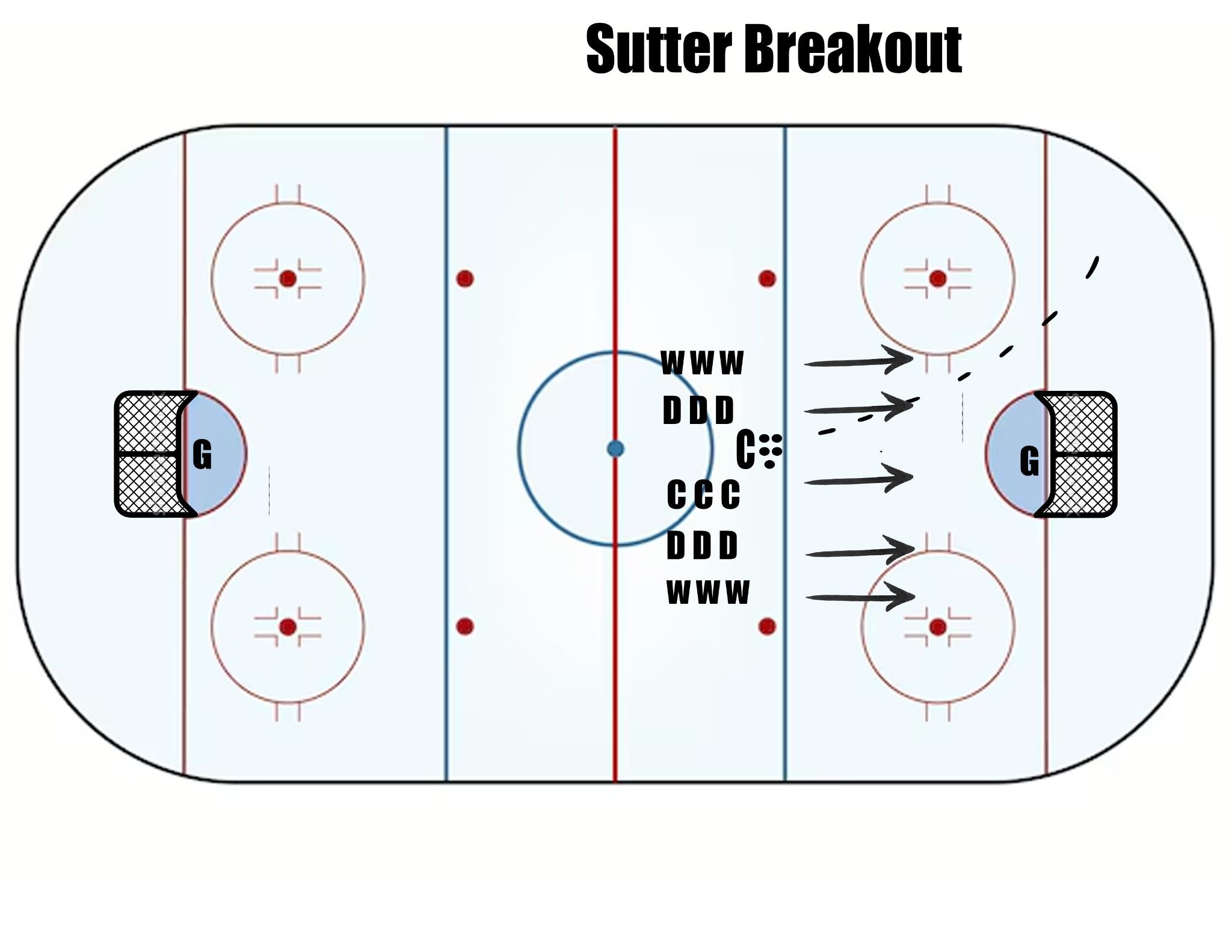
Lines within your pairs and groups positioned up near the blueline with coach and pucks. Goalies in each net.
Stress Backchecking through the middle into D- Zone and Communication away from the puck
Coach calls out a predetermined breakout such as - Quick Up, Reverse, D to D (behind the net), Stretch etc.
Group of 5 executes the breakout. Speed and simplicity through the neutral zone.
Practice good rush offense habits on the entry. 5-0
Make sure there is middle drive, wide and flank, defenseman gapping up and joining the rush. Trailer etc.
Complete the rush with a shot on net and stopping on the net
 00:00:00
4 lines in the neutral zone. Start with one puck. Passing to Side- then cross ice (middle)- then to the other side and repeat. Simple lines that require flats passes, good targets, communication, and soft hands.
Where the drill gets fun and interesting is the introduction of multiple pucks. Watch videos to see the progression to multiple pucks.
By Andrew Trimble
To Purchase Andrew’s book, The Hockey Planner, follow this link here- The Hockey Planner: A Year by Year Plan to Assist You on Your Hockey Coaching Journey: From Learn to Play to Junior Hockey: Trimble, Andrew: 9781963743395: Amazon.com: Books
or www.aihockeyadvisor.com
 00:00:00
When our son is out on the ice for warmups, I can predict 2 things that he will do without fail. The first is stretching – he is a goalie and he can almost do a complete middle split (thank you Karate International of West Raleigh). The second is he will find the referees and will give them fist bumps. The first time I saw this, I asked him about it. He told me he said thank you to them for showing up and appreciating them. I didn’t know really what to say. I have never prompted him to do something like this. I hoped we had been good examples to him, but you never know.
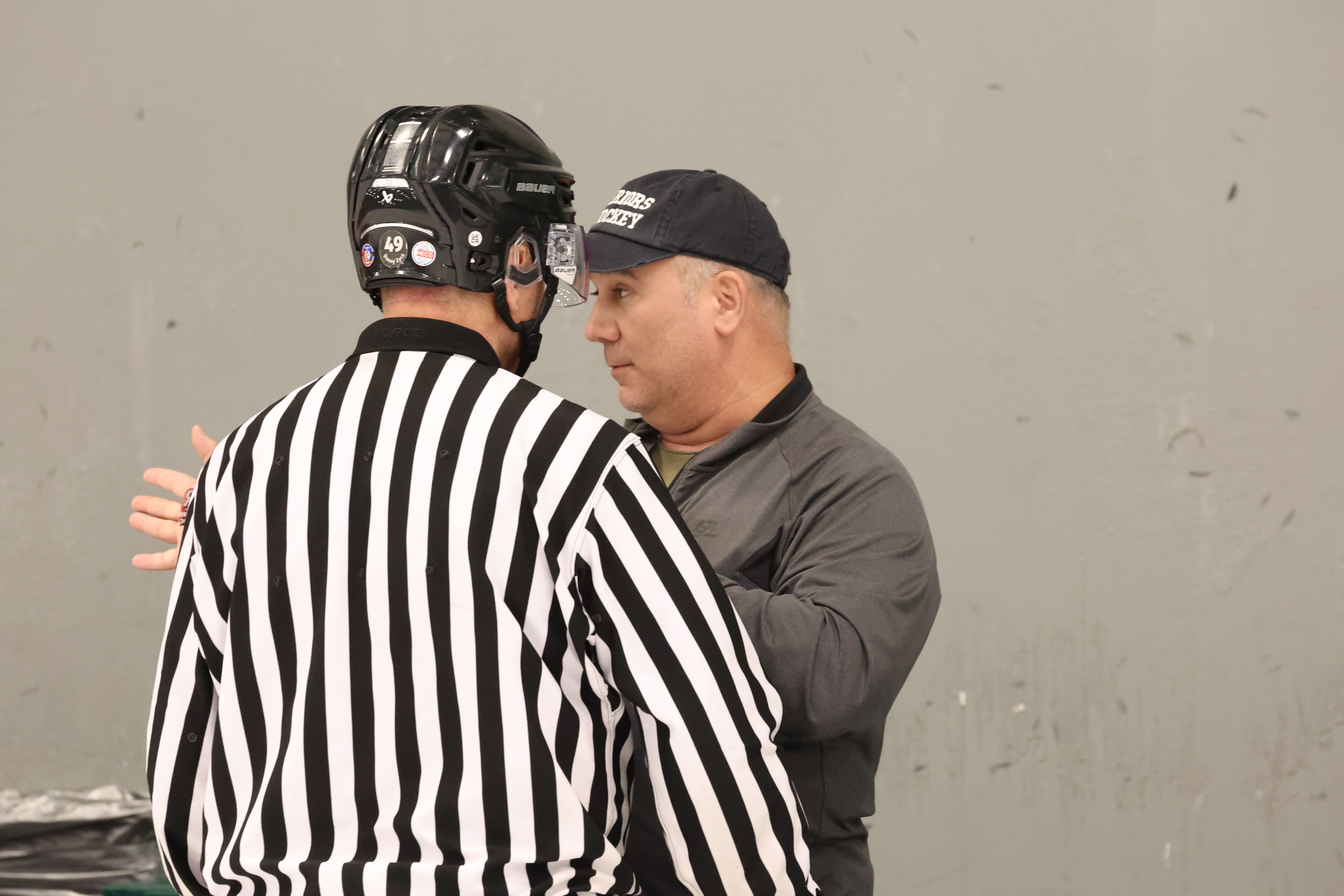
Recently I was coaching in a national tournament, when there were some “concerns” with the junior referee. At the intermission, I called over the senior partner, and I explained my concerns about the junior referee. Now, the senior had gotten close to my face, and the impression could be construed as intense, I didn’t take it personally and explained my position. He stated he hadn’t seen it, but he would mention things and take care of them. He skated off and for the rest of the game, things were fine.
After the game, we went through the handshake line and went to shake hands with the officials. The senior ref and I shook hands and made jokes to each other about how we are getting too old for being out on the ice as much as we had been this weekend, enjoyed a laugh and parted ways. I was following my team out, when the senior ref called to me and skated up to me. He put his hand on my shoulder and said “Thank you”. He told me he appreciated that I was talking TO him, and with him, with respect.
He was telling me about the horrible experiences he had in this last season with parents and coaches, especially in youth hockey. How everyone yells at them (refs) and treats them as if all the ills of the world are their fault. And while he was bracing for that to be my presentation to him, he was pleasantly surprised by the opposite. I told him I unfortunately understood all too well what he experienced. I have sat on disciplinary committee boards, and the stories and negativity that has come out of them is truly disheartening.
I shake my head sometimes, wondering where it all went wrong. People walking up to each other on the street and hitting them for some glorified internet prank, or those in power calling others losers and stupid. Have we lost our way so badly that we can’t remember the word Respect? And there are times that I would believe it, that we have forgotten. But then I see the glimmers of hope in different places, reminders that maybe it's not too late.
All it takes is a soulful woman spelling out the word RESPECT in song, or 2 old guys at the hockey rink remembering the lessons of their elders and acting like men. Or, maybe what we need is more innocence of youth, in the form of a little goalie, skating over to a grown man in authority, and giving him a fist bump with his oversized goalie glove and thanking him for coming out to the game.
End of content
No more pages to load
copyright (c) 2026 The Coaches Site

