
Podcast style interview between Aaron Wilbur from The Coaches Site and Steve Hamilton. Steve is the former Calgary Hitman head coach and current Everett Silvertips head coach. A great conversation about leadership, building the right culture and supporting your athletes.
 00:00:00
3 v 3 Backcheck SAG
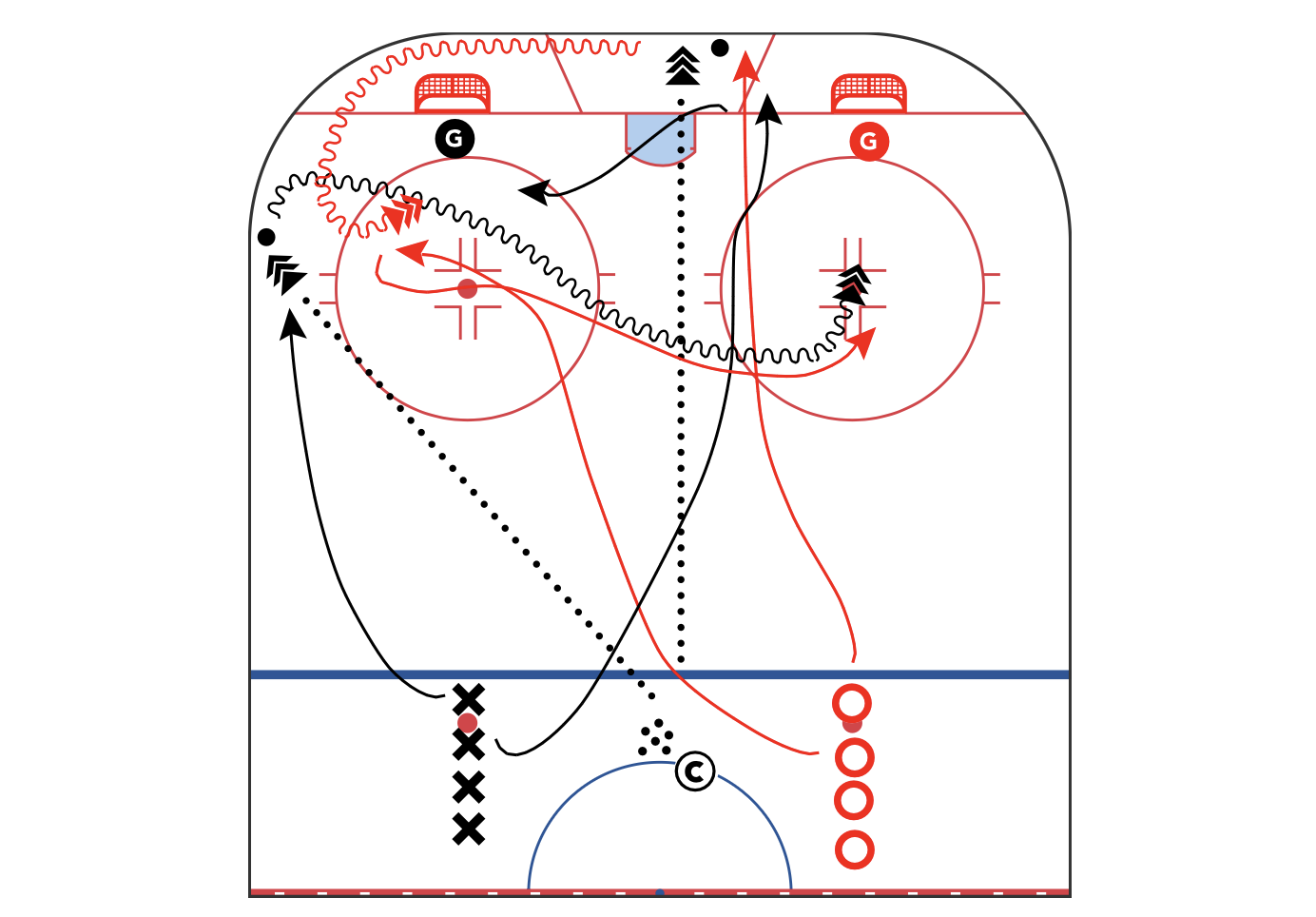
Backcheck 3v3 SAG: X starts by attacking 3 v 0 with 3 opposing O players backchecking. When / if the defensive team wins the puck, they breakout to the next their Ooffense waiting in "N" zone lines drawn on ice (NZ). A new offense can then straight attack (enforce offsides) in the other direction. After they are stopped on offense by the Xbackcheckers the cycle starts again and the O become backcheckers. Offense-Backcheck/Defense-Breakout to your team-Change.
 00:00:00
Less Is More : Are You Spending Time on the Right Things?
In the pursuit of hockey excellence, many players fall into the trap of thinking that more effort, more time, and more sacrifice are the keys to winning. But what if the opposite is true? What if doing less—focusing only on what truly matters—could be the secret to reaching your peak performance?
Time is a fixed resource. You can't create more of it, and once it's spent, you can't get it back. This makes how you choose to spend your time incredibly important, especially when your goal is to perform at your best. Yet, many athletes unknowingly waste precious hours on activities that do nothing to further their goals. The first step to breaking this cycle is to ask yourself: "What am I doing too much of?"
Identify Your Time Wasters
Take a moment to reflect on your daily routine. Are there activities that consume more time than they should, offering little in return? For many athletes, common culprits include:
- Too Much Screen Time:
- Whether it’s playing video games, scrolling through social media, or binge-watching TV shows, excessive screen time is a major distraction. While it might offer short-term pleasure, it often leaves you feeling drained and less motivated to tackle your goals. Imagine if you cut this time in half—what could you achieve with those extra hours?
- Too Much Socializing:
- Spending time with friends is important, but if your social life is eating into your training or recovery time, it might be time to reassess. Winning requires a certain level of focus and discipline, and that sometimes means saying no to social events that don't align with your goals.
- Too Much Multitasking:
- Multitasking often feels productive, but it usually leads to scattered focus and mediocre results. If you find yourself juggling too many things at once, consider simplifying your schedule. Focus on one task at a time, and give it your full attention. You'll likely find that you complete tasks more efficiently and with better quality.
Freeing Up Time for the Winning Path
Once you've identified where you're spending too much time, the next step is to reallocate those hours towards activities that will actually help you win. Here’s how:
- Invest in Recovery:
- Use the time you save to prioritize sleep, rest, and mental downtime. Your body needs these periods of recovery to adapt and improve. Without them, all your hard work in training could be undermined by fatigue and injury.
- Enhance Focused Practice:
- With fewer distractions, you can dedicate more time to high-quality, focused training sessions. This doesn’t mean training longer, but rather training smarter. Concentrate on drills and exercises that directly improve your performance.
- Incorporate Mindfulness:
- Use some of your reclaimed time to practice mindfulness or meditation. These practices can sharpen your focus, reduce stress, and enhance your mental resilience—critical components for success in any sport.
Time Is Your Most Valuable Asset
In the end, winning is not just about what you do—it's also about what you don't do. By cutting out the excess and focusing on what truly matters, you can make the most of your fixed amount of time. So, ask yourself: "What am I doing too much of?" The answer might just be the key to unlocking your full potential.
Rob Pallante
Mental Performance Coach
Mindset Body Bank Inc.
 00:00:00
Eaves 2 on 2
Description:
2 on 2 is played in one end.
As drawn X1 and X2 are defending the left end and when they gain possession will pass to X3 and X4 at the blue line who will skate to attack the far end.
O1 and O2 will try to score at the left end.
Once X3 and X4 get the puck then O1 and O2 must defend the right end and get puck to next pair of Os at blue line.
If puck goes out of play a coach will throw another puck in.
Key points:
Offense: puck support, shooting mentality
Backcheck: Stick lift, stop on puck/net
Defense: Stick on puck, defensive side of puck, breakout pass (tape to tape)
 1:03:05
2023 Coach Day - Dr. Jody Carrington
Dr. Jody Carrington is a renowned psychologist sought after for her expertise, energy, and approach to helping people solve their most complex human-centred challenges. Jody focuses much of her work around reconnection – the key to healthy relationships and productive teams.
A speaker, author, and leader of Carrington & Company, she uses all she has been taught in her twenty-year career as a psychologist to empower everyone she connects with. Jody has worked with kids, families, business leaders, first responders, teachers, farmers and has spoken in church basements and world-class stages; the message remains the same – our power lies in our ability to acknowledge each other first.
Her approach is authentic, honest, and often hilarious. She speaks passionately about resilience, mental health, leadership, burnout, grief, and trauma – and how reconnection is the answer to so many of the root problems we face. Her wildly popular book, Kids These Days, was published in 2019 and has sold 150,000 copies worldwide. Jody’s message is as simple as it is complex: we are wired to do the hard things, but we were never meant to do any of this alone.
 00:00:00
Minnesota Hockey Body Contact & Checking Progression Drills for Bantams
This video walks you through a series of on-ice drills designed specifically for Bantam age players. This video includes game video examples of legal and illegal body checking.
 00:00:00
Maximizing Performance through Neutral Thinking
This past weekend, I found myself taken aback during a conversation with some parents from my youth team. They were already gripped by anxiety over which spring team their child should try out for, and even more stressed about whether their child would make the AAA team next year. It’s only September; we’ve just wrapped up tryouts and enjoyed an incredible first week together as a team. Yet, parents are already fixated on spring hockey, and as the coach, this makes it extremely challenging to secure full commitment from players whose parents are mentally fast-forwarding to April.
Last winter, while vacationing in Mexico, I stumbled upon a highly recommended book for coaches called Getting To Neutral by Trevor Moawad, thanks to resources from The Coaches Site. The book introduces a valuable concept that encourages living in the present and making decisions unburdened by past experiences or future worries..
The Role of Neutral Thinking in Maximizing Performance
With neutral thinking, athletes get to stay in the moment, savor every move, and focus solely on the current play. It empowers them to give their best shot each time, stripping away the pressure that can often create performance anxiety. It’s not about disregarding emotions but rather harnessing them to feed into the game instead of detracting from it. Therefore, mastering neutral thinking can serve as the psychological edge that sets you apart on the ice.
So, if you notice your athletes are seeking that extra boost to your performance, the answer could be as simple as embracing the power of now through neutral thinking.
Shaking Off the Shackles of the Past and Future
Coaches and athletes memories of past performances can either shackle or inspire us. At times, we get caught up in the thorns of past mistakes, allowing them to cloud our present. At other times, we linger in the glow of triumphs, and the pressure to replicate those victories becomes overwhelming.
By anchoring ourselves in the here and now, neutral thinking enables us to engage fully in the moment. This shift in focus can be incredibly liberating, allowing you to play your game with clarity and confidence.
Embracing Emotions Without Letting Them Take Over
Neutral thinking does not call for us to suppress or ignore our feelings. On the contrary, it encourages us to experience and understand them fully. The difference lies in consciously choosing not to let these emotions steer our actions or decision-making process. It’s like being in the driver’s seat of a car. Emotions are the passengers – they are there, they have voices, they have energy, but ultimately, you are the one holding the steering wheel and directing the vehicle.
Feeling frustrated after a missed goal or elated after a winning shot is entirely natural. However, neutral thinking guides us to channel these emotions in a constructive way to fuel performance rather than obstruct it. Instead of letting a moment of frustration throw you off your game, neutral thinking can help use that energy to reignite your focus and determination. Similarly, the euphoria of a good play can be harnessed to bolster your confidence without leading to overconfidence or complacency.
Steps Towards Achieving a Neutral State of Mind
Guiding youth hockey players presents unique challenges compared to coaching professional athletes. The process begins with the parents and gradually influences the entire team dynamic. Therefore, coaches must navigate changes delicately, avoiding any critique of parenting styles. It’s important to establish a mutual understanding with parents at the start of the season, emphasizing that the goal is to help the children savor each moment and relish their journey in the sport.
 00:00:00
2 on 2 - 2 Puck Small Area Game
In this drill, you have a 2 on 2 game with two nets on the goal line.
The coach will dump in two pucks, and teams must score on their assigned net. The goal is for the team to score both pucks, or just one, if the other team scores as well.
You can keep score for each line they are in and come up with a fun "punishment" for the losing team.
What I like so much about this drill is that it forces creativity and thinking since two pucks are in play, but it also forces the forwards to play defense and the defense to play forward, breaking players out of any boxes they may have.
You can also time limit each shift to stop players from trying to gain possession and waste time stick handling and defenders not pressuring in order to avoid forcing a play.
When you tell them they only have 30 seconds to score two goals, they get to work pretty quickly.
 00:00:00
Leadership Lessons from Team Canada’s Captain
Subscribe: Apple Podcasts | Spotify
Tyler McGregor wants to make sure that hockey is in a better place when he’s done with the game.
With the start of the regular season right around the corner, there’s excitement in the hockey world to get another year going. There’s unlimited dreams and possibilities for tens of thousands of minor hockey players in every province. Opportunities abound for players to grow on the ice and within themselves as well.
The captain of Team Canada’s para-hockey team has learned that there’s no single formula to being a leader.
“I think there’s some inherent qualities to leadership, but much of that is learned and evolved along the way,” said McGregor.
His career in Paralympic sport began as a result of a bone cancer diagnosis as a teenager that forced the amputation of his left leg above the knee, altering his lifelong dreams of playing professional hockey. Despite these challenges, McGregor’s unwavering belief and determination helped him adapt, overcome, and continue to pursue excellence within the sport he’s always loved.
This led him to the sport of Para Hockey (formerly Sledge Hockey), where he has competed internationally since 2012 and is now a three-time World Champion and three-time Paralympic medalist.
After his diagnosis, McGregor felt the impact of opportunity and of a sport that could help rebuild himself as a person. While he found the recovery after his surgery more difficult than anticipated, the turning point for him, he says, came when he got back to being physically active.
During his Make-a-Wish trip to Hawaii, McGregor was able to escape the noise and learned to surf, went on hikes, and found his energy and confidence again.
He also got on a sled for the very first time the next month and never looked back.
McGregor has realized the opportunities that obstacles can sometimes provide.
“Intentionally seeking out those challenging moments in whatever way you can is something that builds resilience within a person,” he said.
While he was named Captain in 2019, McGregor admits he didn’t know everything to start.
“I think as I moved through the past four or five years as captain, ultimately it comes down to making sure that for me, I’m the most prepared I can be and that I’m investing in every area of my life, both on and off the ice, so that I can inspire others to do the same.”
He credits his upbringing in the small town of Forest, Ontario as helping develop to his sense of community and making sure that everyone is included.
McGregor wants to be an example to the people that he meets off of the ice as well. He's thorough and dedicated to the power of community work.
Away from the rink, McGregor has also raised over $130,000 for the Terry Fox Foundation through his ‘Sledge Skate of Hope’ since 2021. He's also a member of the National Board of Directors for Make-A-Wish Canada, the Canadian Paralympic Athletes Council, and the Own The Podium Athlete Advisory Committee.
“I always say that leadership is an action, not a position.”
 00:00:00
Stop Comparing Scores in Hockey Tournaments
Hockey tournaments can be intense while players, coaches, and parents are on edge. As the round-robin results are watched closely by everyone in attendance, it can be easy to become distracted by comparing scores of other games and wondering where your team will stand at the end of the day. It's one thing to keep your young player's eye on the ball, but helping parents understand that we want to focus on the process and not the outcome is significant.
The Obsession with Scores in Hockey Tournaments
Hockey tournaments are often filled with high emotions and intense competition. Every team wants to come out on top and take home the trophy. As a result, there’s a strong obsession with scores in hockey tournaments.
It’s not uncommon to see coaches and players glued to their phones or constantly checking the scoreboard during a tournament. There’s a constant need to know where each team stands in the round-robin results and who they’ll be playing next.
While it’s natural to be curious about the standings, it can become a problem when it turns into an obsession. Constantly comparing scores of other games can lead to distractions and ultimately negatively impact a team’s performance.
In some cases, it can also lead to unnecessary stress and anxiety for players and coaches. Instead of focusing on their game plan and individual responsibilities, they may become consumed with the outcome of other games.
The Negative Effects of Comparing Scores
Everyone wants to know where they stand in the overall standings and what they need to do in their upcoming games to advance to the playoffs. However, this constant comparison of scores can have negative effects on both individual players and the team as a whole.
One of the biggest negative effects of comparing scores is that it can lead to overconfidence or complacency. For example, if a team sees that they have an easy matchup against a weaker opponent, they may become too relaxed and not put in their best effort. On the flip side, if a team sees that they are matched up against a strong opponent, they may become discouraged and lose motivation before the game even starts.
The Importance of Controlling What You Can Control
The truth is, there’s little you can do to change the outcome of other games. Your focus should be on your own performance and the task at hand. By focusing on what you can control, you can maximize your chances of success.
So, what can you control? You can control your own preparation, your effort on the ice, and your attitude towards the game. You can control how well you execute the game plan and how you respond to adversity. By putting your energy into these controllable factors, you can give your team the best chance of success.
It’s important to remember that every game is unique. Instead of fixating on the results of other games, it’s better to focus on the task at hand and what you can control in your own game.