Net Front Recovery and Reset Game
Game Overview
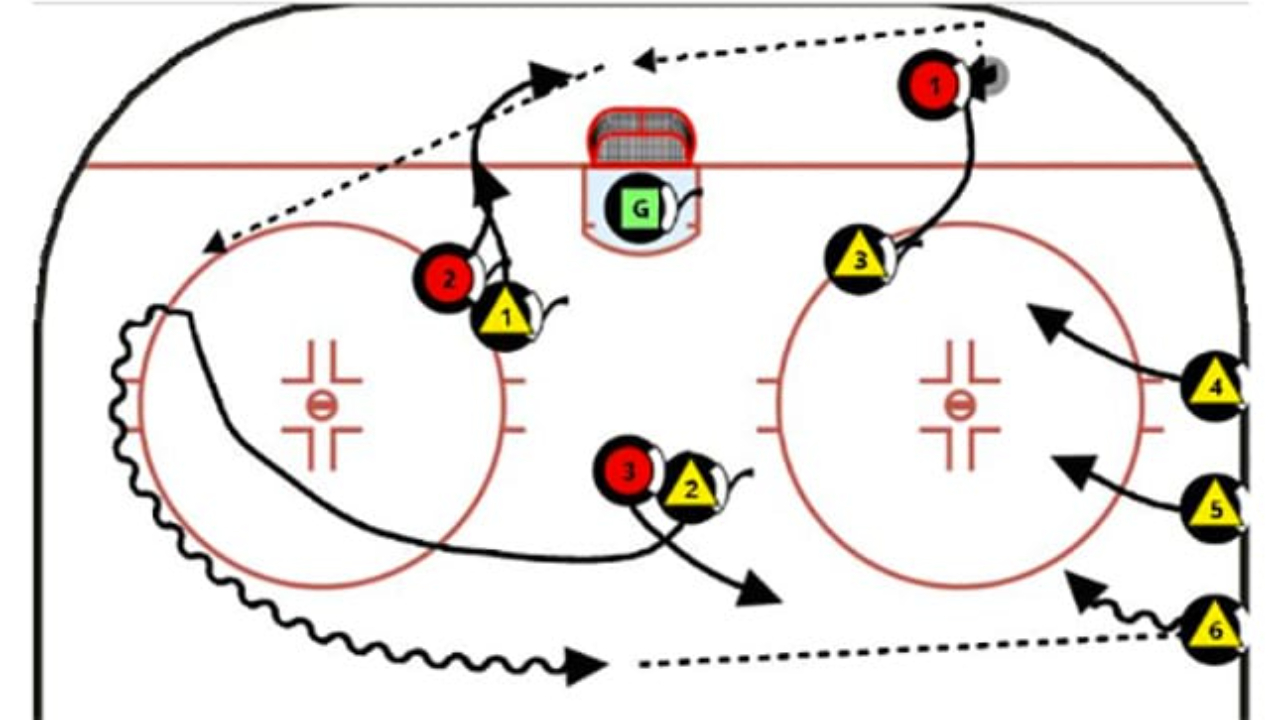
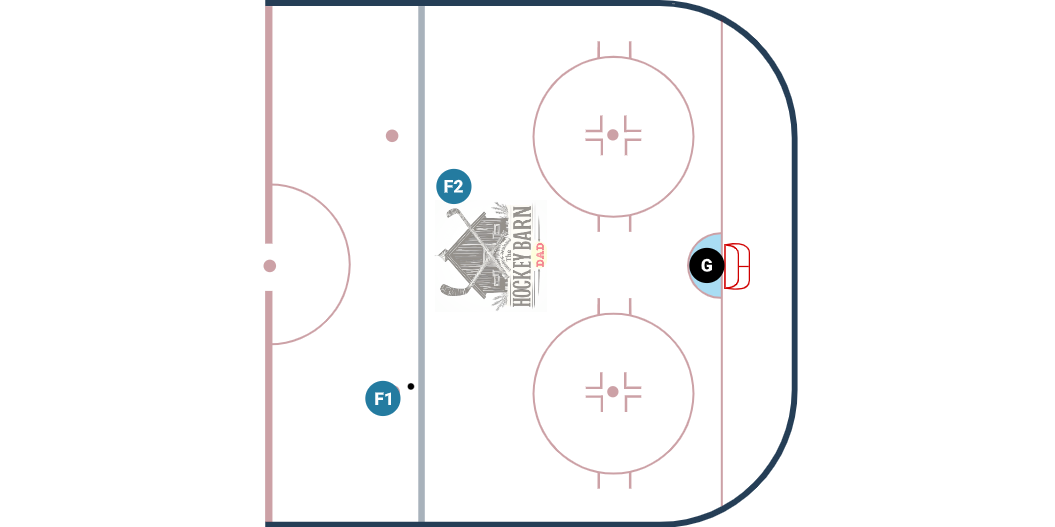
The Net Front Recovery and Reset Game is played in the defensive zone, using the area from the blue line to the back boards. The active playing area is confined to the lane inside the face-off dots, concentrating play around the highest-danger scoring area.
The attacking team consists of three forwards in the scoring area and one defender positioned on the blue line. The defending team consists of two net-front defenders supported by one defender on the blue line.
Play begins with all players outside the dots before the coach spots a puck into the slot. The attacking team attempts to recover possession and score. Every time the attackers regain possession after losing the puck, they must reset through their blue-line defender before attacking again.
The defending team scores by recovering possession and making an outlet pass to a blue-line defender. That defender immediately executes a D-to-D pass across the blue line before transitioning the puck back to the forwards to launch the next attack. Defenders may use either blue-line player as their outlet.
The game creates continuous cycles of puck recovery, transition, attack, loss of possession, and offensive reconstruction.
Game Design Intent
This task recreates one of the most common sequences in hockey, defending the net front, recovering possession under pressure, and transitioning immediately into offence.
Rather than allowing players to simply clear the puck, the environment rewards connected exits through structured support. The requirement to outlet through the blue line and execute a D-to-D pass encourages players to perceive support options instead of reacting with panic clears.
For the attacking team, the mandatory reset through the blue-line defender reinforces offensive patience. Players learn that maintaining possession often requires reorganising the attack rather than forcing immediate scoring opportunities.
Because possession changes frequently inside a confined area, players continuously alternate between offensive and defensive roles.
The environment rewards players who recognise when to recover, when to connect, and when to attack.
4 Role Ecology in Action
Offence With the Puck
The puck carrier must recognise whether an immediate scoring opportunity exists or whether the attack should be reset through the blue-line defender.
Possession becomes an opportunity to reorganise rather than force offence.
Players learn to manipulate pressure before attacking.
Offence Supporting
Supporting players create passing options below the puck while maintaining offensive spacing.
Their movement opens shooting lanes, creates passing angles, and prepares the team for immediate puck recovery following rebounds or turnovers.
Support constantly adapts to the evolving environment.
Defence On the Puck
The primary defender protects the net-front area while attempting to recover possession under pressure.
Rather than simply removing the puck from danger, defenders search for controlled exits through supporting teammates.
Defensive success becomes the beginning of offence.
Defence Away From the Puck
Supporting defenders anticipate rebounds, protect passing lanes, and prepare to become the next puck carrier following recovery.
Their positioning influences both defensive stability and the quality of the breakout.
They exist in constant preparation for transition.
Goalie Ecology
The confined playing area creates repeated net-front situations requiring continuous tracking through screens, rebounds, deflections, and lateral puck movement.
Goalies repeatedly adjust depth, angle, and visual attachment while communicating with defenders during recoveries and outlet situations.
Because transitions occur immediately after recoveries, goalies also develop recognition of breakout cues and defensive communication.
Author Bio
Barry Jones is an IIHF Level 3 High Performance Coach and USA Hockey Level 4 Performance Coach. His work blends ecological dynamics, nonlinear design, and athlete-centred leadership to build adaptive teams that thrive in uncertainty. He is also the developer of Task Sketch, a tool designed to support coaches in creating game-representative training environments.