The beginning:
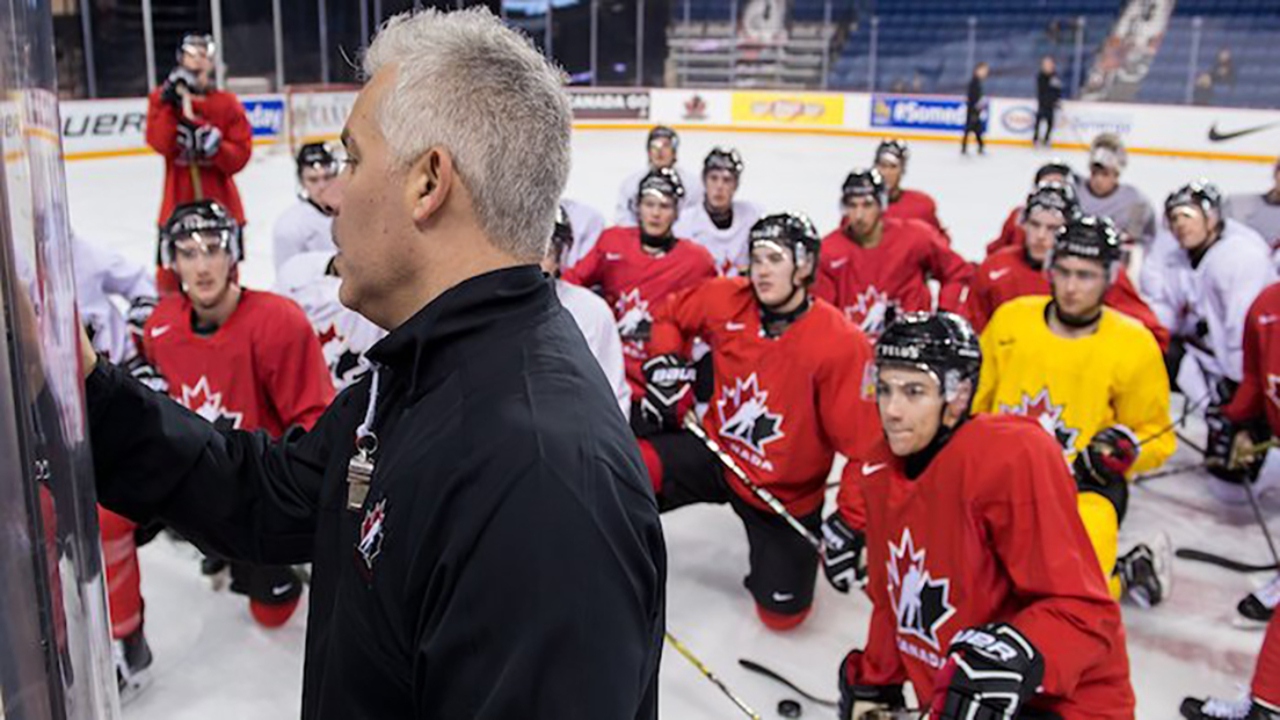
We had just finished the first drill of the practice, and I called everyone to “our” bench. As usual for this group, it was a half-ice practice, with a U9 A4 team on the other side.
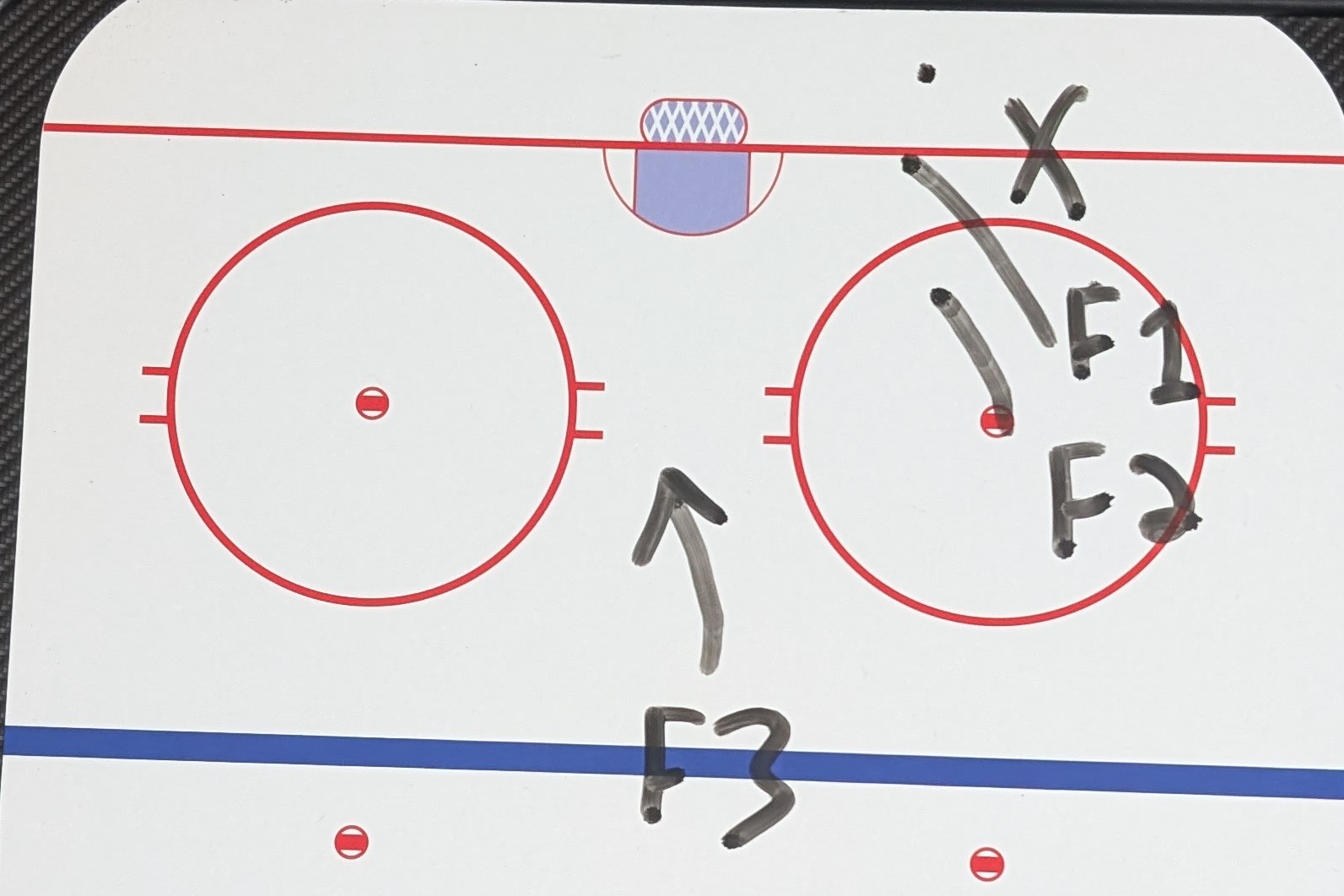
"This one's simple," I said. I walked them through the drill. With blue marker I showed where our players enter the drill from, and then with black I marked where the puck starts, and where it moves to.
With the red marker, I drew the player who acts as support. With the black one again I used a dotted line for where the next pass goes. While colorful, it was not a Picasso – but it served its purpose.
We demonstrated it twice for the players. Looking at them as the huddled in a group watching, I asked if everyone understood.
Thirteen helmets nodded.
Ten seconds later...chaos. Not even a little bit of it – it was blatantly pure chaos.
Someone skated backwards. Someone entered the wrong lane. We had a near-miss of a blindside mid-ice collision. As if totally oblivious to the drill carnage going on, one player looked at me and casually asked, "Coach...where do I go?"
I remember thinking, “I literally just explained this!”
For “Red”, my former coach, this would have initiated a bag-skate. This might be an unpopular take, but I simply do not subscribe to the idea of using bag-skates as punishment. For some coaches this might be their go to method for scaring kids into paying attention – but it’s not my style, nor my interest.
I didn’t use that approach as a classroom teacher, and I certainly don’t use that now on the ice. The strange part wasn't that they forgot. The strange part was that I thought I had explained it well. Actually, I thought it was so simple that the board diagram was mostly overkill.
Looking back, maybe I had. Maybe explanation wasn't the problem. Maybe I had confused hearing with learning.
That question followed me off the ice and then home. I could have bought myself a new pair of skates with the rent I should have charged for taking up so much mental real estate for the next few days after that.
My brain kept circling back to that moment. The more I tried to let it go, the more it refused to leave. I couldn't figure out why it bothered me so much. One idea within Cognitive Load Theory kept coming back to me.
It was like that student who puts their hand up enthusiastically saying, “pick me…pick me!!”.
So I picked it. And had to wrestle with it because it just didn’t fit as easily as it did in Article 1 did. Diving deeper, I realized that instruction itself carries cognitive load.
Every sentence I added...
Every coaching point...
Every correction...
Every demonstration...
was asking players to hold one more thing, and then another one more thing, in working memory before the drill even started. It was one more direction, with one more explanation, and one more skill and technical point…. Sigh.
Suddenly I wasn't worried about my drills anymore. I was questioning my explanations. It also made me rethink something I'd believed for years. I truly thought that “good coaching” meant giving better explanations.
Educational psychologists describe two broad ways people learn:
· Sometimes we learn because someone tells us something.
· Sometimes we learn because the environment teaches us.
I contend that good coaching needs both. The mistake is believing explanation is always the faster route to learning.
The hardest thing for a coach isn't learning what to say. It's learning when to stop talking.
What This Doesn't Mean
This doesn't mean coaches should stop teaching. Players absolutely need demonstrations. They also need feedback. And like students in the classroom, sometimes they need direct instruction.
Standing in front of the bench, after a water break, with a pocket full of coloured dry erase markers and with the whiteboard in hand, the bigger question isn't “should I explain this differently and again?” Rather, it’s “when does another explanation stop helping?”
What I Changed
Looking back, I don't think I was over-explaining because my players needed it. I think I was over-explaining because I did. Every explanation made me feel prepared. Every extra coaching point reassured me that I had done my job. Every demonstration felt like evidence that I was coaching. Each item was another thing I hoped my players would remember.
Before they had even touched a puck.
Silence, on the other hand, felt risky. If I wasn't talking...was I still coaching?
I use to follow this order: Explain. Correct. Explain again. Ask if everyone understands. In an effort to enact my thinking, I tried out a new pathway:
One cue. Play. Observe. Pause. Ask a question. Play again.
I stopped trying to answer every question before the drill started. Instead, I let the drill answer a few of them.
There was a time when I believed explanation was the engine of learning. Now I think explanation is one tool among many.
· Sometimes players need us to tell them.
· Sometimes they need us to show them.
· Sometimes they need us to ask them.
· And sometimes...
they simply need us to get out of the way.
The hardest adjustment wasn't shortening my explanations. It was standing there, saying nothing, and trusting that learning was still happening. That's uncomfortable. Coaches like to feel useful.
We like to hear ourselves contributing. We like players looking back at us for answers. But somewhere along the way I realized something surprising. Every time a player solved a problem without me, I hadn't become less valuable as a coach.
I'd become more successful as a teacher.
The coach who talks the most is not necessarily the coach who teaches the most. The coach who designs the best learning often says the least.
Tuesday Night
This week, look over your practice plan. Choose one drill and cut your explanation in half. Not because shorter is automatically better. Because every sentence you remove creates space for players to discover something themselves.
Then ask yourself afterward Did they need me to explain that.....or did they need an opportunity to notice it?
The Ending
I've started wondering whether great coaching isn't measured by how much we explain.....but by how little players eventually need us to.
Those are not the same thing.
Somewhere along the way I realized I had confused coaching with explaining. I had assumed the more I contributed, the more my players would learn. Now I think almost the opposite. Coaching isn't measured by how much information we give. It's measured by how well we design environments where learning can happen without us.
Education eventually taught me something I had missed for years. Teaching isn't the transfer of information. It's the design of experiences that change understanding.
Coaching, I think, works the same way.
Continue the Conversation
If today's conversation interested you...
Richard Masters' work on implicit motor learning asks a fascinating question: can athletes sometimes learn more effectively when they aren't consciously trying to control every movement?
Rob Gray has spent years translating motor learning research into practical coaching conversations. His books and podcast have had a significant influence on how I think about balancing instruction with discovery.
Both reminded me that great coaching isn't silent.
It's intentional.
My Notebook
The more I trusted players to discover, the more another feeling appeared. Discomfort.
Not theirs, mine.
Watching players struggle without immediately rescuing them felt almost irresponsible. Which raised another question. If struggle is often where learning happens... why are some coaches so determined to remove it?
Next conversation: Why Are We So Afraid to Let Players Struggle?