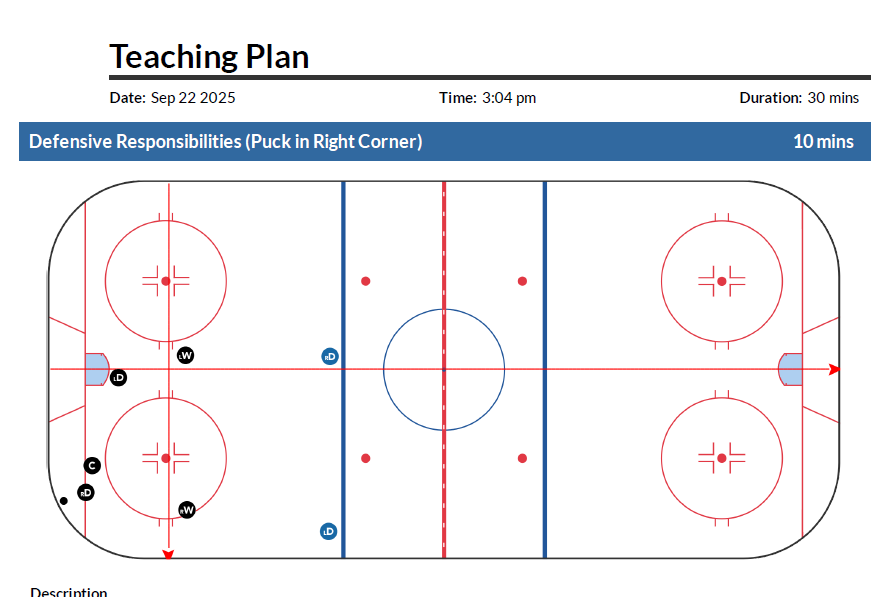
Last season, I wrote about a visual teaching tool I created for my U10 team to help our players and parents better understand our defensive zone coverage and forecheck.
The idea was simple. I wanted to give the players something they could take home, look at and connect back to what we were teaching at the rink.
What started as a simple handout quickly became one of the most useful teaching tools we used all season.
Within a few games, I could see a difference in how our players communicated, positioned themselves and made decisions. Parents also became part of the process because they had something in front of them that showed what we were actually trying to teach.
That was a big takeaway for me.
Going into this season with my U11 team, I didn't want to reinvent something that had worked. I wanted to build on it.
One of the changes I've made this year is personalizing the package for each player.
Every player receives his own copy with his name and primary position identified.
For example:
Rory Candela
Centre
It sounds like a small detail, but I think it gives a young player a much easier starting point.
Instead of opening a diagram and trying to understand five different positions and everything happening on the ice, he can start by finding the C.
Where am I supposed to be?
Who am I supporting?
What am I protecting?
What changes when the puck moves to the other side?
Once a player understands his own responsibility, we can start to expand the conversation into what his teammates are doing and why.
The same thing applies to his parents.
They know which position their child is learning, they can follow that position through the package and they can understand the language we're using with him at the rink.
That part matters.
Parents are a huge part of a young player's hockey experience.
They're driving them to practices and games. They're watching from the stands. They're talking about hockey on the ride to the rink and the ride home.
Those conversations are going to happen.
Last season reinforced for me how helpful it can be when those conversations are connected to the same things we're teaching as coaches.
The goal isn't to turn parents into assistant coaches.
I don't want players getting into the car after a game and receiving another full breakdown of everything they did right or wrong.
What I do want is for the parent to understand what their child is being taught.
If we're asking our center to support down low in the defensive zone, stay between the puck and our net and protect the middle, the player can see that in his package and so can his parents.
If we're talking about supporting a puck battle, protecting the front of the net, or understanding the strong and weak side of the ice, everyone is working from the same reference point.
This year I've also tried to again make some of our team language easier for 10-year-olds to remember.
Our forecheck is a good example.
We're teaching a 2-1-2 forecheck, but rather than relying only on F1, F2 and F3, we've attached names to those responsibilities.
F1 is our Cheetah.
The Cheetah attacks the puck carrier with speed and urgency, uses his angle to take away one side of the ice and tries to force the puck carrier into pressure.
F2 is our Alligator.
The Alligator attacks from the opposite side with more control, reads the pressure created by the Cheetah and looks to close the other escape route.
F3 is our Eagle.
The Eagle stays above the first two forwards, protects the middle of the ice and is ready to support either side.
The terminology is simple.
The hockey concepts behind it aren't.
We're still teaching pressure, angling, support, reading the play, protecting the middle and understanding when responsibilities change.
That's important to me.
Making something easier for a young player to understand doesn't mean we have to make the hockey itself simplistic.
The names just give the players something they can remember and something we can keep coming back to.
If all three forwards get caught below the puck, I can ask who our Eagle was.
If F1 and F2 attack from the same direction, we can talk about how the Cheetah and Alligator are supposed to work together.
If our center gets too far away from the play in the defensive zone, we can go back to his page and talk about why we need him supporting underneath the puck.
The language stays consistent.
That's probably the biggest value I see in these packages now.
They're helping create a team language.
The player hears it from the coaching staff at practice.
He sees it on paper at home.
His parents understand what the terminology means.
Then we can reinforce the same language in practices, games and eventually through video.
That's where I think the parent piece becomes especially valuable.
When a parent hears their child talking about being the Eagle, they know what he means.
When their child says the coach wants them supporting lower as the center, they have something they can look at together.
The conversation in the car can become less about whether the player scored or made a mistake and more about what he was seeing and what his responsibility was.
Maybe the question becomes, "What were you supposed to do there?"
If the player can explain it, he's starting to understand it.
If he can't, that's okay too.
He's 10 years old.
Now we know what we need to keep teaching.
One of the biggest lessons I've learned coaching younger players is that we can give them an instruction and assume they understand the reason behind it.
Stay high.
Protect the middle.
Support the puck.
Don't chase.
Those phrases make sense to us as coaches because we've probably heard them thousands of times.
For a young player, they can still be pretty abstract.
Giving them a picture, a position and some consistent language gives that instruction some context.
It gives them something they can connect back to.
These packages aren't homework.
I'm not expecting players to sit at the kitchen table studying defensive zone coverage, and I'm not asking parents to quiz them.
It's simply another resource they can use to understand what we're working on.
Our ice time is limited.
I'd rather use as much of that time as possible skating, competing, making decisions and actually playing hockey.
If some of the explanation can happen away from the ice, and the player arrives already having some idea of what we're talking about, I think that makes the time we do have together more productive.
This approach has also become a big part of how I think about player development outside of my own team.
This year I launched Candela Hockey Development, and a big part of what I want to explore through CHD is the space between teaching hockey skills and teaching players how to understand the game.
Skating matters.
Puck skills matter.
Passing and shooting matter.
But development also has to include understanding when, where and why to use those skills.
That's the part of development I keep coming back to.
How do we make the game easier for young players to understand without watering it down?
How do we give coaches better teaching tools?
How do we help parents understand what their child is learning without asking them to become another coach?
I don't think the answer is always complicated.
Sometimes it's a simple diagram.
Sometimes it's giving a responsibility a name a 10-year-old will remember.
Sometimes it's putting a player's name and position on the front of a package so he knows exactly where to start.
Last season, I thought I was giving our players and parents a visual reference they could use away from the rink.
This season, I see it a little differently.
I'm trying to create a common language between the player, the parent and the coach.
When everyone understands the same language, I think it gives the player a much better chance to understand the game.
To follow along with what I’m building through Candela Hockey Development and explore more player and coach development resources, visit candelahockey.com.