Legs feel tired by the 2nd period? Better cardio isn’t your problem.
While increasing your heart/lung capacity through steady state and sprint style conditioning is helpful to boost performance and recovery, the feeling of heavy legs stems primarily from a low-threshold for output.
Simply put – tired legs are a result of low volume of work!
So how do we better prepare our body for the demands of a full 60min hockey game? We work through progressive overload with focus on volume, time under tension, and isometric holds (ex. Planks).
Let’s talk a little more about each one – what it is, why it’s helpful, and a few options to implement in your training right away!
-VOLUME-
Refers to the total amount of work done by a muscle group through a training session. The culmination of weight used x total number of repetitions x total number of sets. This displays how much resistance you put the muscle through for a given body part or specific movement.
Ex. Bench Press. If I perform 3 sets of 10 repetitions with 100lbs, using our formula we would take 100 x (10x3) = 100 x 30 = 3,000lbs moved with bench press as my total volume of this exercise.
Being able to move heavier weights, through higher rep ranges, for more sets of an exercise, will improve your overall volume in that movement.
While our example is specifically for a single exercise, this can be applied to exercises of a particular area of the body as well for whatever data you’re trying to extrapolate.
This can be applied to any training program to give both a baseline, and track trajectory of improvement across various movements.
Great exercises for hockey players to develop greater volume output include:
Zercher Squats – 4 sets of 10 reps
Sumo Deadlifts – 5 sets, 6-8 reps
Overhead Press – 3 sets, 10-15 reps
Rows/Pulldowns – 4 sets, 15 reps
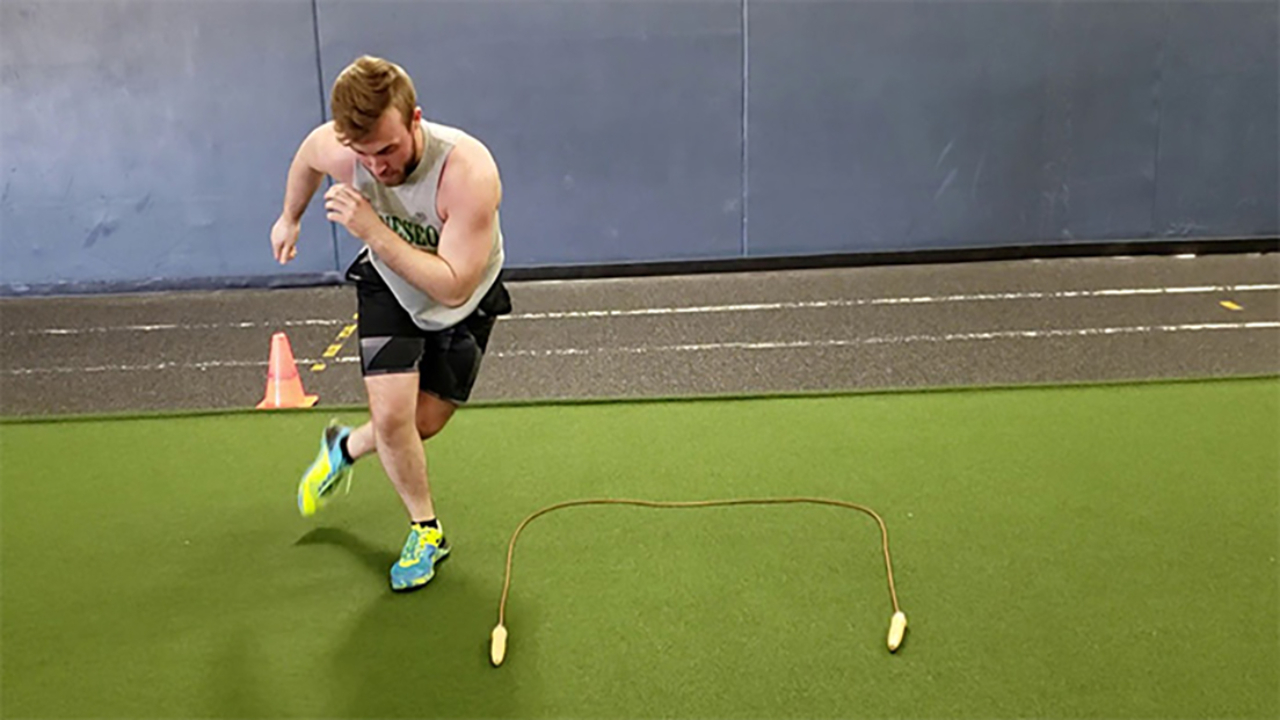
Even sprints, agility ladder or hurdle drills, etc
The greater your volume output, the greater your work capacity, the greater your body will be able to perform in action.
-TIME UNDER TENSION-
In conjunction with volume, Time Under Tension refers to the speed (or lack thereof) of your movements. While hockey is performed in a lightning fast manner, development of muscular control and endurance comes from slooooooooowing down your movements in the gym.
Typically applied to the eccentric (lengthening) portion of the exercise (when the weight/mass is moving down toward the ground), slowing down this portion to 4-8 seconds per rep will not only improve your muscular endurance to withstand the stress of the weight, but will in turn improve your work capacity on the ice to withstand the bursts of a fast, hard shift.
Additionally, for players who struggle with being under weight or easily injured, training through full ranges of motion with emphasis on time under tension should see changes in their overall musculature as this assists greatly in building lean muscle and strengthening the tendons of our joints to also withstand greater stresses.
Want to “feel the burn” in the best (see: worst) way possible? Add these exercises to your workouts
Bulgarian Split Squats – 2 sets, 10 reps each side, 4 second lowering
Lateral Lunge – 2 sets, 10 reps each side, 3 second lowering
Face Pulls – 3 sets, 12 reps, 4 second lowering
The longer your time under tension, the greater endurance your muscles will develop to withstand time being worked.
-ISOMETRIC HOLDS-
Like Time Under Tension, Isometric Holds develop muscular endurance through their held contractions. These are performed when you get into the contraction portion of an exercise and hold the position for as long as prescribed or as long as you can.
By contracting the muscles, and holding that contraction, your muscles, while not moving at any joint, are holding their shortened position against their will. If it is up to them, they would relax into a lengthened position, but by holding the contraction, you are forcing the muscle to continue working well beyond their normal stopping point.
This in turn develops muscular endurance that will carry you into late game scenarios with confidence that your legs will be up to the task.
If you really want to both hate yourself, but see the most improvement on the ice, you’ve GOT to add these to your program.
Side or Copenhagen Planks – 3 sets, 20-45 seconds per side
Single Leg Airplanes – 3 sets, 20-45 seconds per side
Wall Sits – 5 sets, 20-60+ seconds
However you approach it, improving the overall muscular endurance of your body (primarily lower body) will help you skyrocket your performance, recovery, and longevity into late game situations that your tired legs may otherwise keep you benched from when they give out midway through the 2nd period.
Increase your total VOLUME; slow down your movements to increase your TIME UNDER TENSION; and don’t forget to add in some ISOMETRIC HOLDS to really jettison your muscular endurance to the moon.