A seven-part operating framework for junior hockey leaders, built from lessons learned in Laconia, New Hampshire.
Table of Contents
- Introduction
- Part 1: Stability Wins
- Part 2: Understanding Your Market
- Part 3: The Den of Development
- Part 4: Recruiting Without Selling
- Part 5: Housing
- Part 6: Community Support
- Part 7: Operator Scorecard
Use the scorecard to evaluate the health of a junior hockey organization beyond wins and losses.
Over the past six parts, we’ve explored the pillars that helped shape the New England Wolves organization in Laconia.
We’ve discussed:
- Stability
- Understanding Your Market
- Development Systems
- Recruiting
- Housing
- Community Engagement
Each of those topics contributes to something larger: Organizational Sustainability.
One of the biggest mistakes I see in junior hockey is organizations evaluating themselves only by wins and losses.
Winning matters.
But winning alone does not determine whether an organization is healthy.
Some teams win games and disappear.
Others build foundations that last for decades.
The question every operator should ask is:
“How healthy is my organization?”
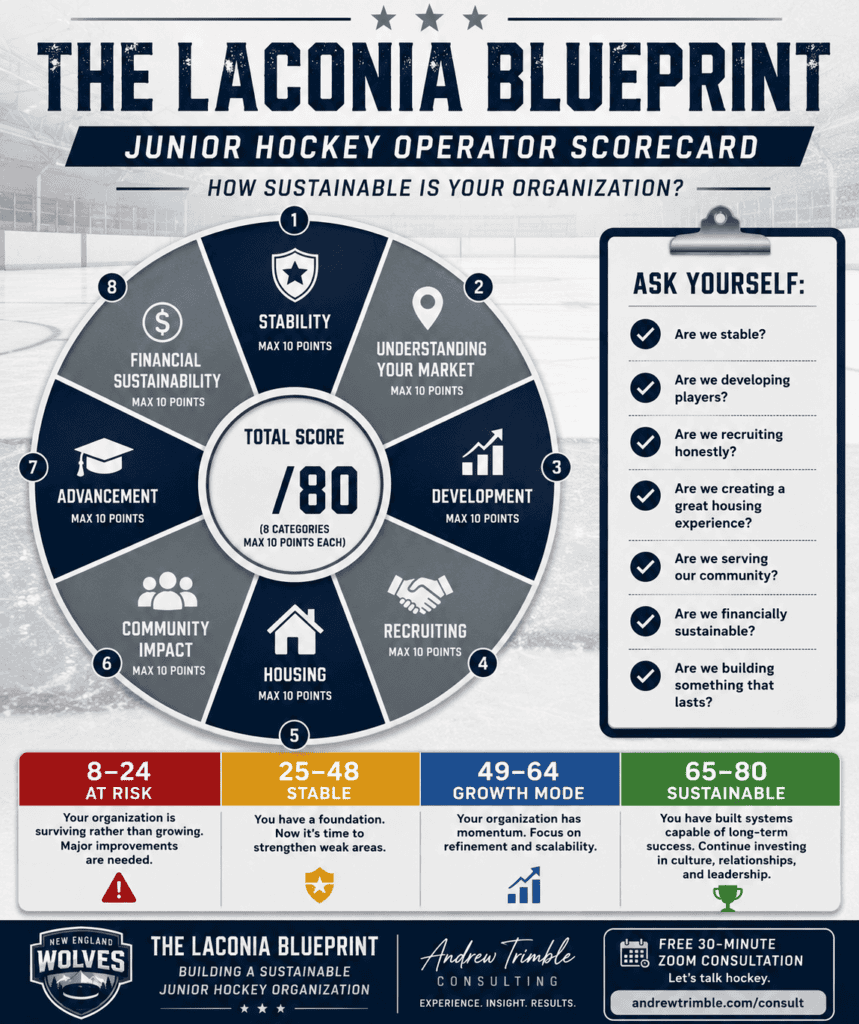
The following scorecard is designed to help answer that question.
Category 1: Stability
Does your organization have:
Consistent ownership?
Consistent leadership?
Long-term planning?
Staff retention?
Score Yourself
1-3 = Constant turnover
4-6 = Some consistency
7-8 = Stable foundation
9-10 = Long-term organizational strength
Category 2: Understanding Your Market
Do you understand:
Your recruiting territory?
Your player pool?
Your competition?
Your community?
Can you “Fish in Other Ponds” when necessary?
Score Yourself
1-3 = No clear market strategy
The Laconia Blueprint 444-6 = Some recruiting structure
7-8 = Strong market understanding
9-10 = Diverse recruiting pipelines
Category 3: Development
Do you have:
Structured development?
Video review?
Strength training?
Hockey IQ training?
Individual development plans?
Or are you simply running practices?
Score Yourself
1-3 = Basic team practices only
4-6 = Some development systems
7-8 = Comprehensive development model
9-10 = Development embedded into culture
Category 4: Recruiting
Does your recruiting philosophy focus on:
Honesty?
Fit?
Long-term success?
Advancement?
The Laconia Blueprint 45Or simply filling roster spots?
Score Yourself
1-3 = Reactive recruiting
4-6 = Average recruiting systems
7-8 = Strong recruiting process
9-10 = Reputation-driven recruiting
Category 5: Housing
Do your players experience:
Structure?
Accountability?
Family support?
Healthy living environments?
Or are they simply housed?
Score Yourself
1-3 = Housing problems common
4-6 = Functional housing model
7-8 = Strong billet culture
9-10 = Housing as a competitive advantage
Category 6: Community Impact
Does your organization:
Volunteer?
Support local causes?
The Laconia Blueprint 46Build community relationships?
Create positive visibility?
Or does it only exist inside the rink?
Score Yourself
1-3 = Little community involvement
4-6 = Occasional involvement
7-8 = Strong community presence
9-10 = Community institution
Category 7: Advancement
How effectively are you helping players move forward?
Consider:
NCAA advancement
ACHA advancement
Professional advancement
Academic success
Personal growth
Score Yourself
1-3 = Limited advancement
4-6 = Some advancement
7-8 = Consistent advancement
9-10 = Proven advancement pathway
Category 8: Financial Sustainability
The Laconia Blueprint 47Perhaps the most important category.
Can your organization survive long term?
Evaluate:
Budget management
Revenue streams
Sponsorships
Enrollment
Operational planning
Score Yourself
1-3 = Significant risk
4-6 = Financially stable
7-8 = Healthy operation
9-10 = Sustainable growth model
Final Score
Add your scores together.
8-24 Points: At Risk
Your organization is surviving rather than growing.
Major improvements are needed.
25-48 Points: Stable
You have a foundation.
Now it’s time to strengthen weak areas.
49-64 Points: Growth Mode
Your organization has momentum.
Focus on refinement and scalability.
65-80 Points: Sustainable
You have built systems capable of long-term success.
Continue investing in culture, relationships, and leadership.
The Laconia Lesson
Over the past decade, we’ve learned that sustainable organizations are rarely built by accident.
They’re built through thousands of small decisions.
The right staff.
The right culture.
The right development model.
The right housing.
The right community relationships.
The right recruiting philosophy.
No single factor creates success.
The combination does.
The purpose of this series was never to suggest there is only one way to operate a junior hockey organization.
Rather, it was to share lessons learned from building one in Laconia, New Hampshire.
Some ideas may fit your market.
Others may not.
But every organization should be asking the same question:
Are we building something that can last?
Because in junior hockey, sustainability isn’t measured in seasons.
It’s measured in decades.
Thank You
Thank you to our players.
Our families.
Our billet families.
Our staff.
Our volunteers.
Our sponsors.
Our community partners.
And everyone who has supported the New England Wolves over the years.
This blueprint was built together.
Free Junior Hockey Operator Consultation
As part of The Laconia Blueprint series, I will be offering a limited number of free Zoom consultations for junior hockey owners, operators, coaches, and leadership groups. If you’d like to discuss organizational structure, recruiting systems, housing, player development, communication, culture, or long-term sustainability, I’d be happy to connect.
Schedule Your Free Zoom Consultation at 5scoringconcepts@gmail.com.
About Andrew Trimble
Andrew Trimble is the co-owner of the New England Wolves Hockey Club, founder of Scoring Concepts, creator of AI Hockey Advisor, author, and hockey development coach. Over the past decade, he has worked with thousands of players, families, coaches, and organizations while helping build one of New England’s most stable junior hockey programs. His work focuses on player development, leadership, organizational systems, and helping hockey organizations create sustainable long-term success both on and off the ice.