Seventeen days after accepting the head-coaching position, we had no players. No roster. No returning group. No identity.
Three years later, we won the first league championship in program history.
This is how that happened.
Why I Accepted the Challenge
Before taking on the role with the U18AAA Battlefords Sharks female hockey team, I spent five years as an assistant coach with the University of Saskatchewan Women’s Huskie Hockey program (USPORTS). During that time, I had the opportunity to watch, recruit, and work with U18AAA players from across Western Canada.
Over time, something became clear.
There wasn’t a lack of talent. These players could skate, make plays, and impact games. But there were missing details, details that ultimately determined how quickly they could earn the coaches' trust and succeed at the next level. For some, that meant stepping into the lineup early. For others, it meant spending years in and out of the lineup, trying to figure it out.
It wasn’t a question of ability. It was a question of preparation, purposeful preparation that, in my experience, was often missing at the U18AAA level.
And it wasn’t just on the ice.
Off the ice, players who had been top performers at the U18AAA level were now navigating reduced roles, increased competition, and the demands of being a student-athlete. Managing time, expectations, and identity within a team of 26 or more players became just as challenging as the game itself.
But more than that, many were still learning what it meant to lead—how to handle adversity, how to be vulnerable and lean into discomfort without defaulting to avoidance, defensiveness, or excuses, and how to grow within a team environment.
Again, not a lack of ability; just a gap in purposeful preparation.
That’s what made this opportunity different.
This wasn’t about taking over a team. It was about building a program that could better prepare players, not just for the next level of hockey, but for what it takes to succeed and overcome challenges on and off the ice.
Where This Started
On March 3, 2023, I interviewed for the head coaching position with the U18AAA Battlefords Sharks. Shortly after, I accepted.
Seventeen days later, on March 20, I released every player on the roster.
Why?
The honest answer is that I knew things had to change.
Having watched the team during the season, I knew just how much needed to shift. This wasn’t going to be a small adjustment or a gradual evolution. It needed to be a reset.
Because the reality was that if nothing changed, nothing was going to change. The standard, the habits, the way the game was being played… it wasn’t at a level that could sustain success. And more importantly, it wasn’t trending that way; it never had been.
That was the moment the situation became clear. Not just that change was needed, but that it was urgent. That staying the same wasn’t an option.
Around that same time, I had picked up Michael D. Watkins' The First 90 Days, and one idea stood out: the importance of understanding the situation you’re stepping into. In some cases, you build on what’s there. In others, you realign. And in some, you have to start over.
This was one of those situations.
There wasn’t a foundation to build from that aligned with where we needed to go. And if we were serious about building something different, something sustainable, we couldn’t carry parts of the past forward just because they were there.
So, with the Board's approval, I decided to hit the hard reset button. Not because of the players themselves, but because of what the program needed to become.
And so the next chapter of the Battlefords Sharks had officially begun. We had no players. No returning group. No built-in leadership. No identity to shape or adjust. We weren’t inheriting a team. We were starting from nothing.
To put that into perspective, in the seasons leading up to 2023, the program had struggled to find consistency. Wins were limited, goals against were among the highest in the league, and the gap between where the team was and where it needed to be was significant. In fact, over the team's 17-year existence, they had a league record of 65-272-2, with 618 goals for and 1580 goals against—a goal differential of -962.
This wasn’t a situation that required adjustment. It required a complete rebuild. And that matters, because everything that followed wasn’t about tweaking or improving; it was about defining what the program would become.
Before Year 1: Building the Foundation
Before we ever stepped on the ice, there was a significant amount of work to do.
From the beginning, the vision for the program centred around holistic development. Not just developing hockey players, but developing people; individuals who were competent, confident, connected, and grounded in character. That philosophy guided every decision.
We wanted players to understand their game, not just execute it. That meant asking questions, encouraging reflection, and helping them become aware of how they were learning and performing. We built our conversations around what they saw, how things felt, and what they noticed in their own movements and decisions.
One idea became an early foundational piece: Event + Response = Outcome. Players don’t control every event, but they always control how they respond. That mindset became central to how we approached both performance and adversity.
Recruiting reflected that same philosophy. With no returning roster, we weren’t just looking for talent; we were looking for alignment. Good players mattered, but so did good people and good families. We spoke to anyone who would listen about the vision. Some believed in it, others were unsure, and some didn’t think it would come together at all, doubting whether we would even have enough players to roster a team.
But slowly, it came together. By early May, we had commitments from 17 players. Shortly after, we finalized a roster of 19 to start the season.
It was a young group with thirteen entering their first year of U18 (2008), four in their second (2007), and just two in their third and final year of eligibility (2006). Only one player had prior AAA experience.
But they were aligned with what we were trying to build. And in year one, that mattered more than experience.
At the same time, everything around the team had to be built with intention and having a supportive Board behind the change was key. They embraced the vision, supporting a fresh identity with a new logo and jerseys, while allowing us to establish clear communication and consistent messaging across every interaction, whether it was a commitment letter, a parent conversation, billeting or a social media post. We wanted everything connected to what it meant to be a Shark.
Even the commitment process itself mattered. Players weren’t just joining a team; they were committing to representing something bigger than themselves, both on and off the ice.
There was also no staff in place. So that had to be built as well. Roles, responsibilities, communication structures, game day expectations; everything had to be taken into account. Because if we wanted consistency on the ice, we needed alignment and structure off it.
Before we coached a single practice, the foundation of the standard was already taking shape.
Year 1: Stabilizing the Standard
Overall Record: 17–24–2 League Record: 12–15–0–3
We finished 12–15–3, but the record wasn’t the focus. The focus was on building habits that players could repeat consistently.
With the players, we didn’t talk about or chase wins. We focused on small details we could improve each day. We talked about how they were adjusting to school, to the community, and to the daily schedule of being a student-athlete.
We emphasized the little things and why they mattered. We taught the details within the game. We connected with them as people—players who had decided to leave home and chase something bigger.
Everything we did had purpose.
From a hockey standpoint, our practices reflected that from day one.
Everything had a purpose, shaped by details within each drill—close support, small-area play, puck protection, defending and so on. Not just running drills, but teaching players how to play within structure and make decisions under pressure.
We started the regular season 4-0-0-1. Unexpected by many, but within, early confidence and an internal underdog role in the league were embraced; maybe even a belief that this could come together more quickly than expected.
But reality set in.
We were a young group learning how to play together against experienced teams with an established structure. As we continued to build and stack skills, details, and habits, there were tough stretches along the way.
We went through 10 weeks of league and showcase games without a win. And in some of those games, we were right there—on the cusp—only to come up short. During this stretch, we attended the Mandi Schwartz Memorial Tournament in Wilcox, SK. A showcase honouring former Notre Dame Hound and Yale Bulldog Mandi Schwartz. The girls had earned the invitation due to a strong start and had the opportunity to take on some of the best teams in Western Canada. An accurate representation of just how far the group had come and would come throughout the season was a first-game tie against the eventual tournament champions.
Throughout the process, our message never changed: this is what development looks like.
What stood out wasn’t the losses—it was the response. Each day, the group showed up ready to learn, willing to work, and committed to the process despite the results.
As the season progressed, we added another layer.
In January, we introduced cognitive-based training before practices. It was a shift for the players, one that replaced an evening workout with a pre-practice one—but the impact was immediate. Players were more engaged, more focused, and ready to go from the start of practice. It didn’t change everything overnight, but it gave us something we could build on. Over time, that started to show.
In late January, we broke through in the win column again and began to pick up points, still grounded in development. By the end of the season, we had moved into fourth place and, in doing so, recorded the most wins in program history to that point.
But more important than the standings was the growth. You could see it in the details of our game, individually and as a team. Those habits carried into a first-round playoff win and an incredible semifinal series, where we fell 5–4, 5–4 to the eventual Esso Cup national champions. That was the moment you could feel it, the energy and excitement building around this group, not just within the rink, but throughout the community.
Some things had nothing to do with our team structure and identity but mattered just as much.
When we arrived, there was no defined pregame routine. No warm-up structure on or off the ice. No music, no entrance, no goal song. Small things on the surface—but things that shape how a team feels, connects, and prepares. We purposely built that from the ground up.
What made that group unique wasn’t just how they improved; it was the decision they made at the beginning.
They joined a program that had no roster. No guarantees. No momentum. Just belief.
And they chose to step into it anyway. They chose something uncertain when it would have been easier to go somewhere established. They chose hard. They chose standard. They chose each other.
And in year one, they laid the foundation for everything that followed.
Year 2: Identity Under Pressure
Overall Record: 36–11–1 League Record: 23–3–2–2
Year two was where everything started to change, not just in how we played but in how we were viewed within the league, province and beyond. The group from year one had done more than improve. They had shifted perception. What was once an afterthought became a
place players wanted to be. Battlefords had suddenly become an option for parents and players. In one year, we had become a destination.
That didn’t happen because of recruiting pitches or promises of ice time or roles. It happened because of what that first group built through their work, their belief, their willingness to step into something uncertain, and a player-first, development-focused environment. They proved it was real.
And because of that, we were able to add key pieces in year two, players who aligned with what we were building and who could help push it forward. With that came something new. Expectation. We went from being a team others circled as an opportunity to one they measured themselves against. And we embraced that.
That year, our message was simple: No Mercy.
No backing off. No waiting for permission. No letting up on the standard we were building.
We believed in what we were doing, and our mindset matched it. On the ice, the focus shifted from habits to identity. We reinforced details regardless of the moment. And over the course of the season, that started to show.
We finished first in the league, setting a franchise record for wins and points. We finished third at the Calgary Firestart Showcase and third at the Mandi Schwartz Memorial. Offensively, we took another step. Defensively, we continued to tighten. We weren’t just competing; we were controlling games more consistently.
But when it mattered most, we didn’t finish. We lost the league final in three games. And that moment mattered. Not because of the result, but because of what it exposed.
We had improved. We had grown. But we weren’t yet unbreakable. There were still gaps, not in what we said, but in what we consistently lived. We had players who believed in what we were building and said they would do whatever it took to get there. But when pressure showed up, that didn’t always translate into action on the bench, in the room, and at times on the ice.
That loss didn’t set us back. It gave us clarity. The next step wasn’t about getting better—it was about alignment. Everyone doing what it takes, consistently, regardless of the moment, the role, or the situation. That’s what we were missing.
And that’s what year three demanded.
Year 3: When the Standard Holds
Overall Record: 44-6
League Record: 25-1-3-1
By year three, the focus wasn’t on building anymore. By year three, the shift was complete. The numbers reflected it, but more importantly, so did the consistency. We weren’t just winning more. We were controlling how games were played. Fewer chances against. More sustained offensive pressure.
We had created and were living the Sharks Standard. The standard wasn’t something we reached for anymore. It was something we played from. And part of that evolution came from the next group that stepped in.
Our 2010s didn’t come in as rookies trying to find their way; they came in ready to contribute and push the program forward. They brought a level of skill and pace we hadn’t consistently experienced before, but more importantly, they aligned with what had already been built. And that mattered because it allowed us to challenge our team in new ways.
One of the ways we supported and reinforced preparation, reflection and details that matter was through something simple: journals.
Each year, I created a journal at the start of the season, not as a formality, but as a tool. Something personal the players could use to reflect, reset, prepare and take ownership of their development.
Each year, the content evolved; each year, the message evolved.
In the early stages, it was about belief and direction—My Dream. My Destiny.
Then it became more direct—No Mercy. Not toward others, but in the standard we held ourselves to.
By year three, it became clear what we needed. NEXT. Not just a word, but a way of operating.
Next shift. Next play. Next challenge. Next opportunity.
The journal became a place to process those moments, reset quickly, stay grounded, and move forward.
From the first practice of year three on August 23, 2025, it felt different. The pace and purpose were elevated not because we added more, but because the foundation laid over the previous two years allowed us to push further. We didn’t overlook details; we executed them at a higher level.
Early in the season, we saw that growth translate into results. Before an early September showcase in Calgary, we implemented a more dynamic offensive-zone structure built on movement and options. Through the round robin, we were solid—but not yet fully connected. An honest and purposeful reflection before the semifinal reinforced what we as coaches believed: the group was on the cusp of taking the next step. That day, they responded. Everything came together in a 9–0 win that reflected just how connected the group had
become. The energy between periods was intense and real. You could feel it. A belief, not just that it could work, but that it was working. In the final, we defeated the reigning national champions 2–1. That wasn’t just a win; it gave the group confidence that their game could hold against top competition.
But just as important as those moments were the setbacks.
Returning to the Mandi Schwartz Memorial Tournament for the third consecutive year, we lost 3–1 in our final round robin game — a game we needed to win to advance. We were flat, overconfident, and disconnected.
Instead of reacting emotionally, we used it as a moment to clarify expectations. That’s where the Sharks Standard was formally defined. The Sharks Standard is how we define readiness — not by how we feel, but by what we do. It shows up in our pace and purpose in warmup, how we compete and execute in our first shifts, how we communicate on the bench, and our awareness in every situation. It’s the baseline we play from — every game, regardless of the moment.
The next day, we responded with a dominant 7–3 win.
As the season progressed, so did the support around the team. WPD Ambulance expanded its commitment by becoming the team’s title sponsor, marking another step forward in what the program was becoming in the community.
In late January, we suffered our only regulation loss. It exposed a gap in our details away from the puck. We reflected on it, addressed it, and from that point forward, we didn’t lose another game until regionals.
Throughout it all, there was never a moment when emotion was used as the driver for change. No blowups. No attempts to “wake the group up” through frustration.
As coaches, we approached every situation the same way: reflect, identify, adjust, and grow.
As we concluded the regular season, the girls once again had taken the program to the next level. Multiple extended win streaks, including runs of 10, 9, and 9 games, and a franchise record of 28 wins in 30 games and 82 points. A resilient group that never lost back-to-back games all year. In fact, it’s been two seasons since they suffered consecutive losses. Even more impressive were the numbers that drove the success, finishing with 137 goals for and only 41 goals against.
One year after a heartbreaking Game 3 loss at home in the league final, the Battlefords WPD Ambulance Sharks made league history, securing their first-ever Fedoruk Cup championship.
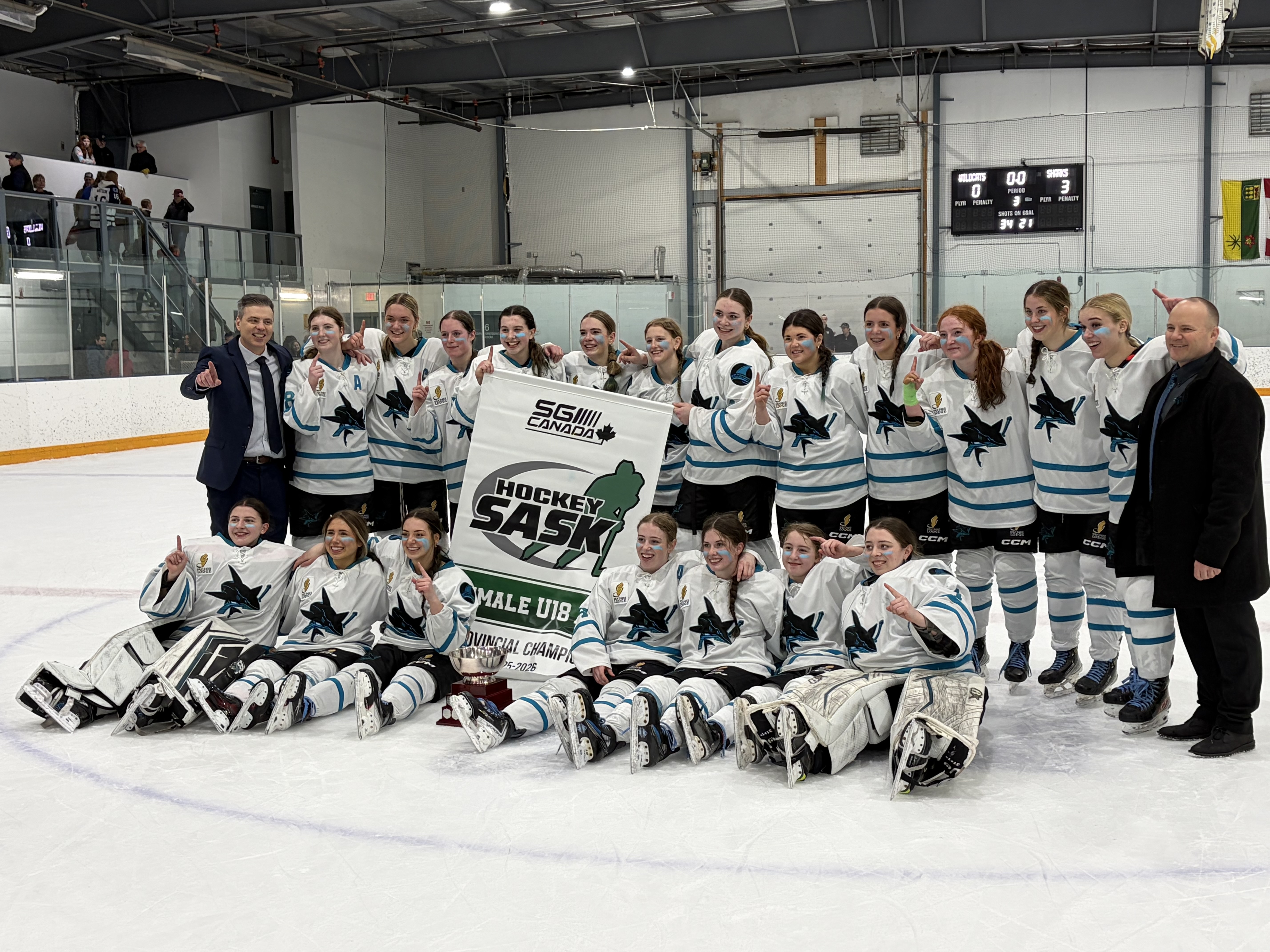
U18AAA Battlefords WPD Ambulance Sharks 2026 Fedruk Cup Champions. Saskatchewan Female U18AAA Hockey League
One Final Test
It’s early April, fresh off our first league championship, and we’re in Manitoba for regionals - a best-of-three series against their league champion with a berth to Nationals on the line. After two intense, high-level games from both teams, we find ourselves in Game 3.
Late in the second period, we’re down 3–1. And in that moment, our identity shows up.
We don’t chase the game. We don’t get away from what we do. We stay with it, shift by shift, and by the end of the period, it’s 3–2. The message heading into the third doesn’t change: Sharks Standard. Play our game. Win the period.
Momentum, as it had for most of the game outside of their goals, stays in our favour. We’re relentless with the puck and dialled in on our details away from it.
Then it happens.
A power play. A shot from the point. The unmistakable ring of the post—and for a split second, everything pauses. Then the puck’s in.
3–3.
Our bench erupts. Our fans erupt. We’re right back in it.
We keep pushing—our game, our way. It feels like we’re one shot away from taking control.
And then, just like that, everything shifts.
A call.
Our captain receives a two-minute-plus game penalty for checking from behind.
In a moment, we’re trying to process everything—the situation, the decision, and the reality that our leader was done for the remainder of the game.
But, like, we have all year; the group responds. They own it.
They sell out on the penalty kill, doing everything they can to make sure this isn’t our captain’s last minor hockey game. We kill it.
The game moves on. Six minutes left and still tied.
We’re tracking into our end with purpose—something that’s become part of who we are.
Then, in a split second, they curl up from deep in our zone and hit a trailing forward. The shot comes from the slot, and I can still vividly see the puck wobble on its way into the top corner.
4–3 them.
We push because that’s what we’ve done from day one.
Final seconds tick away. We get the puck and players to the crease. Six players are all digging for a loose puck. On the bench, we wait. We hope. We want to see the arms go up.
They don’t. We come up short.
That’s the reality.
But walking away from that game, the takeaway wasn’t that we broke.
It was that we stayed consistent.
We were exactly who we said we were—right to the end.
Program Performance Snapshot
From rebuild to championship standard. From 2006 to 2023, over 17 years of league play, the program carried a –962 goal differential. Three years later, it became one of the most dominant teams in the league.
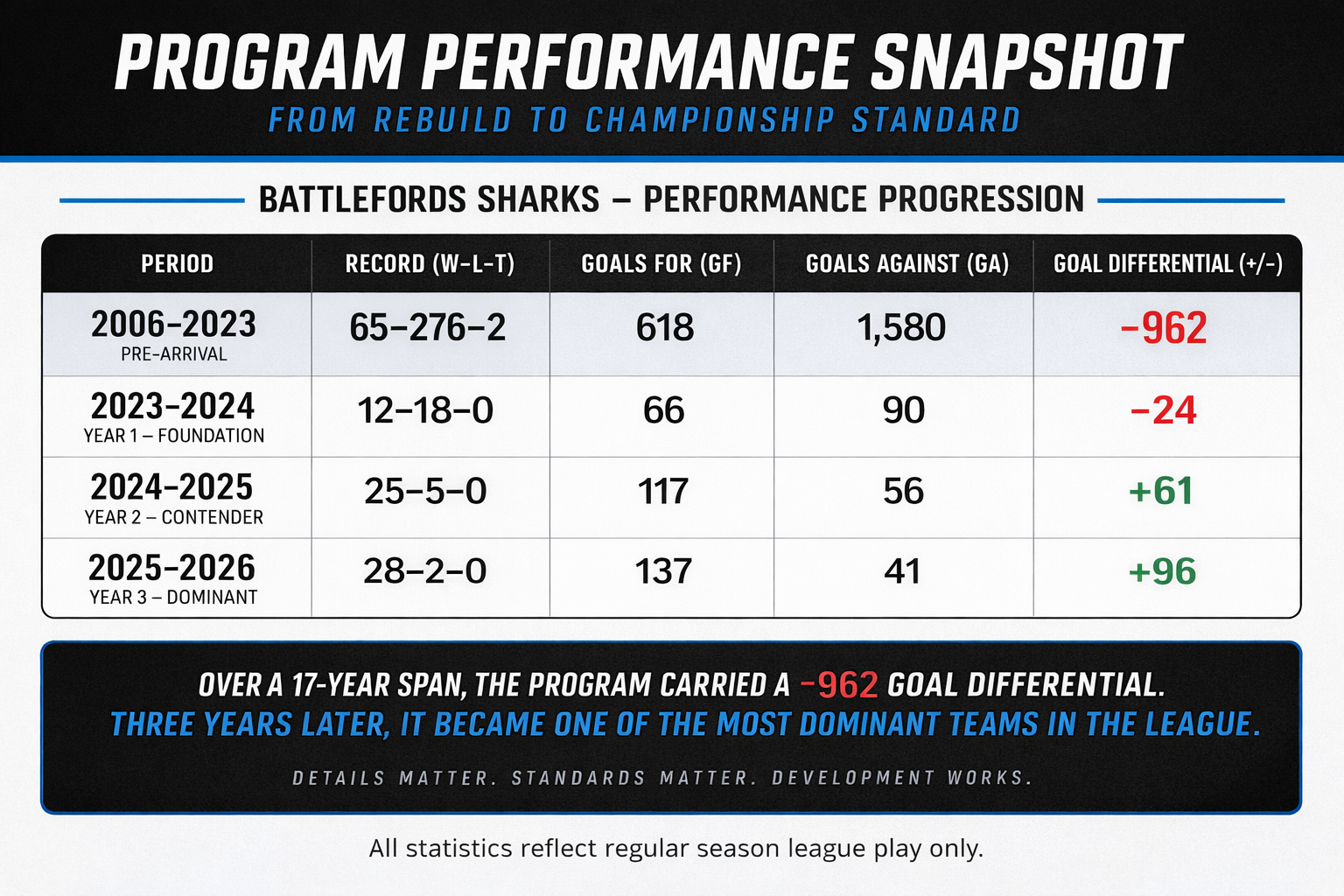
U18AAA Battlefords WPD Sharks – Performance Progression
The Outcome Beyond Wins
While teams, players, and parents are often drawn to success—goals, assists, shutouts, wins, and banners—the ultimate goal has always been something bigger.
It’s about development.
It’s about preparing players to continue their hockey careers—if that’s the path they choose. It’s about supporting young people as they prepare to take on life after high school, minor hockey and other areas that they’ve become familiar with.
From the beginning, that was part of the vision. And over time, it started to show.
In year one, even before the results came, there were signs. College programs began to take notice. The feedback wasn’t about standings—it was about how we played.
There was curiosity. Coaches asked who we were and where we came from.
What stood out was that our players played with purpose. Not for themselves—but within a structure. Within a team. The way the game is played at the next level.
That year, both of our graduating players moved on to play post-secondary hockey in Canada and the United States. In year two, that interest turned into an opportunity.
Programs weren’t just watching—they were recruiting. Players began receiving offers at both the NCAA Division I and USPORTS levels. And by year three, it became a standard.
All eight of our graduating players committed to post-secondary opportunities.
What Actually Matters
This championship team wasn’t built on systems or plays. It was built on clarity, consistency, and accountability—with purpose.
We didn’t become a top team when we started winning. We became a top team when our habits held—when details were embraced, and our culture showed up every day.
Three years ago, this program had no roster. No guarantees. No momentum. Just belief. The 2008 group didn’t inherit a winning program. They built one.
They created an environment where players could be themselves, take risks, find their voice, and grow. And along the way, they won. But that was never the point.
What they built became something bigger. A place people wanted to be. A standard that players wanted to be part of. That doesn’t happen by accident.
None of this was done alone.
The support staff around this group were instrumental. Our health and wellness team created a space where players could be themselves while still being challenged to grow—mentally and physically. Our assistant coach, goalie coach, athletic therapist, team manager, and parents all played a role in building an environment that supported the standard every day.
It starts with a clear vision. But more importantly, it requires people willing to uphold it and live it every day.
Because one person doesn’t build a strong team, they’re built by people aligned in what they’re trying to create.
It happens when a group decides to change the story.
For Coaches Building Something
If you’re building or rebuilding a program, don’t start with systems. Start with what it needs to look like every day.
Define it. Make it visible. Live it. Repeat it until it becomes automatic.
Because when things get hard, and they will, you need something to fall back on. Not emotion. A standard.
And that standard has to be held. That means tough conversations. Tough decisions. Staying true to what you believe, even when it’s uncomfortable. For me, that was a choice. One shaped by what I had seen before and what I knew I didn’t want this to become.
There were no shortcuts. No looking the other way. Everything came back to the team.
Respect was always part of it. But so was clarity.
Because in the end, you’re loyal to people, but you’re accountable to the standard you set for the group.
About the Author
Nolan Horbach is the Head Coach of the U18AAA Battlefords WPD Ambulance Sharks Female program (2023–present) and the founder of Mind Body Hockey, a development-focused training environment centred on skill acquisition, cognitive performance, and mindset.
He previously spent five seasons as an Assistant Coach with the University of Saskatchewan Women’s Huskies (USPORTS), helping the program to a national bronze medal in 2018, and has coached within Hockey Saskatchewan’s Program of Excellence, earning a national silver medal as Head Coach with Team Saskatchewan at the U18 Women’s National Championship.
Nolan holds a Master of Arts in Leadership from Royal Roads University and has achieved Hockey Canada’s High Performance 1 certification, along with multiple coaching-specific credentials. His academic and practical experience shape a holistic approach to development, preparing athletes for success at the next level and beyond.