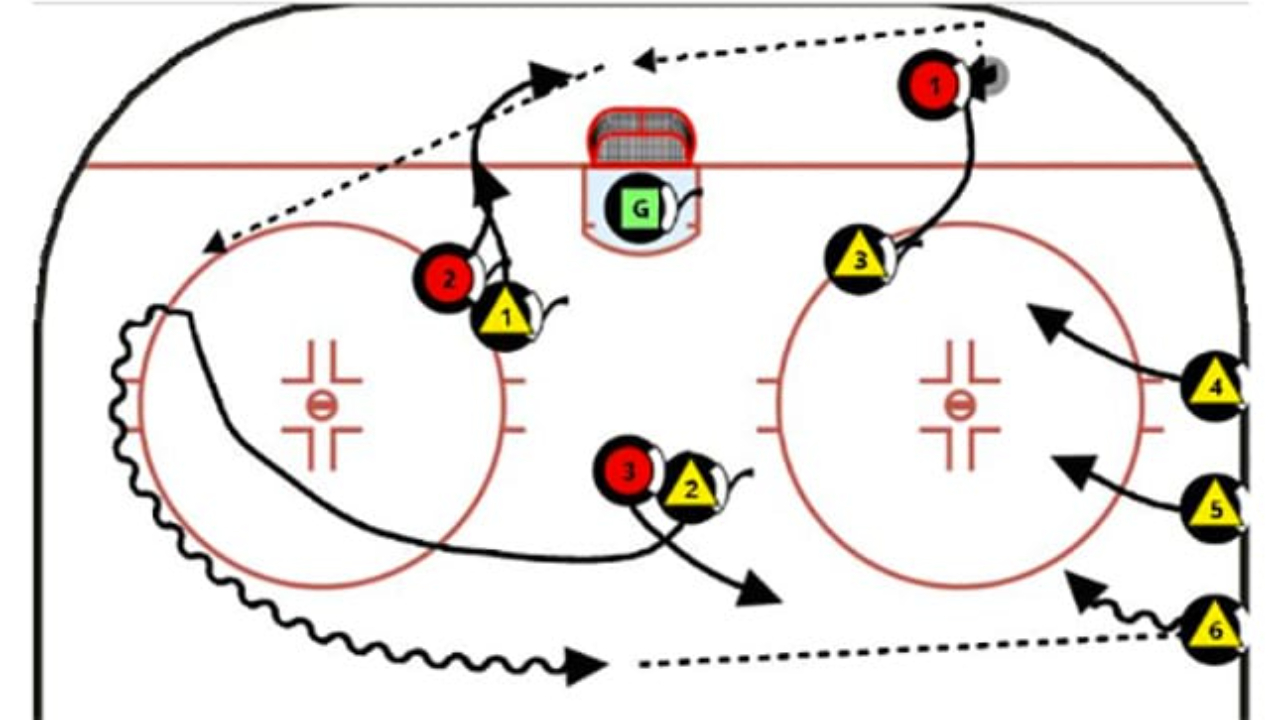
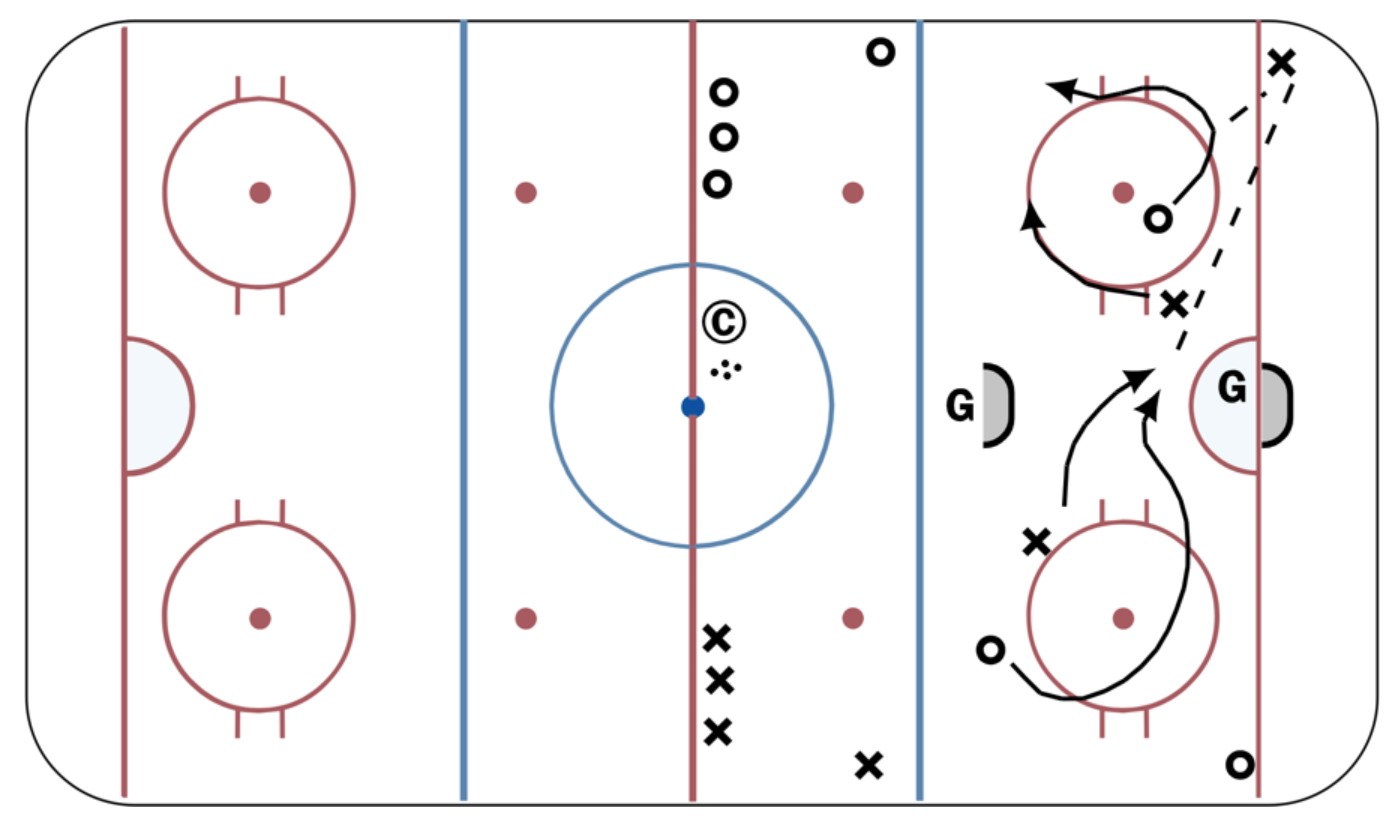
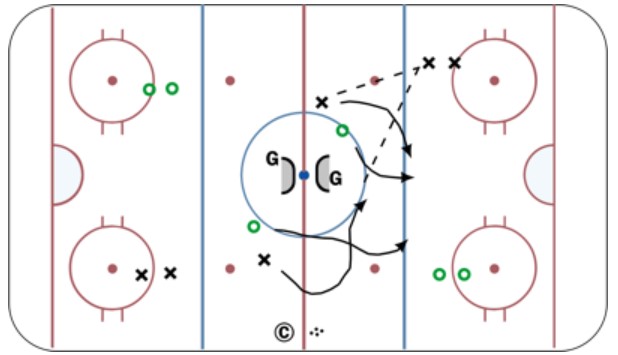
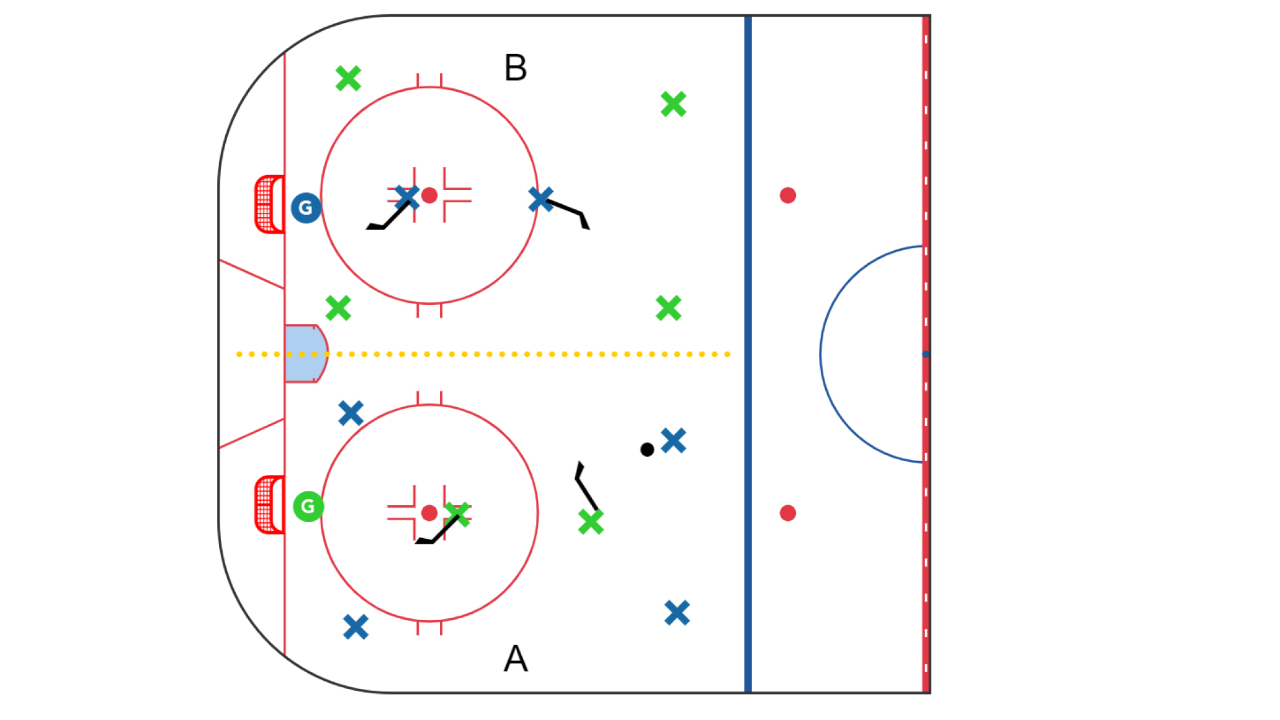
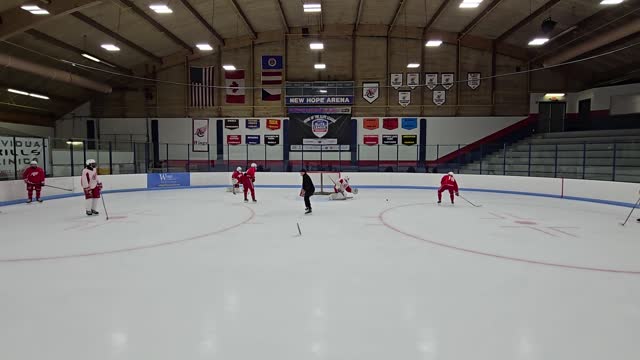
SETUP: Draw lines on the ice with a marker or spray paint as shown. The game can be played with any number of players. Coach and extra players on the walls in NZ, with pucks.
The way the game starts can vary: a faceoff, a dump-in, a pass-in, or a static battle. The offensive team must score within a designated amount of time, which can be varied (30, 45, or 60 seconds).
If the designated time elapses without a defensive clear or a goal scored, the rep ends with no points awarded. If the goalie freezes the puck or it goes out of play before time is up, the rep ends, and the teams are changed without any points awarded.
Switch offensive/defensive teams every rep or every two reps.
Offensive Scoring:
A goal scored from the red areas (anywhere outside the house and middle ice) is worth 1 point. A goal scored from the yellow area is worth 2 points. A goal scored from the green area is worth 3 points.
Defensive Scoring:
If the defense makes at least one breakout pass and exits the zone with possession, it is worth 3 points. If the defense skates the puck across the blue line without any passes, it is worth 2 points. If the defense dumps/chips the puck out, it's worth 1 point.
FOCUS AREAS: Shooting from high percentage scoring areas, quick puck movement, communication, moving to space, puck support, sticks in lanes, battle/compete, defensive coverage, transition, breakout.
KEY TEACHING POINTS (The "IQ" Factor)
1. Space Value Recognition (Offense)
The Habit: Discourage "low-percentage" shots from the Red Zone.
The IQ: Teach players that the Red Zone is for possession and puck protection, while the Yellow/Green Zones are for shooting and scoring. If you are in the Red Zone, your job is to move the puck to someone in a higher-value color or shoot low for a rebound from the Green Zone.
2. Attacking the "Royal Road" (Offense)
The Habit: Moving the goalie’s eyes.
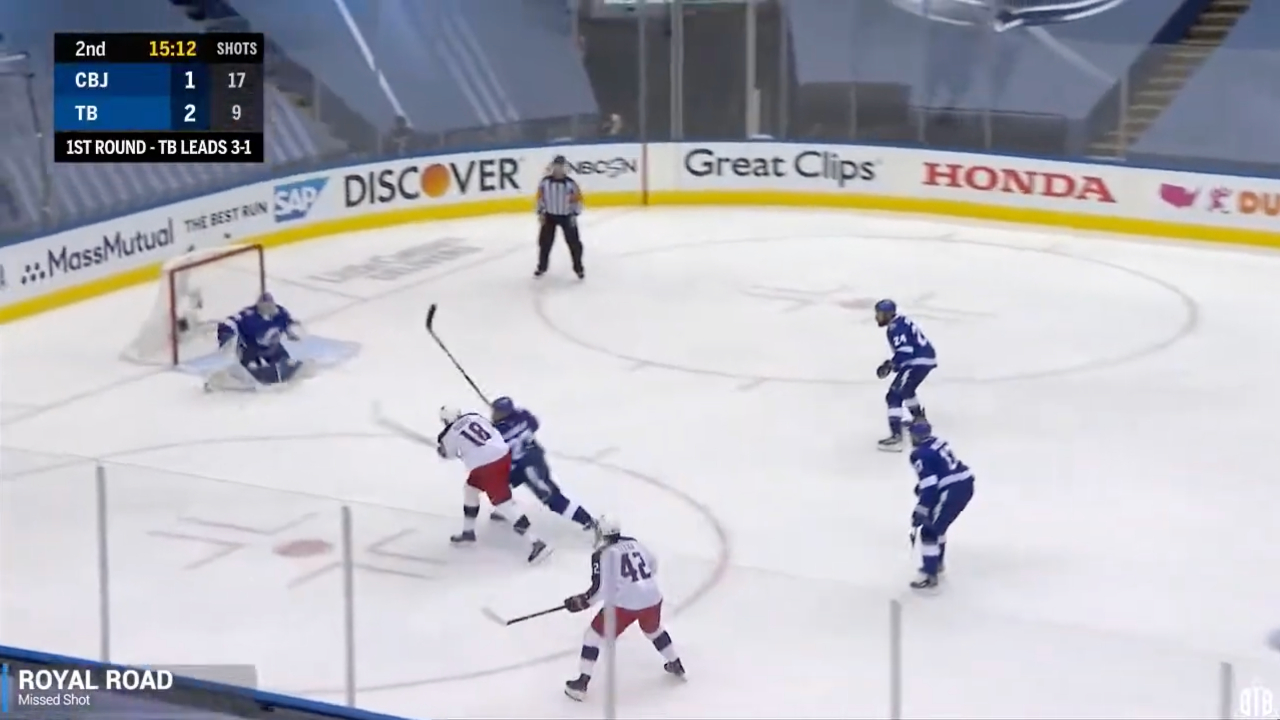
The IQ: A pass across the dashed center line (Royal Road) forces the goalie to reset their angle. This increases scoring probability by over 10x. Players should "hunt" the cross-ice seam.
3. Protect the House (Defense)
The Habit: Defend the House at all costs
The IQ: The defensive priority is to keep the puck in the Red Zones. If the puck enters the Green Zone, it’s a "code red" defensive emergency and all defensive players should collapse into the House to defend.
4. Active Sticks (Defense)
The Habit: "Active" sticks in lanes
The IQ: Since the Royal Road pass is worth so many points (4 or 5), defenders must keep their sticks on the ice in passing lanes, not just chasing the puck carrier.
5. Possession Over Panic (Defense)
The Habit: Stop the "Panic Rim."
The IQ: By awarding 3 points for a pass vs. 1 point for a dump, we train defenders to find their outlet. This builds the "eyes-up" habit required for modern transition hockey.
VARIATIONS/CONSTRAINTS:
- Number of players
- Amount of time per shift
- Reward structure of goals/defensive clears (examples below)
- A goal scored from a pass across the royal road in the green zone is worth 4 points.
- A one-timer scored from a pass across the royal road in the green zone is worth 5 points.
- A defensive clear where a successful stretch pass is executed from the offensive zone into the neutral zone is worth 4 points.
- The "Power Play" Look: Play 3v2, 4v2, 4v3, 5v4, 5v3 to give the offense more time to recognize the color-coded zones.
- The "Transition" Look: On a defensive clear, the Coach immediately chips a second puck back in to see if the D can transition from "Offense" back to "Defense" instantly.
- Two Touch Limit: Players in the Red Zone only get two touches. This prevents over-handling in low-danger areas and forces quick decisions.
- The "Bonus Point" Shadow: Pick one offensive player who is the only one allowed to score from the Green Zone. This forces the other two players to "hunt" for him, teaching them how to manipulate the defense to open up a teammate.