Effectively managing ice time is one of the main challenges for any hockey coach, for goalie coaches it is vital. An advanced method to optimize goalie development is the dynamic structure of drills—an approach that progressively builds difficulty and complexity, while always keeping the focus on technical learning.
What is the Dynamic Structure?
The dynamic structure starts from a basic drill variant and adds, step by step, new elements. This system avoids wasted time from repetitive explanations or moving equipment, and allows you to quickly adapt intensity and difficulty to the athletes’ level.
Why Choose the Dynamic Structure?
Maximize Time, Optimize Learning
When working in a team setting, the time available for goalies is often limited: on average, you get only 10–20 minutes per session, with 2 or 3 goalies on the ice. In these conditions, every second counts. That’s why the dynamic structure is a true game-changer for any goalie coach.
The dynamic structure lets you start with an extremely simple and static version of the exercise, where the goalie focuses solely on the basic technical gesture, free from distractions. This first step helps fix the movement and correct technique. For example, you can begin with a direct shot and the goalie working only on the stick save, stationary in the ideal position.
Once the movement is assimilated, instead of stopping to explain a completely new drill or moving equipment and players, you immediately add a dynamic element:
-
Insert a lateral pass before the shot,
-
Or have the goalie start from the post and move into position (T-push),
-
Or add a second goalie who makes the pass.
In this way, without breaking the rhythm, you gradually increase the difficulty and the game-likeness of the situation. This approach keeps goalies constantly active, minimizes downtime, and allows you to progressively work on multiple aspects: technique, skating, game reading, and coordination.
Within a few minutes, you can reach an advanced version of the drill where:
-
Besides the first shot, the goalie must handle a rebound or a second shot,
-
The players involved are moving,
-
Real game scenarios are simulated, where reactivity and adaptability are crucial.
The concrete advantage? You don’t waste time on lengthy explanations or complicated setups: a brief instruction is enough to introduce the new variant. So, in 20 minutes, your goalies will have completed a full progression from pure technique to dynamic application, never leaving the training flow.
In summary: The dynamic structure lets you maximize effective drill time, adapt difficulty to the level, and keep goalie engagement high. It’s the ideal solution for getting the most out of limited ice time.
Practical Example: Stick Deflection Drill
Step 1: Isolated Technical Focus
-
Goal: Learn the stick deflection technique.
-
Setup: Goalie standing or in butterfly at the top of the crease.
-
Action: Coach delivers a low shot to the side; goalie saves using only the stick.
-
Key: No distractions, maximum focus on the technical gesture.

Step 2: Introducing Movement
-
Goal: Integrate specific skating and technique.
-
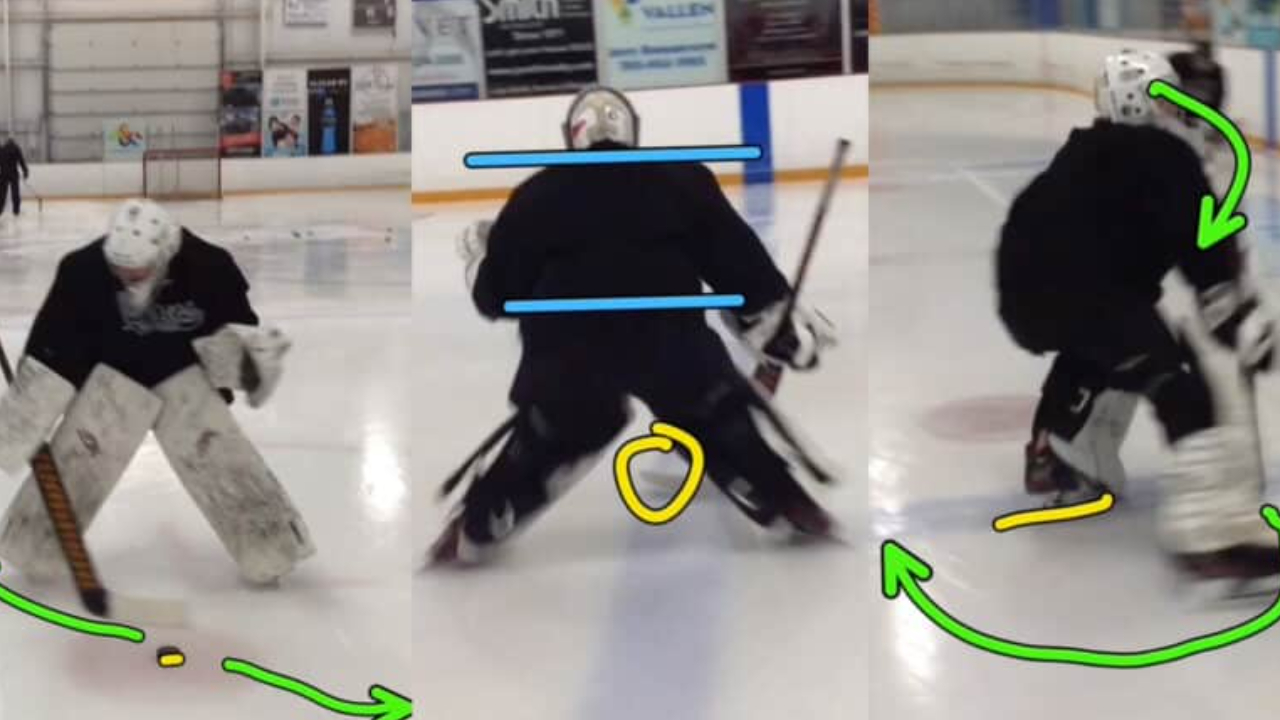
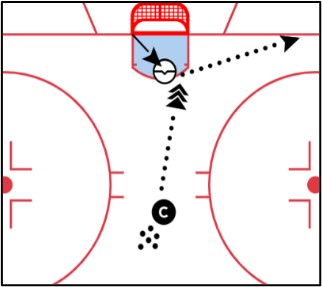
Setup: Goalie starts from the post and moves onto the shooting line (T-push).
-
Action: Acoustic signal for the start; goalie positions and saves the shot.
-
Variant: If there are multiple goalies, one can pass the puck to make the drill more game-like.
Step 3: Dynamics and Coordination
-
Goal: Develop dynamic coordination.
-
Setup: Add movements and direction changes.
-
Action: Goalie moves, maintains alignment, and coordinates the save in a dynamic situation.

Step 4: Recovery and Final Challenge
-
Goal: Train recovery after the save and reactivity.
-
Setup: After the save, the goalie follows the puck, seals the post, and prepares for a new threat.
-
Action: Shooter retrieves the puck and shoots from the faceoff dot, preferably low to keep working on stick deflection.

Practical Tips
Always prepare the basic variant and plan possible additions in advance. This way, you can quickly scale the drill based on your goalies’ responses on the ice, personalizing their technical and tactical development path. Always prepare yourself with different scenarios like you got one or two shooters, or nobody beside you and the goalies.
This structure can be used in every category from Pro's down to U12. Drills and steps need to be adapted at the goalies level (of course).