
Royal Road Goalie Game – Task Sketch Upload
Royal Road Goalie Game
Using East–West Constraint to Shape Scanning, Role Transitions, and Goalie Awareness
By Coach Barry Jones | IIHF Level 3 High Performance | USA Hockey Level 3 Performance
- Designing Small Area Games Series: Above The Net - Solving F3 Support and develops habits
- Designing Small Area Games Series: 3 Player Outlet Game - Solving Breakout Support and develops puck movement habits
- Designing Small Area Games Series: Endzone Outlet Regroup Game - Solving Breakout Support and Regroup Habits habits
- Designing Small Area Games Series: Circle Net Face off Game - Solving Front of Net Behaviours
- Designing Small Area Games Series: Corner Battle Screen Game - Solving Board Battles and Net Front Screen
- Designing Small Area Games Series: Neutral Zone Circle Game - Solving D-to-D Connection and Cross Ice Activation
- Designing Small Area Games Series: Boards to one timer - Solving Board Clearances to outlets
- Designing Small Area Games Series: Asteroids Battle Game - Solving front of the net Clearances to outlets
- Designing Small Area Games Series: Royal Road Goalie Game - Solving S.A.D for Goalies in the Royal Road
- Designing Small Area Games Series: HIT Zone Assist Game - Solving the support problem
Game Overview
Royal Road Goalie Game is a single-net, end-zone game designed to expose how players manage possession, timing, and lateral connection under immediate pressure.
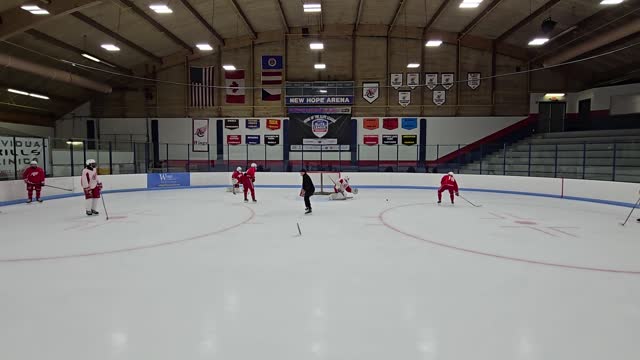
One net is set with a goalie. One skater is positioned in each circle inside the end zone. Play begins with the coach spotting the puck into either circle. Both players compete to win possession, creating an immediate battle for control and space.
The puck winner becomes Offence With the Puck and must protect the puck, scan the environment, and move the puck across the zone to the opposite circle before a shot can be taken. The receiving player becomes Offence Supporting, timing their movement, presenting a passing option, and preparing to attack the net.
If possession changes, the new attacker must move the puck across the Royal Road before shooting. On rebounds, the environment expands into a live 2v2, with both original players joining the play. The task quickly shifts from isolated interaction to collective problem solving.
Game Design Intent
This task is designed to shift attention away from straight-line shooting and toward lateral awareness, connection, and role switching.
By requiring the puck to cross the zone before a shot, the environment creates a recurring problem, how to attack a net when immediate shooting is removed as the primary option. Players must recognise pressure, manage deception, and connect with a teammate before offence can emerge.
The rebound-triggered transition to 2v2 increases complexity without stopping play. Players must adapt to a sudden change in numbers, space, and responsibility, mirroring real game moments where structure breaks and reforms quickly.
The Royal Road constraint is not teaching a tactic. It is shaping perception, forcing players to see and use space that often goes unnoticed under time pressure.
4 Role Ecology in Action
Offence With the Puck
The puck carrier is challenged to protect possession while scanning for lateral options. With shooting delayed, deception, body positioning, and patience become functional behaviours rather than coached instructions.
The attacker learns that moving defenders is often more valuable than beating them directly.
Offence Supporting
The player in the opposite circle is not a static receiver. Their effectiveness depends on timing, availability, and readiness to attack once the puck arrives.
As play becomes live 2v2, supporting players must immediately adjust spacing to stay connected for second touches, rebounds, or quick strikes, reinforcing that support is an ongoing process rather than a fixed position.
Defence On the Puck
Defenders apply immediate pressure to contest possession and disrupt the lateral pass. Stick positioning, body alignment, and pressure timing become critical as defenders attempt to influence puck movement without overcommitting.
Because shots are delayed, defenders learn to manage space and patience rather than chase immediate outcomes.
Defence Away From the Puck
Off-puck defenders read passing lanes, protect the middle, and anticipate transitions once possession changes. The Royal Road constraint heightens the importance of scanning and communication, as denying east–west movement often matters more than attacking the puck.
Roles are not assigned by the coach. They emerge as players interact with the changing demands of the environment.
Goalie Ecology
Goalies experience a high-information environment shaped by traffic, lateral movement, and delayed shooting.
The Royal Road constraint increases east–west puck movement, requiring goalies to stay square through passes, adjust depth on lateral plays, and manage sightlines through bodies. Rebound situations rapidly change the context, demanding quick recovery, emotional regulation, and repositioning.
Goalies are challenged to manage S.A.D, spacing, angle, and depth, while communicating through developing chaos. The task reinforces that goaltending is a perceptual and decision-making skill, not just a technical one.
Why This Task Works
Royal Road Exchange creates an environment that thinks back. Players are not rewarded for speed alone, but for awareness, timing, and connection.
By shaping how and when shots can occur, the task encourages players to recognise pressure, exploit space, and transition seamlessly between roles. The behaviours that emerge are not rehearsed solutions, but adaptive responses shaped by the game itself.
This makes the task highly transferable. The habits developed hold up under real game conditions, where lateral awareness, role clarity, and rapid transitions often determine success.
Author Bio:
Barry Jones is an IIHF Level 3 High Performance Coach and USA Hockey Level 3 Performance Coach. His work blends ecological dynamics, nonlinear design, and athlete-centred leadership to build adaptive teams that thrive in uncertainty.