Asteroids Battle Game
Using Net-Front Pressure and High Soft-Ice to Shape Transition and Role Awareness
By Coach Barry Jones | IIHF Level 3 High Performance | USA Hockey Level 3 Performance
- Designing Small Area Games Series: Above The Net - Solving F3 Support and develops habits
- Designing Small Area Games Series: 3 Player Outlet Game - Solving Breakout Support and develops puck movement habits
- Designing Small Area Games Series: Endzone Outlet Regroup Game - Solving Breakout Support and Regroup Habits habits
- Designing Small Area Games Series: Circle Net Face off Game - Solving Front of Net Behaviours
- Designing Small Area Games Series: Corner Battle Screen Game - Solving Board Battles and Net Front Screen
- Designing Small Area Games Series: Neutral Zone Circle Game - Solving D-to-D Connection and Cross Ice Activation
- Designing Small Area Games Series: Boards to one timer - Solving Board Clearances to outlets
- Designing Small Area Games Series: Asteroids Battle Game - Solving front of the net Clearances to outlets
- Designing Small Area Games Series: Royal Road Goalie Game - Solving S.A.D for Goalies in the Royal Road
- Designing Small Area Games Series: HIT Zone Assist Game - Solving the support problem
Game Overview
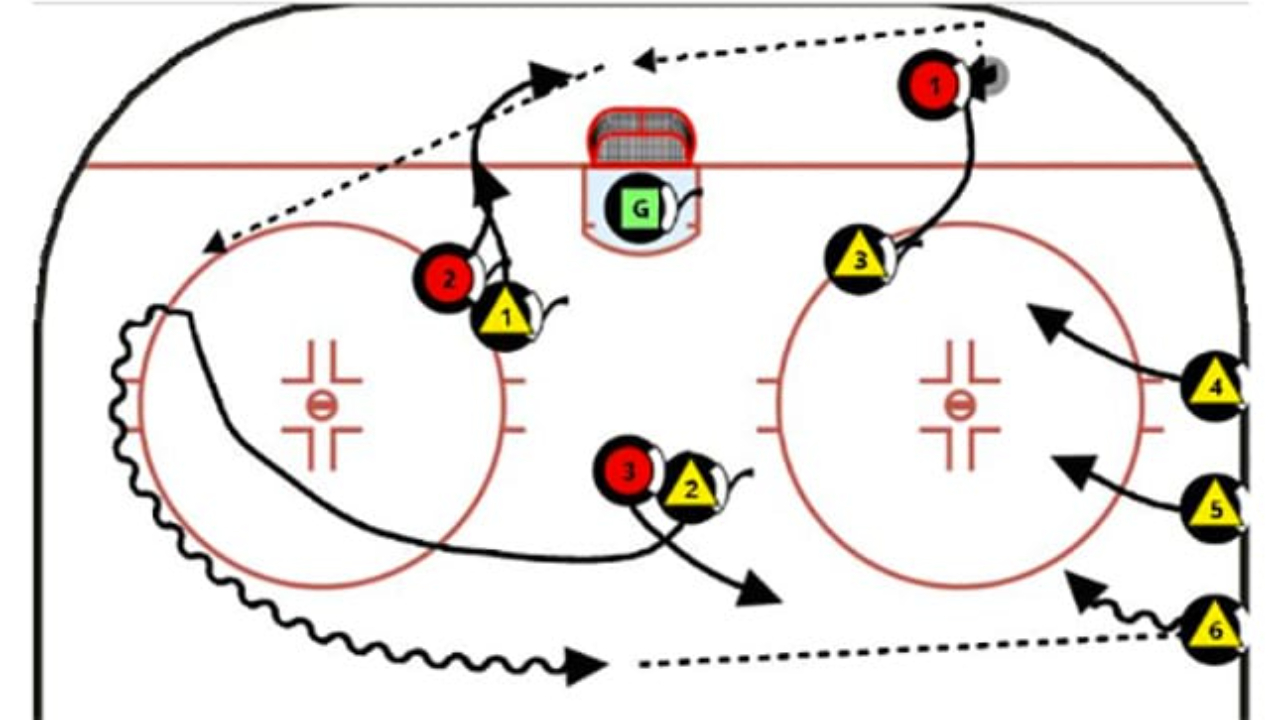
Cross-Ice Outlet Exchange is a split end-zone, cross-ice game designed to expose how players manage pressure, outlet decisions, and rapid role transitions in tight space.
One end zone is divided into two attacking zones, each with its own net and goalie. An east–west line is placed just above the circles, creating a high soft-ice zone between the two attacking areas. Play begins with the coach spotting the puck into either zone.
In each attacking zone, two attackers and one defender battle net-front, while a second defender is positioned high between the circles. The net-front defender’s primary challenge is to win possession under pressure and connect the puck to the high defender. From there, the high defender must scan and move the puck east–west across the middle line to activate the attackers in the opposite zone.
If possession changes in either zone, responsibility immediately shifts. The new defender must locate the high outlet to continue the transition sequence, creating constant movement between roles without stopping play.
Game Design Intent
This task is designed to connect net-front battles with decision-making in soft ice.
By separating pressure zones from the outlet zone, the environment creates a recurring problem, how to exit pressure without forcing play or losing structure. Players are challenged to recognise when possession is secure, where support exists, and how quickly the environment changes once the puck moves east–west.
The requirement to transition through the high defender prevents isolated battles from becoming dead ends. Instead, every possession carries the potential to flip the problem to the opposite side, reinforcing that offence and defence are linked through connection, not effort alone.
The result is an environment that rewards scanning, patience, and awareness while maintaining game-speed chaos.
4 Role Ecology in Action
Offence With the Puck
Attackers receiving the puck off the cross-ice pass are immediately placed in an attacking role with advantage. Shot selection, deception, and puck protection emerge naturally as players adapt to lateral feeds and moving defenders.
Because offence is activated through connection rather than recovery, attackers learn to recognise when to attack space versus when to stabilise possession.
Offence Supporting
Supporting attackers in the opposite zone must manage timing and spacing before the puck arrives. Their role is shaped by anticipation rather than reaction, staying available for lateral feeds, rebounds, or quick secondary actions once the puck crosses the middle.
Support becomes a function of reading the outlet, not following the puck.
Defence On the Puck
Net-front defenders operate under constant pressure. Winning possession requires body positioning, stick detail, and balance rather than chasing outcomes.
Once possession is gained, defenders must immediately shift perception from battle to connection, recognising the high outlet as a continuation of defence rather than a separate task.
Defence Away From the Puck
The high defender occupies a critical ecological role. They must read pressure, scan both attacking zones, and manage passing lanes while staying available as an outlet.
Away-from-the-puck defence becomes about information gathering and anticipation, not static positioning. As possession changes, roles reverse quickly, reinforcing adaptability.
Roles are not assigned by instruction. They emerge as players interact with pressure, space, and time.
Goalie Ecology
Goalies experience a demanding lateral environment shaped by traffic, cross-ice passes, and rapid puck movement.
Tracking through bodies, staying square on east–west feeds, adjusting depth, and managing lateral pushes are constant demands. Because shots often arrive following puck movement rather than recovery, goalies must read developing threats and stabilise rebounds to prevent secondary chances.
The pace of transitions requires quick recovery and emotional regulation, reinforcing that goaltending is about managing sequences, not isolated saves.
Why This Task Works
Cross-Ice Outlet Exchange creates a game that thinks back. Players are rewarded for recognising connection, managing pressure, and transitioning between roles without losing awareness.
The constraints ensure that learning is shaped by the environment rather than instruction. Net-front battles, high outlets, and cross-ice activation combine to create a task where hockey sense emerges through interaction.
The behaviours developed in this environment transfer directly to the full game, where pressure, soft ice, and rapid role switching define success.
Author Bio:
Barry Jones is an IIHF Level 3 High Performance Coach and USA Hockey Level 3 Performance Coach. His work blends ecological dynamics, nonlinear design, and athlete-centred leadership to build adaptive teams that thrive in uncertainty.