This is a debate that has been at the front of mind for many young goalies and coaches. There are many different opinions on the topic both technical and tactical, however there is not enough emphasis on the why. We still have an epidemic of studio coaching in North America, especially with rising ice costs limiting the amount of time and space to train young goalies. There needs to be three steps in the learning process to help goalies train technique but IQ as well. Often we learn in a vacuum (the studio) in a goalie camp or session, some times we are able to have the goalie coach attend practice but we rarely get the opportunity to have influence over a team drill or do game review with young goalies. The most effective process is to first learn in a training environment where the goalie can learn in a low stress environment, with a lot of feedback. The team practice environment with a goalie coach present will then help the goalie to execute in more of a “live” environment with feedback from the GC. Game video review will help the goalie see where they were successful.
Overlap: Where the goalie’s post side foot/leg is set just outside the post, creating double coverage but putting the goalie at the most optimal position on the initial shot. The overlap is a bad to dead angle coverage option, best used off the rush. It is most optimal with a short side threat and no backdoor option on the play.
Reverse Vertical Horizontal (RVH): Is a shoreside blocking technique best used only on dead angle plays, with pass options. The RVH is best used when the puck is above the goal line and inside the dot lane. The goalie needs to be able to articulate on the post to change their position base on the hand of the shooter and the location of any pass threats.
The RVH has unfortunately become a “hope” save, where many young goalies train in a controlled environment with little to no risk. Hope - meaning, I drop into this one position the exact same way, every time and hope the puck hits me. We often train for technique with multiple reps in the “same” manner. IF you watch a goalie session RVH is most often done with one to two shooters and the attack often is done the same path with little to no variation.
Pro Video: In these videos we have Linus Ullmark of the Ottawa Senators with an excellent demonstration of when and how to use the Overlap and RVH. What you want to look for is the type of play, the options and the recovery. In both clips we will see Ullmark identify the immediate scoring threat, then continuously look off the puck or “track” who and where the secondary threats are.
2 skaters start off the wall at the same time. The skater lower on the wall starts with a puck. Both circle around a marker, and the player with the puck hits their partner at the top of the zone.
Skater catching the pass drives the net and shoots.
Skater who passed continues up to the top marker and turns to receive a pass from the coach in the corner. Original shooter stays at the net for a tip/screen. Second player shoots through the traffic.
Players focus on speed through the drill. Encourage them to receive passes and release quick shots. No extra stickhandling. Shots should come quick and from a distance that is playable for a tip/screen.
Squirt Based drill, but could be used at other levels to move pucks and work on smooth handling.
Crossover lane: players are using the numbers on the ice 123, 123, 123 to carry the puck and crossover 3 times to each side as they work from goal line to far blue line.
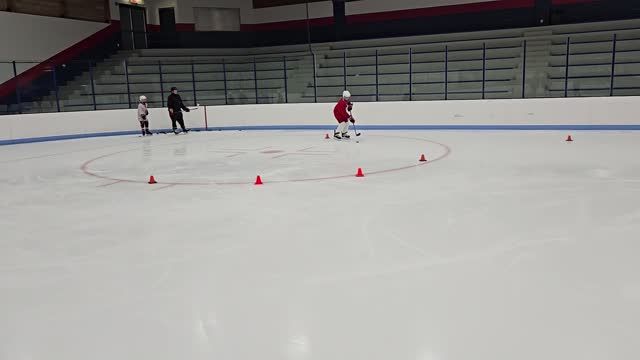
Alternating Dots: players should work to keep their bodies in the middle of the dots and move the puck from side to side, working to get the puck to touch each dot as they move. Speed is not a necessity here.
Arches: Skater is asked to keep body in a straight line through the middle of the arches. The puck should be moved around the body in a arch pattern side-to-side. Players are encouraged to get the puck from one pocket to the other and back. Speed is not a necessity on this lane.
Skater 1 in the inside lane drives the net and shoots quickly. As soon as they shoot, they should turn towards the wall and look for a puck that is chipped by a coach.
Skater 1 imediately passes up the wall to player 2 who is waiting at the blueline. Player 2 receives pass and steps quickly to the inside and drives the net to shoot.
Skater 1 follows pass up the wall and quickly skates a loop around both cones. Player 2 turns towards the wall to also receive a chipped puck from the coach. Player 2 looks to find Skater 1 finishing their loop and gives a pass for the 3rd drive towards the net.
Players should change lines after each rep.
Encourage quick feet, sharp passes, and quick shots at the net. Focus should also be put on making passes to the correct side of the receiver's body.
Drill starts with some figure 8 skating and puck control. Skater then leaves puck for next person in line. Skater should immediately drive off the wall and around the arc of cones.
Player in corner must select a passing lane to pass through and hit the skater in stride.
Skater receiving puck should be ready to snap off shots right away. They are encouraged to have an on-the-tape/off-the-tape mindset, and working to catch the puck on their forehand.
Squirt/PeeWee based drill to work on different slip techniques and angles.
Transition footwork, forward skating, and cutback skating.
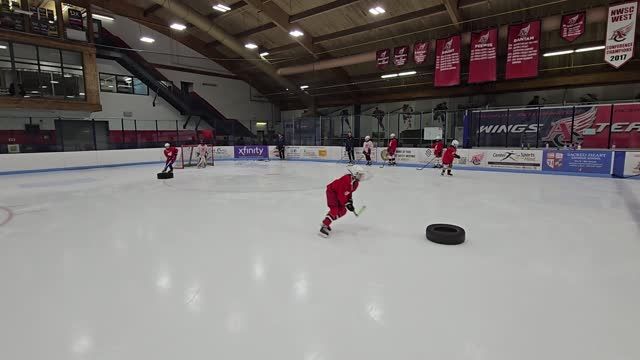
Skaters are encouraged to work their body control, and really give up the puck to get it back. They should not just push pucks and drag their stick over the top of the tire, but really try to give up possession and move around something to get it back.
Outnumbering to advance the puck on net or out of tight spaces is an offensive tactic used by smart hockey players. In the clip below a 3 on 3 is turned into an offensive 2 on 1 because the two offensive players isolated on the strong side defensemen to create a quality opportunity to advance the puck on net to create a scoring chance. The result, a goal is scored and the offensive team exploited the defending team with their execution of a quality offensive tactic.
Players without the puck must find open ice and support the puck carrier to create outnumbered situations and set passing lanes to advance the puck. You’re a better offensive team when you support the puck as a group in all areas of the ice to advance the puck.
Outnumbering your opponent to create an odd man advantage is a basic fundamental offensive tactic that is under emphasized by coaches. You don’t need systems to create scoring chances you need players with strong technical hockey skills combined with sound knowledge of fundamental tactics of the game that haven’t changed in the past 100 years.
Excellent Example of Outnumbering & Offensive Puck Support – 3 on 3 becomes a 2 on 1
Young hockey players should be taught the 3 on 2 Attack Rush as a “Pressure” tactic because it requires speed and skills to effectively execute the play. Young players should be taught tactics that support the development of their technical hockey skills:
Skating,
Shooting,
Passing,
Checking,
Stick Handling (Puck Control).
The 3 on 2 Attack Rush should be played as a pressure tactic for the following reasons:
Forces the opponent to provide excellent back pressure support from their forwards or they will get beat by proper execution of the play.
Takes advantage of the odd player advantage situation when executed properly.
Takes advantage of your teams speed and skills.
Forces the D pairing into man on man coverage which creates an “open” offensive (shooter) player.
Creates quality passing and shooting lane options.
Execution Keys:
The puck must be moved to the player in the outside lane at or just before the blue line,
The player in the outside lane should try to beat the strong side D to the outside with speed and take the puck deep into the zone to force man on man coverage,
The player in the outside lane can take the puck in behind the net or delay and turn back should there not be a play option on net off the Attack Rush,
The offensive player taking the puck wide and the player(s) without the puck driving the net (middle or outside lane) must use their speed,
Players driving the net must have their stick on the ice (target) for a pass and be ready to receive the puck,
Players driving the net should try to get on the offensive side of the puck (between defender and the player with the puck),
The width and depth of the offensive zone should be used to create time and space,
Setting of quality passing lanes by the players without the puck,
One of the players without the puck should drive the middle or outside lane (weak side) to force the weak side D into man on man coverage,
Forward 3 without the puck control skates into open ice (soft spot) above the puck in the slot and sets a quality passing lane.
Players go to the net hard, sticks on the ice to receive a pass, rebound or deflection opportunity on the net.
Player Development Focus
Driving the net hard with speed and skill is one of the best plays in hockey. Teach the kids the 3 on 2 Attack Rush with speed so that can add the skills learned to their tool box.
NHL Video Clips (3) of the 3 on 2 Played with Pressure:
The days of the “Stay at Home Defensemen” should be a thing of the past. Teams today are looking to recruit athletic defensemen who are strong skaters with excellent technical hockey skills. Of course size matters and is part of the player profile but in today’s game speed and skills should trump a size requirement.
Strategy and tactics have become such an important part of today’s game. Every coach is looking to take full advantage of the ice surface and the speed and skills of the athletes to create a winning formula. The Offensive Game Plan of the top teams these days includes the defensemen in the strategy and tactics of the game in all areas of the ice surface without restrictions.
Teams that play fast understand that supporting the puck offensively and defensively in all three zones is critical to winning the puck possession game. You win the puck possession game and you win the hockey game. There is no better way to win the puck possession game than making full use of your resources on the ice surface to control the puck and advance the puck on the opponent’s net. Spend the least amount of time possible in your own end of the rink.
Mobile Defensemen – Part of the Offensive Game Plan
The following are examples of the things defensemen are being asked to do as part of the Offensive Game Plan to win the puck possession game and create scoring chances, such as but not limited to:
Joining the Attack Rush with the forwards in the neutral zone.
Coming down off the point into the offensive zone (OZ) to set a passing & shooting lane.
Coming down off the point to obtain a loose puck in the corner, weak or strong side (deep into the OZ) to maintain puck possession and control.
Working the Give and Go play to get the puck back in all three zones of the rink to be part of advancing the puck on the opponent’s net.
Coming down off the point on a face off win to take the puck down the wall below the goal line and advance the puck on net.
Coming late deep into the OZ on the Attack Rush to set a passing and shooting lane.
Moving to open ice to create a passing lane in the OZ to support the puck carrier.
The video below provides you with examples of some of the tasks defensemen are performing in today’s game to support the puck offensively. You’re encouraged to work with young players to support their development by helping them acquire these skills and abilities so they can play at the next level.
The teaching and coaching of the “Rotation” concept ensures coverage for Defensemen and the success of their engagement in your Offensive Game Plan.
The Youtube video provides examples of tactics performed by Defensemen in today’s game.
Goal scorers know the importance of entering and exiting the neutral zone (NZ) with speed and puck control. These players know the shortest distance to your net is through middle ice (between the dots) so you’d better be prepared to defend this area. It’s much harder for a puck carrier to take the puck wide outside the dots and beat a defender with speed to the outside and drive the net than it is to take the puck directly at a defender, push it through or by them and pick it up on the other side. In the video clip below the puck carrier has full puck control in the neutral zone and he is able to beat two defenders by pushing the puck through and by the defenders, picking it up on the other side of them, to go in all alone on the goalie. Lucky for the defenders, the puck carrier didn’t score on the play. The talented player with the puck makes the two defenders look bad because of their failure to defend against a play that should be easy to defend.
The following are the keys to defending middle ice in the neutral zone:
• ProperAnglingTechnique: the ability to exercise (use) inside out control on a puck carrier by controlling/protecting middle ice and forcing the puck carrier to the outside. Taking the correct approach angle toward the puck carrier is key. The defender must judge the skating ability and speed of the puck carrier because the only option for the puck carrier is to take the puck wide and beat the defender with speed. The player angling the puck carrier must get shoulder to shoulder with the opponent and NOT reaching first before playing body|stick|puck. A player who has mastered Angling Technique & Fundamentals never gets beat to the inside.
• PlayingBody|Stick|Puck: the ability to be in a good hockey position; right amount of knee flexion, butt out with chest over thighs, weight on the inside of your feet in good balance to get shoulder to shoulder with the puck carrier to separate the player from the puck with your shoulder and get your stick under the puck carrier’s to gain access to the puck in the same motion. The puck separation through the checking motion is non violent. The goal is to regain puck possession, not to knock the player over or down.
• DefensemenDefendingtheBlueLine: the ability to defend the blue line requires the defensemen to be able to match the speed of the oncoming puck carrier by backward skating between the dots (protecting middle ice) and giving the puck carrier ONLY one option to beat him and that is to the outside. The defensemen’s partner must be playing between the dots as well backing up a couple stick lengths at most apart from each other to protect middle ice. A defensemen must have the skills and abilities to pivot to the outside and use speed to close the gap and get into the puck carrier taking away space forcing the puck carrier to the wall. Defensemen must play tight GAPS in the neutral zone to ensure their ability to match an oncoming forwards speed with the puck at their blue line and play one stick length GAP at the blue line. A skilled defensemen doesn’t give away the blue line by continuing to back up when there is defensive back pressure support from forwards.
• DefensemenOneonOnePlay – Body First and NOT the Puck: the ability of a defensemen to defend against a puck carrier in a One on One situation with the puck carrier entering the offensive zone requires strong fundamentals.
The following fundamentals must be adhered to if you’re going to prevent yourself from being beat One on One by a forward carrying the puck into the offensive zone: – Back up between the dots, protect middle ice. – Match the puck carrier’s speed with your backward skating speed. – Good posture matters and assures the ability to remain in balance, weight never forward on your toes. – Never allow the puck carrier inside your stick length, if you do, you’re beat. – Eyes on the puck carrier’s sternum (chest) NOT on the puck. Your peripheral vision allows you to see the puck while your eyes are on the chest. – Keep your stick arm bent at the elbow so that you can poke or sweep check effectively. Never out reached with a straight arm fishing with weight forward on your toes. – Always keep your body between the puck carrier and your net and get your shoulder into the puck carrier when playing the body. – Timing of your Pivot is key to being able to close the gap and stay with the puck carrier as your force him wide (outside the dots) towards the wall.
VideoBreakdown
In the clip below the following mistakes were made resulting in the puck carrier being able to take the puck the shortest distance to the net (between the dots):
• Defender #26 stopped skating when he attempted to angle the player wide and chose to reach and play the puck instead of getting shoulder to shoulder and play body|stick|puck. Never play puck first and reach when you’re angling an opponent. • The Defensemen made the following mistakes in his execution of the One on One: – Backward skating speed didn’t match the opponent’s forward skating speed, – Weight was forward on the toes and he was reaching with his stick too far forward to playing puck, – Eyes were on the puck NOT the opponent’s chest, – Played the puck first instead of the body, – Allowed the puck carrier inside his stick length which is always fatal, – Failed to force the puck carrier wide and gave away middle ice.
DevelopmentFocus Young players are reminded to focus on proper technique and fundamentals. There is right and wrong way in executing fundamentals, no easy way. Good players practice what they are weak at not their strengths. If you’re aspiring to play at higher levels of competition, focus on fundamentals.