
We dive into some body contact skills this week!
 00:00:00
Individual Skills Hockey Podcast Episode 1 - Can You Teach Hockey Sense?
Hosted by Miles Death, the Individual Skills Hockey Podcast is aimed at bringing quality education to youth hockey coaches, parents, and players. Our mission is to have a positive impact on the crazy youth hockey world.
Ben Monahan joins to discuss all things hockey sense! We discuss strategies to foster an environment where players are developing their hockey sense, factors that contribute to a propensity to learn sense more quickly, and much more!
 00:00:00
Individual Skills Hockey Podcast Episode 2 - Pete Samargia: All Things Goalie Development
Hosted by Miles Death, the Individual Skills Hockey Podcast is aimed at bringing quality education to youth hockey coaches, parents, and players. Our mission is to have a positive impact on the crazy youth hockey world.
We sit down with Pete Samargia of Attitude Goaltending to discuss all things goalie development. Pete played HS goalie for Eveleth-Gilbert, and went on to play for the University of Minnesota and Augsburg College. He now serves as the goalie coach for Wayzata HS, Dubuque Fighting Saints in the USHL, St. Cloud Norsemen in the NAHL, and Northstar Christian Academy. Pete owns and operates Attitude Goaltending, a goalie training company in the metro area.
 00:00:00
Individual Skills Hockey Podcast Episode 3 - Barry Karn: Glide Platform Training Method
Hosted by Miles Death, the Individual Skills Hockey Podcast is aimed at bringing quality education to youth hockey coaches, parents, and players. Our mission is to have a positive impact on the crazy youth hockey world.
Barry Karn of Karn Skating Dynamics sits down with us to discuss skating technique, the importance of vision, and other topics as well! This is a don't miss episode!
 00:00:00
How to Plank Correctly (and Why It Matters for Hockey Players)
How to Plank Correctly (and Why It Matters for Hockey Players)
The plank looks simple, but it’s one of the most butchered exercises in hockey training.
Most players rush through it. They hold it for time, their hips drop, their ribs flare, and they think they’re training their core. They’re not.
The plank is one of the first building blocks of hockey athleticism. It teaches your body how to create stability through your trunk so you can transfer force more efficiently when you skate, shoot, or battle in the corners.
If you skip this step, everything built on top of it suffers. You can’t be explosive if your core can’t control that power.
Why the Plank Matters for Hockey Players
Every stride starts with a stable core. If your trunk can’t hold tension and control movement, the power from your legs doesn’t fully transfer through your body. You end up leaking energy instead of driving it into the ice.
A proper plank builds bracing, alignment, and control — three things that show up in every movement you make on the ice.
-
Your hips stay level when you push off.
-
Your upper body stays quiet when you shoot.
-
You can rotate with power without losing balance.
It’s the foundation. Without it, your speed and strength don’t transfer.
How to Do It Right
Here’s what to focus on when you plank:
-
Elbows directly under shoulders.
Don’t reach forward. Stack your joints so your shoulders and core can stay active. -
Brace your core.
Pull your ribs down and tuck your hips. Your body should feel solid from head to toe. -
Neutral spine.
Don’t let your hips sag or lift too high. Your body should form a straight line — ear, shoulder, hip, knee, ankle. -
Breathe under tension.
Inhale through your nose, exhale through your mouth. Stay tight, but don’t hold your breath.
Start with short holds — 15 to 30 seconds of perfect position — before adding time or movement.
The Bottom Line
The plank isn’t just a “core” exercise. It’s a movement foundation.
When you learn to control your trunk, every stride, shot, and change of direction becomes more powerful.
If you want to skate faster, be stronger on your edges, and stay injury-free, start by mastering the basics.
Train with purpose. Play with confidence. Build from the ground up.
About the Author
Travis Martell is the founder and head coach of Martell Elite Fitness, specializing in off-ice development for hockey players.
📲 Follow on Instagram: Instagram.com/@martell.elite.fitness
 00:00:00
Offensive Tactics: Skills and Drills with Coach Guido Lamberti-Charles from Euro Elite Hockey Development
Offensive Tactics: Skills and Drills with Coach Guido
Effective offensive strategies are crucial for any hockey team aiming to dominate in the offensive zone. These strategies involve teamwork, communication, and, most importantly, adaptability. In this blog, we discuss offensive zone hockey skills drills with seasoned Skills Coach, Guido, as he emphasizes their importance and shares customized drills to refine these essential tactics.
Guido brings over 20 years of extensive experience as a coach and player developer across various countries, including North America, Germany, Belgium, Austria, and Italy. He has coached at university, U18 Prep, Bantam AAA, and professional levels. Currently, Guido is the Head Coach of the SFU BCIHL Team and the Owner of Euro Elite Hockey Development in Vancouver, BC.
Guido highlights that effective offensive strategies require a deep understanding of teamwork and communication. Players must work together seamlessly, anticipating each other's movements and making quick, accurate decisions. As a Skills Coach, Guido customizes drills to enhance individual players’ offensive zone skills. By focusing on passing accuracy, quick puck movement, and strategic positioning, he helps players develop the adaptability needed to exploit opponents' weaknesses.
Guido also shares his experience with CoachThem:
"I’ve been using CoachThem for quite a few years now. I can't imagine working without it."
Top 3 Drills:
1. Low rim release from Event zone
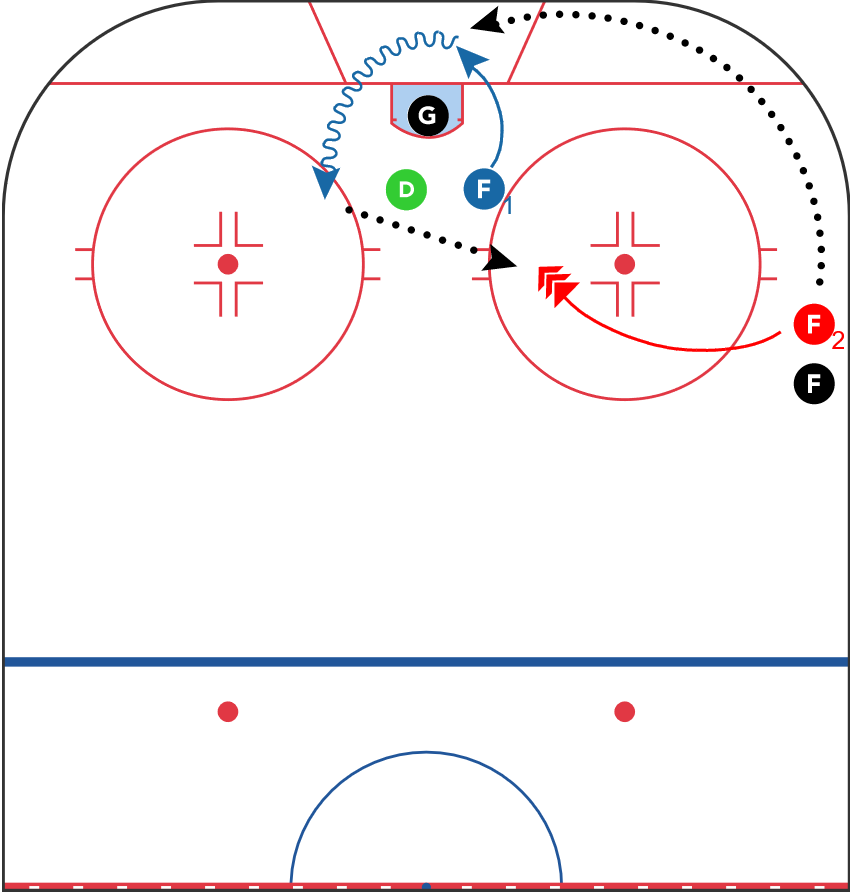
In the 10xhockey system, executing a quick rim release from the end zone (EZ) to the goal line (GL) can disrupt the defensive structure. This creates confusion, allowing the forward (F1) to find a seam pass from below the GL, where 60% of goal chances originate.
2. Defensemen Blue line Attack the middle (the move)
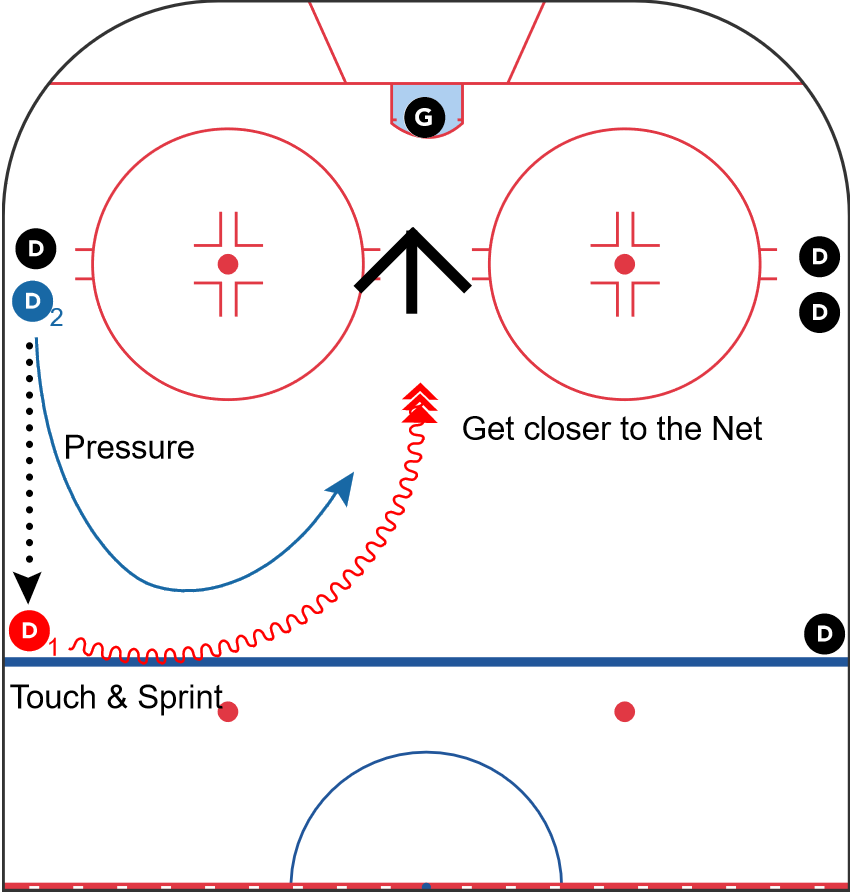
In 10xhockey, defensemen (D) are encouraged to look and prescan towards the middle of the ice rather than shooting without intent. By advancing the puck strategically, they can force the defensive structure to make unfamiliar decisions, leading to high-danger chances through east/west seam passes.
3. Attack from Event Zone (Half Wall)
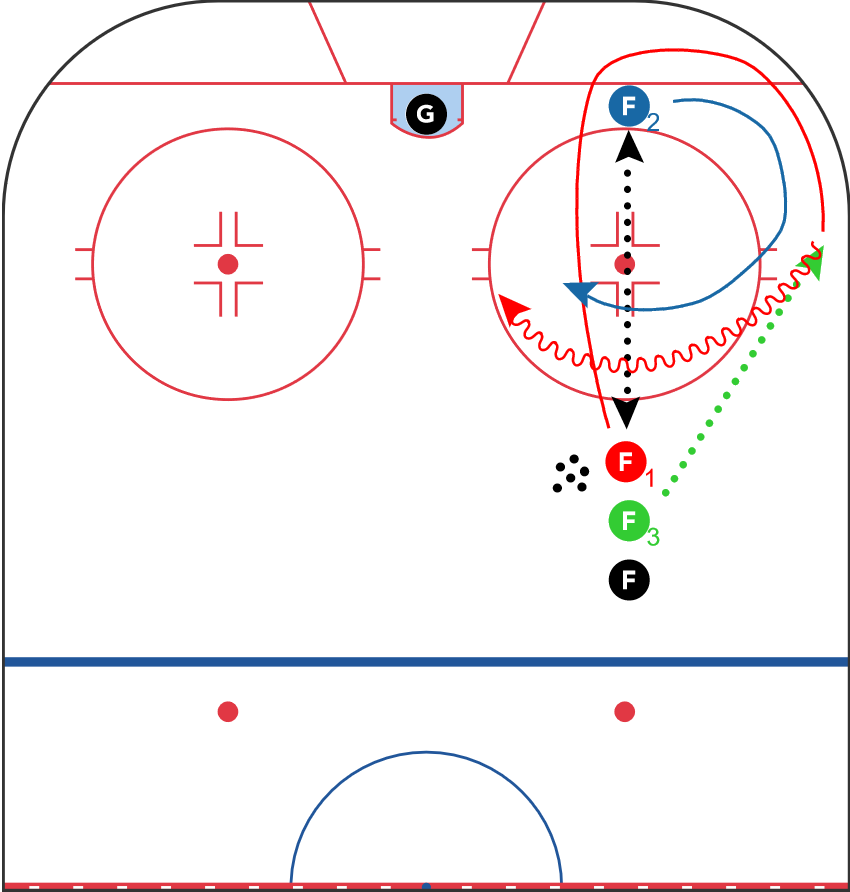
The primary individual play in 10xhockey is the dot drive from any position in the offensive zone. Players are trained to find soft ice and challenge the opposition to defend the middle of the ice, creating offensive pressure and scoring opportunities.
Coach Guido also provided us with a summary of the offensive zone plays he presented above! Additional notes:
Offensive Zone Skills and Drills
- Attacking from the Half wall Even Zone:
- Description: Positioning a player along the half-wall (the area between the blue line and the goal line) allows them to create passing lanes, set up plays, and take shots.
- Objective: Generate scoring opportunities by distributing the puck effectively or taking shots from a favourable angle.
- Attacking from the Point:
- Description: Utilize defensemen positioned at the blue line (the point) to create offensive plays.
- Objective: Set up screens, create traffic in front of the net, and unleash powerful shots from the point.
- High Percentage Shooting Areas:
- Description: Identify and exploit areas on the ice where goals are more likely to be scored.
- Objective: Encourage players to position themselves in prime scoring zones (e.g., near the crease or in the slot)
- Attack Low from Behind the Net:
- Description: Use the space behind the opponent’s net to create scoring opportunities.
- Objective: Set up wraparound shots, bank passes off the goalie, or find open teammates in front of the net.
- Working the Rims and Picking Up Rims Along the Boards:
- Description: Players retrieve the puck along the boards (rims) and maintain possession.
- Objective: Protect the puck, make smart passes, and transition smoothly from defence to offence.
- Speed and Shot in Stride:
- Description: Carry the puck at high speed while maintaining control.
- Objective: Catch opponents off guard, create odd-man rushes, and take accurate shots without slowing down.
- Changing Angle Before the Shot:
- Description: Alter your shooting angle just before releasing the puck.
- Objective: Surprise the goalie, create openings, and increase scoring chances
"Offensive strategies are dynamic," Guido notes. "Coaches and players should tailor these tactics to their team’s strengths and opponents’ weaknesses, always ready to adapt to the changing dynamics of the game."
https://www.instagram.com/euro_elite_hockey/?hl=en
Effective offensive strategies are crucial for any hockey team aiming to dominate in the offensive zone. These strategies involve teamwork, communication, and, most importantly, adaptability. In this blog, we discuss offensive zone hockey skills drills with seasoned Skills Coach, Guido, as he emphasizes their importance and shares customized drills to refine these essential tactics.
Guido brings over 20 years of extensive experience as a coach and player developer across various countries, including North America, Germany, Belgium, Austria, and Italy. He has coached at university, U18 Prep, Bantam AAA, and professional levels. Currently, Guido is the Head Coach of the SFU BCIHL Team and the Owner of Euro Elite Hockey Development in Vancouver, BC.
Guido highlights that effective offensive strategies require a deep understanding of teamwork and communication. Players must work together seamlessly, anticipating each other's movements and making quick, accurate decisions. As a Skills Coach, Guido customizes drills to enhance individual players’ offensive zone skills. By focusing on passing accuracy, quick puck movement, and strategic positioning, he helps players develop the adaptability needed to exploit opponents' weaknesses.
Guido also shares his experience with CoachThem:
"I’ve been using CoachThem for quite a few years now. I can't imagine working without it."
Top 3 Drills:
1. Low rim release from Event zone
In the 10xhockey system, executing a quick rim release from the end zone (EZ) to the goal line (GL) can disrupt the defensive structure. This creates confusion, allowing the forward (F1) to find a seam pass from below the GL, where 60% of goal chances originate.
2. Defensemen Blue line Attack the middle (the move)
In 10xhockey, defensemen (D) are encouraged to look and prescan towards the middle of the ice rather than shooting without intent. By advancing the puck strategically, they can force the defensive structure to make unfamiliar decisions, leading to high-danger chances through east/west seam passes.
3. Attack from Event Zone (Half Wall)
The primary individual play in 10xhockey is the dot drive from any position in the offensive zone. Players are trained to find soft ice and challenge the opposition to defend the middle of the ice, creating offensive pressure and scoring opportunities.
Coach Guido also provided us with a summary of the offensive zone plays he presented above! Additional notes:
Offensive Zone Skills and Drills
- Attacking from the Half wall Even Zone:
- Description: Positioning a player along the half-wall (the area between the blue line and the goal line) allows them to create passing lanes, set up plays, and take shots.
- Objective: Generate scoring opportunities by distributing the puck effectively or taking shots from a favourable angle.
- Attacking from the Point:
- Description: Utilize defensemen positioned at the blue line (the point) to create offensive plays.
- Objective: Set up screens, create traffic in front of the net, and unleash powerful shots from the point.
- High Percentage Shooting Areas:
- Description: Identify and exploit areas on the ice where goals are more likely to be scored.
- Objective: Encourage players to position themselves in prime scoring zones (e.g., near the crease or in the slot)
- Attack Low from Behind the Net:
- Description: Use the space behind the opponent’s net to create scoring opportunities.
- Objective: Set up wraparound shots, bank passes off the goalie, or find open teammates in front of the net.
- Working the Rims and Picking Up Rims Along the Boards:
- Description: Players retrieve the puck along the boards (rims) and maintain possession.
- Objective: Protect the puck, make smart passes, and transition smoothly from defence to offence.
- Speed and Shot in Stride:
- Description: Carry the puck at high speed while maintaining control.
- Objective: Catch opponents off guard, create odd-man rushes, and take accurate shots without slowing down.
- Changing Angle Before the Shot:
- Description: Alter your shooting angle just before releasing the puck.
- Objective: Surprise the goalie, create openings, and increase scoring chances
"Offensive strategies are dynamic," Guido notes. "Coaches and players should tailor these tactics to their team’s strengths and opponents’ weaknesses, always ready to adapt to the changing dynamics of the game."
https://www.instagram.com/euro_elite_hockey/?hl=en
 00:00:00
The Adaptive Coach : Designing the Map – Creating Safety in Chaos
The Adaptive Coach: Designing Environments That Think Back
(2:5) Designing the Map – Creating Safety in Chaos
By Coach Barry Jones – IIHF Level 3 High Performance | USA Hockey Level 3 Performance | Head Coach, Perth Inferno (AWIHL)
- Part 1 - The Adaptive Coach : How We Think, How We Play
- Part 2 - The Adaptive Coach : Designing the Map – Creating Safety in Chaos
- Part 3 - The Adaptive Coach : Safe to Fail – Coaching the Sequential Mind in an Ecological World
- Part 4 - The Adaptive Coach: Applied Chaos – Stories from the Ice
- Part 5 - The Adaptive Coach: Adaptable Reflection – Creating Environments That Learn in Real Time
The Myth of Freedom
Coaches love to talk about freedom.
“Let them play,” we say. “Let the game teach.”
But true freedom in learning doesn’t come from removing structure; it comes from designing structure that feels invisible.
Too much control, and players freeze. Too little, and they drift.
The sweet spot is a designed uncertainty, an environment that looks chaotic on the surface but is full of landmarks underneath.
That’s what the sequential reasoners in our program taught me: they don’t fear chaos, they fear disorientation.
The Map Inside the Storm
Every season, I build what I call the Master Plan, a living map drawn from our team’s habits, season themes, cultural identity, and ecological philosophy.
It’s not a calendar or a playbook; it’s an ecosystem.
For the intuitive thinkers on our team, that ecosystem gives space to explore.
For the sequential thinkers, it provides a path to start from.
When the environment shifts, when games tilt, drills fail, or stress rises, that map becomes the anchor.
They might not know what the next moment brings, but they know what they’re playing for.
Context Before Chaos
One of the most powerful lessons I’ve learned is that context is the safety net of exploration.
During practice, I now start each task with one simple line: “Here’s why we’re doing this.”
It doesn’t take long, ten seconds maybe, but it shifts the entire energy of the session.
When players understand why, they begin exploring the how without hesitation.
The “why” becomes a temporary structure that allows the sequential reasoners to lean into the task instead of overthinking it.
It’s the difference between giving them a treasure map and dropping them in a jungle with no compass.
Designing for Safety Without Removing Struggle
Safety doesn’t mean easy.
It means a space where players can struggle without feeling threatened.
In an ecological environment, you can’t protect athletes from mistakes; that’s where learning lives.
But you can protect them from misunderstanding those mistakes.
When a player fails, I ask two quick questions:
1. What did you notice?
2. What did you try?
The focus stays on perception and intent, not error and outcome.
This language helps sequential learners reframe failure as data instead of deficiency.
A Real-World Example
In one session, I designed a game around Role Ecology to build player support in net-front battles.
The goal was to let perception–action coupling drive learning, to let players feel spacing and timing through the problem.
But I skipped the why.
I thought my design would do the explaining. It didn’t.
The task collapsed early.
The intuitive players adapted; the sequential ones froze, unsure what success even looked like.
When we debriefed, several players said, “We just didn’t know what the point was.”
That wasn’t resistance, it was feedback.
They weren’t asking for control. They were asking for clarity.
When I reframed the task in the next session, connecting it back to our theme of Support the Puck, the same activity came alive.
Nothing about the design changed except the context, and that made all the difference.
Invisible Frameworks, Visible Freedom
The best ecological environments aren’t chaotic; they’re carefully unstable.
The instability is where growth happens, and the framework is what keeps it safe.
Your job as a coach is to make the framework invisible but felt.
Let players believe they’re roaming freely, when in fact every landmark was placed with purpose.
Sequential reasoners find safety in those landmarks; intuitive players barely notice them, and both groups thrive.
Closing Reflection
Coaching isn’t about choosing between order and chaos.
It’s about building a map of meaning inside the storm.
When athletes understand why they’re exploring, they don’t cling to certainty; they chase discovery.
That’s not control; that’s connection.
And in an ecological world, connection is the only real safety we have.
“Chaos doesn’t teach by itself. It teaches when the learner feels safe enough to explore it.”
Author Bio: Barry Jones is an IIHF Level 3 High Performance Coach and USA Hockey Level 3 Performance Coach. He currently serves as Head Coach of the Perth Inferno (AWIHL) and leads the Blaze Development Program. His work blends ecological dynamics, nonlinear design, and athlete-centred leadership to build adaptive teams that thrive in uncertainty.
 00:00:00
The Adaptive Coach : Safe to Fail – Coaching the Sequential Mind in an Ecological World
The Adaptive Coach: Designing Environments That Think Back
(3:5) Safe to Fail – Coaching the Sequential Mind in an Ecological World
By Coach Barry Jones – IIHF Level 3 High Performance | USA Hockey Level 3 Performance | Head Coach, Perth Inferno (AWIHL)
- Part 1 - The Adaptive Coach : How We Think, How We Play
- Part 2 - The Adaptive Coach : Designing the Map – Creating Safety in Chaos
- Part 3 - The Adaptive Coach : Safe to Fail – Coaching the Sequential Mind in an Ecological World
- Part 4 - The Adaptive Coach: Applied Chaos – Stories from the Ice
- Part 5 - The Adaptive Coach: Adaptable Reflection – Creating Environments That Learn in Real Time
The Paradox of Safety
Every coach says they want their athletes to “feel safe to fail.”
But in reality, most of us only mean safe to fail when it’s convenient.
We celebrate failure as learning data until it shows up in the standings.
For athletes who think sequentially, who build confidence through clarity, understanding, and completion, that mixed message can create internal conflict.
They don’t fear the error itself; they fear the ambiguity that follows it.
When something breaks down, they immediately want to know:
Why? What part didn’t fit? What should I fix?
If that answer doesn’t come, the failure lingers, replaying like unfinished homework in the back of their mind.
The Psychology of Closure
In traditional coaching, we often move on after a failed task once we understand why it failed.
But for the sequential reasoner, closure is part of psychological safety.
They don’t need the perfect answer, they need to understand the logic behind the outcome.
If I skip that step, I unintentionally create a gap that their brain fills with self-blame.
Inside an ecological environment, that’s a problem.
Because if athletes internalize failure as identity, they stop exploring.
The uncertainty that should drive discovery becomes a threat to self-worth.
Turning Failure Into Data
The fix isn’t to protect them from failure, it’s to reframe what failure means.
When a task breaks down, I shift the conversation from outcome to observation:
- What did you notice?
- What information did the environment give you?
- What did that tell you about the problem?
By moving attention away from fault and toward feedback, the failure becomes part of the data loop.
It transforms from I failed to I learned something that didn’t work yet.
That subtle shift creates permission to experiment again.
Case Study: The Support-Zone Breakdown
Mid-season, I ran a progression designed to build net-front support within our Role Ecology framework.
The first version flopped, no rhythm, no flow, no learning.
The second version looked almost identical on paper, but the difference was the why.
Before we began, I anchored the task:
“We’re exploring how our second-layer support changes the defender’s read at the net front. You’re not chasing pucks, you’re shaping decisions.”
That one sentence changed the session.
The sequential players had a reason to explore; they weren’t just moving, they were investigating a problem.
Mistakes still happened, but this time they laughed, discussed, and adjusted.
The environment didn’t change, the framing did.
Safety Through Shared Meaning
For athletes who process sequentially, clarity equals safety.
The more they understand the intent behind the constraint, the more freely they explore within it.
That doesn’t make them rigid; it makes them deliberate.
And deliberate players, once confident in the rules of engagement, become some of the most adaptable problem-solvers you can coach.
Our job is to create a culture where curiosity replaces fear, where “why did it fail?” is met with “let’s find out together.”
From Control to Connection
Traditional coaching relies on control: fix the error, repeat the pattern, measure the output.
Ecological coaching relies on connection: understand the context, engage with the environment, interpret the output.
Sequential learners bridge these worlds.
They show us that the path to creativity doesn’t start with chaos; it starts with clarity.
When they feel safe to fail, they stop performing for approval and start performing for understanding.
Closing Reflection
Failure is the most honest feedback system in sport.
It tells us what the environment values and what the athlete perceives.
But without context, it becomes emotional rather than educational.
As coaches, our role isn’t to remove failure; it’s to make it safe enough to study.
That’s when failure stops being a setback and starts becoming the foundation of mastery.
“Failure isn’t feedback until it’s understood. Clarity turns chaos into data.”
Author Bio: Barry Jones is an IIHF Level 3 High Performance Coach and USA Hockey Level 3 Performance Coach. He currently serves as Head Coach of the Perth Inferno (AWIHL) and leads the Blaze Development Program. His work blends ecological dynamics, nonlinear design, and athlete-centred leadership to build adaptive teams that thrive in uncertainty.
 00:00:00
The Adaptive Coach: Adaptable Reflection – Creating Environments That Learn in Real Time
The Adaptive Coach: Designing Environments That Think Back
(5:5) Adaptable Reflection – Creating Environments That Learn in Real Time
By Coach Barry Jones – IIHF Level 3 High Performance | USA Hockey Level 3 Performance | Head Coach, Perth Inferno (AWIHL)
- Part 1 - The Adaptive Coach : How We Think, How We Play
- Part 2 - The Adaptive Coach : Designing the Map – Creating Safety in Chaos
- Part 3 - The Adaptive Coach : Safe to Fail – Coaching the Sequential Mind in an Ecological World
- Part 4 - The Adaptive Coach: Applied Chaos – Stories from the Ice
- Part 5 - The Adaptive Coach: Adaptable Reflection – Creating Environments That Learn in Real Time
Reflection That Moves
When I started writing this series, I thought reflection was what happened after the season.
But the longer I coach, the more I realise reflection isn’t a review, it’s a real-time design tool.
Adaptation doesn’t wait for the off-season.
If the environment is alive, reflection has to be too.
This isn’t a plan for next year.
This is how we’re coaching now.
The Realisation That Shifted Everything
Through the identity meetings, task failures, and athlete feedback loops, I learned that ecological design alone isn’t enough.
Without orientation, chaos can still feel unsafe.
For some athletes, the environment needs to communicate why before it can challenge how.
So my framework has evolved, not in theory, but in daily execution.
Every session now includes context, exploration, reflection, and adaptation, all inside the same feedback loop.
It’s no longer non-linear periodisation.
It’s adaptive ecology.
The Four-Frame Loop
The structure hasn’t changed much; the intent has.
Each environment now runs through four live frames:
1. Context – Establish the why. Ground the activity in purpose and meaning.
2. Exploration – Let players discover solutions within boundaries that matter.
3. Reflection – Debrief during training, not after. Ask, “What did we notice?”
4. Adaptation – Tweak constraints immediately based on those reflections.
This micro-loop keeps the learning system alive.
The athletes adapt. The design adapts.
And so do I.
From Periodisation to Perception
Traditional periodisation focuses on time; non-linear focuses on emergence.
Adaptive reflection focuses on perception, what players notice and how that changes their decisions.
Sequential learners find stability through understanding the pattern inside the chaos.
Intuitive learners thrive by disrupting that pattern.
Both belong. Both shape the environment.
Our practices now pulse between structure and release, order and experimentation, guided by the shared rhythm of noticing and adjusting.
The Environment as the Reflection
The biggest shift isn’t in the plan; it’s in how I read the session.
I no longer judge success by completion, execution, or even flow.
I look for responsiveness.
Does the environment react to the athletes as much as they react to it?
If yes, learning is happening.
If not, it’s just noise.
Reflection used to be a clipboard.
Now it’s a conversation between design and behaviour.
Culture in Motion
Our H.E.A.T. identity (Hunt, Execute, Attack, Trust) no longer sits on the wall, it moves through each adaptive loop.
- Hunt gives intent.
- Execute brings action.
- Attack brings urgency.
- Trust creates safety.
For sequential learners, that trust comes from clarity.
For intuitive learners, it comes from freedom.
For me, it comes from building an environment that flexes to serve both, every day.
Closing Reflection
Adaptability isn’t a coaching style; it’s an ecosystem.
Reflection isn’t the mirror at the end, it’s the current in the middle.
We can’t design for the future if the environment isn’t learning now.
So, we don’t wait.
We adapt in real time, with every conversation, constraint, and cue.
That’s what this series has taught me, that design isn’t fixed, and neither is reflection.
Because in ecological coaching, the environment isn’t just where learning happens, it’s what learns.
“Reflection isn’t what follows learning. It’s what keeps it alive.”
Author Bio: Barry Jones is an IIHF Level 3 High Performance Coach and USA Hockey Level 3 Performance Coach. He currently serves as Head Coach of the Perth Inferno (AWIHL) and leads the Blaze Development Program. His work blends ecological dynamics, nonlinear design, and athlete-centred leadership to build adaptive teams that thrive in uncertainty.
 00:00:00
Transforming D-Men into Offensive Weapons | Guido Lamberti-Charles
- D2 Passes to D1:
- Description: Defenceman 2 (D2) makes a pass to Defenceman 1 (D1).
- Objective: Initiate offensive movement and transition from defense to attack.
- D1 Touches the Puck and Sprints to the Blue Line (Find Open Ice):
- Description: D1 receives the pass and quickly touches the puck toward their skating.
- Objective: Gain momentum and find open space near the blue line for an offensive opportunity.
- D2 Pressures D1 Outside-In and Forces D1 to Protect the Puck While Skating to the Top of the Circle:
- Description: D2 applies pressure on D1, forcing them toward the outside (boards).
- Objective: Limit D1’s options and create a defensive challenge. D1 protects the puck while moving toward the top of the offensive circle.
- D1 Takes a Shot (Shoot to Score):
- Description: D1 positions themselves for a scoring opportunity and releases a shot.
- Objective: Aim for the net and try to score a goal.
- Description: Defenceman 2 (D2) makes a pass to Defenceman 1 (D1).
- Objective: Initiate offensive movement and transition from defense to attack.
- Description: D1 receives the pass and quickly touches the puck toward their skating.
- Objective: Gain momentum and find open space near the blue line for an offensive opportunity.
- Description: D2 applies pressure on D1, forcing them toward the outside (boards).
- Objective: Limit D1’s options and create a defensive challenge. D1 protects the puck while moving toward the top of the offensive circle.
- Description: D1 positions themselves for a scoring opportunity and releases a shot.
- Objective: Aim for the net and try to score a goal.
Key Takeaways:
- Timing and Decision-Making: D1 must execute the play swiftly, making decisions based on D2’s pressure and positioning.
- Creating Space: D1’s sprint to the blue line aims to find open ice and create a shooting lane.
- Defensive Responsibility: D2’s role is to disrupt D1’s progress and force them to protect the puck.
Remember, effective offensive plays involve teamwork, communication, and smart positioning. Coaches often tailor these tactics based on their team’s strengths and opponent’s defensive structure.
https://www.instagram.com/euro_elite_hockey/?hl=en