The Importance of a Coaching Philosophy
By Mike Schwartz
USA Hockey Coach Developer
Former Collegiate & Professional Hockey Coach
This is one in a series of articles intended for coaches and leaders, inspired by my more than 30 years of coaching experience from youth through professional hockey. I hope you enjoy it and pass it along to another coach or leader in your life.
When most new coaches begin their careers, they spend countless hours searching for drills, systems, and practice plans. There's nothing wrong with that. The mistake is believing those things should come first.
Early in my coaching career, I was fortunate to be surrounded by outstanding mentors. My student teaching supervisors, Terry Skrypek and Jerry Bennek, challenged me to think beyond drills and systems. I also learned by example from Wes Barrett, was fortunate to meet Herb Brooks early in my career, and was inspired by John Wooden's Pyramid of Success.
At the time, I was teaching elementary and secondary physical education while coaching boys and girls in multiple sports. Over the years, the sports changed, the athletes changed, and the game continued to evolve. What never changed were the principles of good teaching.
That realization led me to write my own coaching philosophy in 1983, during my first year of coaching. The wording has evolved over the years, but the foundation has remained the same.
I think of a coaching philosophy as the holding company for an entire coaching program. Everything else—your offensive and defensive philosophies, player development, communication, culture, systems, practice plans, and drills—should align with it.
Every new idea, clinic, book, or system should be filtered through that foundation. If it supports your philosophy, keep it. If it doesn't, let it go.
Before you spend another hour searching for the next great drill, spend an hour writing down what you believe. Those answers will become the foundation for every decision you make throughout your coaching career.
Coaching Exercise
If you're not sure where to begin, the Positive Coaching Alliance (PCA), a national organization dedicated to developing better athletes and better people through youth and high school sports, recommends coaches begin by reflecting on these questions:
· Why do you coach? What is your purpose? What does success look like?
· How will your philosophy be reflected in your daily actions and in the relationships you build with your players?
· Who will hold you accountable to your philosophy?
· What is your coaching philosophy catch phrase?
Additional Resource
The Positive Coaching Alliance offers additional articles, workshops, and coaching resources to help coaches develop a meaningful coaching philosophy.
https://positivecoach.org
My Coaching Philosophy 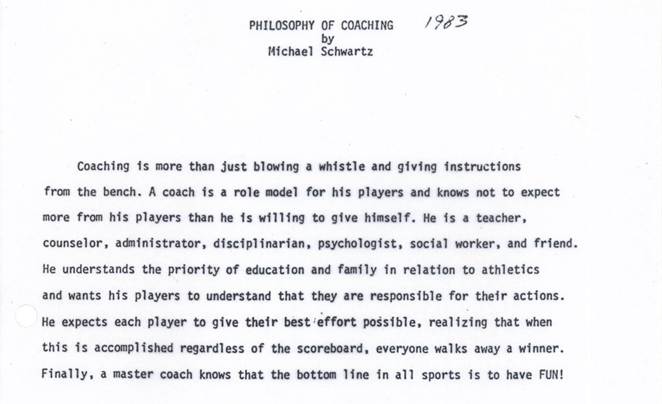
More than forty years have passed since I first wrote those words. The game has changed. Coaching methods have changed. Players have changed.
But the importance of having a coaching philosophy has not.
Systems will evolve. Drills will change. New ideas will come and go.
A well-defined coaching philosophy remains the foundation that guides every coaching decision you make.