
The Game Has Changed. So Have I.
By Jeff German
I have been around hockey for five decades.That is a strange thing to write because I still feel like the game is moving faster than I am. But when I stop and think about it, I have watched hockey change in ways that would have been difficult to imagine when I first started playing.
I was talking with my brother recently about defensive-zone coverage, and our conversation got me thinking about just how different the game is today. He was a solid player five decades ago and we were both taught a very different game back then.
The defensive zone back then was a different place. You protected the front of the net. You stayed between your man and the net. The strong side defenseman took the corner, the weakside defenseman took the man in front of the net. You knew your responsibility, you picked up your player, and you physically moved him away from the dangerous areas. There was a certain simplicity to it.
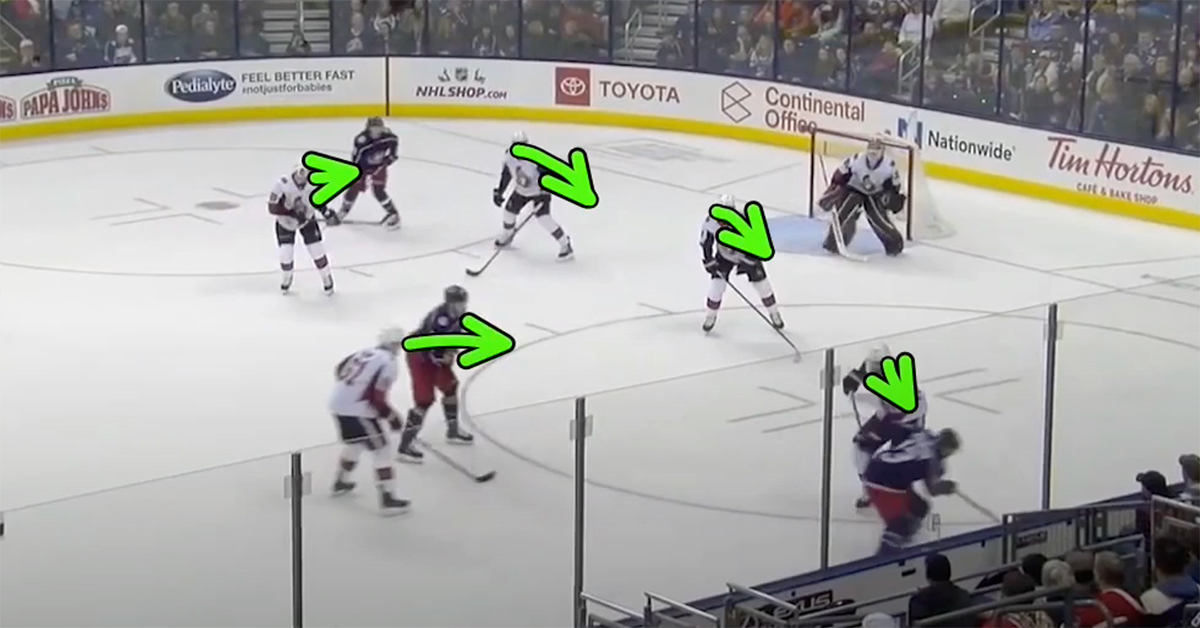
Today, defensive-zone coverage can look completely different. The game I coach at the college level looks and acts entirely different then it did when my brother and I played. Five players are connected to the puck. There are layers. There are rotations. There are switches. The weak-side forward may collapse. A defenseman may pressure deep into the zone. Players are constantly reading the puck, their teammates and the opposition.
The defensive zone has become active. In many ways, it is a five-man defense rather than two defensemen protecting the goalie.And I like a lot of it. But, I also think we have to be careful not to confuse different with better.
The game has changed for a lot of reasons. The removal of the red line eliminated the old two-line pass rule and opened up the neutral zone. That created more space and more transition. The restrictions on hooking, holding and interference forced players to actually skate and defend instead of simply grabbing somebody who got past them.
The result is a faster, more free-flowing game. Players today are also incredible athletes. They are stronger, faster and better conditioned than players from earlier generations. Strength and conditioning have become an integral part of hockey development. Skating instruction is better. Nutrition is better. Equipment is better. Video and analytics have changed how we prepare. The players simply have more skill.
The influence of European hockey has also had a tremendous impact. Cycling, puck possession, support underneath the puck, controlled entries and constant movement have become major parts of the modern game.
When I was younger, there was a lot more emphasis on getting the puck behind the defenseman and going to work. Today, teams want to enter with possession, establish control and make the other team defend. That is progress.
But sometimes I wonder if we have made hockey so sophisticated that we have started to lose sight of some very simple truths.
And I was reminded of these truths while talking with my brother, especially in the Defensive-zone..
We teach players to swarm the puck, and there is a tremendous amount of value in that. Pressure creates turnovers. Five players working together can take away time and space. The puck dictates where the defense goes. But, there are times when five players can be moving so much that nobody is actually defending the most dangerous player. I still believe in the old principle of putting yourself between your opponent and the net. I still believe in protecting the middle. I still believe there are times when the best defensive play is simply to get inside position and move a player away from the front of the net.
That doesn't mean I want to go back to the hockey I played 40 or 50 years ago. I don't.
I want to coach today's game, but I don't want to throw away something that worked simply because it came from an older generation.
The same thing applies to physical hockey.
There was plenty of obstruction in the old game. Hooking and holding were part of defending. Players could slow down an opponent instead of having to actually skate with him. I don't miss that part of the game, even though as a big defenseman, I made use of my ability to obstruct.
I don't think eliminating obstruction means eliminating physicality.
There is still a place for finishing a legal check. There is still a place for body position. There is still a place for separating a player from the puck and making the other team uncomfortable. There is a way to do this without being reckless. Good teams have to strike that balance. Today's player has to win the physical battle with his feet, shoulder and hip positioning instead of relying on a stick around someone's waist. That is a good change.
Offensively, I have similar thoughts. I love watching a team cycle the puck, support one another and maintain possession. I love watching five players connected through the offensive zone. I love the creativity that today's players have. But sometimes the puck needs to go behind the defense. Sometimes you need to chip it. Sometimes you need to put it on the goalie. Sometimes you need to get a puck to the net and create a rebound instead of making one more pass. And sometimes the old answer is still the right answer.
That is probably one of the biggest lessons I have learned as a coach. Experience can be both an advantage and a trap. If I say, "This is how we did it when I played," I am not coaching today's players. I am coaching my memories. The game has changed, and I have to change with it.
But the opposite is also true. If I assume that everything from the past was wrong because hockey has evolved, I am making the same mistake from the other direction. Some things have changed because the game improved. Some things changed because the rules changed. Some things changed because athletes changed. And some things changed simply because coaches found new and better ways to solve old problems.
But there are fundamentals that don't really care what decade it is. These fundamentals will always matter. Like:
-
Puck support matters.
-
Position matters.
-
Competing matters.
-
Communication matters.
-
Protecting the middle matters.
-
Taking away time and space matters.
-
Winning races matters.
-
Winning battles matters.
-
And situational awareness (understanding what is happening around you) matters.
Those things were true when I first put on skates, and they are still true today. So when I coach now, I don't want to be the guy arguing that the old game was better. It wasn't necessarily better. It was different.
And today's game isn't necessarily better in every way either. It is faster. It is more skilled. It is more sophisticated. It is more demanding physically and mentally. Players have more information, more resources and more ways to develop.
But sometimes the sophistication of the modern game can hide a very simple problem. A player can know exactly where he is supposed to be in the system and still not know what he is supposed to do. That is where coaching comes in. A Coach’s job isn't simply to teach a system. It is to teach players how to play.
There is a difference.
I want our players to understand modern defensive-zone concepts. I want them to pressure the puck. I want them to think as a five-man unit. I want them to understand layers, switches and support. But I also want them to know when to stop chasing and protect the middle. I want them to understand when to pressure and when to contain. I want them to recognize when the best play is complicated and when the best play is incredibly simple.
After five decades in this game, I think that is one of the privileges of coaching. I have seen hockey change. I have been part of some of those changes and I have had to change myself. But I also have the benefit of having seen things work before the game looked the way it does today.
No, I don't want to go backward. I want to take the best of what we have learned over the last 50 years and combine it with where the game is going. The game will continue to evolve, and it should. My responsibility as a coach is to evolve with it without losing sight of the fundamentals that made hockey a great game in the first place.
The game has changed, and so have I, but there are some things I still believe in.