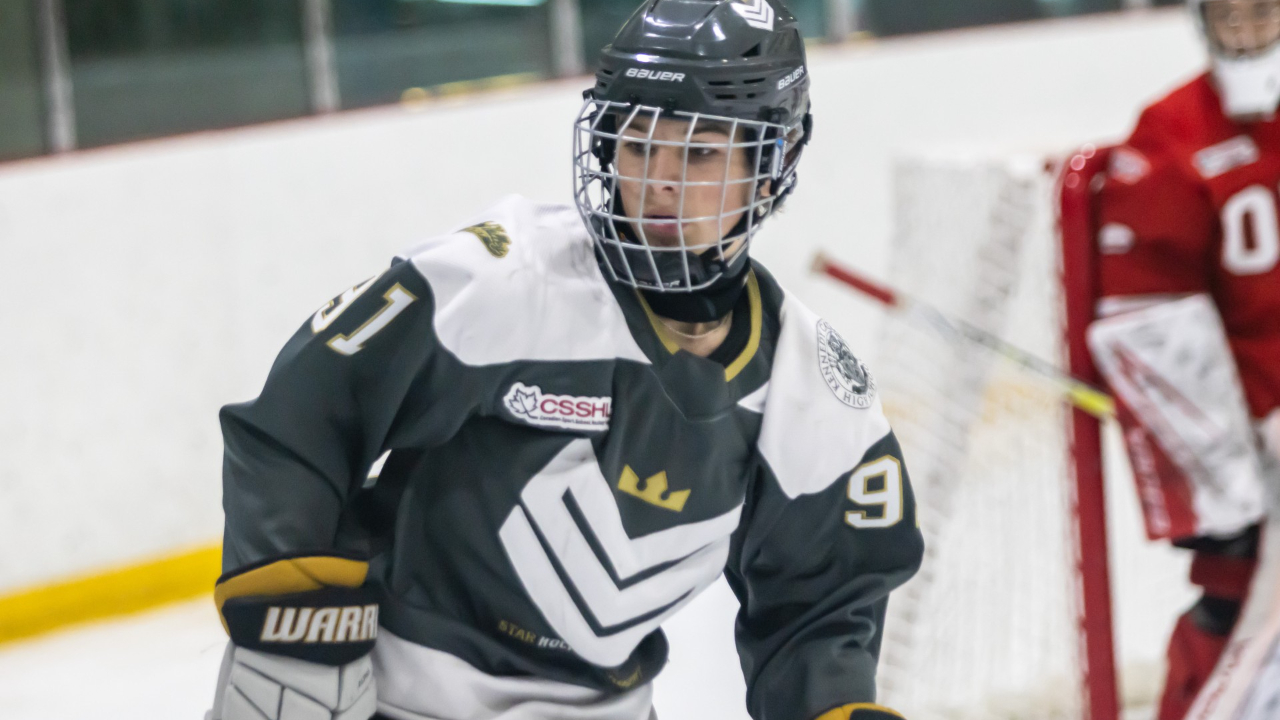
The conversation about the future of hockey in BC doesn’t start with “what if” anymore.
The NCAA’s decision to allow CHL players to accept NCAA offers is no longer speculation—it’s established fact, and it’s already reshaping hockey development pathways in BC. And now, in real time, we’re watching the entire system begin to adjust around it.
If you coach in BC—minor hockey, academy, junior, or development—you’re likely already feeling parts of this shift, even if the full picture isn’t clear yet. Pathways are changing. Timelines are compressing. And advice that worked five years ago may already be outdated.
This is one read of where the system appears to be heading, based on how the pieces are currently moving.
The Proof of Concept: Gavin McKenna and the NCAA Pathway
The clearest example so far is Gavin McKenna.
At just 17 years old, McKenna was the CHL Player of the Year and the centerpiece of Medicine Hat’s run to the Memorial Cup Final in the 2024–25 season. On July 8, he committed to Penn State.
McKenna isn’t the first CHL player to make this move, but he is the proof of concept. He’s projected to be the number one pick in the 2026 NHL Draft, and instead of staying in the WHL to dominate until he turns pro, he’s choosing the NCAA route immediately after high school.
That’s exactly the pathway the NCAA wanted to unlock. And now it’s in motion.
What This Means for the CHL and WHL Development Pathway
The most immediate impact is straightforward: the CHL—and the WHL in particular—are getting younger.
The very best players, the ones who historically stayed in Major Junior until they were 19 or 20, are now leaving earlier. As soon as they finish high school, many are heading straight to the NCAA.
That forces CHL and WHL teams to backfill with younger talent. Lineups will start to look a year or two younger than what fans and scouts have been used to.
This doesn’t mean the product gets worse. The speed will still be there. The skill will still be there. In some cases, the raw talent may even look flashier.
What does change is roster makeup. The era of 19- and 20-year-old anchors—the battle-tested veterans who brought stability and maturity to championship teams—is fading. The WHL is moving away from being a finishing school for pros and toward becoming a faster, higher-turnover development league.
Young stars will still shine. They just won’t stay as long.
The BCHL’s Shift: An Older, Global NCAA Showcase League
While the WHL gets younger, the BCHL has gone the opposite direction.
When the BCHL stepped away from Hockey Canada, it wasn’t just about politics—it was about control. Control over recruiting, control over player movement, and control over the league’s identity.
Since then, the transformation has been clear.
Today, more than 60% of BCHL rosters are made up of imports. Players from Europe, the United States, and other hockey markets that NHL scouts used to overlook because of distance or visibility. At the same time, the league is still attracting top Canadian talent.
But the core has shifted.
The BCHL is now built around 19- and 20-year-old players—many of whom slipped through the CHL system or are still chasing an NCAA Division I offer. That last window before opportunities close.
Not all of them will land Division I. That’s just math. But that doesn’t reduce the BCHL’s value. In fact, it increases it.
For NCAA Division III programs, especially in the U.S., the BCHL has become a gold mine. Older players. Experienced players. Imports with international upside.
The league has carved out its own lane:
-
For some, it’s a bridge to Division I
-
For others, it’s an audition for Division III
Either way, it has value. But it’s no longer the same BCHL that once fed the NCAA almost exclusively with Canadian high school graduates.
And when one league shifts upward like that, something else has to slide in underneath.
PJHL and KIJHL: The Future of Junior A Hockey in BC
That brings us to the PJHL and KIJHL.
With the BCHL stepping away from Hockey Canada, a vacuum was left behind. And the PJHL and KIJHL are in a prime position to fill it—but only if alignment happens.
The expectation is that, eventually, these leagues split into a Tier 1 and Tier 2 system.
Tier 1 would become the new sanctioned Junior A: a league designed for roughly 16–19-year-olds. A place to face higher competition, sharpen their game, and prove they belong on a bigger stage.
What everyone is waiting for is official alignment with the WHL. Because once that happens, Tier 1 doesn’t just become another league—it becomes the battle-testing ground. The place where players who aren’t ready for an immediate WHL jump can develop against older, stronger opponents and show they belong.
In that sense, Tier 1 becomes the bridge between midget hockey and the WHL, while still keeping NCAA pathways open.
But Tier 1 can’t stand alone. To truly work, it needs Tier 2 underneath it.
Rethinking Tier 2 Hockey Development in BC
Tier 2 is often misunderstood.
People hear “Tier 2” and assume lesser, or think back to the old days when Junior B was written off as a dead end. But the reality is the talent level in BC’s Tier 2 leagues is already comparable to Tier 2 leagues across the rest of Canada.
What’s been missing is structure and standards.
If BC Hockey and Hockey Canada get this right, Tier 2 won’t be a dumping ground. It becomes a legitimate development stage. A place where players receive proper coaching, resources, and competition while preparing for Tier 1—or simply playing high-level hockey in their communities.
And here’s the critical piece: teams that don’t meet those standards risk sliding backward.
That pressure matters. It forces organizations to invest in coaching and development. Nobody wants to lose relevance. And that competition raises the level of the entire system.
Tier 2 becomes the foundation—the wide base of the pyramid that supports everything above it.
Where the VIJHL Fits in BC’s Hockey Development Landscape
Not every league fits neatly into this structure.
The VIJHL is a unique case. Historically labeled Junior C while operating under a Junior B banner, the league followed the BCHL out of Hockey Canada in hopes of carving out a feeder role.
In practice, very little has changed.
The VIJHL remains largely island-based. It caters to players who want to stay close to home, play in front of family, and keep hockey central in their lives without chasing mainland pathways.
There’s value in that. But in the new ecosystem, the VIJHL isn’t positioned to attract outside talent or play a major role in the broader development pipeline. It remains steady—but on the periphery.
CSSHL and the WHL Draft Pathway
At the center of the elite development conversation is still the CSSHL.
Its identity hasn’t changed. It remains the WHL’s primary feeder system, especially at the U15 Prep level—the critical age where draft boards are built and futures are decided.
Older age groups, U17 and U18, still matter. They provide structure, daily development, and opportunity for late bloomers.
But the shift is what happens after the draft.
Increasingly, players will leave the CSSHL and move into Tier 1 Junior A. That’s where the pace ramps up. That’s where players battle older, stronger bodies. That’s where the game starts to resemble the WHL grind.
In this model, the CSSHL identifies and develops skill. Tier 1 battle-tests it. Together, they form the backbone of the new WHL pipeline.
JPHL: An Alternative Hockey Development Pathway
Running parallel is the JPHL.
Built as an alternative for families seeking high-level development at a more accessible price point, the JPHL has proven it can develop real prospects. Players like Liam Pue have shown that clearly.
Is it on the same level as the CSSHL at the very top end? Not yet. The prestige and established WHL ties still favor the school model.
But the JPHL doesn’t need to replace the CSSHL. It’s carving out its own niche—affordable, competitive, and improving every year.
That growth matters. It gives families real choice. And that competition will push everyone to get better.
Over the next decade, the balance between CSSHL and JPHL may become one of the defining features of hockey development in BC.
The Big Picture: Where Hockey Development in BC Is Headed
Step back, and the direction is clear:
-
The WHL and CHL are getting younger
-
The BCHL has reinvented itself as an older, import-heavy showcase league
-
The PJHL and KIJHL are positioned for a potential Tier 1 / Tier 2 ladder
-
The VIJHL remains a local option
-
The CSSHL continues to anchor WHL drafting at U15
-
The JPHL is emerging as a credible alternative
But this is still a projection.
Politics, egos, money, and alignment all matter. Until official announcements are made, this is a read of where the pieces appear to be moving—not a final answer.
And that’s intentional.
Let’s Open the Conversation on the Future of BC Hockey
The future of hockey in BC won’t be shaped by one voice.
It’ll be shaped by coaches, parents, players, and organizations who are closest to the ice and closest to the kids.
So let’s talk about it.
-
Where do you see this heading?
-
What feels accurate—and what doesn’t?
-
Do you believe Tier 1 and Tier 2 alignment actually happens?
-
Or do you see it breaking a different way?
Share your perspective. Challenge this take. Film a response and tag us.
The more we push back and question each other, the sharper our collective understanding of BC hockey’s future becomes.
👉 Follow the conversation on Instagram
👉 Learn more about our training environment and facility here