Designing Problems Worth Solving -
UOAT THUNDER DOME
Small Area Game | 1v1 | Spatial Manipulation | Deception | Perception–Action Coupling
1. Game overview
UOAT Thunder Dome is a 1v1 small area game designed to help athletes recognise, manipulate and exploit space using four spatial movement keys: Under, Over, Around and Through.
The attacker must unlock the defender using a prescribed spatial key before attacking the net. As the game develops, athletes are challenged to stack multiple keys together, creating combinations that manipulate the defender's movement, balance, positioning and available defensive options.
The intention is not simply to beat the defender. It is to develop an understanding of how one movement can create the conditions for another.
2. Playing environment and setup
-
Position the nets as illustrated in the Task Sketch diagram.
-
Both sides of the playing area operate simultaneously, creating two independent 1v1 games.
-
Each game has one attacker and one active defender.
-
Position multiple pucks along the boards for attackers to select from.
-
The attacker can collect any available puck and initiate the attacking problem.
-
When the defender wins possession, the puck is returned to the boards and play resets.
-
Rotate attacking and defending roles regularly.
Game objective: Unlock the defender using the prescribed UOAT key, then exploit the created space to attack the net.
3. Understanding the four keys
UNDER
OVER
AROUND
THROUGH
These are spatial relationships rather than four fixed techniques. The defender's actions determine which opportunities become available.
4. Game progression and stacking
1
Single Key, Unlock the Defender
The coach prescribes one key, for example UNDER. The attacker must find a way to use an under movement to create an attacking advantage before taking a shot.
The athlete controls how and when to execute the movement, rather than following a predetermined technique.
2
Double Key, Stacking Movements
Prescribe two keys, for example UNDER + AROUND.
The attacker must connect both spatial solutions before attacking the net. An under movement might draw the defender's stick lower, opening a pathway around their defensive reach.
The emphasis moves from executing isolated movements to connecting movements that create new opportunities.
3
Triple Key, Manipulating Space
Prescribe three keys, for example AROUND + UNDER + THROUGH.
The attacker needs to connect three spatial solutions while responding to the defender's changing position.
Each movement should influence the next, rather than becoming three unrelated tricks.
4
Open Stack, Athlete Autonomy
Remove the prescribed sequence. The athlete can select and combine any available UOAT keys to solve the defensive problem.
The coach now observes whether athletes recognise opportunities and connect movements without needing instructions.
5. Examples of stacking keys
|
Key combination |
Attacking solution |
|---|---|
|
UNDER → AROUND |
Move the puck beneath the defender's extended stick, then navigate around their defensive reach. |
|
AROUND → THROUGH |
Threaten the outside lane, encouraging the defender to shift, then attack the central gap that opens. |
|
OVER → AROUND |
Lift the puck over an extended stick and continue around the defender into attacking space. |
|
THROUGH → AROUND |
Threaten or enter the inside gap, then exploit the defender's closing movement by going around. |
|
UNDER → AROUND → THROUGH |
Beat the initial stick obstruction, draw the defender laterally and attack the gap created by their recovery. |
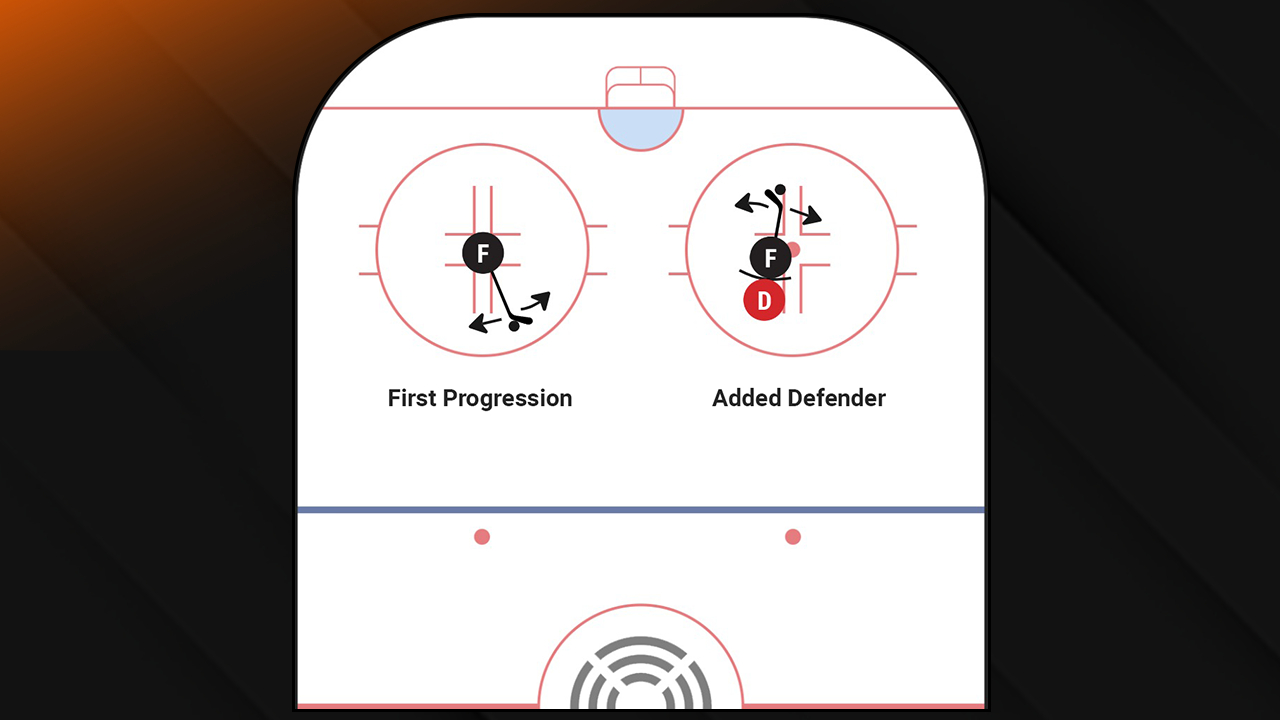
Example: Stacking AROUND + THROUGH
Conceptual example, not a fixed movement pattern. The attacker threatens the outside, invites a defensive shift and exploits the newly available inside lane.6. Manipulating constraints
The coach can modify the game environment to encourage different solutions without prescribing the exact movements.
|
Constraint |
Intended invitation |
|---|---|
|
Smaller playing space |
Closer engagement, faster puck manipulation and tighter spatial decisions. |
|
Wider playing space |
More lateral options, deception and opportunities to attack around the defender. |
|
Starting near the boards |
Explore using the boards, body position and puck protection to escape pressure. |
|
Defender begins with an extended stick |
Increase opportunities to explore under or over movements. |
|
Two keys in any order |
Encourage athletes to identify available solutions rather than rehearse a predetermined sequence. |
|
Defender changes starting angle |
Create new spatial information and different opportunities to exploit. |
7. Scoring and success conditions
A simple scoring system can reinforce the objective without turning the activity into a compliance exercise.
-
1 point: The attacker successfully creates an advantage using the prescribed key.
-
2 points: The attacker connects two prescribed keys and produces a quality scoring opportunity.
-
3 points: The attacker connects three keys and scores.
-
Defender earns 1 point: Successfully wins possession and returns the puck to the boards.
For the open-stack version, remove the requirement for a specific number of movements. Reward creating genuine advantages and scoring goals.
8. Coaching observations and questions
Look beyond whether a player completes the prescribed movement.
Perception: Does the attacker recognise the position of the defender's stick, body and available space?
Manipulation: Can the attacker invite the defender to move or commit, creating space somewhere else?
Connection: Does the first key create an opportunity for the next key?
Adaptability: If a space closes, can the attacker reorganise and explore another solution?
Transfer: Can the athlete use similar combinations in game-representative situations without prompting?
Useful questions include: What did your first movement make the defender do? What space opened next? What other key became available?
9. Important design consideration
There is one limitation I would deliberately manage in Thunder Dome.
When a coach prescribes three movements before a shot, athletes might become more focused on completing the sequence than recognising the actual opportunity to score. This risks turning a perception-action task into a choreographed puck-handling challenge.
I would use prescribed keys to expand an athlete's movement vocabulary, but progressively move toward prescribed problems with self-selected solutions.
For example, start with UNDER + AROUND, then allow athletes to use either order, then let them select any two keys based on the information presented by the defender.
This maintains the ecological intention, the defender and available space guide the solution, not a rehearsed sequence.
10. Task Sketch summary
Primary intention: Spatial awareness, deception, defender manipulation and attacking adaptability.
Task: Two simultaneous 1v1 games, with the attacker required to unlock the defender using UOAT before attacking the net.
Progression: Single key → Double stack → Triple stack → Open stack.
Success indicator: The athlete can recognise and manipulate space, connect spatial movements and exploit the resulting scoring opportunity.
Coaching principle: The key is not the movement itself. The key is understanding what the movement makes possible.
I think that final distinction is especially important for UOAT. Stacking is not simply performing two or three movements in succession. It is using one spatial solution to change the environment so another solution becomes available. That is where Thunder Dome moves from stick-skill practice into deception, decision-making and hockey sense.
Barry Jones is an IIHF Level 3 High Performance Coach and USA Hockey Level 4 Performance Coach. His work blends ecological dynamics, nonlinear design, and athlete-centred leadership to build adaptive teams that thrive in uncertainty. He is also the developer of Task Sketch, a tool designed to support coaches in creating game-representative training environments.