By Coach Barry Jones
IIHF Level 3 High Performance | USA Hockey Level 4 Performance
As coaches, we are pretty good at seeing solutions.
We watch a player struggle to move a puck through traffic and immediately start thinking about what we could teach.
Maybe they need a toe drag.
Maybe they need to chip the puck.
Maybe they need to change their skating angle or protect the puck differently.
Our experience helps us recognise possible answers.
But what if we moved one step back?
What information told the athlete they needed that solution in the first place?
And if we remove that information when developing the skill, how does the athlete learn when, where and why to use it?
That question has changed how I think about practice design.
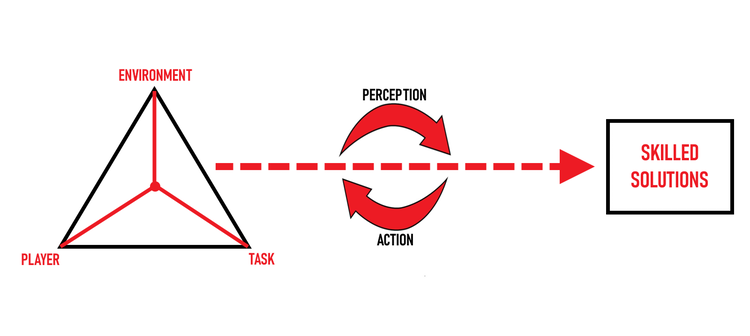
Instead of always starting with the movement I want an athlete to perform, I've become increasingly interested in designing problems worth solving.
Problems deep enough to invite exploration.
Problems that require adaptation.
Problems containing enough information for skills to have a reason to emerge.
Skill Development Isn't the Problem
Athletes need repetitions.
They need time on task.
Sometimes they need to work on a movement without the full complexity of the game around them.
I use those approaches in my own coaching.
The question isn't whether we should simplify.
The more interesting question is:
What information did we remove when we simplified?
Imagine I want an athlete to become better at moving the puck past a defender's stick.
I can remove the defender, place a cone on the ice, demonstrate a movement and have the athlete repeat it.
I've created repetition.
But I've also removed much of the information that originally made the movement necessary.
The defender's stick position.
Changing space.
Pressure.
Timing.
Distance.
The opportunity beyond the defender.
That doesn't automatically make the activity wrong.
It simply means I've made a trade.
Understanding that trade has become an important part of how I design learning environments.
What Makes a Problem Worth Solving?
I've started looking at practice problems through three ideas:
Exploration. Adaptation. Skill.
Exploration: Is there more than one way the athlete could solve the problem?
If every movement, route and outcome is predetermined, there isn't much left to explore.
Adaptation: Does the solution need to change when the environment changes?
Move the pressure.
Change the distance.
Alter the available space.
Change the angle.
What worked five seconds ago might need to be reorganised.
Skill: Does the athlete have enough information to understand why a movement might be useful?
This is where I think we can change the starting point of practice design.
Instead of beginning with:
How do I teach this skill?
Try asking:
What problem does this skill solve?
Then:
What information tells the athlete that problem exists?
Before designing the answer, design the reason an answer might be needed.
Depth Isn't Complexity
A deeper problem doesn't necessarily mean a more complicated practice.
A simple one-on-one interaction can have enormous depth.
A puck interacting with a defender's stick can contain opportunities to perceive space, manipulate pressure, change direction and discover different solutions.
Meanwhile, a five-player drill can look incredibly complex while being relatively shallow if everyone already knows where to skate, where the puck is going and what happens next.
For me, the distinction is:
Complexity is how much is happening.
Depth is how much there is to perceive, explore and adapt to.
That matters.
Adding another player doesn't automatically create better learning.
Adding another rule doesn't necessarily create depth.
Sometimes a small change in space, pressure, time or opportunity completely changes what the athlete has to perceive and how they organise a solution.
Designing Relationships
This is where I've found a simple scaffold useful:
UNDER. OVER. AROUND. THROUGH.
U-O-A-T.
These aren't four techniques.
They're four spatial relationships.
The puck might travel under a stick.
Over an obstacle.
Around pressure.
Through available space.
Instead of prescribing a specific movement, I can create a problem around one of those relationships.
Rather than saying:
Do this movement.
I might ask:
How many ways can you find to go OVER?
I've narrowed the problem without necessarily narrowing the athlete to one solution.
That's an important distinction.
The coach can provide structure without providing the answer.
For me, U-O-A-T has become as much a scaffold for the coach as it is language for the athlete.
It gives us somewhere to begin designing without immediately reaching for a predetermined movement solution.
The Coach Still Coaches
Designing problems doesn't mean standing back and hoping something useful happens.
The coach still decides what matters.
We manipulate space, pressure, time, rules and scoring.
We decide which information stays and which information can temporarily be removed.
We ask questions.
We provide feedback.
We demonstrate when it helps.
Sometimes we might even isolate a movement for a period of time.
The difference is understanding why we're doing it.
If I remove information to help an athlete develop a movement, I should also think about how I'm going to put that information back.
The goal isn't to become a different type of coach.
It's to become more intentional about the problems we create.
Our knowledge of solutions isn't something we need to abandon.
In fact, I think the opposite is true.
The more solutions a coach understands, the more interesting the problems they should be able to design.
Take It to the Ice
At your next practice, don't redesign everything.
Choose one skill you were already planning to develop.
Then ask three questions:
What problem does this skill solve?
Describe the problem without naming the technique.
What information tells the athlete that problem exists?
Pressure? Space? A stick? A defender? Speed? A teammate? The net?
How much of that information can I keep while still creating the repetitions the athlete needs?
Then build the activity.
Give the athlete something meaningful to perceive.
Leave enough room for exploration.
Allow something to change so they may need to adapt.
And watch what happens.
Not just whether they execute the movement you expected.
Look for what they discover.
Because perhaps better skill development doesn't always start with finding a better way to teach the solution.
Sometimes it starts with designing a better problem to solve.
Coming Next: Under, Over, Around and Through
In the next article, we'll explore U-O-A-T as a practical coaching scaffold and how four simple spatial relationships can help us create deeper problems while leaving room for athletes to discover different movement solutions.
about the Author
Barry Jones is an IIHF Level 3 High Performance Coach and USA Hockey Level 4 Performance Coach. His work blends ecological dynamics, nonlinear design, and athlete-centred leadership to build adaptive teams that thrive in uncertainty. He is also the developer of Task Sketch, a tool designed to support coaches in creating game-representative training environments.