Most players think their hips are “tight.”
They stretch, stretch, and stretch… and nothing changes.
The truth?
For a lot of hockey players, the problem isn’t flexibility. It’s hip strength.
When the muscles around your hips aren’t strong enough to control rotation, your body limits your range of motion. That “tight” feeling is actually your nervous system protecting you because you don’t have the strength to access those positions.
In skating, where every stride moves from external rotation (pushing out) to internal rotation (recovering the leg), strength and control are more important than passive flexibility.
That’s what this exercise targets.
Why Hip Strength Matters More Than Stretching
Skating demands a high level of hip rotation. If your hips can’t rotate fully, your stride becomes shorter, your push-off becomes weaker, and your recovery becomes less efficient. You feel tight hips.
Most players try to solve this with stretching. The problem is, the muscles responsible for rotation aren’t strong, and stretching won’t give you strength, which then doesn't give you the mobility.
Strength creates mobility.
Strength allows you to control the range you’re asking your body to access.
This exercise is one of the most effective ways to build that strength.
The 90/90 Heel-to-Heel Rotation Exercise
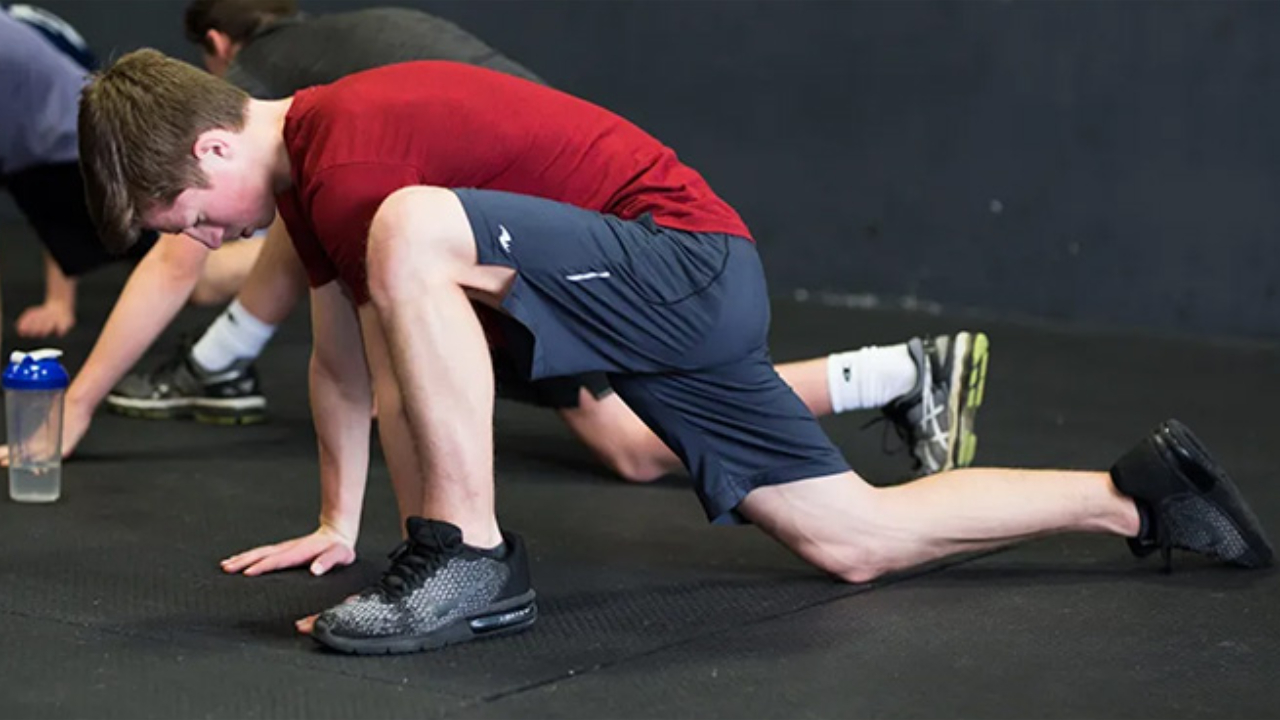
This drill looks simple, but it completely changes how your hips move. It teaches your body to control internal and external rotation under tension, exactly what you need for a stronger, more efficient stride.
Starting Position
-
Sit in the 90/90 position: front leg at 90°, back leg at 90°.
-
Use your outside hand on the ground for light support.
-
Stay tall through your torso.
Movement
-
Lift the back leg up without leaning or collapsing.
-
Rotate the leg forward until your back heel taps your front heel.
-
Return slowly to the starting position.
-
Keep your foot active — toe pulled toward your shin.
-
Perform 7–10 reps per side, smooth and controlled.
Progression
-
Remove the outside hand and balance without support.
-
Perform the same motion — heel-to-heel, then back.
-
This version requires more core strength, hip stability, and control.
Why This Exercise Works
✔ Strengthens internal and external hip rotation
Two essential components of a powerful skating stride.
✔ Builds the muscles that stabilize your pelvis
This reduces wobbling, shifting, or collapsing during the stride.
✔ Improves motor control
Your body learns how to move through rotation smoothly and efficiently.
✔ Helps prevent injury
Weak hips force compensations that often show up in the groin, low back, or knees.
✔ Creates functional mobility
This is a usable range of motion — the kind you’ll actually feel on the ice.
Direct Application to Skating
Every stride requires:
-
External rotation to push out
-
Internal rotation to recover and reset
If your hips can’t do these smoothly and under control, you lose power.
This drill strengthens the exact muscles that control these motions.
Stronger rotation = stronger stride.
The result?
A smoother, longer, more powerful push-off — without forcing positions your body isn’t ready for.
Summary Table
| Step | What to Do | Key Tips |
|---|---|---|
| Position | Sit in 90/90 with hand support | Keep chest tall |
| Lift & Rotate | Lift back leg, rotate heel to heel | Toe to shin, stay controlled |
| Reps | 7–10 per side | Smooth tempo |
| Progression | Remove hand support | Requires more core + hip control |
Final Thoughts
Improving hip mobility isn’t about stretching more, it’s about teaching your hips to be strong in the positions skating demands.
The 90/90 heel-to-heel rotation drill is one of the best ways to do that. When you add it into your routine consistently, your stride becomes smoother, you access more range without forcing it, and you generate more power with every push.
Train your hips the right way — and your skating will follow.
About the Author
Travis Martell is the founder and head coach of Martell Elite Fitness, specializing in off-ice development for hockey players.
📲 Follow on Instagram: @martell.elite.fitness