
Having a strong power play can lead to victories at all levels of hockey. Over 70% of NHL power-play goals result from simple, repeatable habits rather than complex plays. By adhering to some foundational principles, any team can achieve a successful power play.
In this video, the Montreal Canadiens execute a nearly perfect power-play sequence that results in a goal. As you watch the video, you will notice many of the eleven key principles of an effective power play. You may need to watch the video several times, as there are numerous details to observe.
This article is a comprehensive guide to understanding these principles as you watch the clip. Feel free to download both the video and the article to share with your coaching staff and players.
1. Face-offs – Starting with puck possession is the first key principle of the power play. If the power-play team loses possession and the penalty killers clear the puck down the ice, they must retreat, break out, and re-enter the offensive zone, losing valuable time. Therefore, the power play center must prioritize winning the face-off. If the power play wins the draw, it's advisable to run a set play, which can result in a goal or at least a good scoring chance. In this clip, the Canadiens' #13 nearly scores on a set power play face-off play.
2. Take all available shots – "You will miss 100% of the shots you don’t take" (Wayne Gretzky). Shot volume is essential on the power play. Scanning the ice, reading opponent pressure, and looking for options are very important skills. It is important not to force shots when they are not available, see 4—patience (take what the defence gives).
3. Puck Recoveries – When a shot is taken but no goal is scored, and the puck remains in play, the objective of the power play is to recover loose pucks after shots to set up another scoring opportunity. Every member of the power play unit must be ready to sprint for loose pucks and win all puck battles along the boards. The key principle is "possession then position." In this clip, the Canadiens successfully recover at least four pucks after shots or missed passes.
4. Patience – When on the power play, players must exhibit patience; they have two minutes to score a goal. Thus, they should not rush. Avoid taking shots or making passes when they are not available. Only take what the defence (penalty killers) gives. If they offer a shot, take it; if they provide a seam pass, take it. In this clip, Canadiens' #93 Ivan Demidov has a clear lane to the net for a shot, which he takes. Hutson then recovers the puck but has good control at the blue line. The Canadiens recover the puck at least four times in this sequence.
5. Quick puck and player movement - and chaos for the penalty killers – The objective of the power play is to disrupt the penalty killers' structure and create confusion. Quick puck movement and player exchanges can confuse the defenders, leading to opportunities for quality shots. In this clip, #48 Hutson, #14 Suzuki, and #93 Demidov swap positions, which opens a passing lane for #20 Slafkovský right by the net. In the video, notice the quick passes; players do not hold the puck for long. It is quick on and off the stick.
6. Create 2-on-1 Situations – When your team is on the power play, it's essential to generate offensive opportunities. Whether playing 5-on-5 or with an extra player, the goal should be to create offensive 2-on-1 situations through quick puck and player movement. By successfully creating these scenarios, the offensive team increases its chances of creating opportunities to strike. Throughout the clip, you can observe how the Montreal power play effectively creates 2-on-1 opportunities.
7. Exploiting seams – Seams in hockey are the spaces between defenders. With effective player and puck movement, the penalty killers must adjust to the power play; that's when seams open up. The power play players must read the penalty killers' movements and position themselves strategically to create a passing seam. A proficient power play will exploit these seams. When the puck is passed side to side through an open seam, the goalie will be vulnerable to a shot as they will need to move laterally. Slafkovsky’s shot by the net is a result of an open seam.
8. Take what the defence gives – Throughout the clip, you'll see that the Canadiens have possession of the puck but refrain from taking shots or making passes when the penalty killers are effectively defending. These situations present no openings. The defence successfully prevents the power play from capitalizing, so the players on the power play need to be patient. They must continuously reposition themselves and move the puck until the defence creates an opportunity to strike.
9. Taking one-timers – Attempt as many one-timer shots as possible. The one-timer allows the shooter to quickly release the puck, catching defenders and goalies off guard and potentially leading to a goal. In this sequence, players switch positions again, and #48 Hutson (who moves from the top of the power play to the flank) sets up Suzuki (who moves from the flank to the top) for a one-timer shot. The goalie makes the save, but the Canadiens recover the puck and continue to take several more shots and passes.
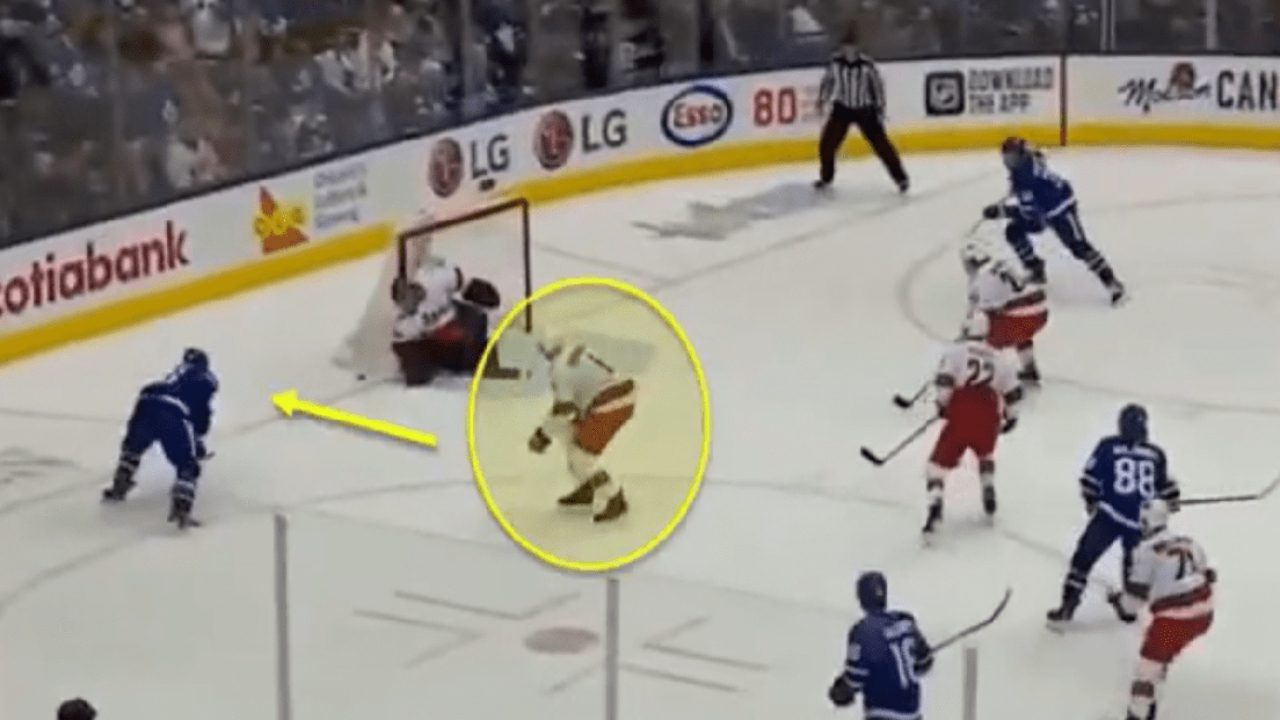
10. Deception – The definition of deception is the act of deliberately making someone believe false information for personal gain or advantage. Throughout the sequence, you can see Canadiens players faking passes and shots. Near the end of the sequence, #48 Hutson fakes a shot, skates around the Sabre player (who lost his stick), and finds #13 Caufield for an open-net goal.
11. Net front presence – Every power play has a net front player whose job is to obstruct the goaltender's view; in hockey language, we call this “taking the goalie's eyes away.” The goaltender cannot stop what he does not see. This player should also be looking for tips, deflections, and rebounds. The net front player must be versatile and know when to pop out as a release option for flankers and bumpers. Once they move out to the goal line, they must be able to read the next play and make a decision. Net front players must compete actively for loose pucks with second and third efforts. Notably, ninety percent of goals scored on the power play involve players in front of the net. After taking shots, all players must go to the net to hunt for rebounds and loose pucks.
12. A good penalty kill percentage is above 80%, and a good power play percentage is above 20% – The clear advantage lies with the penalty killers. Therefore, power-play players must adopt a mindset of competing diligently to outwork the penalty killers with second and third efforts.
A great power play is not strictly about talent – it is about habits. Master these 12 principles, and your team will generate power-play chances every game. As you can see by this Montreal Canadiens sequence, simplicity works best.
Enio Sacilotto is the President of International Hockey Camps and runs the Mental Edge High-Performance Training. Enio has 44 years of coaching experience (professional hockey in Europe and the Victoria Royals (WHL)). Currently, he coaches at the Burnaby Winter Club Hockey Academy, is the coach of the Serbian U18 men’s National hockey team, and is the Head Coach with the Burnaby Steelers. If you have questions or are interested in his services, contact Enio at enio@coachenio.com or call 604-255-4747. Website: www.coachenio.com.