
The Value of a Demanding Training Camp in College and Junior Hockey
By Jeff German
The modern conversation around conditioning in hockey has shifted dramatically over the last decade. Terms like “bag skate” have become synonymous with outdated coaching, punishment-based practices, and unnecessary exhaustion. In many circles, difficult conditioning is viewed as counterproductive, even harmful. There is truth in that criticism when conditioning lacks purpose, structure, or measurable intent. Exhaustion for the sake of exhaustion has little value in today’s game.
But that does not mean difficult training camps have lost their place in college or Junior hockey. If it is designed correctly and purposefully, a demanding, disciplined preseason camp remains one of the most valuable evaluation and development tools a coaching staff possesses. Intense on ice and off ice testing, including rope skates, shuttle work, repeated sprint intervals, and high-pressure conditioning drills, can reveal far more than who is simply “in shape.” When measured properly, these sessions expose how players respond to stress, fatigue, adversity, and accountability. They reveal who can still think, compete, communicate, and lead when physically pushed beyond comfort.
That is the true purpose of an elite hockey training camp. Hockey is not a sport of isolated effort. It is a game built around repeated high intensity bursts layered over long periods of fatigue. An average shift may only last forty to fifty seconds, but within that shift a player can perform multiple explosive efforts: a full ice sprint, a battle on the wall, a transition recovery, a net front battle, and another acceleration into open ice. The demands are not singular. They are repeated, chaotic, and relentless.
Because of this, conditioning for hockey cannot simply be a timed mile, a bike test, or a straight-line sprint. Those tests measure athleticism in isolation, but they fail to mimic the physiological and mental realities of a game.
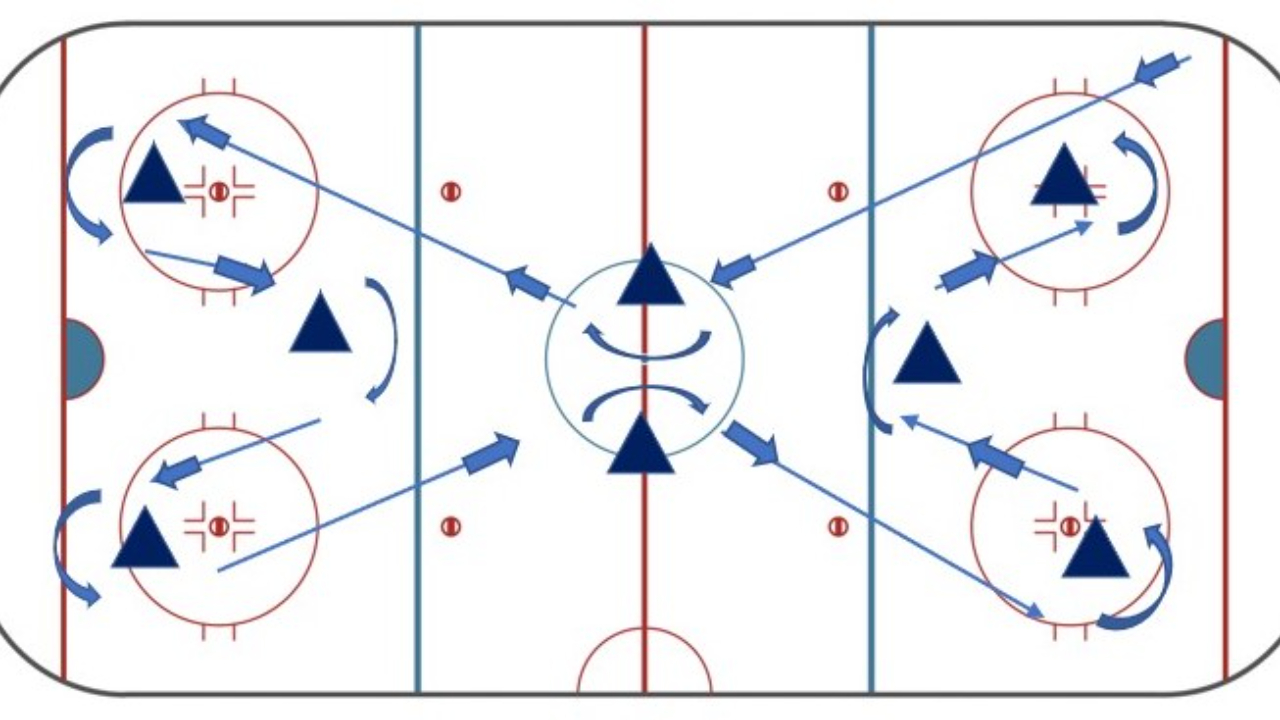
A properly designed hockey conditioning camp should mirror the structure of competition itself. The most effective testing models simulate an actual period of play. Players are not asked to perform one sprint at maximum effort and stop. Instead, they complete repeated shuttle patterns that represent the multiple explosive movements within a shift. A single “shift” may include three to five separate sprints with changes of direction, transitions, stops, starts, and recovery patterns. Those patterns should vary constantly to eliminate pacing and force adaptation.
Over the course of testing, players may complete seven simulated shifts, which mirrors the average number of shifts a player takes during one period of hockey. Between shifts, work-to-rest ratios should closely resemble game conditions, often ninety to one hundred twenty seconds between efforts.
This structure changes conditioning from a simple fitness test into a performance evaluation. Timing and measurement remain important components of the process. Coaches should absolutely track sprint times, heart rate recovery, consistency of output, and degradation over repeated efforts. Objective data matters. It creates accountability and provides benchmarks for development. Strong measurements can also support difficult roster decisions by identifying which players can repeatedly perform at a required standard.
But the stopwatch alone is not the ultimate result. The most valuable information appears after fatigue sets in. How does a player adapt when the legs become heavy? Does their technique deteriorate? Does their compete level disappear? Can they still execute details under stress? Do they mentally reset between reps, or do they allow one poor effort to spiral into several? Perhaps most importantly, how do they affect the players around them?
True conditioning exposes character. A demanding training camp reveals which athletes encourage teammates when everyone is exhausted. It reveals who becomes negative, detached, or selfish under pressure. Some players become louder and more supportive as adversity increases. Others retreat internally. Coaches learn quickly who can elevate a bench during difficult moments and who require perfect conditions to perform effectively.
Those lessons matter deeply over the course of a season. In February, no team is fresh. Injuries accumulate. Travel becomes exhausting. Academics intensify. Confidence fluctuates. Teams that survive are not simply the most talented. They are the teams that can remain disciplined and connected while fatigued. A rigorous preseason conditioning environment helps establish that standard early.
Critics often argue that hard conditioning skates break players down physically and mentally. Again, poorly designed conditioning can absolutely do that. If sessions are random, punitive, or emotionally reactive, they lose developmental value. But there is an enormous difference between punishment skating and intentional performance testing.
Purpose matters. An intelligently structured conditioning camp is not about humiliation. It is not about proving toughness through suffering alone. It is about preparing players for the realities of competitive hockey while collecting meaningful information about performance capacity, resilience, and team dynamics.
Rope skates, repeated shuttle tests, and high output interval work all have value when tied directly to measurable objectives. They challenge recovery systems. They stress decision making under fatigue. They force athletes to regulate emotion while competing physically. Most importantly, they create an environment where players must consistently choose discipline over comfort. That choice defines successful teams.
There is also a psychological component to demanding camps that should not be ignored. Shared adversity builds trust when handled correctly. Players gain confidence not only from surviving difficult work, but from watching teammates do the same. Standards become earned rather than discussed. Conditioning stops being theoretical and becomes part of the identity of the program.
In many ways, preseason testing establishes the cultural foundation for the year ahead. A player who understands they can survive seven simulated shifts of repeated high intensity work gains perspective late in games. A team that has already experienced controlled adversity together is less likely to fracture during losing streaks or difficult stretches of the season. Conditioning, when purposeful, becomes preparation for far more than skating.
Ultimately, the value of an intense hockey training camp is not found in punishment, exhaustion, or theatrics. Its value lies in discovery. It reveals who can sustain performance under stress. It identifies who can adapt, compete, and lead through fatigue. It provides measurable standards while exposing immeasurable qualities. When properly structured, conditioning skates are not relics of old school coaching. They are sophisticated evaluation tools that combine physiology, psychology, discipline, and culture into one demanding but revealing process.
If done correctly, preseason conditioning tells coaches almost everything they need to know before the season ever begins.