From Coaches to Ecosystems: Developing Players, Goalies, and Coaches Together
By Coach Barry Jones
IIHF Level 3 High Performance | USA Hockey Level 4 Performance
Full set of articles in this series:
- Part 1: Why Winning Matters in Grassroots Sport, But It's Not What You Think
- Part 2: The Winning Continuum: How Children Actually Experience Success
- Part 3: The Goldilocks Paradigm: Designing Challenges That Keep Kids Coming Back
- Part 4: One Ice Surface, Three Athletes: Coaching Mixed Ability Teams
- Part 5: The Challenge Algorithm: Moving Athletes Beyond Labels
- Part 6: From Coaches to Ecosystems: Developing Players, Goalies, and Coaches Together
- Part 7: Winning the War: Why Long-Term Development Beats Short-Term Success
- Part 8: The Grassroots Coach as an Environment Designer
When coaches talk about development, the conversation almost always centres on players.
How do we develop better skaters?
How do we improve hockey sense?
How do we produce more elite athletes?
These are important questions.
However, over the years I have come to believe that they are incomplete.
Grassroots sport does not have a player development problem.
It has an ecosystem design problem.
Players do not develop in isolation.
They develop within environments.
Those environments are shaped by coaches, teammates, parents, goalies, support staff, and culture.
If we want better player outcomes, we must first design better ecosystems.
Beyond Player Development
When I began implementing the model described throughout this series, it quickly became obvious that the environment could not focus solely on skaters.
The system had to develop everyone.
Players.
Goalies.
Coaches.
Parents.
The environment itself needed to become a learning system.
This changed the fundamental question.
Rather than asking:
"How do I develop players?"
I began asking:
"How do I develop an environment that develops people?"
Goalies Are Athletes Too
Traditional grassroots environments often unintentionally isolate goalies.
Goalies may receive isolated technical instruction.
They may face endless shots during drills.
Sometimes they simply act as equipment for the rest of the team.
This approach never sat comfortably with me.
Goalies are athletes.
They perceive.
They decide.
They solve problems.
They communicate.
Like every other player on the ice, they require meaningful opportunities to experience challenge and success.
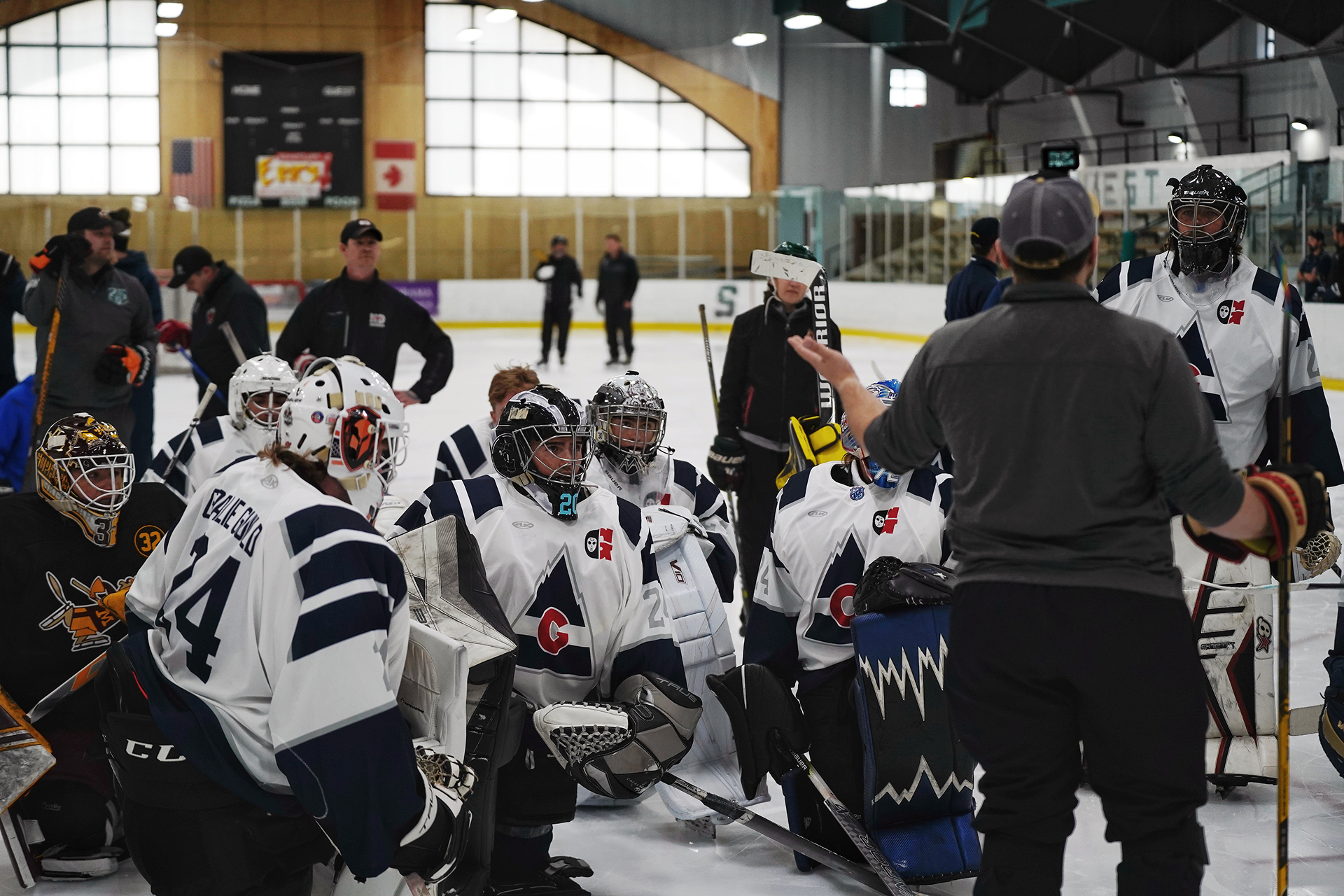
Within our environment, goalies were integrated into the learning process.
Small Area Games became opportunities for goalies to:
-
Read developing play.
-
Manage depth and positioning.
-
Track multiple threats.
-
Communicate with teammates.
-
Influence transitions through puck movement.
Importantly, goalies also experienced the Goldilocks Paradigm.
A New to the Game goalie may focus on maintaining angle and tracking the puck.
An Age Appropriate goalie may work on reading secondary threats.
A Performance goalie may be challenged to influence team tactics through communication and puck handling.
Everyone experienced challenge.
Everyone experienced winning.
Developing Coaches Through Practice
Perhaps the most significant group requiring development was the coaching staff.
Like many grassroots environments, I was fortunate to work alongside enthusiastic assistant coaches who possessed a genuine desire to help athletes.
However, enthusiasm alone does not automatically translate into effective environment design.
If the system was to survive beyond one season, coaches needed to develop alongside the athletes.
The training environment therefore became a coach development environment.
Assistant coaches were not simply assigned drills.
They were encouraged to observe.
Reflect.
Question.
Adapt.
Coaches rotated across all developmental profiles and all stations.
This ensured that every coach gained experience working with:
-
New to the Game athletes.
-
Age Appropriate athletes.
-
Performance athletes.
-
Goalies.
Importantly, coaches also experienced different challenges.
One session may require supporting exploration.
Another may involve manipulating constraints.
Another may focus on facilitating discussion rather than providing instruction.
Just like the athletes, coaches experienced their own Goldilocks challenges.
From Instructor to Designer
Within this environment, the coach's role changed.
Traditionally, coaches often occupy the role of information provider.
The coach tells.
The athlete listens.
The athlete attempts to reproduce.
Within our model, coaches became designers and facilitators.
The emphasis shifted from:
"Here's the answer."
to:
"What did you see?"
"What solutions did you try?"
"What else might work?"
Coaches learned that sometimes the most powerful intervention was not instruction.
Sometimes it was simply changing the environment.
Adding a constraint.
Removing a player.
Increasing pressure.
Creating space.
Allowing athletes to search for solutions.
The environment itself began teaching.
Distributed Leadership
One of the unexpected outcomes was the emergence of distributed leadership.
Leadership no longer resided exclusively with the head coach.
Performance athletes mentored younger athletes.
Age Appropriate athletes supported New to the Game athletes.
Assistant coaches facilitated learning conversations.
Goalies communicated tactical information.
Parents reinforced process-oriented successes.
The environment became self-sustaining.
Learning was no longer dependent upon a single individual.
Everyone contributed.
Everyone taught.
Everyone learned.
The Parent Ecosystem
Parents also played a crucial role.
Early in the season, meetings were held with parents, managers, and support staff to explain the philosophy underpinning the program.
We discussed:
-
Broadening definitions of winning.
-
Supporting challenge and exploration.
-
Celebrating effort and growth.
-
Understanding development as a long-term process.
This alignment proved invaluable.
Parents began recognising and celebrating micro-wins.
Car rides home shifted from:
"Did you win?"
to:
"What did you learn?"
"What problem did you solve?"
"What are you proud of?"
The environment extended beyond the rink.
The Environment as Teacher
Perhaps the greatest lesson from this experience was recognising that the environment itself can become the primary teacher.
When thoughtfully designed, environments provide:
Feedback.
Challenge.
Opportunity.
Information.
Connection.
Athletes learn from teammates.
Coaches learn from athletes.
Parents learn from the process.
The system continuously adapts.
This does not diminish the importance of the coach.
It elevates it.
The coach becomes an architect of learning.
A designer of ecosystems.
A curator of experiences.
Winning Beyond the Scoreboard
Throughout this series, I have argued that grassroots sport should seek to create more winning experiences for more children.
Part 6 expands this idea.
Perhaps the greatest win is not producing better players.
Perhaps the greatest win is creating environments where everyone develops.
Players.
Goalies.
Coaches.
Parents.
Communities.
Because when entire ecosystems learn together, extraordinary things become possible.
And those outcomes often extend far beyond hockey.
Author Bio
Barry Jones is an IIHF Level 3 High Performance Coach and USA Hockey Level 4 Performance Coach. His work blends ecological dynamics, nonlinear design, and athlete-centred leadership to build adaptive teams that thrive in uncertainty. He is also the developer of Task Sketch, a tool designed to support coaches in creating game-representative training environments.