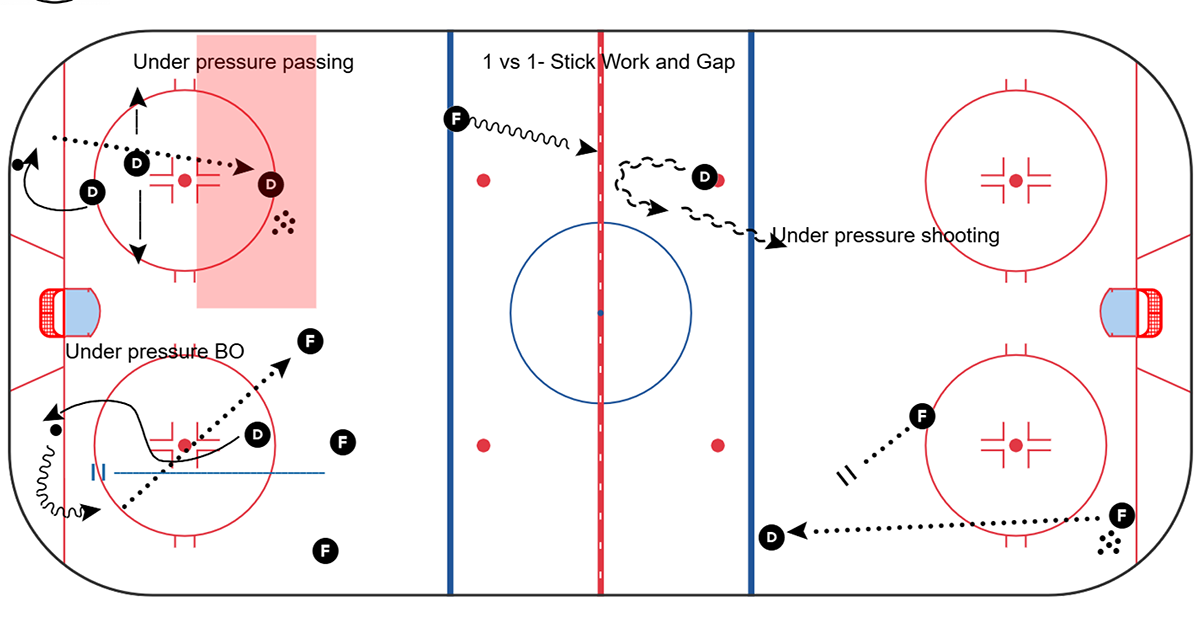
PLAYER EVALUATION — OBSERVABLE BEHAVIORS
The goal is not to evaluate whether a player follows one predetermined solution. We want to observe how well the player reads, adapts, executes, and connects under pressure.
FORWARDS
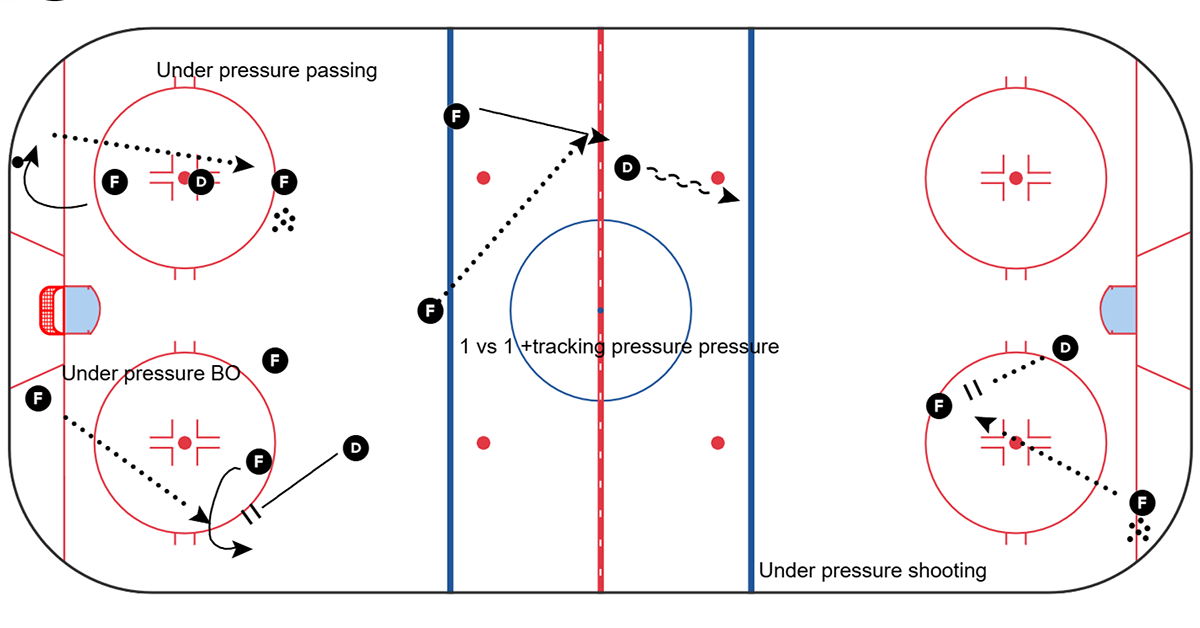
1. Scanning Before Reception Scans the environment and identifies pressure, available teammates, and open space before receiving the puck.
2. Puck Retrieval and Protection Retrieves the puck under pressure and positions the body between the opponent and the puck.
3. Passing and Receiving Under Pressure Presents a clear target, adjusts the support angle, and connects with pace and accuracy.
4. Decision-Making With the Puck Quickly chooses whether to pass, protect, deceive, or attack available space.
5. Creating an Advantage in 1-on-1 Situations Changes speed or direction to attack the inside, create separation, or escape pressure.
6. Shooting Under Pressure Changes the shooting angle and releases the puck quickly despite defensive pressure.
7. Reload and Response After Puck Loss Gets back above the puck and immediately contributes to regaining possession.
DEFENSEMEN
1. Scanning and Pressure Recognition Collects information before retrieving the puck and identifies the first available option.
2. Puck Retrieval Under Pressure Approaches with proper body orientation, protects the puck, and keeps the feet active.
3. First Pass and Zone Exit Creates a passing lane and connects with an available teammate to support the breakout.
4. Gap and Angle Management Protects the middle, adjusts speed, and guides the puck carrier toward a less dangerous area.
5. Defensive Stick and Body Positioning Places the stick in the most effective lane and uses the body at the right moment.
6. Defensive Transition and Recovery Pivots, accelerates, and recovers inside positioning after a change of possession.
7. Offensive Support and Rotation Activates as an option and fills available space without breaking the team’s connections.
These criteria focus on adaptable behaviors rather than rigid systems or isolated technical execution.
Evaluate the player’s ability to perceive, decide, adapt, and connect—not simply their ability to reproduce a predetermined solution.
_________________________________________________________________________________________________
The evaluation should lead directly to an individualized six-week development plan.
1. Evaluate observable behaviours
Players are evaluated in representative situations—not only isolated drills. Coaches observe how each player performs when time, space, pressure, and available options change.
Use a four-level scale:
- Emerging — The behaviour rarely appears, even without much pressure.
- Developing — It appears inconsistently or only in favourable situations.
- Effective — It appears consistently under realistic pressure.
- Adaptable — The player recognizes different situations and adjusts effectively.
The rating should be supported by a short observation describing what happened.
2. Identify two priorities
After several observations, the coach selects a maximum of two priorities.
The priorities should be:
- Important for the player’s role
- Observable and trainable
- Connected to game situations
- Specific enough to guide practice design
- Complementary when possible
For example:
- Priority 1: Scanning before reception
- Priority 2: Passing and receiving under pressure
Rather than treating them separately, practices can connect both behaviours.
3. Build the six-week plan
Each week includes situations that expose the player to both priorities. The problem remains similar, but the pressure, space, angle, teammates, and decisions change.
| Week | Development focus |
|---|---|
| 1 | Establish a baseline and help the player recognize the targeted behaviours |
| 2 | Create successful repetitions with moderate pressure |
| 3 | Vary angles, timing, space, and available options |
| 4 | Connect both priorities in representative small-area situations |
| 5 | Increase pressure, speed, uncertainty, and decision-making demands |
| 6 | Transfer the behaviours into game-like situations and reassess |
4. Use repetition without repetition
The goal is not to repeat the exact same drill for six weeks. We repeat the intention while changing the environment.
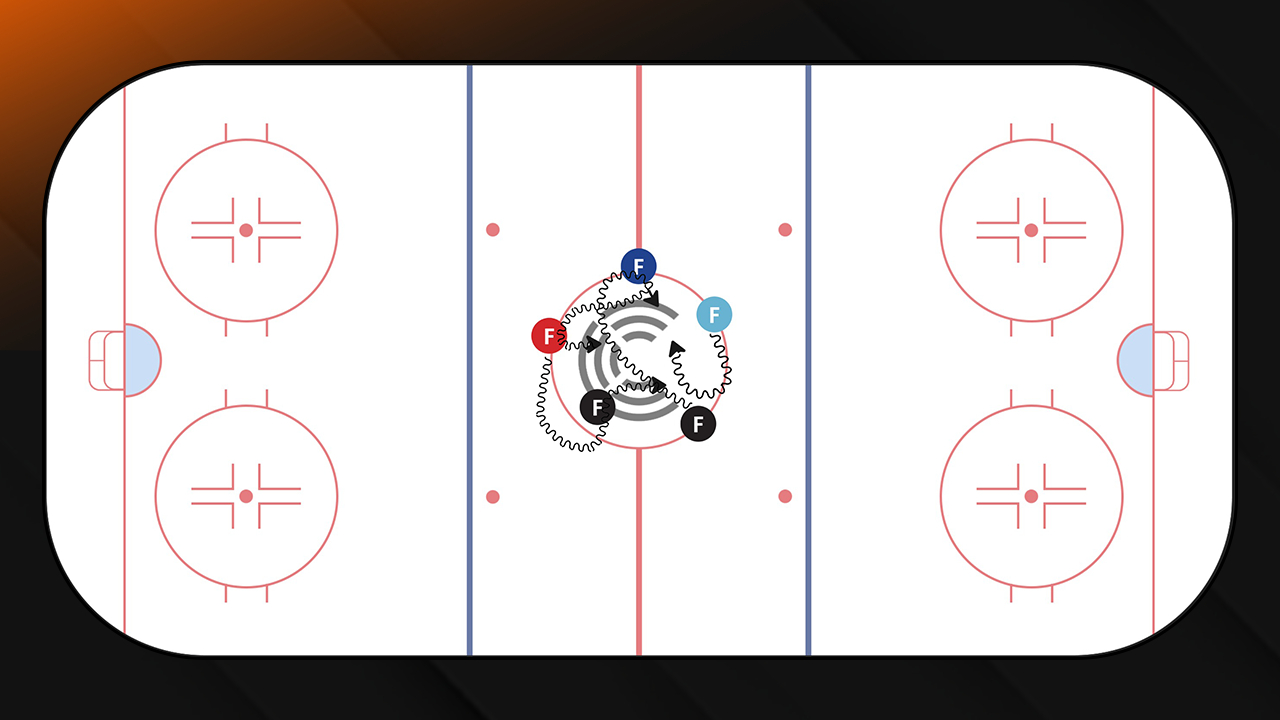
For scanning and passing under pressure, we could manipulate:
- Size and shape of the playing area
- Number and location of defenders
- Direction of pressure
- Support angles
- Available passing options
- Time before pressure arrives
- Scoring rules or target areas
This encourages players to perceive information, make decisions, and discover adaptable solutions.
5. Reassess after six weeks
At the end of the cycle, the coach evaluates the same two priorities in representative situations.
The review should determine:
- Has the behaviour become more consistent?
- Does it transfer into game situations?
- Can the player adapt it under different types of pressure?
- Should the priority continue, evolve, or be replaced?
The objective is not simply to improve a score. It is to create a visible connection:
Evaluation → Two priorities → Six-week plan → Representative practice → Reassessment.